

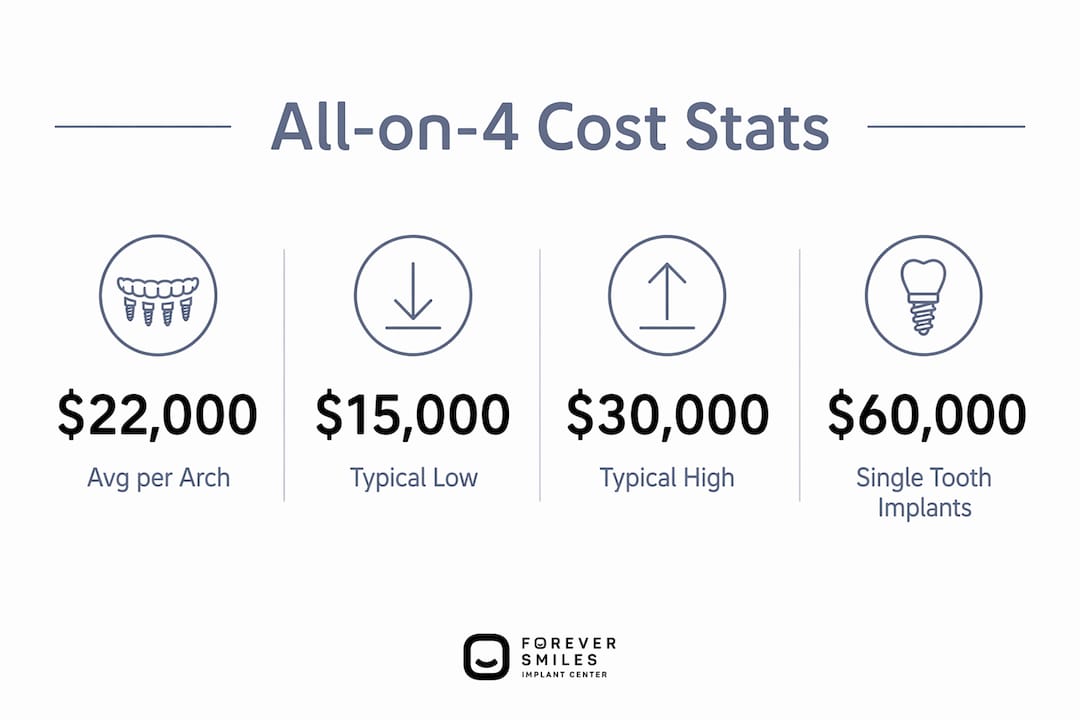
All-on-4 dental implants run $15,000–$30,000 per arch in the United States, with a national average around $22,000. Full-mouth treatment covering both arches typically lands in a range depending on material and provider, though premium providers using zirconia prostheses and concierge care can charge more. The all-on-4 cost you receive in a quote depends on several variables that are worth understanding before you sign anything.
Here is what drives the total price:
- Implants: Four titanium fixtures per arch, often from manufacturers like Nobel Biocare
- Surgery fees: Surgeon time, anesthesia, and operating room or facility costs
- Prosthesis material: Acrylic versus zirconia (the single biggest price variable)
- Diagnostics: 3D CBCT scans, digital treatment planning, and smile design
- Follow-up care: Post-surgical visits, adjustments, and final delivery of the permanent bridge
- Location and provider type: A practice in Manhattan charges more than one in rural Tennessee
Regional variation and facility type can shift your quote by thousands of dollars even for identical clinical work. Knowing why helps you compare quotes accurately.
What factors drive All-on-4 pricing up or down?
Material choice: the biggest single variable
Zirconia prostheses cost $5,000–$15,000 more per arch than acrylic options, but they are harder, more stain-resistant, and typically last longer without repairs. Acrylic bridges are lighter and less expensive upfront, but they chip more easily and may need repairs or full replacement within 5–10 years. Budget clinics tend to default to acrylic; premium practices build their packages around zirconia from the start.
Facility type and what it costs you
Outpatient surgical centers often cost less than hospital-based procedures because their overhead is lower. A hospital operating room adds facility fees that have nothing to do with the quality of your implants. Most high-volume implant practices operate out of dedicated outpatient surgical suites for exactly this reason.
Provider expertise and technology
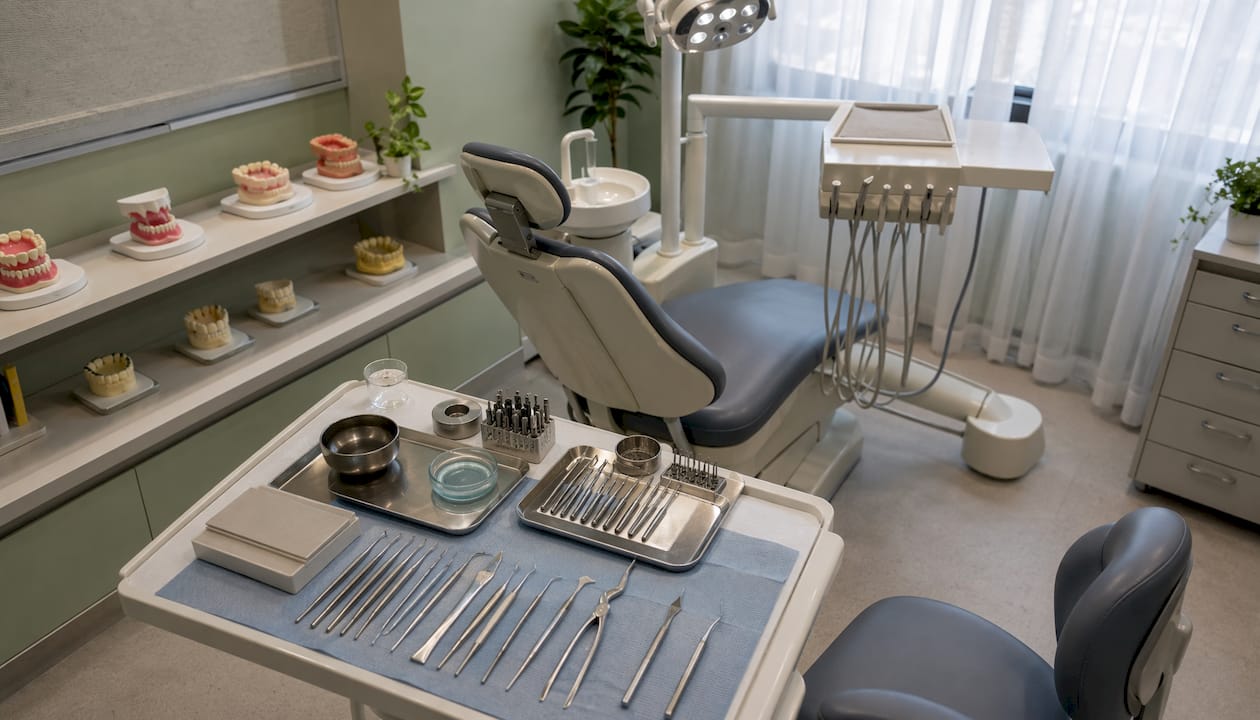
A residency-trained surgical specialist with 20,000+ implants placed charges more per case than a general dentist who added implants to their menu. That gap reflects real differences in case planning, complication management, and surgical efficiency. 3D CBCT imaging and computer-guided planning add to the upfront cost but reduce the risk of errors that become expensive to fix. Always confirm whether diagnostics are included in your quoted price or billed separately.
Regional cost differences across the US
States like California and New York average 10–13% above the national mean, while many southern states fall below it. The table below reflects approximate per-arch averages by region.

| Region | Approximate per-arch range |
|---|---|
| Northeast (NY, MA, CT) | Higher-end range |
| West Coast (CA, WA, OR) | Higher-end range |
| Midwest (IL, OH, MI) | Moderate range |
| Southeast (FL, GA, NC) | Moderate to lower range |
| Southwest (TX, AZ, NV) | Moderate range |
These are ranges, not guarantees. A high-volume specialist in Florida may charge more than a general dentist in New York. The region sets a baseline; the provider sets the actual number.
How All-on-4 compares to replacing teeth individually
Replacing each missing tooth with a single implant can exceed $60,000 per arch. All-on-4 achieves a full arch of fixed teeth using four implants, which is why it became the standard for full-arch reconstruction. Fewer implants, no bone grafting in most cases, and a single surgery session all contribute to a lower total cost compared to individual tooth replacement.
Does insurance cover All-on-4, and what financing options exist?
Insurance coverage: limited but not zero
Most dental insurance plans offer limited coverage toward implant procedures, often capping annual benefits well below the total cost of treatment. Medical insurance occasionally covers the surgical portion when tooth loss is tied to a medical condition, accident, or disease, but it rarely covers the prosthetic component. The practical reality for most patients is that out-of-pocket costs remain high regardless of coverage.
Key coverage points to verify before treatment:
- Whether your plan covers implant surgery at all (many do not)
- Annual maximum benefit and whether it resets mid-treatment
- Coverage for diagnostics like CBCT scans, which some plans treat as a separate claim
- Whether the prosthesis (the teeth themselves) falls under dental or medical benefits
Financing options that actually work
Most patients finance at least part of their All-on-4 treatment. Common paths include:
- CareCredit or Alphaeon Credit: Dental-specific financing with promotional periods that can offer deferred interest if paid in full within the promotional window
- Personal loans: Fixed-rate loans through banks or credit unions, often with lower long-term interest than revolving credit
- FSA/HSA accounts: Flexible spending accounts and health savings accounts can cover qualifying dental procedures, including implants, with pre-tax dollars
- In-house payment plans: Many practices offer structured payment plans, sometimes interest-free for established patients
Pro Tip: Ask every provider for an itemized quote that lists diagnostics, surgery, the temporary prosthesis, the final bridge, extractions, and anesthesia as separate line items. A quote that bundles everything into one number makes it impossible to compare providers accurately.
Negotiating and finding legitimate discounts
Some practices offer reduced fees for paying in full upfront, for scheduling during slower periods, or for patients who refer others. University dental programs with implant residencies sometimes offer lower fees for straightforward cases, though wait times can be long and complex cases may not qualify. Dental tourism is another route patients explore; international All-on-4 pricing in countries like Mexico or Turkey can run 50–70% below US rates, though follow-up care, warranty enforcement, and complication management across borders carry real logistical risks.
Who qualifies for All-on-4, and how does the procedure work?
The clinical steps from consultation to final teeth
The All-on-4 protocol places four implants per arch, with the two posterior implants angled at approximately 30–45 degrees. That angle maximizes contact with available bone and positions the implant head near the second premolar, allowing a full arch of up to 12 teeth without extending into areas where bone is typically thinner. The angled placement is also what lets most patients skip bone grafting entirely.
The treatment sequence runs roughly as follows:
- Consultation and 3D imaging: CBCT scan, bone assessment, and treatment planning
- Extractions (if needed): Remaining failing teeth removed at the time of surgery
- Implant placement: Four implants placed per arch under anesthesia
- Temporary prosthesis: A fixed provisional bridge delivered the same day
- Healing period: Implants integrate with bone over 3–6 months
- Final bridge delivery: Permanent zirconia or acrylic prosthesis fitted and adjusted
Who is a good candidate?
Candidacy for All-on-4 is not just about missing teeth. Clinical eligibility criteria include adequate bone volume in the anterior jaw, controlled systemic health conditions, and lifestyle factors that affect healing. Specifically:
- Bone volume: Sufficient anterior bone is required; severe atrophy may require zygomatic implants instead
- Diabetes: Uncontrolled diabetes (HbA1c above 8%) increases implant failure risk and may disqualify a patient until glucose levels are managed
- Smoking: Active heavy smokers face higher failure rates; most surgeons require cessation before and after surgery
- Gum disease: Active periodontal infection must be treated before implant placement
- General health: Conditions affecting healing, such as uncontrolled autoimmune disorders or certain medications, require evaluation
Patients who have been told they are not candidates elsewhere are sometimes still treatable. Severely atrophic jaws that cannot support standard implants may qualify for zygomatic implants, which anchor in the cheekbone rather than the jaw.
What recovery looks like after All-on-4 surgery
The first two weeks
Swelling, bruising, and mild to moderate discomfort are normal in the first 3–5 days. Most patients manage with prescription pain medication for a few days, then transition to over-the-counter options. A soft diet is required for the first several weeks while the implants begin integrating. Most patients return to desk work within a few days, though physical labor or strenuous activity typically waits 1–2 weeks.
Common side effects to expect:
- Swelling and bruising around the jaw and cheeks
- Temporary numbness or altered sensation near the surgical sites
- Difficulty chewing firm foods during the healing phase
- Minor bleeding from extraction sites in the first 24–48 hours
Long-term maintenance and replacement costs
The implants themselves, once integrated, can last decades with proper care. The prosthesis is a different story. Acrylic bridges may need repair or replacement every 5–10 years, adding recurring costs that patients often underestimate when comparing initial quotes. Zirconia bridges carry higher upfront costs but generally require less maintenance over time. Regular professional cleanings, water flossers, and annual implant check-ups are part of the long-term commitment regardless of material.
Pro Tip: Factor replacement and maintenance costs into your total investment calculation, not just the surgery price. A $15,000 acrylic bridge that needs two replacements over 20 years can cost more in total than a $25,000 zirconia bridge that lasts the same period without major repairs.
Dr. Brian Young's perspective on All-on-4 cost and treatment planning
Dr. Brian Young is the founder and lead surgeon at Forever Smiles Implant Center in Jacksonville, Florida. He is a residency-trained surgical specialist with more than 20 years of experience and over 28,000 implants placed. He trains surgeons nationally, lectures on full-arch technique, and sits on the editorial board of Implant Practice US. His perspective on pricing comes from performing this surgery every single day, not occasionally.
The distinction between a surgical specialist and a general dentist offering implants is not just about credentials on a wall. A specialist who performs full-arch surgery daily has seen and managed the complications that a part-time implant provider has not. That experience affects outcomes, not just price. Patients who arrive at Forever Smiles after a failed procedure elsewhere often face costs that dwarf what they would have paid for a well-planned surgery the first time.
Facility type also matters in ways patients rarely consider. An in-house dental lab eliminates the back-and-forth with outside labs, shortens timelines, and gives the surgeon direct control over the final prosthesis. A board-certified MD anesthesiologist on staff is a different level of safety than a dental sedation setup. These are not luxury add-ons; they are structural differences in how care is delivered.
Pro Tip: Before choosing a provider, ask specifically: How many full-arch cases does the surgeon perform per week? Is the lab in-house? Who administers anesthesia, and what are their credentials? The answers tell you more than the price does.
Key takeaways
All-on-4 dental implant treatment in the US averages $22,000 per arch in 2026, with total full-mouth costs typically ranging from $30,000 to $60,000 depending on material, facility, and provider expertise.
| Point | Details |
|---|---|
| Average cost per arch | The national average is $22,000, with a typical range of $15,000–$30,000 per arch. |
| Material drives price and longevity | Zirconia costs $5,000–$15,000 more per arch than acrylic but requires less maintenance over time. |
| Facility type affects total cost | Outpatient surgical centers run 30–50% less than hospital-based procedures for the same surgery. |
| Insurance covers little | Most dental plans offer limited implant benefits; medical insurance may cover surgery but rarely the prosthesis. |
| Candidacy affects feasibility | Bone volume, diabetes control, and smoking status all influence whether and how treatment proceeds. |
Why Forever Smiles Implant Center is the right choice for your All-on-4 treatment
Forever Smiles Implant Center in Jacksonville, Florida, is built around one thing: full-arch implant reconstruction. Dr. Young and his team perform this surgery every day, with an in-house lab, a board-certified MD anesthesiologist, and a treatment process that covers everything from 3D imaging through final zirconia teeth under one roof. Full-mouth treatment starts at $15,000 per arch, with every step included in that number.
If you have been told you are not a candidate, or if you are trying to understand what a real quote should include, start with the dental implant FAQs or explore full-mouth implant options to see what treatment at a dedicated surgical center actually looks like. Experience isn't expensive. Inexperience is.
Recommended
- Is Cheaper All-on-4 Treatment Risky? - Forever Smiles Dental Implant Center
- What Questions Should You Ask Before Choosing an All-on-4 Provider? - Forever Smiles Dental Implant Center
- Who Should NOT Perform All-on-4 Surgery? - Forever Smiles Dental Implant Center
- Forever Smiles Implant Center Jacksonville, FL | All-on-4 Expert