
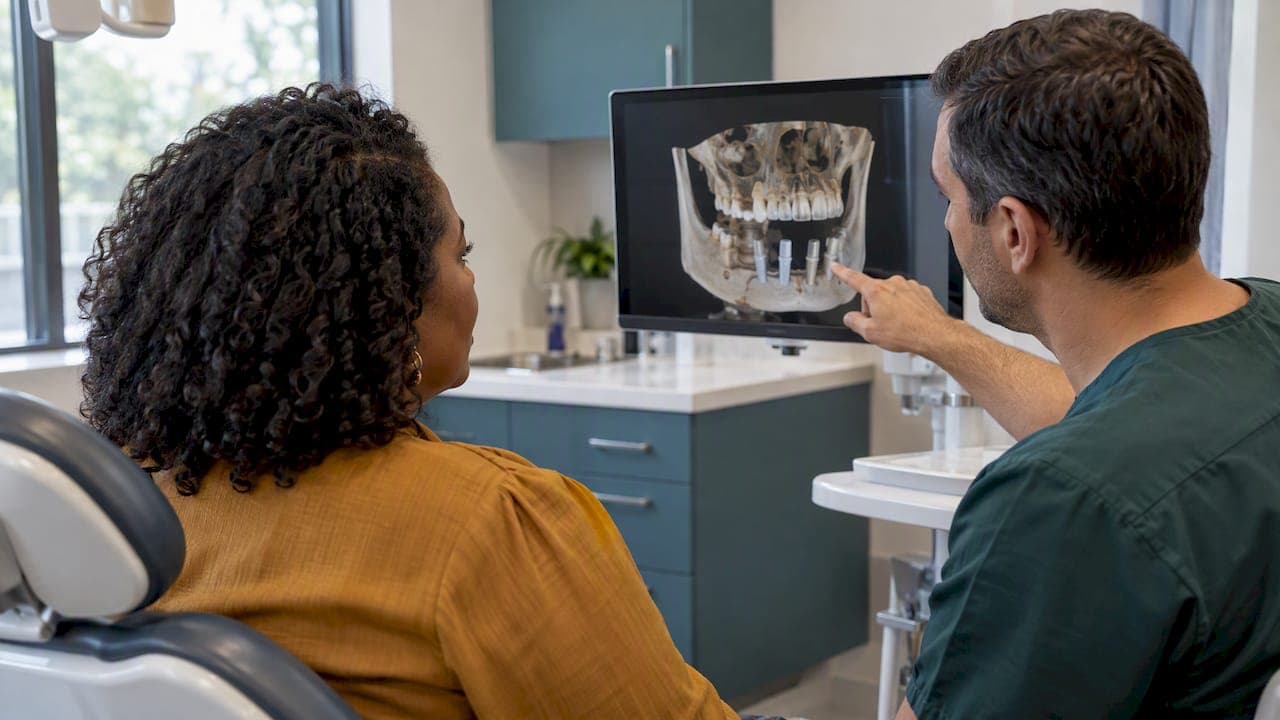
You should get a second opinion before dental implants in Jacksonville when the plan is large, irreversible, or does not feel right: full-arch reconstruction, a diagnosis of implant failure, a "you are not a candidate" verdict, or a big gap between two quotes. The American Dental Association (ADA) says patients who are uncomfortable with a recommendation should feel free to seek a second opinion. This guide covers when to do it, what to bring, what the second dentist should evaluate, and which questions get you straight answers.
TL;DR
- Get a second opinion before any irreversible, high-cost implant plan, especially full-arch work, failed implants, or a "not a candidate" verdict.
- Request your records, X-rays and written plan first. The ADA Code of Ethics says dentists must provide records that benefit your future treatment.
- A good second opinion reviews your diagnosis, bone volume on 3D imaging, the surgical approach, the final teeth design, and your overall health.
- Ask each provider for the same things in writing, so you compare technique, implant brand, timeline and total fee side by side.
- Pressure to commit the same day is a reason to slow down, not speed up.
Table of Contents
- When a second opinion makes sense
- What to bring to the appointment
- What a good second opinion should evaluate
- Questions to ask about full-arch implants and alternatives
- How to compare two recommendations side by side
- Our perspective on second opinions
- Signs you should slow down
- What a second opinion visit looks like at Forever Smiles
- Cost: what to expect and how to read a quote
- Ready for a specialist's view of your case?
- FAQ
- Sources
When a second opinion makes sense
Not every implant plan needs one. A single tooth replacement with a clear diagnosis and a modest quote is a different decision from replacing every tooth in an arch. A second opinion earns its time in these situations:
- Full-arch reconstruction has been recommended. You are committing to major surgery, a long healing period and a five-figure investment.
- You were told you do not have enough bone. That verdict can mean grafting, sinus lifts, or a different implant approach altogether. Different surgeons treat severe bone loss very differently.
- An implant has failed or is failing. Whether to remove it, replace it or redesign the case is a surgical judgment call.
- Two providers disagree. If one says extract and the other says save the tooth, you need a tiebreaker.
- You have a health condition that affects healing. The U.S. Food and Drug Administration notes that overall health, smoking and diabetes can affect implant healing and success.
- You feel rushed. The ADA expects patients to receive a comprehensive examination and a discussion of treatment options before they decide.
One more reason is simple: implants are not something you can undo. A second look costs little next to a plan you regret.
What to bring to the appointment
The second dentist can only be as good as the information you hand over. Before you book, ask your first provider for:
- X-rays and 3D scans. This includes any panoramic images and CBCT (cone-beam CT) data, ideally as digital files you can carry.
- The written treatment plan. It should name the procedures, the number of implants, the timeline and every fee.
- Your clinical notes or diagnosis summary. This tells the reviewer why the plan was recommended.
- Implant details, if you already have implants. The FDA encourages patients to keep a record of the brand and model of the implant system used in their treatment. Surgeons need this to repair or replace parts.
- Your medical history and medication list. Include diabetes, osteoporosis treatments, blood thinners and smoking history.
You are entitled to ask. The ADA Code of Ethics says dentists must provide requested records that will benefit your future treatment, under applicable law and for free or a nominal cost, whether or not the account is paid in full. Asking for your records is routine and does not signal that you are leaving.
If you cannot get everything before your visit, come anyway. A new set of 3D images is often the most useful thing a second specialist can work from.
What a good second opinion should evaluate
A second opinion is not a sales pitch for a different price. It is an independent read of the same problem. Here is what a thorough review covers.
Your diagnosis and whether teeth can be saved
The first question is whether the diagnosis is right. Are the teeth truly non-restorable, or could some be kept? Is gum disease active, and has it been treated? A second reviewer should be able to explain, using your own images, why each tooth stays or goes.
Bone volume on 3D imaging
Implant planning depends on how much bone you have and where. The American Academy of Oral and Maxillofacial Radiology says successful planning brings together surgical and prosthetic needs and often requires high-quality cross-sectional imaging to match bone volume to the implants. If your plan includes bone grafts or sinus lifts, ask the reviewer to check those recommendations against your 3D scan specifically. You want to know whether they are needed, and whether a different placement strategy avoids them.
The surgical approach
For full-arch cases, there are several ways to anchor a fixed set of teeth. Standard angled-implant designs such as All-on-4 work for many patients. When bone loss in the upper jaw is severe, longer zygomatic implants anchored in the cheekbone can be an option. Ask the reviewer which approach fits your anatomy and why.
The final teeth
A surgical plan is only half the story. Ask what the final teeth are made of, how they are made, who makes them, and how they will be cleaned and repaired. A plan that is vague about the restorative side deserves more questions.
Your overall health
Candidacy, healing time and expected longevity depend partly on your general health. The FDA says patients should discuss benefits, risks, smoking, the implant's brand and model, and the healing process before treatment. If you smoke, the odds shift; our guide on what smokers must do before dental implants explains how to prepare. Giving up cigarettes is hard, and this overview of the long-term health benefits of quitting smoking can help you stay motivated while you prepare for surgery.
Questions to ask about full-arch implants and alternatives
The ADA says treatment discussions should cover alternatives such as restorations, crowns, bridges, implants and dentures, chosen according to your diagnosis, oral-health status, needs and preferences. It also says financing should come up after treatment options, not before. Use that order as your guide. Bring these questions to any consultation, ours included:
About the diagnosis
- What exactly is wrong, and how do you know from my images?
- What happens if I wait or do nothing?
- Are there alternatives, such as a bridge, a denture, or fewer implants? What are the trade-offs?
About the procedure
- How many implants, where, and why that number?
- Do I need bone grafting or a sinus lift? Is there a plan that avoids them?
- Will I leave with teeth the same day, and how long until the final set?
- Who performs the surgery, and how many full-arch cases do they do in a typical week?
- What kind of anesthesia or sedation is used, and who monitors me?
About the restoration and lab work
- What material are the final teeth, and where are they made?
- What happens if a tooth chips or a screw loosens?
About cost and follow-up
- What is the total fee, and what does it include: planning, imaging, surgery, temporary teeth, final teeth, follow-up visits?
- Are there extra charges if the plan changes?
- What is the process if an implant fails?
If you wear dentures now, the JADA notes that implants can support crowns, bridges or dentures, and that full dentures can be held by implants or by a natural seal. That distinction matters when you compare a removable implant-supported denture to a fixed set of teeth. Our page on whether full-mouth implants can permanently replace dentures walks through it.
How to compare two recommendations side by side
Two proposals written differently are hard to compare. Ask both offices to put the same items in writing, then line them up:
| What to compare | Provider A | Provider B |
|---|---|---|
| Diagnosis and reason for each extraction | ||
| Number and placement of implants | ||
| Implant brand and model | ||
| Bone grafting or sinus lift needed | ||
| Temporary teeth on surgery day | ||
| Final teeth material and who makes them | ||
| Anesthesia type and who provides it | ||
| Timeline from surgery to final teeth | ||
| Total fee and what it covers | ||
| Follow-up care and failure policy |
The ADA Code of Ethics also states that a dentist giving a second opinion should not have a vested interest in the resulting recommendation. Ask yourself whether the reviewer is positioned to be objective. A fair reviewer will explain where they agree with the first plan, not only where they differ. Sometimes the answer is that the first plan was sound, and then you can proceed with confidence.
Once you have chosen, read the written proposal slowly. This guide to caring for dental implants properly is worth a look as you think about what daily upkeep your chosen plan will require.
The Oregon Board of Dentistry, in its consumer FAQ, suggests that when extensive work like implants, crowns or bridges is proposed, a second or even third opinion may be appropriate. It also recommends asking for a written plan and asking which treatments are necessary, elective, cosmetic, urgent or deferrable. That is an Oregon agency, but the advice applies in any state, including Florida.
Our perspective on second opinions
We welcome second opinions, and many of our patients arrive with one in hand. A large share of the people who come to us were told elsewhere that they were not candidates, that they had too little bone, or that their failed implants could not be fixed. Those are the cases we plan for.
Our center was built around one procedure: full-mouth implant reconstruction. I am a residency-trained surgical specialist, and our team performs full-arch procedures every day. Surgical planning, surgery, the in-house dental lab and a board-certified MD anesthesiologist are all under one roof, so the person who plans your case is part of the team that carries it out and finishes it.
When you compare plans, compare experience as well as price. Ask who does the surgery, how often, and what they do when bone is minimal or an earlier implant has failed. We believe that experience isn't expensive. Inexperience is. Our aim is a permanent result, planned in advance and done once and done right.
Bring your scans and your questions. We will show you what we see on your own 3D images, and you can decide at your own pace.
Dr. Brian Young
Signs you should slow down
A good consultation leaves you better informed. Be cautious if you notice any of the following:
- A same-day commitment is demanded. The ADA Code of Ethics expects patients to have adequate time to weigh options. A "sign today or lose the price" approach does not fit that standard.
- Alternatives are not discussed. Dentures, bridges or fewer implants may suit some people better, and you should hear why they were set aside.
- Imaging is skipped. A full-arch plan without 3D scans is guesswork.
- Financing comes first. The ADA says financing discussion for complex procedures should follow the discussion of treatment options.
- Nothing is written down. If a plan is not on paper, you cannot compare it.
- The provider cannot explain the experience behind the plan. Ask about the surgeon's training and how many comparable cases they perform.
A second opinion is also sensible when the first quote comes with urgency you cannot explain. Real emergencies exist, such as infection or a broken tooth, and we address those on our page about emergency dental implants in Jacksonville. Even then, you can ask for a written plan and a clear reason for the timeline.
It is also worth reading about risks of weekend-course implant providers before choosing who will place your implants. Training and daily volume matter most in complex cases.
What a second opinion visit looks like at Forever Smiles
At our Jacksonville center, an evaluation starts with your history and your goals. We then take 3D imaging and review your bone, your remaining teeth, your gums and any existing implants. You can learn more about that step on our implant consultation and 3D imaging page.

From there, we explain what we see in plain language: which teeth can be saved, which cannot, how the implants would be placed, and what your final teeth would look like. If your case involves severe bone loss, we can discuss zygomatic implants and the questions to ask about their risks. If you are weighing options, our overview of dental implant options in Jacksonville and our guide to All-on-4 for denture wearers set out the choices.
We only do full-mouth implant reconstruction, so we are not the right stop for routine cleanings or general dental care. If you want a fixed, permanent solution for most or all of your teeth, we are.
Cost: what to expect and how to read a quote
We publish our pricing so you can compare it with other quotes. Our All-on-4 Zirconia treatment is $19,000 per arch. Our full-mouth zirconia implants start from $19,500 per arch, depending on your specific needs. Our fee includes planning, surgery, teeth the same day, final zirconia teeth and follow-up care. Details on payment plans and financing are on our cost and financing page.
When you compare quotes, look for what is inside the number. A lower headline fee that leaves out imaging, anesthesia, temporary teeth or the final restoration is not the same offer. Ask each office for an itemized total. We do not compete on price, and we would rather you compare what is included.
We have not found an official source on what a second opinion visit costs or whether dental insurance pays for it, so ask each office what it charges for an evaluation and ask your insurer what it covers before you book.
Ready for a specialist's view of your case?
If you have been told you need full-arch implants, have been turned down, or have implants that are failing, we will review your records and 3D imaging and tell you what we see. Our team plans, operates and finishes your teeth in one place, with an MD anesthesiologist for complex and previously failed cases.
Start with our full-mouth dental implants page, or book an evaluation through Forever Smiles Implant Center.
FAQ
Will my dentist be offended if I ask for a second opinion?
A good dentist will not be. The ADA states that patients uncomfortable with a recommendation should feel free to seek a second opinion. Ask for your records politely and say you want to be sure about a major decision.
Can I get a second opinion if I already have implants that are failing?
Yes, and it is one of the most useful times to do so. Bring your scans, any notes, and the brand and model of the implants if you have them. A surgeon experienced in revision cases can tell you whether the implants can be saved, removed or replaced, and what bone is available.
Can I get a second opinion if I was told I do not have enough bone?
Yes. Bone volume should be measured on 3D imaging, and different surgeons plan around limited bone in different ways, including grafting, angled placement, or zygomatic implants. Bring your CBCT scan or have new images taken, and ask the reviewer what each option involves.
Should the second opinion come from a different office?
Yes. Choose a provider with no financial relationship to the first one, because the ADA Code of Ethics says a dentist giving a second opinion should not have a vested interest in the outcome. Ask who would do the work and how often they perform full-arch procedures.
What if the two opinions disagree?
Ask both providers to explain their reasoning using your own images, and put each plan in writing. Compare diagnosis, technique, implant brand, timeline and total fee side by side. Differences often come down to experience, so weigh how often each surgeon handles cases like yours.
Sources
- ADA: Statement on Dental Implant Practices in the News
- ADA Principles of Ethics and Code of Professional Conduct
- FDA: Dental Implants: What You Should Know
- Oregon Board of Dentistry: Consumer FAQs
- AAOMR position statement on dental implants
- JADA: Bridges, implants, and dentures
- How to care for dental implants properly
- Long-term health wins from quitting smoking