
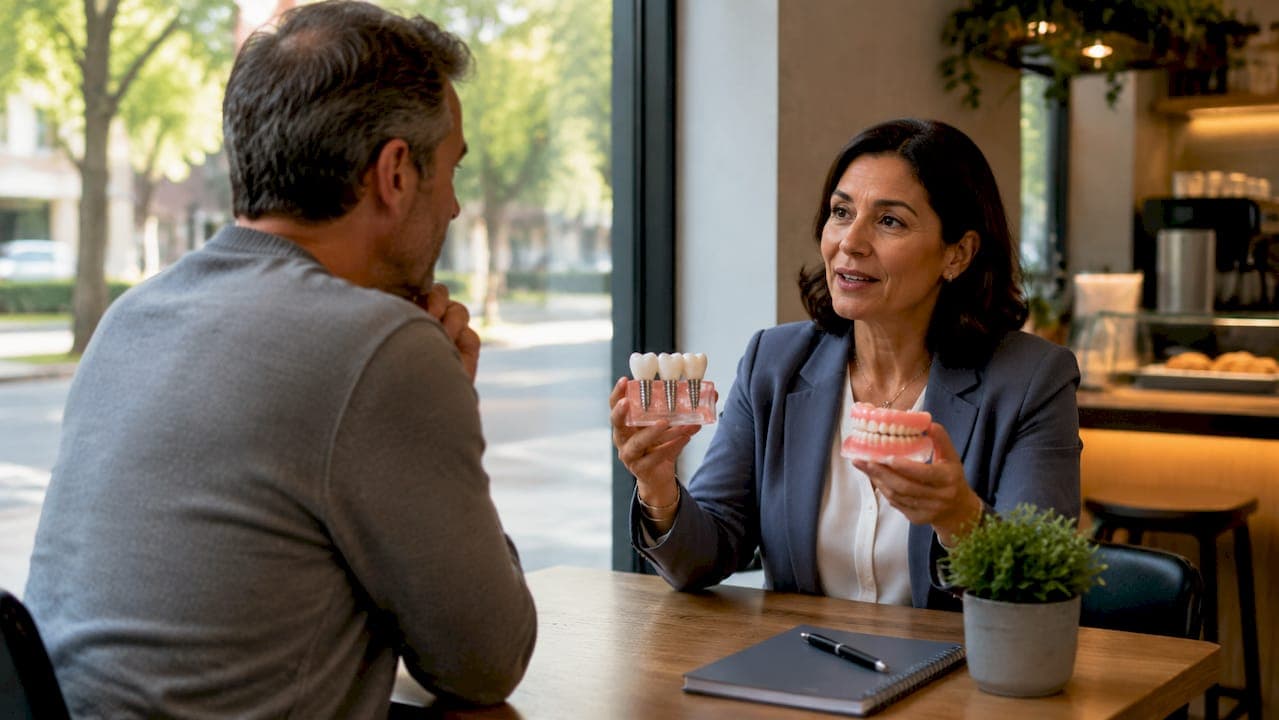
Implant-supported foxed teeth are the superior tooth replacement option for most patients, delivering better stability, comfort, chewing efficiency, and long-term satisfaction than conventional dentures. This denture vs implant comparison benefits every patient who wants to make a confident, informed decision rather than guess. The core difference is structural: implants anchor into the jawbone, while dentures rest on the gum surface and depend on suction or adhesive. That single distinction drives every downstream difference in function, longevity, and quality of life. Your best option depends on your anatomy, budget, and goals, and this guide breaks down each factor clearly.
1. How do dentures and implants differ in comfort and stability?
Implant-supported overdentures score significantly higher in patient-reported comfort and stability than conventional dentures. In clinical research, overall satisfaction scores averaged 8.7 out of 10 for implant patients versus 6.6 out of 10 for conventional denture wearers. That gap is not subtle. It reflects a daily lived difference in how confident patients feel eating, speaking, and smiling.
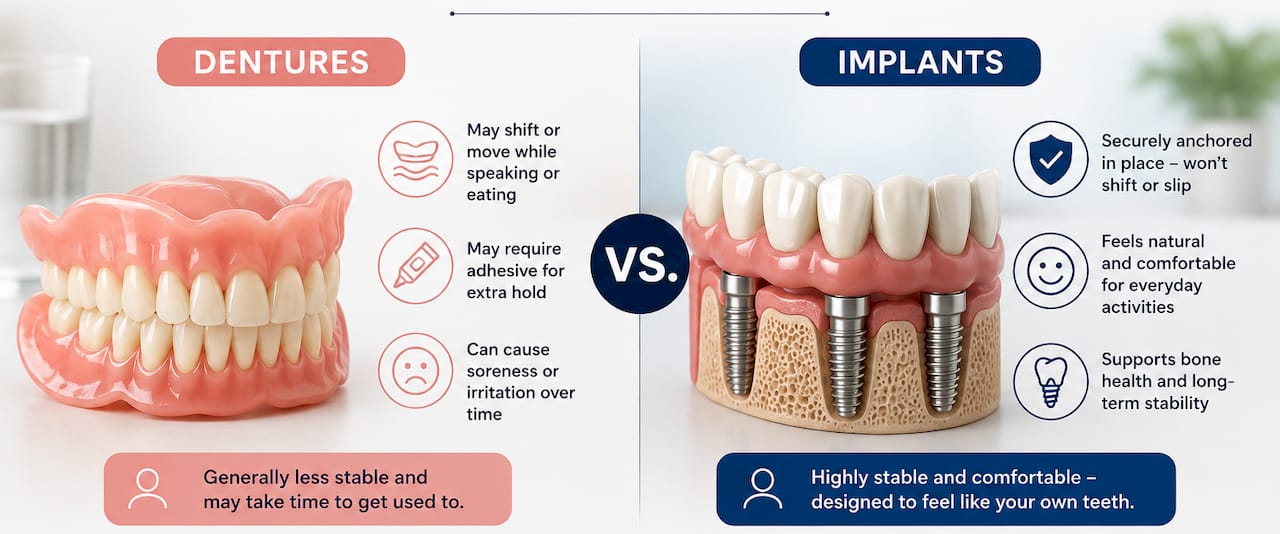
Conventional dentures rely on suction and the shape of the gum ridge to stay in place. Both factors degrade over time as bone resorbs beneath the denture base. Patients often report slipping, clicking, and the need for adhesive pastes just to get through a meal.
Implant-supported options use physical attachment systems, such as ball attachments, locator abutments, or bar clips, to lock the prosthesis in place. That mechanical retention is what drives the satisfaction gap. Stability and retention are the top two factors patients cite when rating their experience with implants over dentures.
-
Conventional dentures: held by suction, saliva, and adhesive
-
Implant overdentures: locked to implant fixtures via attachment hardware
-
Snap-in implant dentures eliminate the slipping and clicking that frustrates most denture wearers
-
Adaptation period for implant prostheses is shorter because the fit is mechanically reliable from day one
Pro Tip: If you find yourself applying denture adhesive more than once a day, that is a clinical signal your ridge has changed and your denture no longer fits properly. Ask your provider whether relining or implant conversion makes more sense.
2. What are the differences in chewing ability and oral function?
Implants restore chewing function far closer to natural teeth than conventional dentures. Implant-supported prostheses enhance chewing efficiency by anchoring directly to the bone, which transfers bite force through the implant rather than pressing on soft tissue. Denture wearers typically experience reduced masticatory efficiency because the prosthesis can shift under pressure, limiting how hard they can bite.
The practical consequence is dietary restriction. Many conventional denture wearers avoid raw vegetables, tough meats, and hard fruits because chewing them is uncomfortable or impossible. That restriction affects nutrition and, over time, overall health.
Implants also preserve the jawbone. Dentures accelerate alveolar bone loss because they apply pressure to the gum surface rather than stimulating the bone the way a natural tooth root does. Bone loss changes the shape of the jaw, which in turn changes how the denture fits, creating a cycle of worsening function.
The functional advantages of implants over dentures, in order of patient impact:
-
Stronger bite force, closer to natural dentition
-
Stable platform that does not shift during chewing
-
Bone stimulation that prevents jaw shrinkage
-
Broader food choices, including hard and fibrous foods
-
Better digestion from more thorough chewing
-
Improved speech clarity from a stable prosthesis
-
Greater confidence in social eating situations
3. How do durability, maintenance, and longevity compare?
Implants outlast conventional dentures by a wide margin when properly maintained. Implant survival rates exceed 98% at the three-year mark, and long-term data supports decades of function with appropriate care. Conventional dentures have no equivalent survival benchmark because they require periodic replacement driven by bone resorption and fit changes, not material failure alone.
Denture lifespan is limited by how fast the underlying bone changes. Hard relines last 3–5 years, and soft relines need replacing every 1–2 years. Each reline is a cost and an appointment, and it only delays the inevitable need for a new denture. Patients who need frequent relines are often experiencing accelerated bone loss, and that is a sign that implants deserve serious consideration.
Implant overdentures have their own maintenance demands. Prosthetic attachments wear over time and require periodic servicing to maintain proper retention. The implants themselves may survive indefinitely, but the hardware connecting them to the prosthesis needs attention. This is a manageable burden, not a dealbreaker, and it is far less disruptive than repeated denture remakes.
| Factor | Conventional dentures | Implant-supported prostheses |
|---|---|---|
| Expected lifespan | 5–10 years before remake | Implants: decades; prosthesis: 10–15 years |
| Reline frequency | Every 1–5 years | Minimal; attachment servicing as needed |
| Bone preservation | No; accelerates bone loss | Yes; stimulates and preserves bone |
| Maintenance burden | Moderate, ongoing | Low to moderate, periodic |
Pro Tip: If your denture has needed two or more relines in five years, the bone beneath it is changing faster than average. That pattern often means implants will deliver better long-term value, both financially and functionally.
4. What are the cost considerations between dentures and implants?
Dentures cost less upfront, and implants cost less over a lifetime. That is the honest summary of the denture ongoing cost vs implant cost comparison. A conventional full denture carries a lower initial price, but relining, remaking, and adhesive expenses accumulate steadily over years. Implants require a larger upfront investment, and that investment does not repeat.
Dr. Brian Young is a surgeon at Forever Smiles Implant Center- full-mouth implant treatment in this specialty clinic starts at $19,000 per arch. That price covers 3D imaging, surgery, same-day teeth, final custom zirconia teeth, and follow-up care. Patients pay once for a complete result rather than paying repeatedly for a solution that degrades.
Several factors affect whether implants are financially accessible for a given patient:
-
Bone volume: patients with significant bone loss may need grafting or advanced techniques such as zygomatic implants, which affect total cost
-
Systemic health: conditions like uncontrolled diabetes can complicate healing and influence treatment planning
-
Financing: structured payment plans make the upfront cost manageable for many patients
-
Insurance: coverage varies widely; most plans treat implants as elective, though some cover portions of the prosthetic work
The long-term math favors implants for most patients who are candidates. The short-term math favors dentures for patients with strict budget limits or anatomical barriers to surgery.
5. Which option suits different patient needs best?
The right choice depends on three factors: health, anatomy, and goals. Implants are the better option for patients who want a permanent, stable result and who have adequate bone or are willing to address bone deficiency. Dentures remain appropriate for patients with severe systemic conditions that make surgery unsafe, extreme bone loss without surgical options, or a firm preference to avoid surgery.
Immediate loading protocols allow select patients to receive functional teeth the same day as implant surgery. This approach reaches survival rates near 98%, but it requires careful patient selection and precise prosthetic control. Not every patient qualifies, and not every provider has the surgical volume to execute it reliably.
Material choice also matters. Titanium implants show higher success rates than zirconia at 91.7% versus 77.78%, along with better bone stability. Zirconia offers aesthetic advantages and easier cleaning in some configurations. The right material depends on the patient’s priorities and the surgeon’s recommendation based on anatomy.
| Patient profile | Better option |
|---|---|
| Good bone volume, wants permanence | Implant-supported prosthesis |
| Limited budget, medically complex | Conventional denture |
| Bone loss, willing to address it surgically | Implants with grafting or zygomatic approach |
| Unhappy with existing denture | Implant overdenture or full-arch implants |
| Wants same-day teeth | Immediate-load implants (case-dependent) |
Patients who have been told they are not candidates elsewhere should seek a second opinion from a specialist. Many patients at Forever Smiles Implant Center arrive after being turned away, and a significant number qualify for advanced techniques that general providers do not offer. Checking implant candidacy with a surgical specialist is always worth the consultation.
Key takeaways
Implant-supported prostheses outperform conventional dentures in stability, chewing function, bone preservation, and long-term cost, making them the better investment for most patients who are surgical candidates.
| Point | Details |
|---|---|
| Satisfaction gap is measurable | Implant patients score 8.7 vs 6.6 out of 10 for denture wearers in clinical research. |
| Implants preserve bone | Dentures accelerate bone loss; implants stimulate the jaw and maintain its shape. |
| Denture lifespan is limited | Hard relines last 3–5 years; implants can function for decades with proper care. |
| Upfront cost vs lifetime cost | Dentures cost less initially but accumulate relining and replacement expenses over time. |
| Patient suitability varies | Anatomy, health, and goals determine the right option; a specialist consultation is the only reliable way to know. |
What I’ve learned after 28,000 implants placed
Most patients who come to me have already spent years managing a denture that never felt right. They adapted. They avoided certain foods, they stopped smiling in photos, and they told themselves it was fine. The honest truth is that conventional dentures are a compromise, and most patients accept that compromise because no one told them there was a better option available to them.
The research confirms what I see every day in surgery. Prosthetic control and loading protocols determine implant outcomes as much as the implant itself. Two patients with identical implants can have very different results based on how the prosthesis is designed, loaded, and maintained. That is why surgical volume and specialty training matter. A surgeon who places implants occasionally cannot develop the pattern recognition that comes from doing this every single day.
I also want to be direct about maintenance. Implant overdentures are not maintenance-free. The attachments wear, and they need servicing. Patients who expect zero upkeep after surgery are sometimes surprised. But that maintenance is a fraction of what conventional denture patients deal with in relining, remaking, and adhesive management over a decade.
The patients I worry about most are those who choose dentures purely on upfront cost without understanding the long-term picture. If you need a reline every two years, your bone is changing fast. That bone loss is permanent. Every year you wait with a denture is a year of bone you cannot get back, and that affects what implant options remain available to you.
My advice is simple. Get the consultation. Understand your anatomy. Then make the decision with full information rather than assumptions about cost or candidacy.
— Dr. Brian Young, Forever Smiles Implant Center (Jacksonville, Florida)
Full-mouth implant care at Forever Smiles Implant Center
Patients in Jacksonville, Florida, and across the Southeast choose Forever Smiles Implant Center because the entire process happens under one roof with one accountable surgical team. Dr. Brian Young has placed over 28,000 implants and performs full-arch implant surgery daily, not occasionally.
From 3D imaging and surgical planning through same-day teeth and final custom zirconia restorations, every step is handled in-house. The practice includes a board-certified MD anesthesiologist and an on-site dental lab, which means no outsourcing and no delays. Patients who have been told they are not candidates elsewhere, including those with severe bone loss, are encouraged to schedule a consultation. Many qualify for advanced options that general providers do not offer. Visit the dental implants FAQ page or explore implant cost and financing to understand what treatment looks like from start to finish.
FAQ
Are implants more comfortable than dentures?
Yes. Patient satisfaction scores average 8.7 out of 10 for implant patients versus 6.6 for conventional denture wearers, with comfort and stability driving the difference.
How long do implants last compared to dentures?
Implants survive at rates above 98% at three years and can function for decades. Conventional dentures typically require relining every 3–5 years and full replacement within 5–10 years.
What is the difference between mini implants and standard implants?
Standard implants are wider in diameter and designed for full load-bearing restorations, while mini implants are narrower and typically used to stabilize lower dentures in patients with limited bone. Standard implants generally offer better long-term stability and bone integration for full-arch cases.
Do implants require more maintenance than dentures?
Both require regular care. Dentures need daily cleaning, periodic relining, and eventual replacement. Implant overdentures require attachment servicing over time, but the overall maintenance burden is lower than managing a conventional denture over a decade.
Can I get implants if I have been wearing dentures for years?
Many long-term denture wearers qualify for implants, though bone loss from years of denture wear may require grafting or advanced techniques. A 3D imaging consultation with a surgical specialist is the only way to assess your specific anatomy and options.