

Dental implants are titanium posts surgically placed into the jawbone to anchor a full prosthetic arch, replacing every tooth in a way that no removable denture can match. Understanding how implants replace full denture solutions starts with one core concept: osseointegration, the biological process by which titanium fuses directly with living bone. That fusion creates a fixed foundation. Traditional dentures sit on top of the gum and shift with every bite. Implant-supported prostheses do not move. Forever Smiles Implant Center in Jacksonville, Florida, performs this type of full-arch reconstruction every single day, treating patients who have worn dentures for years and are ready for a permanent solution.
How do implants replace full dentures? Types and options explained
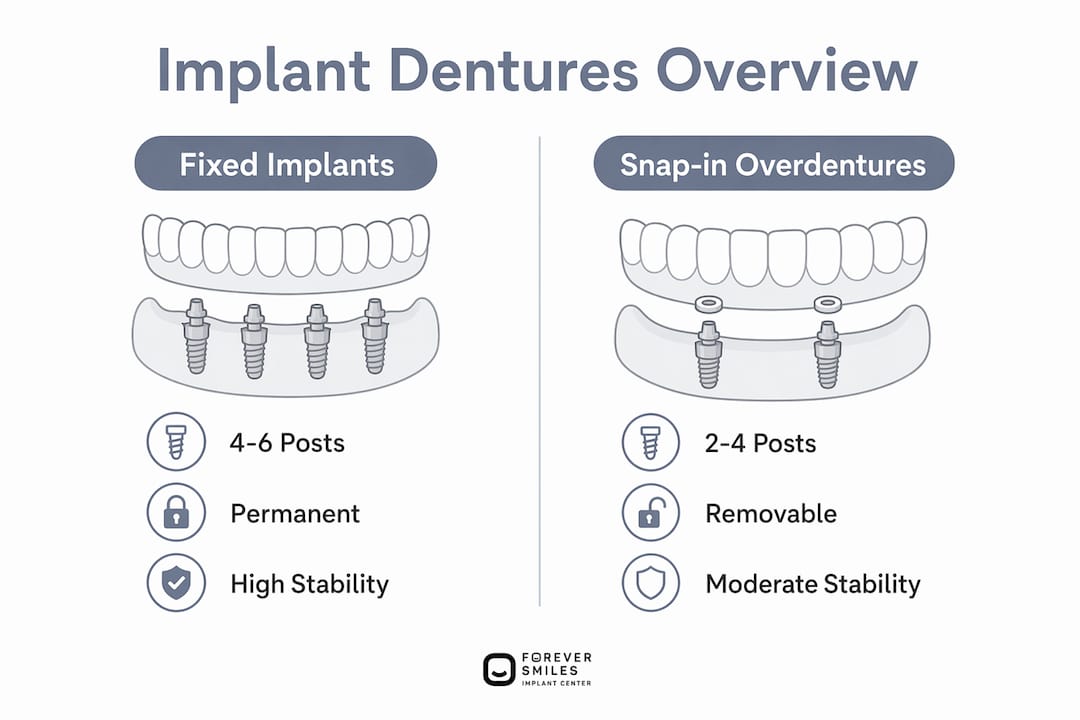
Two main categories of implant-supported prostheses replace a full denture, and they serve different patient needs.
Fixed full-arch implants (commonly called All-on-4 or All-on-6) use 4–6 implants per arch to permanently anchor a full set of teeth. Only a dental professional can remove them. Patients brush and floss them like natural teeth. This option delivers the closest experience to a real set of teeth and is the preferred choice for patients who want to forget they ever wore a denture.
Snap-in overdentures are removable by the patient and snap onto 2–4 implants using ball or bar attachments. They offer far better stability than a conventional denture, but patients remove them nightly for cleaning. This option costs less upfront and works well for patients who prefer a familiar removal routine.
The key differences between the two options:
- Stability: Fixed arches do not move at all. Overdentures can shift slightly under heavy bite pressure.
- Maintenance: Fixed arches require standard brushing and water flossing. Overdentures require nightly removal and cleaning of the attachment hardware.
- Implant count: Fixed arches typically use 4–6 implants. Overdentures typically use 2–4.
- Cost: Fixed full-arch sets represent a higher investment. Overdentures cost less per arch.
- Bone requirements: Fixed arches require adequate bone volume or bone grafting. Overdentures can work with less bone.
Pro Tip: If you have been told you lack enough bone for standard implants, ask specifically about zygomatic implants. These anchor into the cheekbone instead of the jaw and open the door for patients who were previously turned away.
3D imaging guides the selection of implant type and placement angle, which is why the planning phase matters as much as the surgery itself.
What is the step-by-step process for getting implants to replace dentures?
The full process from consultation to final teeth follows a predictable sequence. Knowing each step removes the uncertainty that keeps many patients from moving forward.
- Consultation and 3D imaging. A cone beam CT scan maps your bone density, nerve locations, and jaw anatomy. This scan determines how many implants you need, where they go, and whether bone grafting is required before surgery.
- Surgical planning. The surgeon designs the implant positions digitally before touching a patient. At Forever Smiles Implant Center, this planning happens in-house with the same team that performs the surgery.
- Implant placement surgery. The surgical procedure takes 1–2 hours per arch under anesthesia. The titanium posts are placed directly into the jawbone through precise incisions.
- Immediate provisional teeth. In qualifying cases, same-day teeth are placed on the implants before the patient leaves. These are temporary but fully functional.
- Osseointegration healing. The implants fuse with bone over a period of 3–6 months. This phase requires no surgery. Patients eat soft foods and follow post-operative care instructions.
- Final prosthesis delivery. After healing is confirmed, impressions or digital scans capture the final bite. Custom zirconia teeth are fabricated and attached permanently.
Pro Tip: Ask your surgeon whether you qualify for immediate loading before your surgery date. Not every case qualifies, but when it does, you leave the office with functional teeth the same day.
The full reconstruction timeline from surgery to final teeth typically runs 3–6 months. Patients who need bone grafting before implant placement add time to that window.
Can existing dentures be converted to implant-supported dentures?
Yes, in some cases. Retrofitting an existing denture to snap onto implants is possible, but it comes with real limitations that patients need to understand before choosing this path.
Retrofitting is only viable when the existing denture meets specific structural requirements. The acrylic must be thick enough to accept the attachment hardware without cracking. The denture must still fit the gum ridge accurately. And the bite relationship must be correct. When any of these conditions fail, retrofitting produces a weak, short-lived result.
Key considerations before retrofitting:
- Denture age and fit. A denture that already rocks or gaps on the gum is not a good candidate. Implants will stabilize the attachment, but they cannot fix a poor-fitting base.
- Acrylic thickness. Drilling attachment housings into thin acrylic weakens the denture structurally. Many older dentures do not have enough material to survive this modification.
- Cost vs. longevity. Retrofitting costs less upfront, but a purpose-built implant prosthesis lasts longer and functions better. The savings often disappear when the retrofitted denture needs replacement within a few years.
- Clinical judgment. A specialist evaluates the denture in person before recommending retrofitting. No patient should make this decision based on cost alone.
The honest answer is that most patients seeking a permanent result are better served by a new custom prosthesis. Retrofitting is a reasonable bridge for patients with budget constraints, not a permanent solution.
Why are permanent dental implants better than traditional dentures?
Traditional dentures rest on the gum surface and rely on suction or adhesive to stay in place. That design has one fundamental flaw: it does nothing to stop bone loss. Dentures do not stimulate the jawbone, so the bone beneath them slowly resorbs. Over years, the face changes shape, the denture fits worse, and patients need relining or replacement every 5–7 years.
Implants solve this at the root level. The titanium post acts as an artificial tooth root, delivering mechanical stimulation to the bone with every bite. That stimulation signals the body to maintain bone volume. Patients who switch from dentures to implants preserve their facial structure in a way that denture wearers cannot.
"Bone loss from dentures is not just a cosmetic issue. It is a progressive structural change that makes future implant placement harder and more expensive. The longer a patient waits, the more complex the solution becomes."
The functional difference is equally significant. Implant-supported prostheses improve chewing efficiency well beyond what conventional dentures deliver. Patients can eat foods they have avoided for years, including raw vegetables, steak, and apples.
| Category | Traditional dentures | Implant-supported prostheses |
|---|---|---|
| Stability | Adhesive or suction dependent | Fixed to bone, no movement |
| Bone preservation | None, bone resorbs over time | Active stimulation maintains bone |
| Lifespan | Replacement every 5–7 years | Implants last a lifetime; prostheses 10–15+ years |
| Maintenance | Nightly removal, adhesives | Brush and floss like natural teeth |
| Confidence | Slippage risk in social settings | No movement, no adhesive needed |
The long-term math favors implants. A denture replaced every 5–7 years accumulates significant cost over a lifetime, while implants placed correctly last decades with only prosthesis maintenance.
Key Takeaways
Dental implants replace full dentures by fusing titanium posts into the jawbone, creating a permanent foundation that preserves bone, restores function, and eliminates the instability of removable prostheses.
| Point | Details |
|---|---|
| Two main implant options | Fixed full-arch implants and snap-in overdentures serve different budgets and lifestyle needs. |
| Surgery and healing timeline | Implant placement takes 1–2 hours per arch; full osseointegration requires 3–6 months. |
| Retrofitting has real limits | Existing dentures can sometimes be converted, but structural flaws make a new prosthesis the better long-term choice. |
| Bone preservation is the core advantage | Implants stimulate the jawbone; traditional dentures allow bone to resorb and the face to change shape. |
| Longevity favors implants | Implants last a lifetime; traditional dentures need replacement every 5–7 years. |
What I have learned after 28,000 implants placed
The patients who struggle most with this decision are not the ones with the most complex cases. They are the ones who waited too long and now face more bone loss, more complexity, and higher cost than they would have five years earlier. I see this pattern constantly.
The second thing I have learned is that patients almost universally underestimate how much their denture has been affecting their life. They adapt. They stop ordering certain foods at restaurants. They stop laughing as freely. They manage. Then they get implants, and within weeks they tell me they had no idea how much they were compensating.
The third thing is about provider selection. This procedure requires a surgeon who does it every day, not occasionally. Full-arch implant reconstruction is not a procedure you want performed by someone who places a handful of implants per month. The planning, the surgical execution, and the prosthetic outcome are all connected. When one part of that chain is weak, the whole result suffers. I train other surgeons nationally, and the gap between high-volume specialists and occasional providers is significant.
My practical advice: get a consultation with a specialist who can show you a 3D scan of your own bone and explain exactly what your case requires. Generic answers to generic questions are not enough. Your jaw is specific. Your treatment plan should be too. If a provider cannot show you a detailed plan before asking for a commitment, keep looking.
— Dr. Brian Young
Full-mouth implant solutions at Forever Smiles Implant Center
Forever Smiles Implant Center focuses exclusively on full-mouth dental implants in Jacksonville, Florida. Every case goes through in-house 3D imaging, surgical planning, surgery, and custom zirconia fabrication under one roof with one accountable team. Dr. Brian Young has placed over 28,000 implants and performs full-arch surgery daily, including advanced cases involving zygomatic implants and previously failed implant repairs.
Patients who have been told they are not candidates elsewhere are encouraged to schedule an evaluation. Forever Smiles specializes in the cases other providers decline. Treatment starts from $19,000 per arch and includes planning, surgery, same-day teeth, final zirconia prostheses, and follow-up care. Financing options are available. Visit the dental implants FAQ page to get answers to the most common questions before your first appointment.
FAQ
How long does it take to replace a full denture with implants?
The full process takes 3–6 months from surgery to final teeth, with the surgical procedure itself lasting 1–2 hours per arch. Patients who qualify for immediate loading receive provisional teeth the same day as surgery.
Can I get implants if I have been wearing dentures for many years?
Yes, but long-term denture wear causes bone loss that may require additional planning, bone grafting, or zygomatic implants. A 3D scan assessment determines exactly what your bone can support before any treatment begins.
What is the difference between snap-in dentures and fixed implant teeth?
Snap-in overdentures attach to 2–4 implants and are removed nightly by the patient. Fixed full-arch implants attach to 4–6 implants and are only removable by a dental professional, functioning like permanent natural teeth.
How much do implant-supported dentures cost compared to traditional dentures?
Retrofitting an existing denture to implant attachments costs less upfront but typically does not last as long as a purpose-built prosthesis. Full fixed implant arches represent a higher initial investment that pays off in longevity, function, and bone preservation over time.
Do dental implants stop bone loss from missing teeth?
Yes. Implants stimulate the jawbone the same way natural tooth roots do, preventing the resorption that occurs under traditional dentures. This bone preservation protects facial structure and makes the implant result more stable over decades.