
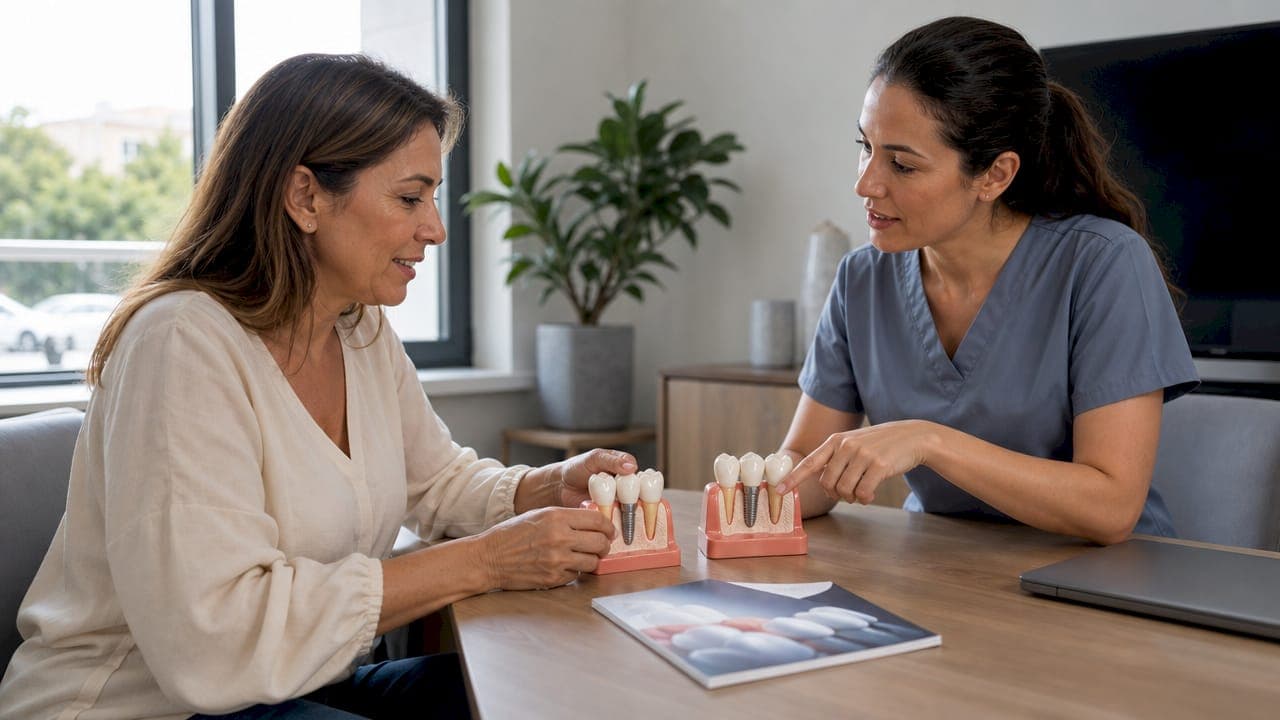
Removable and fixed implant teeth are the two primary prosthetic options for patients who have lost most or all of their teeth. Both are implant-supported, meaning titanium posts anchor the replacement teeth to your jawbone. The key difference is attachment: removable prostheses snap on and off for cleaning, while fixed prostheses are permanently secured and never leave your mouth. A 2026 systematic review confirms that both options significantly improve function and quality of life over conventional dentures. The right choice depends on your bone structure, budget, hygiene ability, and personal priorities.
What are the structural differences between removable and fixed implant teeth?
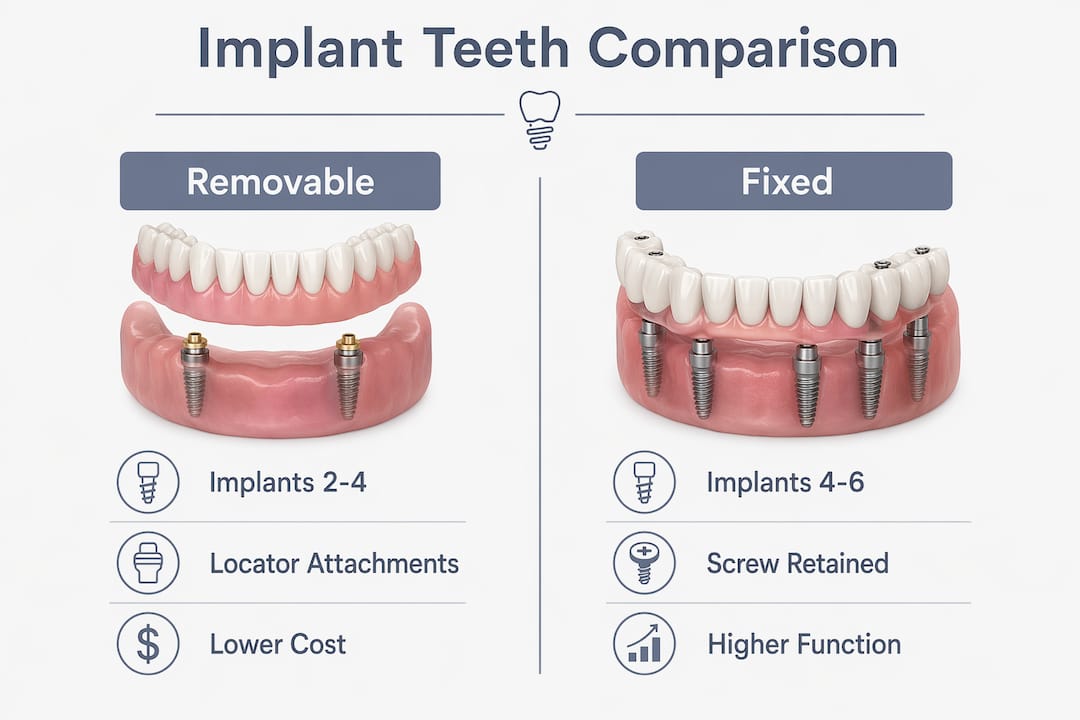
Fixed and removable implant prostheses differ in implant count, attachment method, and daily function. Fixed prosthetics typically use 4–6 implants per arch, while removable overdentures use 2–4. Fewer implants mean less surgery, lower cost, and faster healing for removable patients.
The attachment method drives most of the practical differences. Removable overdentures connect to implants using locator attachments or a bar system. You snap the prosthesis in each morning and remove it at night. Fixed prostheses are screw-retained or cemented directly onto the implants. They do not come out between appointments.
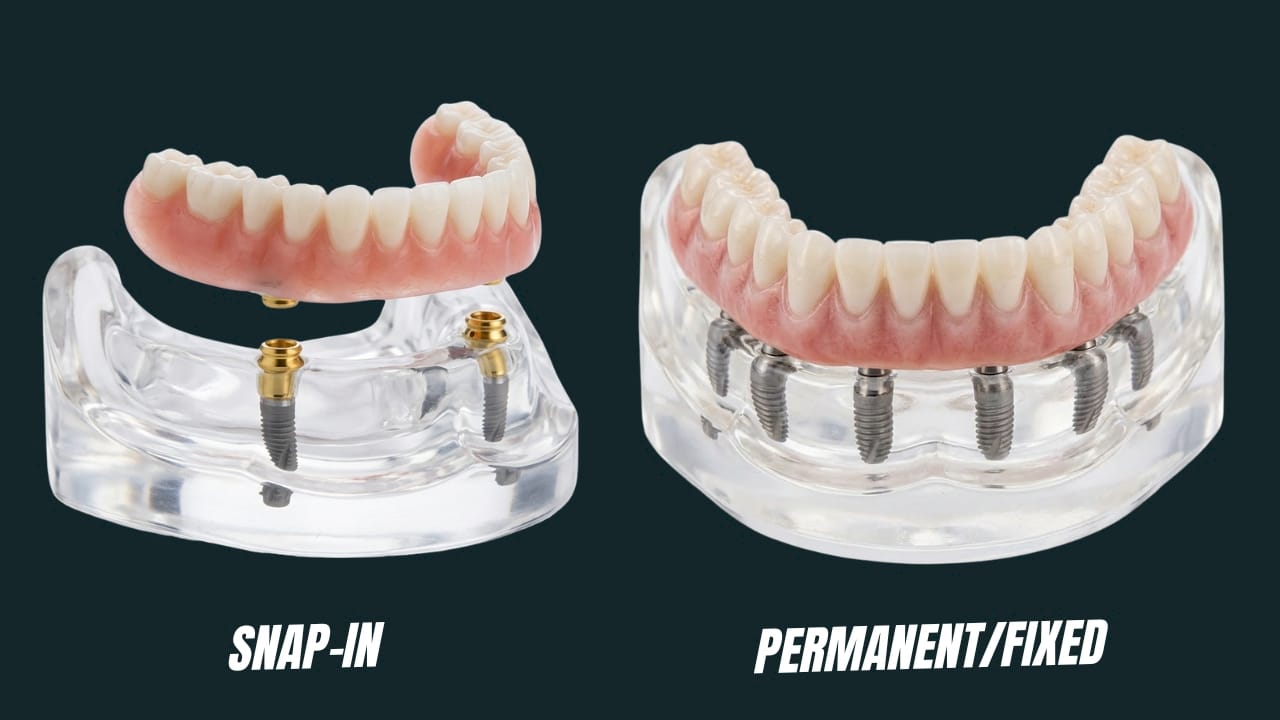
Chewing force is where fixed implants pull ahead. Fixed prostheses offer the highest masticatory function of any implant option. Patients report a feel much closer to natural teeth. Removable overdentures still outperform conventional dentures significantly, but the stability gap between the two modalities is real and noticeable during meals.
| Feature | Removable overdenture | Fixed prosthesis |
|---|---|---|
| Implants per arch | 2–4 | 4–6 |
| Attachment type | Locator or bar | Screw-retained, non-removable |
| Chewing stability | Good | Excellent |
| Daily removal | Yes | No |
| Cleaning method | Remove and brush | Interdental tools, water irrigation |
| Feel vs. natural teeth | Improved | Closest match |
Pro Tip: Ask your surgeon to show you a locator attachment in person before deciding. Feeling how it snaps in and out tells you more than any description.
What do cost and maintenance look like for each option?
Cost is one of the clearest separators between the two options. Removable implant-supported prostheses cost about one-third less than fixed options. That gap reflects fewer implants, simpler surgical planning, and less complex lab work. For patients working within a budget, removable overdentures deliver strong function at a lower entry price.
Long-term maintenance costs tell a more nuanced story. Removable prostheses require regular attachment component replacement. Locator inserts wear down with daily use and need periodic swapping. The prosthesis itself may need relining as the jawbone changes shape over time. These are predictable costs, but they add up.
Fixed prostheses carry different maintenance demands. Attachment wear and prosthesis maintenance are frequent in removable overdentures, while fixed prostheses require professional screw checks and occasional technical repairs. Neither option is maintenance-free. The difference is where the cost lands: removable patients pay more often for smaller replacements, while fixed patients pay less frequently but for more complex interventions.
A smart maintenance plan separates implant component checks from prosthetic upkeep. These are two distinct systems with different schedules and different cost profiles. Patients who understand this distinction avoid surprise bills and keep both the implants and the prosthesis in better condition longer.
-
Removable overdenture ongoing costs: locator insert replacement, prosthesis relining, routine implant checks
-
Fixed prosthesis ongoing costs: professional cleaning visits, screw torque checks, occasional prosthetic repairs
-
Both options: annual radiographic monitoring, periodontal assessment, and peri-implant tissue evaluation
-
Dental implant cost and financing options vary by case complexity and implant count
Pro Tip: When comparing quotes, ask each provider to break out implant costs from prosthetic costs. A low headline price often excludes the teeth themselves.
Who is the ideal candidate for removable vs fixed implant teeth?
Bone volume is the first clinical filter. Fixed prostheses require more implants, which means more bone. Patients with significant bone loss may not have enough volume for 4–6 implants without grafting. Removable overdentures on 2–4 implants are often viable in cases where a full fixed arch is not. Your surgeon’s 3D imaging assessment determines this before any other conversation happens.
Removable overdentures simplify daily cleaning for patients with limited hand dexterity or arthritis. Removing the prosthesis to brush it is straightforward. Fixed prostheses require consistent use of interdental brushes, water flossers, and floss threaders to clean under the bridge. Patients who struggle with fine motor tasks may find fixed hygiene protocols genuinely difficult to maintain.
Lifestyle and psychology matter more than most patients expect. Fixed implants provide a sense of permanence that many patients describe as life-changing. There is no prosthesis to remove at night, no container on the bathroom counter, and no social anxiety about the teeth shifting. Removable patients gain flexibility and easier cleaning but trade the psychological comfort of teeth that never come out.
Ideal candidates for removable overdentures:
-
Limited bone volume without desire for grafting
-
Tighter budget with strong long-term maintenance commitment
-
Reduced hand dexterity or difficulty with complex cleaning routines
-
Preference for simpler prosthetic repairs and adjustments
-
Patients who want an upgrade from conventional dentures without full fixed surgery
Ideal candidates for fixed prostheses:
-
Adequate bone volume or willingness to undergo grafting
-
Strong daily hygiene compliance with interdental tools
-
Priority on natural feel, chewing power, and permanent stability
-
Patients who want to forget they ever had implants
-
Those who qualify after a thorough implant candidacy evaluation
What are the long-term outcomes and common pitfalls of each option?
Both options deliver strong long-term implant survival rates when patients maintain them properly. The biggest threat to either modality is peri-implantitis, an infection of the tissue around the implant. Risk-stratified maintenance protocols reduce peri-implantitis incidence by 75%. That number makes the case for structured follow-up care more clearly than any clinical argument.
Fixed prostheses carry a higher rate of technical complications requiring professional intervention. Screw loosening, porcelain chipping, and prosthetic fractures are the most common issues. These are manageable but require a skilled provider to address. Patients who chose a low-cost provider for their original surgery often find that fixing failed dental implants is far more expensive than doing it right the first time.
Removable overdentures have their own failure pattern: attachment wear. Locator inserts degrade with daily snap-in and snap-out cycles. Patients who skip replacement appointments end up with loose, poorly retained prostheses that accelerate bone loss and reduce function. The prosthesis itself can crack or warp if not stored and cleaned correctly.
| Outcome category | Removable overdenture | Fixed prosthesis |
|---|---|---|
| Primary complication | Attachment wear, relining | Screw loosening, prosthetic fracture |
| Hygiene risk | Lower with removal | Higher without consistent interdental care |
| Peri-implantitis risk | Reduced with maintenance | Reduced with maintenance |
| Patient satisfaction | High | Highest |
| Repair complexity | Low to moderate | Moderate to high |
Patient satisfaction scores favor fixed prostheses, but the gap narrows significantly when removable patients receive proper follow-up care and realistic expectations from the start.
How do you decide between removable and fixed implant teeth?
The decision starts with a thorough clinical evaluation, not a preference conversation. A global consensus report frames the choice around five structured treatment stages and patient-specific risk assessment. Bone volume, systemic health, hygiene capacity, and financial tolerance all feed into the recommendation before patient preference enters the picture.
Once the clinical picture is clear, shared decision-making takes over. Patient education and shared decision-making critically influence outcomes because comfort, hygiene preference, and cost tolerance drive which modality a patient will actually maintain long-term. A fixed prosthesis on a patient who cannot clean it properly fails faster than a well-maintained overdenture.
Here is how to prepare for a productive consultation:
-
Write down your top three priorities: function, cost, hygiene ease, permanence, or something else.
-
Ask your surgeon how much bone you have and whether grafting is needed for either option.
-
Request a breakdown of first-year costs versus five-year projected maintenance costs for each option.
-
Ask to see photos or models of both prosthesis types before committing.
-
Confirm that your provider performs both options regularly, not just one.
Pro Tip: If a provider recommends one option without discussing the other, ask why. A thorough clinician presents both trade-offs and lets your priorities guide the final call.
Key takeaways
Fixed implant prostheses deliver superior chewing function and a more natural feel, while removable overdentures cost less upfront and are easier to clean for patients with limited dexterity.
| Point | Details |
|---|---|
| Implant count differs | Fixed arches use 4–6 implants; removable overdentures use 2–4, affecting cost and surgery complexity. |
| Cost gap is real | Removable prostheses cost roughly one-third less than fixed options at the time of placement. |
| Maintenance is different, not easier | Removable patients replace attachments regularly; fixed patients need professional technical maintenance. |
| Hygiene ability matters | Patients with limited dexterity maintain removable prostheses more reliably than fixed bridges. |
| Maintenance protocols protect both | Risk-stratified follow-up care reduces peri-implantitis risk by 75% regardless of prosthesis type. |
What I have learned after placing over 28,000 implants
The question I hear most often is: “Which one is better?” My honest answer is that the question itself is wrong. Fixed implants are not better than removable overdentures. They are better for certain patients. Removable overdentures are not a compromise. They are the right solution for a specific set of clinical and personal circumstances.
What I have seen over two decades is that the patients who struggle most are not the ones who chose the wrong prosthesis type. They are the ones who were never given a real comparison. They were sold one option by a provider who only offers one option. That is a clinical failure, not a patient failure.
Fixed prostheses do feel more like natural teeth. That is not marketing. It is what the research shows and what patients tell me every day. But a fixed prosthesis on a patient who cannot maintain it, or who did not have enough bone to support it properly, becomes a problem within years. The prosthesis type matters far less than the quality of the surgical plan and the patient’s commitment to follow-up care.
The other misconception I push back on constantly is that removable means inferior. A well-placed overdenture on two to four implants transforms a patient’s life. It stops bone loss, restores chewing, and eliminates the instability of conventional dentures. For patients with limited bone, limited budget, or limited dexterity, it is often the most responsible recommendation.
My advice: find a provider who performs both options every day and who will show you the clinical data behind their recommendation for your specific case.
— Dr. Brian Young, Forever Smiles Implant Center (Jacksonville, Florida)
Forever Smiles Jacksonville can help you find the right implant solution
Choosing between a removable overdenture and a fixed prosthesis requires more than a preference conversation. It requires 3D imaging, bone assessment, and a surgeon who performs both procedures regularly.
At Forever Smiles Implant Center in Jacksonville, Florida, expert dental implant surgeon Dr. Brian Young and his team evaluate every patient with cone beam CT imaging and a full surgical plan before any recommendation is made. With over 28,000 implants placed and a practice built exclusively around full-mouth dental implants, the team sees both straightforward and complex cases daily. Patients who have been told they are not candidates elsewhere often find a path forward here, including zygomatic implants for severe bone loss cases. If you want a clear, evidence-based answer about which option fits your anatomy and your life, start with a consultation and 3D imaging at Forever Smiles Implant Center.
FAQ
What is the main difference between removable and fixed implant teeth?
Removable implant teeth snap onto implants and can be taken out for cleaning, while fixed implant teeth are permanently attached and never removed between dental visits.
Are fixed dental implants worth the higher cost?
Fixed implants deliver the highest chewing function and the closest feel to natural teeth, making them worth the investment for patients with adequate bone and strong hygiene compliance.
How often do removable overdenture attachments need replacing?
Locator inserts in removable overdentures wear with daily use and typically require replacement every one to two years, depending on the attachment system and patient habits.
Can I switch from a removable overdenture to a fixed prosthesis later?
Switching is possible in many cases, but it requires a clinical reassessment of bone volume and may involve adding implants. A surgeon experienced in full arch implants can evaluate your specific situation.
Which implant option is easier to keep clean?
Removable overdentures are easier to clean because the prosthesis comes out entirely. Fixed prostheses require consistent use of interdental brushes, water flossers, and floss threaders to maintain hygiene under the bridge.