

How do All-on-4 and All-on-6 implants compare?
Both All-on-4 and All-on-6 replace every tooth in a full arch with a fixed, non-removable bridge anchored to titanium implants. The core difference is structural: four implants versus six, and that single variable ripples through biomechanics, bone requirements, cost, and who each protocol fits best.
Here is the short version before the full breakdown:
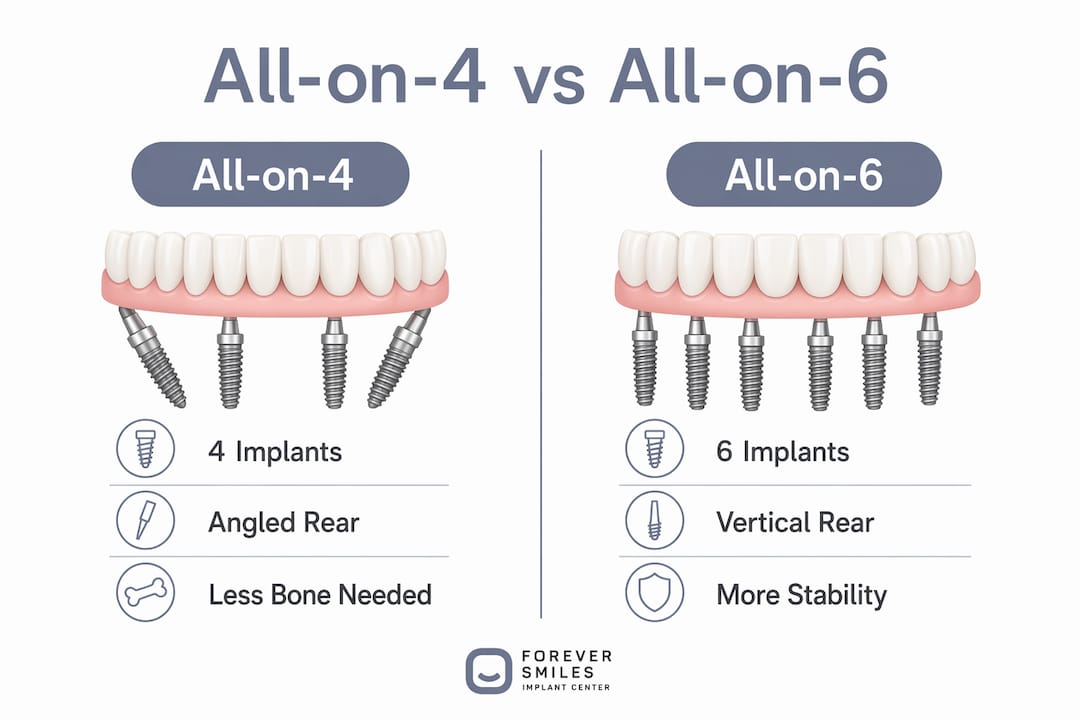
- All-on-4 uses four implants per arch. The two front implants sit vertically; the two rear implants are angled at roughly 30–45 degrees to maximize contact with available bone and sidestep areas where bone has thinned or sinus anatomy limits depth.
- All-on-6 uses six implants per arch, typically all placed vertically and distributed more evenly across the jaw, creating a wider structural base for the bridge.
- Osseointegration rates for both protocols are high, with prosthetic survival approaching 100% in most clinical studies. No statistically significant difference in long-term implant survival separates the two.
- All-on-6 produces lower stress on cortical bone and implants under load, making it the stronger choice for patients with bruxism, low bone density, or high bite forces.
- All-on-4 was specifically designed to reduce or eliminate the need for bone grafting by using angled rear implants to access bone that would otherwise be unusable.
- All-on-4 typically costs less than All-on-6 due to fewer implants and less complex surgery, with a price difference of thousands per arch in US markets. In the US, All-on-4 averages $20,000–$28,000 per arch, while All-on-6 averages $23,000–$32,000 per arch.
- Peri-implantitis occurs more frequently in All-on-4 cases than in All-on-6 cases in some studies.
- All-on-4 suits patients with moderate to severe bone loss, tighter budgets, or urgent timelines. All-on-6 suits patients with adequate bone volume, heavy occlusal forces, or higher biomechanical risk.
The right protocol is not a preference. It is a clinical determination driven by your bone volume, jaw anatomy, and specific risk factors.
What are All-on-4 and All-on-6 dental implants?
Full-arch implant treatment replaces every tooth in the upper or lower jaw with a fixed bridge permanently anchored to implants. You do not remove it. You clean it like natural teeth. It does not shift when you eat or speak, which is the fundamental difference from a conventional denture.
Both All-on-4 and All-on-6 follow this same concept. The variation lies in how many implants anchor the bridge and how they are positioned in the jaw.
All-on-4 was developed by Dr. Paulo Malo and introduced clinically in 1998. The protocol places four titanium implants per arch: two in the front of the jaw, positioned vertically, and two toward the rear, angled distally at approximately 30–45 degrees. That angling is the key engineering decision. It allows the rear implants to engage a longer stretch of available bone, bypassing the zones of maximum resorption at the back of the jaw and, in the upper arch, avoiding the sinus floor. The result is a stable four-point foundation that works even when posterior bone volume is limited. A provisional bridge is typically placed the same day as surgery, giving patients functional teeth immediately.
All-on-6 follows the same full-arch concept but places six implants, usually all vertically oriented and spread more evenly from front to back. The additional two implants create more anchor points, distribute chewing forces across a wider area, and reduce the mechanical load each individual implant must carry. The six-implant design also eliminates or shortens the cantilever extension at the back of the bridge, which is one of the primary stress concentrators in full-arch prosthetics.
Key structural points for both protocols:
- The bridge is fixed permanently at the implant connections, not removable by the patient.
- Both support immediate loading, meaning a temporary fixed bridge can be placed within 24 hours of surgery.
- Final zirconia prosthetics are typically delivered 3–4 months after surgery, once osseointegration is confirmed.
- Both protocols are viable for the upper jaw (maxilla) and lower jaw (mandible), though candidacy factors differ by arch.
- The surgical approach for each is shaped by a cone beam CT (CBCT) scan that maps bone volume, density, and anatomical structures before any implant is placed.
How do implant number and placement affect stability and stress?
The biomechanical difference between four and six implants is not trivial, and finite element analysis makes it measurable. A three-dimensional biomechanical study comparing both protocols found that All-on-6 produces lower maximum principal stress on cortical bone and implants under vertical, horizontal, and oblique loading conditions. The six-implant model distributes force across a larger area, extending from the most distal implant forward, which reduces the peak load any single implant must absorb.
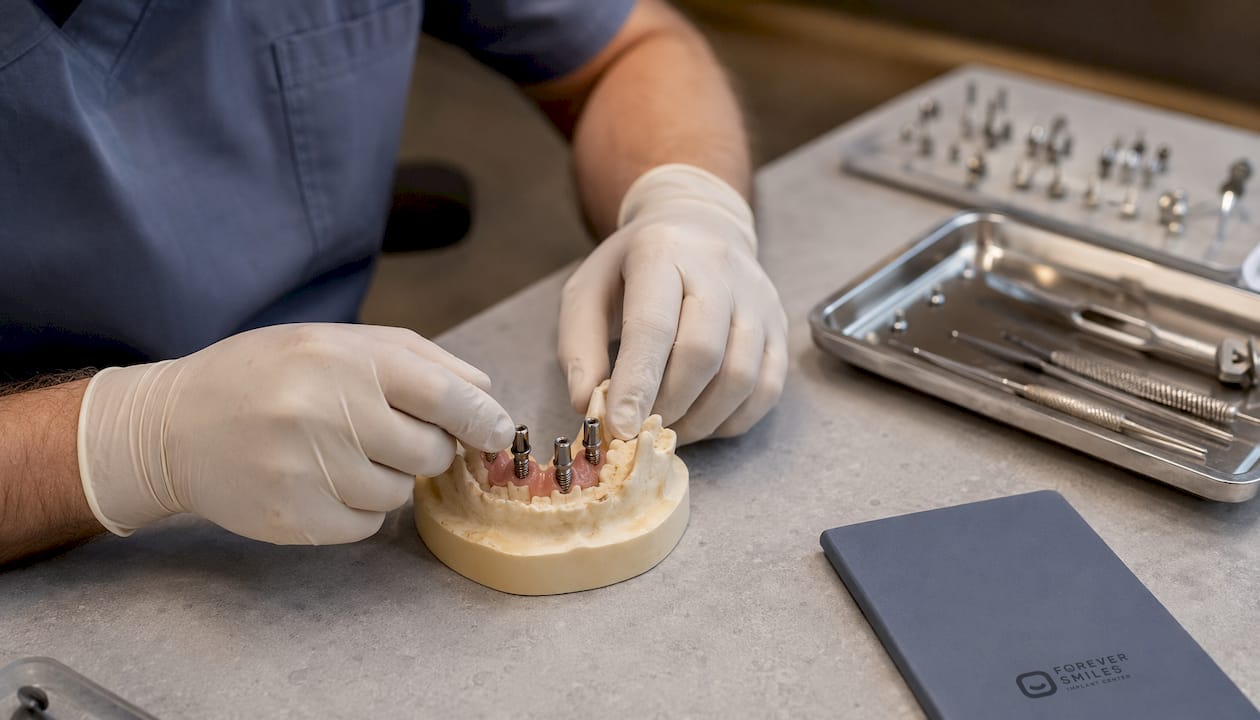
The angled rear implants in All-on-4 do provide a biomechanical advantage by reducing cantilever length compared to four vertically placed implants. Cantilever length matters because stress at the distal-most implant increases proportionally as the cantilever extends. All-on-6 eliminates or minimizes that cantilever by placing implants further back in the arch, which is why the distal implants in the four-implant model consistently showed higher stress values than their counterparts in the six-implant model.
| Feature | All-on-4 | All-on-6 |
|---|---|---|
| Implants per arch | 4 | 6 |
| Rear implant angle | 30–45 degrees | Typically vertical |
| Cortical bone stress | Higher under load | Lower under load |
| Cantilever length | Moderate | Minimal to none |
| Load distribution points | 4 | 6 |
| Bridge support area | Narrower | Wider |
| Preferred for bruxism/low bone density | No | Yes |
| Suitable for atrophic ridges | Yes | Requires more bone |
One nuance worth noting: the same biomechanical study found that trabecular bone stress was actually lower in the All-on-4 model under vertical and horizontal loading. This does not reverse the overall finding, but it illustrates that the biomechanical picture is not one-sided. For most patients, cortical bone stress is the more clinically relevant concern, and All-on-6 handles it better.
Clinicians prefer All-on-6 for cases involving heavy occlusal forces and biomechanical risk factors precisely because the increased implant support area reduces the risk of overloading any single implant-bone interface.
What bone volume does each protocol require?
Bone requirements are where All-on-4 and All-on-6 diverge most practically for patients.

All-on-4 was designed from the ground up to work with compromised bone. The angled posterior implants circumvent anatomical limitations including the sinus floor in the upper jaw and the inferior alveolar nerve in the lower jaw, providing stable anchorage without requiring the patient to first undergo bone grafting. For patients who have worn dentures for years or lost teeth to advanced gum disease, this is often the deciding factor. All-on-4 minimizes grafting through angled implants; All-on-6 typically needs greater bone volume to place all six implants in viable positions.
Key bone-related considerations for each protocol:
- All-on-4: Works with moderate to severe posterior bone loss. Angled implants access anterior bone that is typically better preserved. Sinus lifts are rarely needed. Bone grafting is often avoidable, which shortens treatment time and reduces cost.
- All-on-6: Requires adequate bone volume across a wider span of the arch. When bone is insufficient, a sinus lift or grafting procedure may be needed before implant placement, adding months to the treatment timeline.
- Bone preservation long-term: Both protocols stimulate the jawbone through functional loading, which slows the bone resorption that accelerates under dentures. All-on-6's wider distribution of load may offer a slight advantage in preserving bone health at each implant site over time.
- Very severe bone loss: Neither protocol may be immediately viable when bone loss is extreme. In those cases, bone grafting, sinus lifts, or zygomatic implants may be required first. Bone grafting and sinus lifts are surgical procedures that rebuild volume before standard implant placement.
- Upper jaw specifics: The maxilla tends to have lower bone density than the mandible and is more often affected by sinus proximity. All-on-4's angled design handles this well; All-on-6 in the upper jaw may require sinus augmentation in lower-volume cases.
Pro Tip: A CBCT scan is the only reliable way to assess whether your bone volume supports All-on-4, All-on-6, or requires augmentation first. X-rays alone do not give the three-dimensional picture needed for accurate treatment planning.
Who is a good candidate for All-on-4 versus All-on-6?
The choice between these two protocols is driven by clinical assessment, not personal preference. Your CBCT scan, bite force, systemic health, and specific risk factors collectively determine which protocol gives you the best long-term outcome.
Factors that favor All-on-4:
- Moderate to severe posterior bone loss where angled implants can access available anterior bone
- Patients who want to avoid bone grafting or sinus lift surgery
- Budget constraints, since All-on-4 costs less per arch
- Urgent cases where faster treatment is a priority
- Patients with adequate anterior bone but limited posterior volume
Factors that favor All-on-6:
- Good bone volume across the full arch, supporting six vertical implants
- Bruxism (teeth grinding) or clenching, where distributing load across more implants reduces the risk of overloading
- High natural bite forces, such as patients with muscular jaw anatomy
- Low bone density (poor bone quality), where the additional implants create a larger safety margin
- Elderly patients, smokers, or patients with a history of implant complications, where All-on-6 is more predictable in some clinical measurements
- Patients treating both arches who want maximum long-term stability
Diagnostic process:
A CBCT scan is the starting point for every candidacy evaluation. It gives the surgeon a three-dimensional map of bone volume at each proposed implant site, bone density, and the exact positions of anatomical structures that limit implant depth or angle. Without this imaging, treatment planning is guesswork. After reviewing the CBCT, the clinical picture generally falls into one of three categories: bone is adequate for All-on-6, bone is reduced and All-on-4 is the better fit, or bone loss is severe enough that augmentation is needed before either protocol.
Systemic health also matters. Uncontrolled diabetes, active smoking, and certain medications affect osseointegration. These are not automatic disqualifiers, but they shift the risk profile and may influence whether four or six implants are the safer choice. Patients who want to understand what questions to ask before selecting a provider will find that candidacy evaluation quality varies widely between practices.
What does the procedure involve, and how long is recovery?
Both protocols follow a similar surgical and prosthetic sequence, with some variation in complexity and timeline.
Surgical phase:
- Pre-surgical planning uses CBCT imaging and digital smile design to map implant positions precisely before the patient enters the operating room.
- Surgery is performed under local anesthesia, IV sedation, or general anesthesia depending on the patient and practice. At Forever Smiles Implant Center, a board-certified MD anesthesiologist manages sedation.
- Implants are placed in a single surgical session. Any remaining teeth are extracted at the same appointment if needed.
- A provisional fixed bridge is attached to the implants the same day or within 24 hours, giving patients functional teeth immediately after surgery.
Recovery timeline:
- The first 3–5 days involve swelling, soreness, and fatigue. Most patients manage discomfort with prescribed medication.
- A soft-food diet is required for approximately 8–12 weeks while osseointegration occurs. This means no hard, crunchy, or chewy foods during the healing phase.
- Most patients return to normal daily activities within 1–2 weeks, though strenuous exercise should wait 4–6 weeks.
- The final zirconia prosthetic is typically delivered 3–4 months after surgery, once the implants have fully integrated with the bone.
Long-term maintenance:
- Daily cleaning with a water flosser, interdental brushes, and a soft-bristle toothbrush keeps the tissue around implants healthy.
- Professional cleanings every 6 months are standard, with annual imaging to monitor bone levels.
- Patients with bruxism should wear a night guard to protect the prosthetic and implants from excessive force.
- Screw loosening is the most common mechanical complication and is typically resolved at a routine follow-up appointment.
For a detailed walkthrough of what to expect from surgery through final teeth, the full mouth implant process covers each stage in depth.
How much do All-on-4 and All-on-6 cost in the US?
Cost is one of the most practical factors in this decision, and the difference between the two protocols is real but not enormous.
| Cost Component | All-on-4 (per arch) | All-on-6 (per arch) |
|---|---|---|
| Implants and surgery | lower price range | higher price range |
| CBCT scan | Often included in consultation | Often included in consultation |
| Provisional bridge | Typically included | Typically included |
| Final zirconia prosthetic | Typically included | Typically included |
| Bone grafting (if needed) | Less common | More common |
| Sinus lift (if needed) | Rarely needed | Occasionally needed |
All-on-4 typically costs less than All-on-6 due to fewer implants and less complex surgical planning. The price gap between the two protocols in US markets runs in the thousands per arch. When bone grafting is factored in, that gap can narrow or even reverse for patients who need augmentation before All-on-6 placement.
A few financial realities worth understanding:
- Insurance rarely covers full-arch implant treatment. Some plans contribute toward the prosthetic component; most do not cover the surgical phase. Verify your specific plan before assuming coverage.
- Financing is widely available through third-party lenders. Monthly payment plans make the investment more manageable, though total cost over the financing term will exceed the upfront price.
- Price variation across providers is wide. A quote of $12,000 per arch and a quote of $30,000 per arch for "the same procedure" are not the same procedure. Surgeon training, implant brand, prosthetic materials, and what is included in the quoted price all differ. Patients considering lower-cost options should read about whether cheaper All-on-4 treatment carries risks before making a decision based on price alone.
- Full-mouth treatment (both arches) doubles the per-arch cost. Patients treating both arches often find the per-arch price slightly lower when both are done simultaneously.
At Forever Smiles Implant Center, full-mouth implant treatment starts at $19,000 per arch. That price covers planning, surgery, same-day teeth, final zirconia prosthetics, and follow-up care. For patients who want to understand the cost and financing options in detail, the cost and financing page breaks it down clearly.
What are the pros and cons of each approach?
All-on-4 advantages and disadvantages
Advantages:
- Fewer implants mean lower cost per arch and a less complex surgical procedure.
- Angled rear implants allow treatment without bone grafting in most moderate bone-loss cases.
- Same-day teeth are standard. Patients leave surgery with a fixed provisional bridge.
- Over 20 years of clinical data support the protocol's predictability.
- Shorter overall treatment timeline when grafting is not needed.
Disadvantages:
- Higher stress per implant under load, particularly at the distal implants.
- Peri-implantitis rates are higher in some studies (approximately 10.3%) compared to All-on-6.
- Less redundancy: if one implant fails, the four-point foundation is more significantly compromised than a six-point one.
- May not be the optimal choice for patients with bruxism, low bone density, or high bite forces.
- Strict prosthetic success rates (prostheses requiring no maintenance or repair) are occasionally lower than All-on-6.
All-on-6 advantages and disadvantages
Advantages:
- Better load distribution across six implants reduces stress per implant and on surrounding bone.
- Lower peri-implantitis rates in some studies (approximately 1%).
- Greater redundancy: the bridge remains functional even if one implant has a complication.
- Preferred by experienced implant prosthodontists and medium-experienced clinicians for complex cases.
- Slightly better long-term bone preservation across the arch due to wider load distribution.
Disadvantages:
- Higher cost per arch due to additional implants and more complex planning.
- Requires greater bone volume; may necessitate grafting or sinus lift when bone is insufficient.
- Longer treatment timeline when augmentation procedures are needed first.
- More complex surgery with a slightly longer operative time.
The right framing is not "which is better" but "which is better for this patient's jaw." A well-placed All-on-4 in the right candidate outperforms a poorly indicated All-on-6 every time.
What does 2026 clinical research say about outcomes?
The evidence base for both protocols is now substantial, and the headline finding is consistent: both All-on-4 and All-on-6 deliver high implant survival and prosthetic success, with osseointegration rates ranging from 94.6% to 100% and prosthetic survival approaching 100% in most studies. The protocols are clinically equivalent for the average patient.
Where they diverge is in specific high-risk subgroups.
"For some specific characteristics, All-on-6 seemed to be more predictable in some clinical measurements than All-on-4. Medium-experienced clinicians and the implant prosthodontists showed significant preference for All-on-6." — Retrospective cohort study of 217 patients followed 3–13 years
A retrospective cohort study following 217 patients over 3–13 years found no statistically significant difference between All-on-4 and All-on-6 in implant survival, prosthetic survival, biological complications, or marginal bone loss for the general patient population. But for patients with specific risk factors, including elderly patients, smokers, bruxers, long cantilever lengths, low bone density, and opposing natural dentition, All-on-6 showed measurably better outcomes in some clinical measurements.
Key statistics from 2026 research:
- Patient satisfaction is generally high for both protocols, with some reports suggesting a tendency toward higher satisfaction with All-on-6 in complex clinical cases.
- Peri-implantitis occurred in approximately 10.3% of All-on-4 cases versus roughly 1% in All-on-6 cases in some studies. Mechanical complications like screw loosening occurred at comparable rates in both groups.
- The All-on-4 protocol showed a survival rate exceeding 99.8% over more than 24 months in a systematic review, confirming its long-term reliability when properly indicated.
The complication picture for All-on-4 is worth examining honestly. Peri-implantitis, an inflammatory condition affecting the tissue and bone around an implant, is the most serious biological complication in full-arch implant dentistry. The higher rate in All-on-4 cases likely reflects the greater stress concentration at fewer implants, which can affect the bone-implant interface over time. Patients considering All-on-4 should understand potential complications before committing to treatment, including how maintenance habits and provider skill influence long-term outcomes.
The biomechanical research adds another layer. Finite element analysis consistently shows that All-on-6 distributes load more favorably across cortical bone and implants. In cases of biomechanical risk, including bruxism and low-quality bone, the six-implant model provides a larger safety margin that the four-implant model cannot replicate through angling alone.
Key Takeaways
Both All-on-4 and All-on-6 deliver reliable full-arch tooth replacement, but All-on-6 offers measurably better biomechanical load distribution and lower complication rates in high-risk patients, making bone volume and clinical risk factors the decisive variables in treatment planning.
| Point | Details |
|---|---|
| Survival rates are comparable | Both protocols achieve osseointegration rates of 94.6%–100% with prosthetic survival near 100% in most studies. |
| All-on-6 wins on biomechanics | Six implants produce lower cortical bone stress and are preferred for bruxism, low bone density, and high bite forces. |
| All-on-4 handles bone loss better | Angled rear implants access available bone without grafting, making it the stronger fit for moderate to severe bone loss. |
| Cost difference is real but modest | All-on-4 runs approximately $20,000–$28,000 per arch; All-on-6 runs approximately $23,000–$32,000 per arch in US markets. |
| Forever Smiles Implant Center | Dr. Brian Young and his team in Jacksonville, Florida evaluate each case with CBCT imaging and perform full-arch implant surgery daily to determine the right protocol for each patient. |
The case for choosing protocol over preference
Most articles on this topic treat All-on-4 and All-on-6 as competing products. They are not. They are two tools designed for different clinical situations, and the research makes clear that the distinction is not about which one is superior in the abstract.
What the evidence actually shows is that All-on-4 is a genuinely excellent solution for the patient it was designed for: someone with significant bone loss who cannot or does not want to undergo grafting, who needs a functional result quickly, and whose bite forces and bone quality fall within a manageable range. The 99.8% survival rate over 24 months is not a marketing claim. It is a systematic review finding. The protocol works.
All-on-6 is not a premium upgrade for everyone. It is the right answer for a specific clinical profile: adequate bone volume, elevated biomechanical risk, or a patient whose long-term situation calls for the widest possible safety margin. The lower peri-implantitis rate and better stress distribution are real advantages, but they only matter if the patient's bone can support six implants in the first place.
The part that gets underweighted in most patient-facing comparisons is provider skill. The biomechanical advantages of either protocol are only realized when the implants are placed correctly, the prosthetic is engineered properly, and the follow-up is consistent. A well-executed All-on-4 by a high-volume surgical specialist will outperform a poorly planned All-on-6 by a general dentist who does this occasionally. The protocol matters. The surgeon matters more.
Patients who have been told they are not candidates for implants, or who had implants fail elsewhere, are often surprised to learn that the problem was not their biology. It was the plan. Zygomatic implants, for example, exist specifically for patients with severe maxillary bone loss who cannot support either standard protocol. The range of options is wider than most patients realize, and the right starting point is always a thorough clinical evaluation, not a preference for one number over another.
Full-arch implant surgery done right, every day
If you are weighing All-on-4 or All-on-6 and want a straight answer about which one fits your jaw, Forever Smiles Implant Center in Jacksonville, Florida is built for exactly this. Dr. Brian Young is a residency-trained surgical specialist with over 28,000 implants placed and more than 20 years performing full-arch reconstruction daily. This is not a general dental office that does implants occasionally. Full-arch surgery is the only thing the practice does.

Every patient goes through CBCT imaging, surgical planning, surgery, an in-house lab, and final zirconia teeth under one roof with one accountable team. A board-certified MD anesthesiologist manages sedation. Patients who have been turned away elsewhere, including those with minimal bone or previously failed implants, regularly find that a proper evaluation changes what is possible.
Full-mouth implant treatment starts at $19,000 per arch, covering planning, surgery, same-day teeth, final prosthetics, and follow-up care. If you want to know which protocol is right for your specific jaw, the next step is a consultation. Schedule yours at the full-mouth dental implants page and get a clinical answer, not a guess.
Recommended
- Replacing All Teeth with Implants: The Specialist’s Guide to Full-Mouth Reconstruction
- What Questions Should You Ask Before Choosing an All-on-4 Provider? - Forever Smiles Dental Implant Center
- Dental Implants vs. Dentures: Reclaiming Your Quality of Life in 2026
- Full Mouth Dental Implants in Jacksonville, FL: The Comprehensive 2026 Guide