

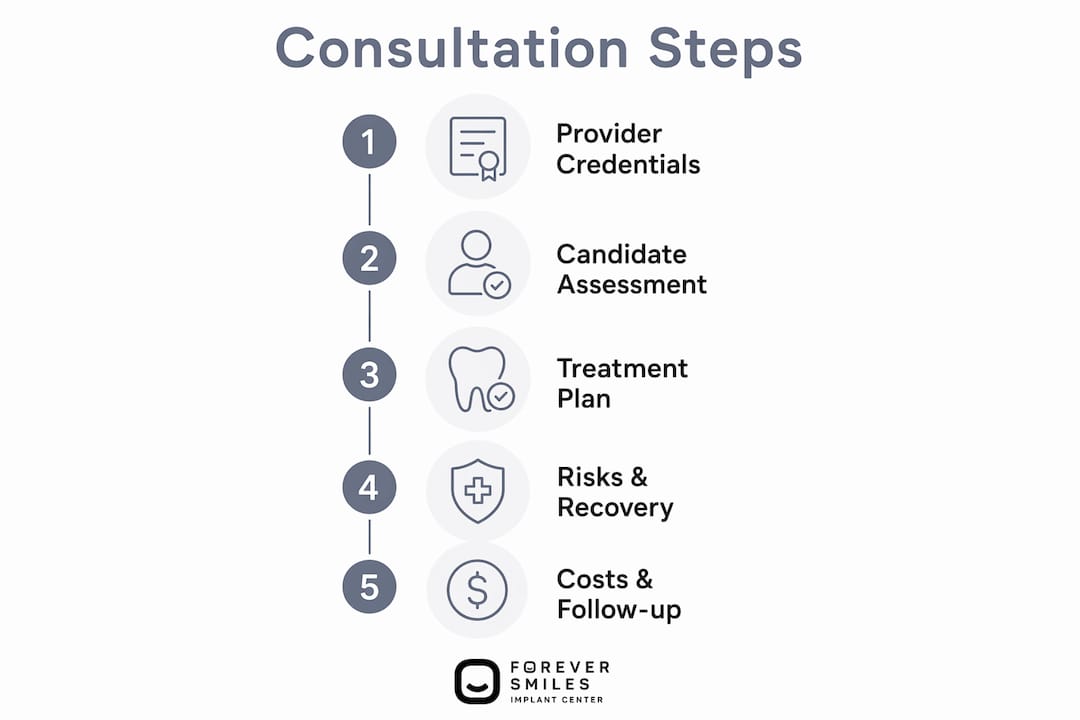
Knowing the right dental implant consultation questions to ask is the single most effective way to protect yourself from poor outcomes, unexpected costs, and the wrong provider. A high-quality consultation lasts 45–60 minutes and covers your full oral health picture, imaging, and a dedicated question-and-answer session. That time is yours to use. Patients who walk in prepared with specific questions get specific answers. Those who don't often leave with a vague plan and a price they don't fully understand. This guide organizes every critical question by category so you can walk into any implant consultation ready to evaluate what you hear.
What credentials and experience should you verify in your implant provider?
Provider qualifications are the first thing to confirm before any treatment discussion begins. Ask directly whether the provider holds an active state dental license and whether any disciplinary actions appear on their State Dental Board record. Both are public information, and a confident provider will not hesitate to point you toward that record.
Specialist training matters more than general experience. Ask whether the provider holds fellowship or board status with organizations like the American Academy of Implant Dentistry (AAID) or the American College of Prosthodontists (ACP). A residency-trained surgical specialist carries a fundamentally different level of preparation than a general dentist who completed a weekend implant course. The distinction is not subtle. It shows up in how complex cases are planned and how complications are handled.

Volume is a concrete measure of expertise. Ask how many implant procedures the provider performs each year and what case types they handle regularly. High-performing implant centers maintain specific case outcome statistics and can show you data relevant to patients with a health profile similar to yours. A provider who can only cite industry averages lacks the case transparency you need to make an informed decision.
One question most patients skip: who handles each phase of your care. Ask specifically who plans the case, who performs the surgery, and who delivers the final restoration. Many practices split these roles across different providers. Continuity of care, where one accountable team manages every step, produces better outcomes and clearer accountability when something needs to be addressed.
- Does the provider hold an active state dental license with no disciplinary record?
- What specialist certifications or fellowship status do they hold (AAID, ACP)?
- How many implant procedures do they perform annually?
- Can they share outcome statistics for cases similar to mine?
- Who plans, places, and restores my implants?
Pro Tip: Search your state's dental board website before your appointment. A five-minute check tells you whether the provider's license is current and whether any complaints have been filed.
How do you find out if you are a good candidate?
Candidacy is not a yes-or-no answer. It depends on gum health, jawbone density, oral hygiene habits, and systemic health factors that interact in ways specific to your anatomy. Ask your provider to explain exactly how each of these factors applies to your case.
Certain medications and health conditions directly affect implant success. Patients must disclose their full medical history, including bisphosphonate use, uncontrolled diabetes, and smoking status, so the provider can stratify risk accurately. A good provider asks about these factors proactively rather than waiting for you to volunteer the information. If your provider does not ask, that is a red flag worth noting.
Imaging quality determines how safely surgery can be planned. Ask whether the practice uses CBCT 3D imaging rather than standard 2D X-rays. Skipping advanced diagnostics near nerve areas without documented justification is a major warning sign. CBCT imaging shows bone volume, nerve location, and sinus anatomy in three dimensions, which is the standard for safe implant placement in 2026.
- What does my current gum health and bone density show?
- Do any of my medications or health conditions affect implant success?
- Will you use CBCT 3D imaging to plan my case?
- Is bone grafting or a sinus lift likely to be necessary?
- How do these findings change my treatment options or timeline?
Pro Tip: Bring a complete medication list to your consultation, including supplements. Bisphosphonates, blood thinners, and immunosuppressants all affect surgical planning in ways that must be addressed before any consent is signed.
Check your candidacy criteria before your appointment so you arrive knowing which factors apply to your situation.
What questions clarify your treatment plan and alternatives?
A treatment plan that cannot be explained in plain language is not a plan you should accept. Ask the provider to walk you through the rationale behind every recommendation. Understanding why a specific approach is recommended for your anatomy matters more than simply accepting what is presented. A plan centered on your long-term oral health looks different from one driven by what a practice sells most often.
Request a written, itemized treatment plan before signing anything. Vague verbal estimates are a red flag. Standard practice in 2026 requires detailed documentation that breaks down procedures, materials, visit timelines, and costs. That document lets you compare plans objectively if you consult more than one provider.
Ask specifically about the implant system being recommended. Dental implants are FDA-regulated medical devices, and your provider should be able to confirm the brand, FDA clearance status, and device lot number. Requesting lot number documentation reflects a high standard of surgical traceability and protects you if a device issue arises later.
| Question to ask | What a strong answer looks like |
|---|---|
| Why this implant system? | Specific rationale tied to your bone type and anatomy |
| What are my alternatives? | Clear comparison of implants, bridges, and removable options |
| What does the timeline look like? | Phased schedule with healing milestones and visit count |
| What temporary teeth will I have? | Description of provisional prosthetics during healing |
| How long should implants last? | Honest answer tied to your health factors, not a generic claim |
- Ask whether the plan includes same-day teeth or requires a staged approach.
- Confirm what happens if a stage does not go as planned.
- Ask how the final restoration is made and what material is used.
Which questions reveal risks, recovery, and long-term maintenance?
Risk disclosure is a direct measure of a provider's honesty. A trustworthy surgeon openly discusses the possibility of nerve damage, sinus complications, infection, and implant failure, and explains exactly what protocols they follow if any of those problems occur. If a provider minimizes risk or avoids the topic, that tells you something important about how they will handle a complication.
Ask for the provider's personal complication rate, not the industry average. Ask what the aftercare plan looks like in specific terms: how many follow-up visits, what signs of trouble to watch for, and how to reach the provider if something feels wrong between appointments. Vague answers to these questions are a warning sign.
Recovery expectations vary by case complexity. Ask how much discomfort to expect, how long healing typically takes for a case like yours, and what restrictions apply during that period. Lifestyle factors like smoking significantly reduce implant success rates. Your provider should address this directly and explain what it means for your specific plan.
"Open discussions about procedure risks and realistic outcomes correlate strongly with patient satisfaction and safety. A provider who skips this conversation is not protecting you. They are protecting themselves."
Long-term maintenance is not optional. Ask what your home care routine should look like, which tools are recommended, and how often professional maintenance visits are required. Understanding why implants fail and how to prevent it gives you the information you need to protect your investment for decades.
- What are the most common complications for a case like mine?
- What is your personal complication rate?
- What is your protocol if an implant fails?
- How long is the recovery, and what restrictions apply?
- What does long-term maintenance look like?
How do you ask about costs, financing, and follow-up policies?
Cost transparency is non-negotiable. Request a written estimate that separates every component: imaging, surgery, materials, lab fees, provisional teeth, final restoration, and follow-up visits. Itemized costs and phased timelines protect you from financial surprises and make it possible to compare two treatment plans on equal terms.
Ask explicitly what is included in the quoted price and what could trigger additional fees. Bone grafting, sinus lifts, extractions, and sedation are commonly quoted separately. Knowing this upfront prevents the experience of a price that grows significantly between consultation and surgery.
- Is this estimate all-inclusive, or are there procedures that could add to the total?
- Does my dental insurance cover any portion of this treatment?
- What financing options or payment plans are available?
- What is your policy if an implant fails after placement?
- If I need multiple visits, how are those scheduled and billed?
Insurance coverage for implants varies widely. Ask whether the practice works directly with your insurer and whether they can provide a pre-authorization estimate. For patients traveling to Jacksonville for treatment at Forever Smiles Implant Center, ask how multiple visits are coordinated and what aftercare support is available between trips.
Pro Tip: Ask for the fee schedule in writing before your consultation ends. A practice that resists providing written cost documentation is one that expects to change the numbers later.
Key Takeaways
Asking the right questions at your implant consultation is the most direct way to protect your health, your money, and your long-term outcome.
| Point | Details |
|---|---|
| Verify credentials first | Confirm active licensure, specialist training, and annual procedure volume before discussing treatment. |
| Demand CBCT imaging | 3D imaging near nerve areas is the standard for safe implant planning; skipping it is a red flag. |
| Get everything in writing | A written, itemized treatment plan and cost estimate are non-negotiable before signing consent. |
| Ask about risks directly | A provider who openly discusses complications and protocols is more trustworthy, not less. |
| Clarify the full cost | Request a breakdown of every fee, including what is excluded, to avoid surprises after surgery. |
What I have learned from 28,000 implants about consultation quality
Most patients arrive at a consultation hoping to be told they are a good candidate. That is the wrong frame. The consultation is not a sales meeting. It is a diagnostic and planning session, and your job is to stress-test what you hear.
The question I see patients skip most often is the one about who actually does what. They assume the person they meet in the consultation room is the person who will place their implants and deliver their final teeth. That assumption is wrong in more practices than patients realize. At Forever Smiles Implant Center, the same surgical team that plans your case performs your surgery and oversees your final restoration. That continuity is not standard everywhere, and it matters enormously when something unexpected comes up during surgery.
The second mistake is accepting a plan without understanding the rationale. I have seen patients arrive at our practice after spending money elsewhere on a plan that was never right for their anatomy. The original provider never explained why they chose a particular approach. A good consultation answers "why this, for you, given what your imaging shows." If you leave without that answer, go back and ask again.
Honest risk disclosure is the clearest signal of a provider's character. I discuss nerve proximity, sinus anatomy, and failure protocols with every patient before surgery. Not because regulations require it, but because a patient who understands the risks is a patient who follows the aftercare plan. That directly improves outcomes. Providers who minimize risk are not being reassuring. They are setting you up for a harder conversation later.
— Dr. Brian Young
What a Forever Smiles Implant Center consultation actually looks like
Patients who come to Forever Smiles Implant Center for a consultation receive a comprehensive clinical assessment that includes CBCT 3D imaging, a written treatment plan, and a direct conversation with Dr. Brian Young about their specific anatomy, options, and realistic outcomes. Nothing is vague, and nothing is left to a follow-up email.
Dr. Young has placed over 28,000 implants and performs full-arch surgery daily. He specializes in complex cases, including patients with severe bone loss who have been told elsewhere that they are not candidates. The full-mouth implant options at Forever Smiles cover everything from standard arch reconstruction to zygomatic implants for patients with minimal bone. For answers to the most common patient questions before your visit, the dental implants FAQ covers candidacy, procedure details, costs, and recovery in plain language. Schedule a consultation to get a plan built around your anatomy, not a template.
FAQ
How long should a dental implant consultation last?
A high-quality dental implant consultation lasts 45–60 minutes and includes a physical exam, CBCT imaging, and dedicated time for questions. Shorter appointments that skip imaging or rush the discussion are a warning sign.
What imaging should be done before implant surgery?
CBCT 3D imaging is the standard for implant planning in 2026. It shows bone volume, nerve location, and sinus anatomy in three dimensions. Providers who rely only on 2D X-rays near nerve areas are not meeting current diagnostic standards.
Should I get a written treatment plan before agreeing to surgery?
Yes. A written, itemized treatment plan that details procedures, materials, costs, and timelines is required before any surgical consent is signed. Verbal estimates are not sufficient and are considered a red flag by patient advocacy standards.
What medical information should I bring to my consultation?
Bring a complete medication list, including supplements, and disclose any health conditions such as diabetes or osteoporosis. Bisphosphonate use, smoking status, and immune conditions all affect implant planning and must be disclosed for accurate risk assessment.
What questions reveal whether a provider is trustworthy?
Ask about their personal complication rate, what their protocol is if an implant fails, and who performs each phase of your care. A provider who answers these questions directly and without hesitation demonstrates the transparency that patient-centered implant care requires.