
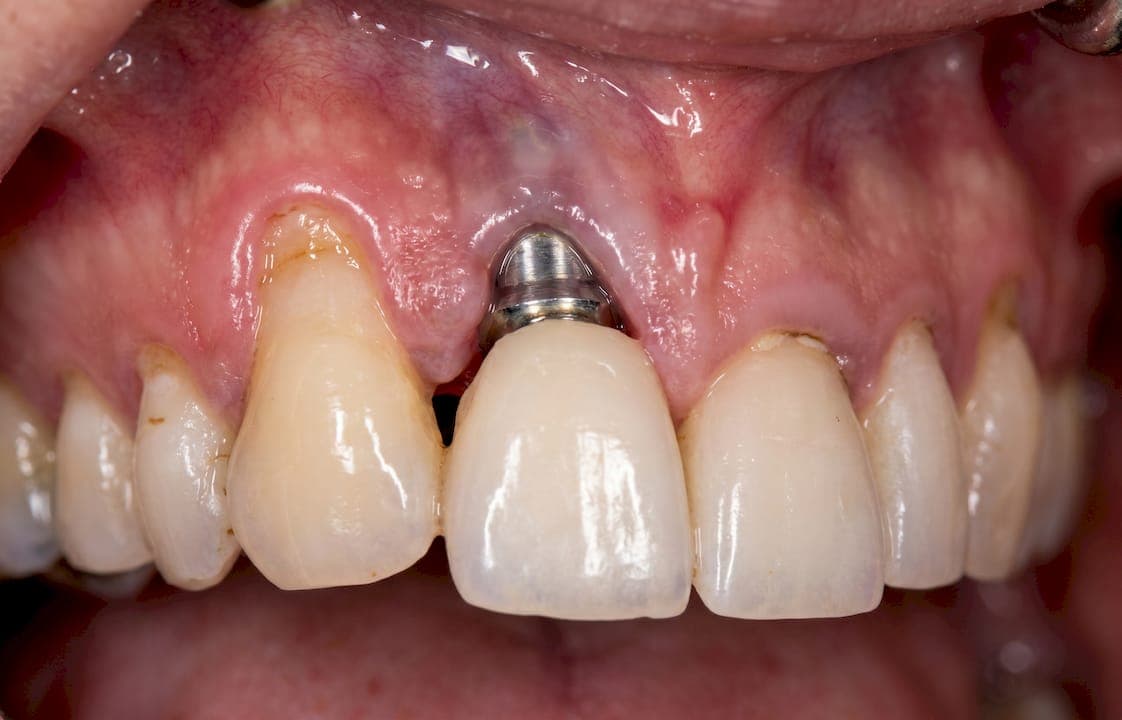
A dental implant is considered a failure when it loses osseointegration, the biological process where the implant fuses with the jawbone, or when a later complication such as infection or mechanical breakdown takes away its ability to function. Across the general population, roughly 3 to 7 percent of implants fail over a 10-year span. That is a low number on paper. Every point of it, though, is a real person who spent the money, gave up the time, and trusted the outcome, then watched it come apart. Knowing what actually drives those failures, and what separates the cases that hold from the ones that do not, puts you in a far stronger position before you ever sit down for surgery.
Why do dental implants fail in the first place?
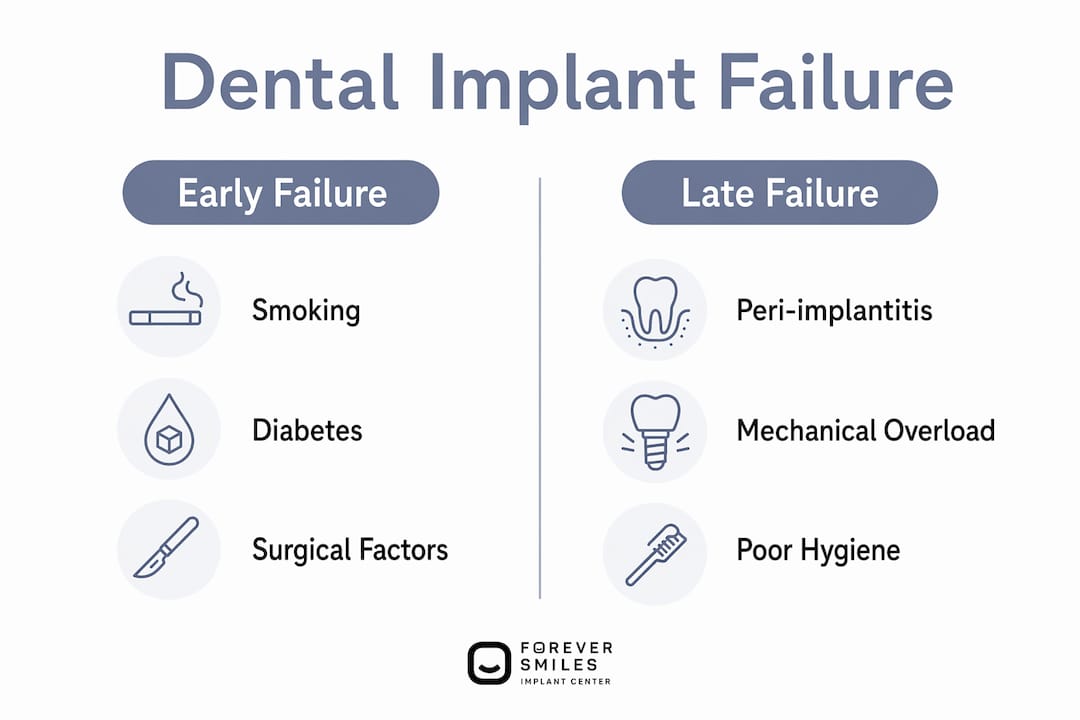
There are two kinds of implant failure, and they behave very differently. Early failure shows up in the first three to six months, before the implant has fully bonded to the bone. Late failure can arrive years down the road, usually from infection or from mechanical stress the bone could no longer absorb. Most of the time, both are preventable. The catch is that the risk factors have to be caught and managed on the front end and the back end. The causes tend to be a mix of biology, mechanics, and lifestyle, and they almost never show up one at a time.
What causes early dental implant failure?
At its core, early failure is a failure of osseointegration. The implant goes in, but the bone never grips it the way it should. A handful of factors push a case in that direction.
Surgical and biological causes:
-
Poor surgical technique. Overheating the bone during drilling kills off the cells integration depends on. That one sits with the surgeon, not the patient.
-
Low bone density. Soft or thin bone gives the implant less to hold onto. When bone loss is significant, grafting before placement is often the right call.
-
Infection at the surgical site. Bacteria introduced during or after surgery can shut healing down before integration ever gets going.
-
Premature loading. Putting real chewing force on an implant before it has integrated can physically break the bond.
Of every controllable biological risk, smoking is the big one. Smokers run roughly 2.6 times the odds of early failure that non-smokers do. The reason comes down to blood flow. Smoking constricts it, and a healing implant site starved of oxygen and nutrients simply cannot integrate the way it needs to.
Systemic health carries just as much weight. Uncontrolled diabetes, reflected in a high HbA1c, slows tissue repair and raises infection risk right at the implant site. Plenty of patients with well-managed diabetes make excellent candidates. The problem is poorly controlled blood sugar, which measurably raises the failure rate. If you have diabetes and you are weighing implants, getting your HbA1c into a healthy range before surgery is one of the highest-return moves available to you.

Pro Tip: Ask your surgeon, specifically, how they keep the bone cool while drilling. If they cannot walk you through it in detail, that tells you something worth paying attention to.
Why do dental implants fail years after placement?
Late failure has a main character, and it is peri-implantitis. This is an inflammatory infection of the gum and bone around the implant, essentially gum disease that has set its sights on the implant instead of a natural tooth. Here is why the distinction matters. A real tooth has a periodontal ligament, a built-in biological buffer against infection. An implant has none. Take that ligament out of the equation and bacteria reach the bone faster, with far less standing in the way.
Once an implant has been in place five years or longer without proper maintenance, peri-implantitis turns up in 40 percent or more of cases. Far from a rare edge case, it is the single most common reason an implant that once worked perfectly well begins to fail.
Early signs of implant failure to watch for:
-
Bleeding or swelling around the implant
-
Pain or tenderness that was not there before
-
Visible bone loss on X-rays at routine checkups
-
The implant feeling loose or shifting
-
A bad taste or odor that brushing does not resolve
The other major driver of late failure is mechanical overload. Bruxism, the grinding and clenching most people do without realizing it, loads the implant with bite force the bone cannot keep absorbing forever. Over time, that stress shows up as bone loss around the implant and, eventually, mechanical breakdown. For patients who grind, a custom night guard is the standard line of defense.
| Late failure cause | Primary mechanism | Preventive measure |
|---|---|---|
| Peri-implantitis | Bacterial infection causing bone loss | Daily hygiene, professional cleanings |
| Bruxism overload | Mechanical stress fracturing bone interface | Custom night guard |
| Poor oral hygiene | Plaque buildup triggering inflammation | Consistent brushing and flossing |
| Missed maintenance visits | Undetected early bone loss | Regular X-rays and probing |
Pro Tip: Care for your implant like a natural tooth, but remember it is actually more vulnerable to infection than one. Floss daily, work in an interdental brush, and never let a professional cleaning slide.
How do patient health and lifestyle factors impact implant success?
The factors that most reliably predict whether an implant lasts are, for the most part, the ones you control. A surgeon can place a flawless implant. Whether it survives still comes down to your health and your habits in the years that follow.
The four highest-impact factors:
-
Smoking. The 2.6x early-failure risk is only part of the picture. Smoking also drags out healing whenever a complication does crop up and makes peri-implantitis worse once it sets in. Quitting before surgery and staying off cigarettes afterward is the most powerful single change a patient can make.
-
Diabetes management. Tight diabetes control translates directly into better implant survival. An HbA1c above the recommended threshold is a signal that the body's ability to fight infection and rebuild tissue is already compromised.
-
Oral hygiene. Plaque that builds up around the implant is what sets peri-implantitis in motion. It is not a complicated problem to solve, just a daily one: brush, floss, and do not let it slip.
-
Bite forces and bruxism. Most night grinders have no idea they do it until the damage surfaces. If you wake up with a sore jaw, or your partner mentions the grinding, say so before placement rather than after.
Taking an honest look at your candidacy for dental implants, health factors and all, is not there to gatekeep you out of treatment. It is the difference between a result that holds and one that fails on you and costs you twice over. If a surgeon waves you past that evaluation, treat it as a warning rather than a convenience.What happens if a dental implant fails and how is it treated?
The first and most important step when an implant feels wrong is accurate diagnosis. Not every problem is a true implant failure. Loose crowns or abutment screws are frequently mistaken for implant failure by patients, but they are mechanical issues with straightforward fixes. Tightening or replacing a screw is a minor procedure. Losing an implant to bone loss is not.
The critical diagnostic question is: which component is failing? The crown, the abutment, the implant body itself, or the bone surrounding it? Each answer leads to a different treatment path.
Treatment options by failure type:
-
Loose crown or abutment. Tighten or replace the screw. No surgery required in most cases.
-
Peri-implantitis without bone loss. Deep cleaning, antibiotic therapy, and a strict hygiene protocol can resolve early-stage infection.
-
Peri-implantitis with significant bone loss. Surgical debridement and bone grafting may be needed to save the implant or prepare the site for replacement.
-
Complete osseointegration failure. The implant is removed. Removal under local anesthesia is generally straightforward, but bone grafting is typically required before a new implant can be placed.
-
Repeat failure at the same site. Replacement implants at previously failed sites carry lower success rates unless the underlying cause, whether smoking, bone quality, or infection, is fully addressed first.
Complex cases involving repeated failure or significant bone loss should be referred to a specialist. An oral surgeon or periodontist with high-volume implant experience has the diagnostic tools and surgical options that a general dental office typically does not. If you are dealing with a previously failed implant, the expertise of the treating surgeon matters more on the second attempt than it did on the first.
Pro Tip: Before agreeing to a second implant at a failed site, ask your surgeon to identify the specific cause of the first failure. If they cannot give you a clear answer, the second implant faces the same odds as the first.
What happens if a dental implant fails and how is it treated?
When something feels off with an implant, the first job is an accurate diagnosis, because not every problem is a true failure. Loose crowns or abutment screws get mistaken for a failed implant all the time, when in reality those are mechanical issues with simple fixes. Tightening or replacing a screw is minor. Losing an implant to bone loss is a different story entirely.
The question that has to be answered first is which part is actually failing. Is it the crown, the abutment, the implant body itself, or the bone around it? Each of those answers sends you down a different treatment path.
Treatment options by failure type:
-
Loose crown or abutment. Tighten or replace the screw. In most cases, no surgery is required.
-
Peri-implantitis without bone loss. Deep cleaning, antibiotic therapy, and a strict hygiene protocol can resolve early-stage infection.
-
Peri-implantitis with significant bone loss. Surgical debridement and bone grafting may be needed to save the implant or prepare the site for replacement.
-
Complete osseointegration failure. The implant comes out. Removal under local anesthesia is usually straightforward, though bone grafting is typically needed before a new implant can go in.
-
Repeat failure at the same site. Replacement implants at previously failed sites carry lower success rates unless the underlying cause, whether smoking, bone quality, or infection, is fully sorted out first.
Cases that involve repeated failure or real bone loss belong with a specialist. An oral surgeon or periodontist who places implants in high volume has diagnostic tools and surgical options a general dental office usually does not keep on hand. If you are dealing with a previously failed implant, the surgeon's experience counts for even more the second time around than it did the first.
Pro Tip: Before you agree to a second implant at a failed site, ask your surgeon to name the specific cause of the first failure. If they cannot give you a clear answer, the second implant is walking into the same odds as the first.
Key takeaways
Dental implant failure is preventable in most cases when risk factors are identified, managed, and monitored before and after surgery.
| Point | Details |
|---|---|
| Early vs. late failure | Early failure involves osseointegration loss within 3–6 months; late failure is usually peri-implantitis or mechanical overload. |
| Smoking doubles your risk | Smokers face 2.6 times greater odds of early failure; quitting before surgery is the highest-return lifestyle change. |
| Peri-implantitis is the top late threat | Over 40% of implants placed 5+ years ago are vulnerable without consistent hygiene and professional maintenance. |
| Diagnosis before treatment | A loose crown is not the same as a failed implant. Accurate diagnosis determines the correct treatment path. |
| Surgeon experience matters | Repeat failures and complex bone loss cases require a specialist, not a general dentist with occasional implant experience. |
What 28,000 implants taught me about failure
By Dr. Brian Young, Founder and Lead Surgeon, Forever Smiles Implant Center
After 28,000-plus implants, and a lot of years spent cleaning up cases that failed somewhere else, I can tell you the pattern barely changes. The implant did not fail because implants are unreliable. It failed because somewhere along the line, someone skipped a step.
And the step is almost never the surgery itself. It is the honest conversation that should have happened first. Did anyone ask about smoking? Did anyone pull an HbA1c? Did anyone look hard at the bone volume on a 3D scan and say out loud, "this site needs grafting before we put anything in it"? In the cases that land on my table, the answer is usually no.
The part that gets to me is that these patients blame themselves. They are convinced their body rejected the implant. What actually happened is that the implant went into conditions that were never ready for it. That is a planning failure, and the patient is the last person who should be carrying it.
I see another version of this constantly. A patient comes in with a loose crown or a small abutment issue, and they have been told the whole implant failed. That is not the same thing at all. A loose screw is a five-minute fix. Pulling a perfectly good implant over it is the wrong call, and it happens far more often than it should.
My honest advice is simple. Before you commit to any implant procedure, ask the surgeon how many implants they place a year, how they handle the ones that fail, and what their protocol is for complicated bone cases. An experienced implant surgeon will answer all three without flinching. If yours cannot, keep looking.
— Dr. Brian Young
Patients with implant concerns find answers at Forever Smiles Implant Center
Forever Smiles Implant Center in Jacksonville, Florida, was built for exactly the cases most offices send away: failed implants, severe bone loss, and patients who have already been told they are not candidates. Dr. Brian Young and his team are in full-arch implant surgery every day, with 3D imaging, an in-house lab, and a board-certified MD anesthesiologist all under one roof.
Whether you are sorting out a current implant concern or planning your first procedure, the dental implants FAQ page answers the questions patients raise most often. For the full picture on treatment options and what to expect, the dental implants overview is the right place to start. Every case here is built around one standard: done once, done right.
Whether you are evaluating a current implant concern or planning your first procedure, the dental implants FAQ page covers the questions patients ask most. For a full picture of treatment options and what to expect, the dental implants overview is the right starting point. Forever Smiles Implant Center builds every case around one standard: done once, done right.
FAQ
What is a failed dental implant?
A failed dental implant is one that has lost osseointegration with the jawbone, or has been compromised by infection or mechanical breakdown to the point where it can no longer function. Early failure occurs within 3 to 6 months; late failure typically develops years after placement.
What are the most common causes of implant failure?
The most common causes are peri-implantitis, poor oral hygiene, smoking, uncontrolled diabetes, and mechanical overload from bruxism. Surgical factors such as poor technique or inadequate bone preparation also contribute to early failure.
Can a failed dental implant be replaced?
Yes, though replacement implants at previously failed sites carry lower success rates unless the root cause is identified and corrected first. Bone grafting is often required before a new implant can be placed.
How do I know if my implant is failing?
Early signs include pain, swelling, bleeding around the implant, and a feeling of looseness. Visible bone loss on X-rays is a definitive indicator. Any new or worsening symptom around an implant warrants prompt evaluation.
Does smoking cause dental implants to fail?
Yes. Smokers have roughly 2.6 times greater odds of early implant failure compared to non-smokers. Smoking restricts blood flow and delays the healing process that osseointegration depends on.