
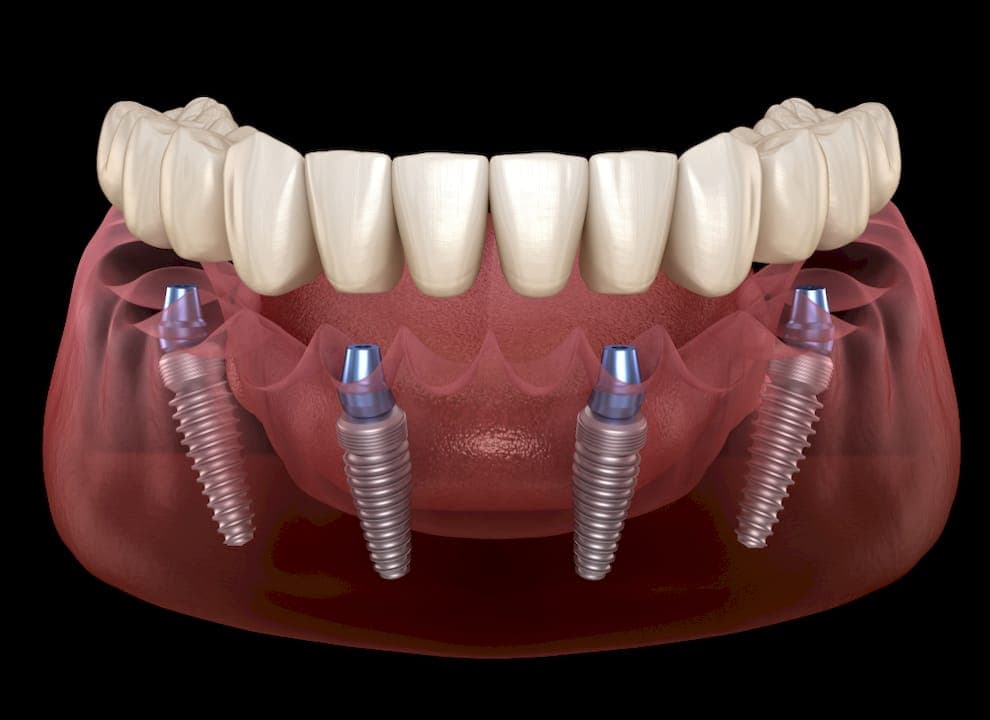
A dental implant is an artificial tooth root, usually a titanium post, anchored surgically into the jawbone to rebuild a missing tooth from the ground up. Making sense of how that works means understanding osseointegration, the biological process by which living bone grows directly onto the implant surface and locks it permanently in place. It is not a surface-level fix sitting on top of the gum. The implant actually becomes part of your skeleton, and that one fact is what separates implants from every other tooth replacement option on the market, which is also why patients who choose them tend not to look back.
How do dental implants work? The three-part system explained
A dental implant is not a single piece. Every implant has three components, the fixture, the abutment, and the crown, and each one does a specific mechanical and biological job.
The fixture is the implant itself, a small threaded post usually made of titanium or zirconia that a surgeon places directly into the jawbone. Titanium is the standard choice because bone accepts it without triggering an immune response. The fixture works as the artificial root, carrying all the load a natural tooth root once handled.
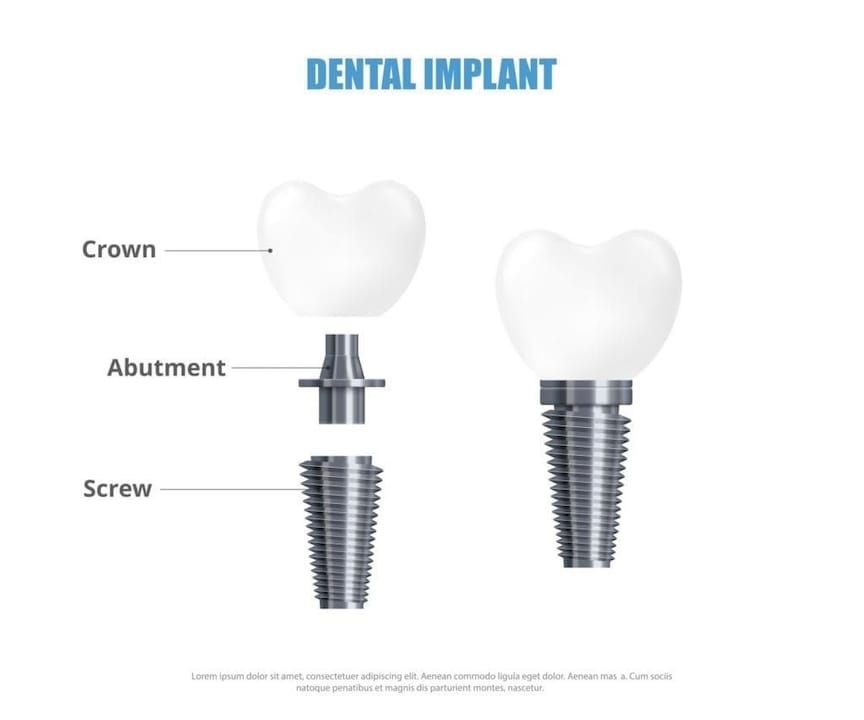
The abutment connects the fixture to the visible tooth. It passes through the gum tissue and shapes the soft tissue around it, a property called the emergence profile. How that abutment is contoured directly affects the health of the tissue around the implant. A poorly shaped abutment traps bacteria and raises the risk of inflammation.
The crown is the visible tooth, attached to the abutment either with a screw or with cement. Screw retention allows the crown to be removed later for maintenance. Cement retention can look more natural in some cases, though it makes future access harder. Which one makes sense depends on where the implant sits and on the patient’s own anatomy.
Pro Tip: Ask your surgeon whether your crown will be screw-retained or cemented, and why. The answer tells you a lot about how they plan for long-term maintenance.
What does the dental implant procedure involve?
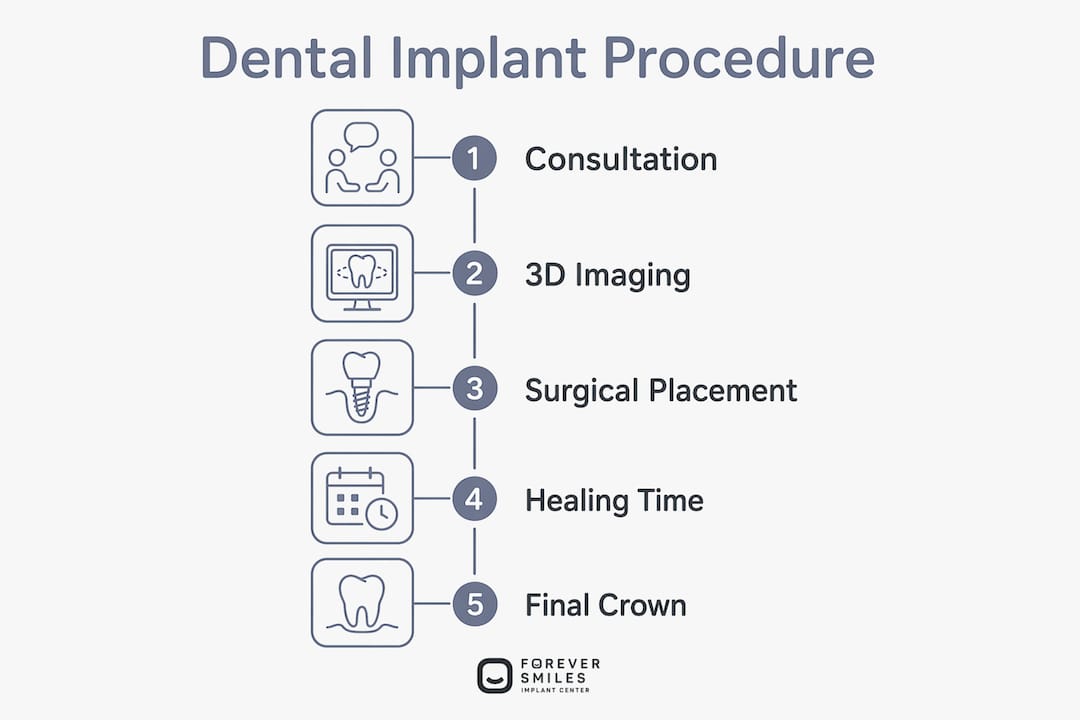
The dental implant procedure follows a defined sequence, and knowing each step ahead of time takes a lot of the anxiety out of not knowing what is coming.
-
Consultation and 3D imaging. The surgeon evaluates bone density, gum health, and jaw anatomy using cone beam CT imaging. This step determines whether bone grafting is needed before or during implant placement.
-
Gum incision. The surgeon opens the gum tissue to expose the jawbone at the implant site.
-
Osteotomy drilling. A series of drills create a channel in the bone sized precisely for the implant fixture.
-
Implant insertion. The titanium fixture is threaded into the prepared channel and seated at the correct depth and angle.
-
Suturing. The gum tissue is closed around or over the implant to begin healing.
-
Healing phase. Soft tissue heals within weeks. Bone integration takes longer.
-
Abutment and crown placement. Once the implant has integrated, the abutment is attached and the final crown is delivered.
Surgical placement itself takes about one to two hours. The full process, from that first surgery to the final crown, usually runs three to six months, longer if bone grafting comes first. Patients wear a temporary crown through healing, so there is never a stretch where they are without teeth.
Pro Tip: 3D imaging before surgery is not optional if you want predictable results. It maps nerve locations, bone volume, and sinus anatomy before a single drill touches your jaw.
What biological process makes an implant stable long term?
Osseointegration is the biological mechanism that lets dental implants function like natural teeth. The term describes a direct structural bond between living bone and the implant surface, with no fibrous layer in between, and that lack of a buffer layer is exactly what separates an implant from a tooth sitting loosely in a socket.
The process moves through stages. Soft tissue heals in the first one to two weeks. Bone healing gets underway in months one and two. Full integration and maturation happen between months three and six. A patient can feel completely fine weeks after surgery while the implant is still, quietly, gaining strength through that entire window.
Osseointegration is not just healing. It is bone remodeling around a foreign surface until that surface becomes load-bearing. The implant starts with mechanical stability from the threads gripping the bone, then transitions to biological stability as bone grows into the implant's textured surface. These are two different types of stability, and both matter.
Surface treatments speed this along. Manufacturers use acid etching, sandblasting, and hydroxyapatite coatings to roughen the implant surface at a microscopic level, which gives bone cells more contact points to grab onto. The emergence profile and the abutment angle, ideally somewhere between 20 and 45 degrees, also shape how well soft tissue seals around the implant and how much that seal cuts down on bacteria reaching the bone.
What factors determine whether a dental implant succeeds?
Implant survival and implant success are not the same thing, even though people use the words interchangeably. Survival just means the implant is still physically present. Success means it is stable, free of symptoms, and functioning without meaningful bone loss. Patients deserve to know which one they are actually being told about before they commit to treatment.
A handful of factors drive that outcome:
-
Periodontal history. Patients with a history of periodontitis carry a higher risk of implant failure. A multicenter cohort study of 3,555 implants found that periodontitis history and weak compliance with supportive periodontal therapy were each independently tied to higher failure rates.
-
Bone quality and volume. Dense, well-vascularized bone integrates faster and holds an implant more securely. Patients with bone loss may need grafting first.
-
Hygiene and maintenance. Peri-implantitis, the implant version of gum disease, is the leading cause of late implant failure, and it is largely preventable with consistent home care and professional cleanings.
-
Surgeon experience. Placement depth, angle, and torque all shape how well the implant integrates, and none of those correct themselves after the fact.
-
Systemic health. Uncontrolled diabetes, smoking, and certain medications all get in the way of bone healing and raise the risk of complications.
Long-term implant prostheses need ongoing maintenance, and the research backs that up: minor complications tend to build up over the years, which is exactly why regular follow-up care belongs in the plan from day one rather than getting treated as optional.
How do implants compare to other tooth replacement options?
Dental implants are the only tooth replacement option that preserves jawbone. Every other option sits on top of the bone or relies on adjacent teeth. That single biological difference drives most of the practical advantages patients experience.
| Feature | Dental implants | Fixed bridge | Removable denture |
|---|---|---|---|
| Bone preservation | Yes | No | No |
| Adjacent teeth affected | No | Yes (crowns required) | No |
| Stability | Permanent, fixed | Fixed | Removable, can shift |
| Maintenance | Standard hygiene | Floss threader required | Daily removal and cleaning |
| Lifespan | Decades with care | 10–15 years typically | 5–10 years typically |
| Procedure complexity | Surgical | Non-surgical | Non-surgical |
Bridges call for grinding down healthy neighboring teeth to use as anchors, and that permanent damage to otherwise sound teeth is a cost that rarely gets mentioned upfront. Dentures skip surgery but speed up bone loss over time, which reshapes the face and makes future implants harder to place down the road. Patients hoping to replace dentures permanently with something fixed tend to find that implants are the only route that actually stops that bone loss cycle.
The cost of dental implants runs higher upfront than bridges or dentures. Stretch the comparison out over twenty years, though, and implants generally come out ahead, because they skip the repeated replacements and adjustments the other options demand.
Key takeaways
Dental implants work because titanium fixtures fuse directly to living bone through osseointegration, creating a permanent, load-bearing artificial root that no other tooth replacement option can replicate.
| Point | Details |
|---|---|
| Three-part structure | Every implant has a fixture, abutment, and crown, each with a distinct mechanical and biological role. |
| Osseointegration timeline | Bone integration takes 3–6 months; feeling fine after surgery does not mean the implant is fully stable yet. |
| Survival vs. success | An implant that is still present is not automatically a success; stability, bone levels, and absence of symptoms define true success. |
| Periodontal health matters | A history of gum disease raises failure risk; compliant maintenance markedly improves 5-year survival rates. |
| Long-term maintenance required | Minor complications accumulate over years; consistent professional follow-up is part of the treatment, not an afterthought. |
What 20 years of placing implants taught me about what patients miss
Most patients walk in asking about the procedure itself. They want to know about surgery, recovery, and cost, and those are fair things to ask. But the patients who do best over the long run are the ones who take the time to understand what happens after the implant goes in, not just during the surgery.
Osseointegration is not passive. Your body spends months actively building bone around something foreign, and that process is sensitive to inflammation, infection, and mechanical overload. Patients who smoke, skip cleanings, or grind their teeth at night are not just making lifestyle choices they will deal with someday. They are working against the exact biology that makes the implant function in the first place.
The other thing patients tend to underestimate is the gap between a surgeon who places implants now and then and one who does it every single day. I have placed over 28,000 implants. I train other surgeons nationally. I sit on the editorial board of Implant Practice US. I bring that up not to impress anyone, but because placement angle, depth, and torque are skills you build through sheer repetition. Get a millimeter off in the wrong direction and you change the emergence profile, the tissue response, and the long-term stability of the whole restoration.
Periodontal history is another thing patients tend to overlook. If gum disease took your teeth the first time, that same disease process can come after your implants too. The implant itself cannot get gum disease, but the tissue and bone holding it in place absolutely can. Treating that underlying condition before placing implants is not a nice-to-have. It is the difference between a result that lasts a lifetime and one that fails inside five years.
My honest advice is to pick your surgeon the way you would pick a structural engineer for a building you plan to live in for the rest of your life. Experience isn't expensive. Inexperience is.
Dr. Brian Young, Forever Smiles Implant Center
Full-arch implant care at Forever Smiles Implant Center
Forever Smiles Implant Center in Jacksonville, Florida, is a surgical center built around one thing: full-mouth dental implant reconstruction. Dr. Brian Young performs full-arch implant surgery daily, with more than 28,000 implants placed and a team that covers every phase of treatment under one roof.
From 3D imaging and surgical planning through surgery, in-house lab fabrication, and final zirconia teeth, patients never have to coordinate between separate providers. Full-mouth treatment is from $19,000 per arch and includes planning, same-day teeth, final restorations, and follow-up care. Financing options are available for patients who want to spread the investment over time. Forever Smiles also takes on complex cases, including significant bone loss and implants that have failed elsewhere. If you have been told you are not a candidate, that conversation may not be over.
FAQ
What is osseointegration and why does it matter?
Osseointegration is the direct bonding of living bone to a titanium implant surface. It is the biological process that gives dental implants their permanent stability, and it takes 3 to 6 months to complete after surgery.
Are dental implants safe for most patients?
Dental implants are safe and well-documented for most healthy adults. Patients with uncontrolled diabetes, active gum disease, or significant bone loss require additional evaluation and treatment before placement.
What is the difference between implant survival and implant success?
Survival means the implant is still in place. Success means it is stable, free of symptoms, and functioning without bone loss. Patients should ask their provider which outcome they are tracking.
How long does the dental implant healing process take?
Soft tissue heals within 1 to 2 weeks. Full bone integration takes 3 to 6 months. The complete process from consultation to final crown may be longer when bone grafting is needed.
Does a history of gum disease disqualify me from getting implants?
A history of periodontitis raises implant failure risk but does not automatically disqualify a patient. Compliant periodontal maintenance significantly improves outcomes, and treating the underlying condition before surgery is a standard part of responsible implant planning.