
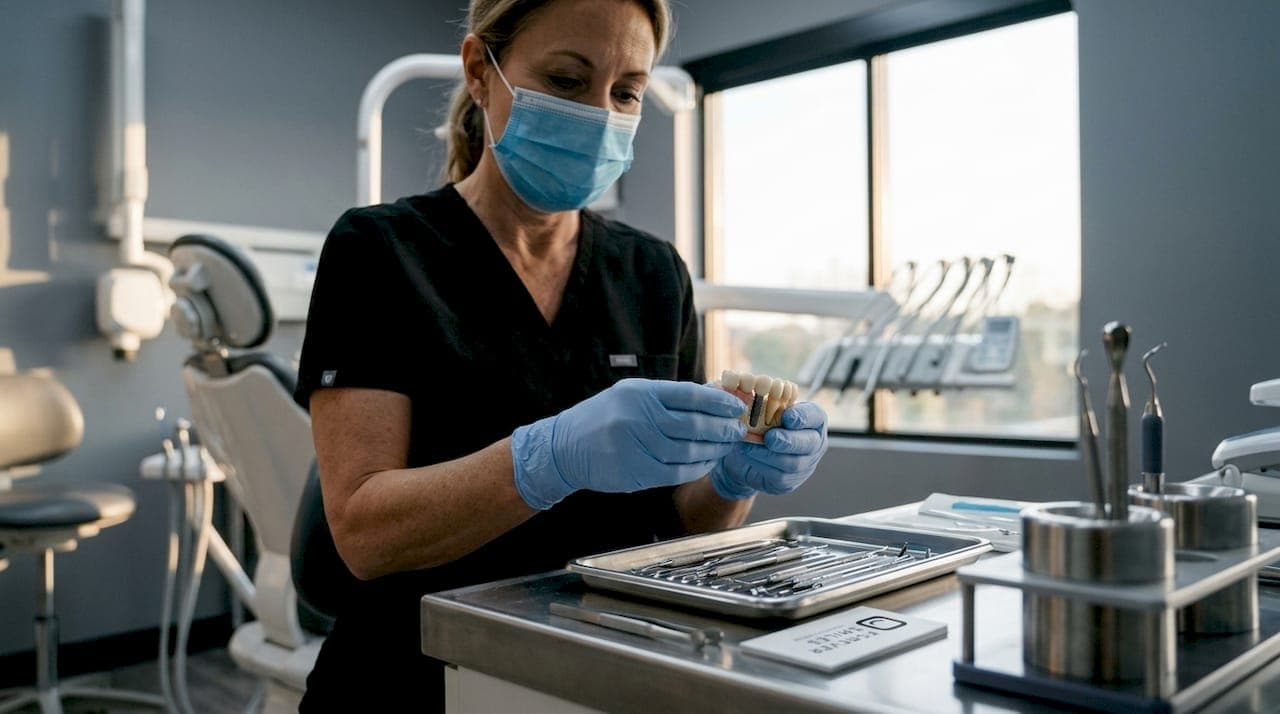
Healing implant teeth are temporary dental restorations placed over a healing implant to maintain appearance, speech, and basic function during the osseointegration period. The industry term is “provisional restoration,” though patients often call them temporary or healing implant teeth. These restorations typically stay in place for 1 month while the implant fuses with the jawbone. They are not the final result. They are a carefully designed bridge between surgery and your permanent smile, and understanding how they work changes how you experience the entire implant process. Forever Smiles Implant Center places healing restorations as a standard part of every full-arch treatment plan.
What is healing implant teeth: definition and core purpose
Healing implant teeth are defined as temporary crowns, bridges, or full-arch prostheses attached to dental implants during the healing phase. The clinical goal is to protect the implant while it fuses with the bone, a biological process called osseointegration that takes time to heal and the soft tissue to settle. During that window, the implant cannot bear the same load as a healed, fully integrated fixture. A healing restoration manages that load carefully so the implant has the best chance of long-term success.
The secondary purpose is equally important. Patients leave surgery with teeth. They can speak, eat soft foods, and smile without a visible gap. This matters more than most people expect before surgery. The psychological benefit of avoiding an empty space accelerates confidence and recovery in ways that clinical outcomes alone do not capture.
Healing dental crowns also serve as a functional blueprint. Patients wear them for months and can tell their surgeon exactly what they want to change before the final restoration is made. Tooth length, shape, midline position, and smile width can all be refined during this phase. That feedback loop produces a final result that fits the patient’s face and preferences, not just the surgical plan.
What materials are healing implant teeth made from?
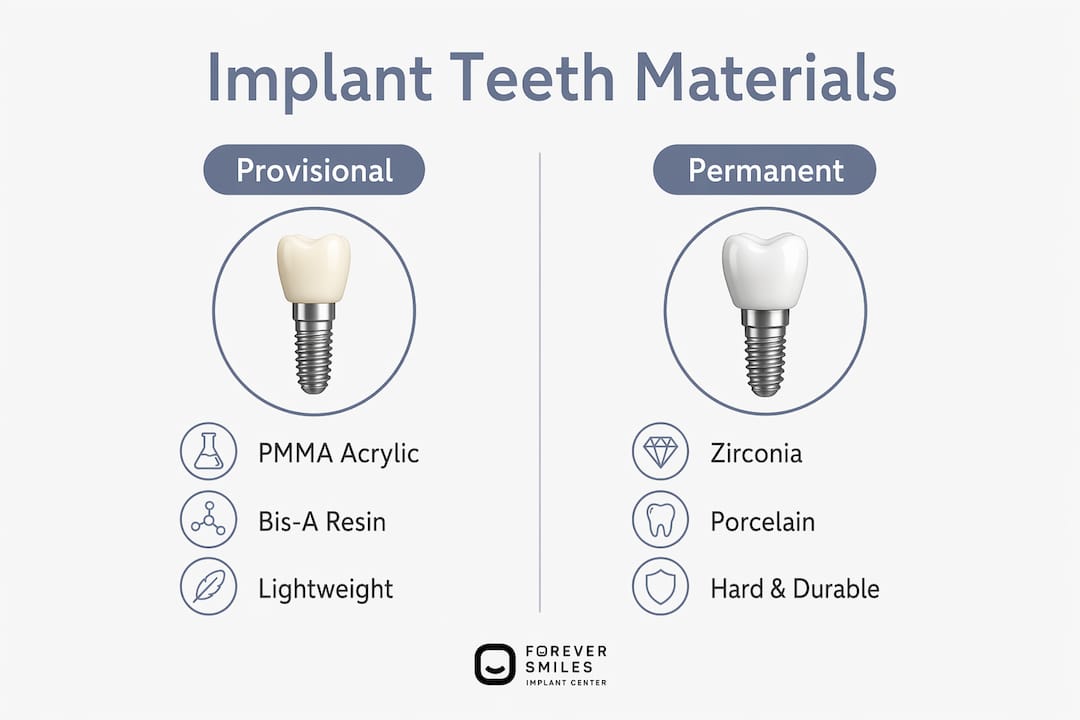
Provisional restorations are made from lightweight materials designed to protect the implant, not outlast it. The three most common are polymethyl methacrylate (PMMA) acrylic, resin, and bis-acryl composites. Each has trade-offs in strength, color stability, and cost.
| Property | Provisional materials | Permanent materials |
|---|---|---|
| Primary materials | PMMA acrylic, bis-acryl composite, resin | Zirconia, porcelain-fused-to-metal, full-cast metal |
| Fracture resistance | Moderate | High |
| Color stability | Fair to good | Excellent |
| Weight | Lightweight | Heavier |
| Lifespan | 3–6 months | 15+ years with proper care |
| Cost | Lower | Higher |
Permanent implant teeth use zirconia or porcelain, which are far harder and more color-stable. That hardness is exactly why they are not used provisionally. A rigid, heavy crown placed on a healing implant can transmit too much force and disrupt osseointegration. The lighter provisional material acts as a buffer.
Manufacturing method also affects how well a provisional restoration performs. Milled resin restorations show higher fracture resistance than those made by conventional hand-fabrication or 3D printing. Milling cuts the crown from a solid block of resin, which produces a denser, more uniform structure. 3D-printed healing teeth are faster to produce but currently show lower strength. The right choice depends on the case complexity, the surgeon’s lab setup, and how long the provisional needs to last.
Pro Tip: Ask your surgeon whether your provisional will be milled or 3D-printed. Milled restorations hold up better over a full healing period, especially for full-arch cases.
Why do healing implant teeth matter for healing and function?
The primary clinical role of a healing teeth restoration is managing occlusal forces during osseointegration. Occlusal force is the pressure generated when you bite and chew. An implant that has not yet fused with the bone is vulnerable to micro-movements. Even small, repeated movements at the implant-bone interface can prevent fusion and cause failure. A well-designed healing teeth bridge distributes bite force in a controlled way that protects the implant below.
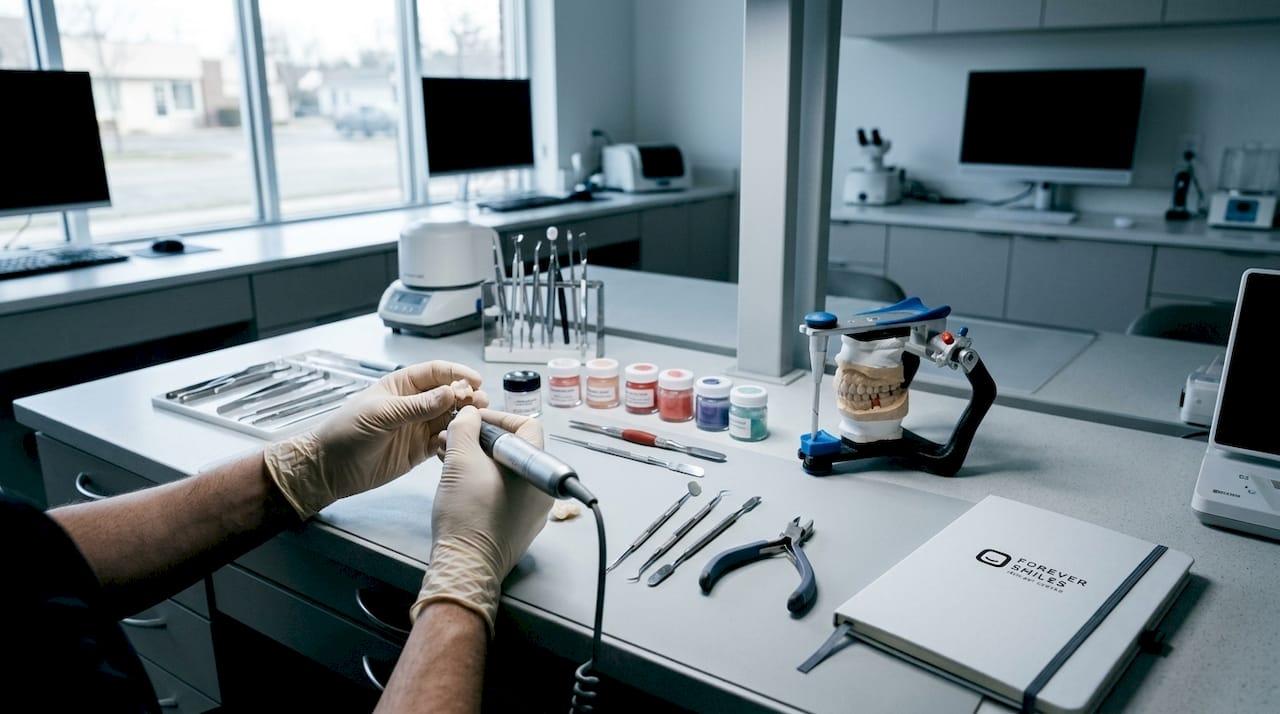
Healing teeth restorations also shape the gum tissue around the implant. As the gums heal, they conform to the contour of the restoration sitting above them. This creates what clinicians call an emergence profile, the natural-looking transition between the implant crown and the gum line. Without a healing teeth in place, the gum tissue heals flat and shapeless. The final crown then looks like it is sitting on top of the gum rather than emerging from it. That difference is visible and significant.
The benefits of healing teeth on implants extend well beyond the clinical. Patients who leave surgery with teeth report less anxiety, better sleep, and faster return to normal social activity. Eating, even on a restricted soft diet, feels normal. Speech returns quickly because the tongue has a surface to work against.
Key care behaviors during the healing phase include:
-
Eating soft foods only (eggs, yogurt, fish, cooked vegetables, pasta)
-
Avoiding hard, crunchy, or sticky foods that stress the implant
-
Brushing gently twice daily with a soft-bristle toothbrush
-
Using a water flosser or interdental brush rather than traditional floss
-
Attending every scheduled follow-up appointment
-
Contacting your surgeon immediately if the healing teeth feels loose or cracks
Pro Tip: Treat your healing teeth like a test drive, not a throwaway. The feedback you give your surgeon during this phase directly shapes your final teeth.
What types of healing implant teeth are there?
Teeth options vary based on how many teeth are being replaced and when the healing teeth beidge is being placed relative to surgery.
A healing bridge spans two or more missing teeth and may attach to one or more implants. A removable temporary partial denture, sometimes called a flipper, is the most basic option. It is not attached to the implant at all and sits on the gum. Flippers are inexpensive but offer the least protection and the least comfort.
For patients replacing all teeth on an arch, the most common healing teeth solution is an immediate-load full-arch bridge. This is the “teeth in a day” concept. The surgeon places implants and attaches a full healing teeth resin bridge during the same appointment. The result is a fixed set of teeth the patient walks out with on surgery day. Those teeth are provisional. The permanent zirconia arch comes later, after full osseointegration.
Not every patient qualifies for immediate provisional loading. Surgeons evaluate several factors before deciding:
-
Bone density at the implant site
-
Gum tissue health and absence of active infection
-
Implant primary stability achieved during surgery
-
Patient’s bite force and jaw habits (grinding, clenching)
-
Overall medical health and healing capacity
Patients who do not meet these criteria follow a delayed loading protocol. The implants are placed and left to heal without a fixed provisional attached. A removable option may be used in the interim. Immediate loading is almost always provisional. The permanent restoration still requires the full osseointegration period regardless of when the provisional was placed.
How do you care for healin implant teeth?
Provisional restorations require more careful handling than permanent teeth. The materials are less fracture-resistant, and the implant below is still healing. The typical lifespan of a provisional crown ranges from a few weeks to 6 months, depending on the treatment plan and how well the patient follows care instructions.
| Do | Don’t |
|---|---|
| Eat soft, non-sticky foods | Bite into hard foods (apples, nuts, crusty bread) |
| Brush gently with a soft toothbrush | Use abrasive whitening toothpaste |
| Use a water flosser around the crown | Pull floss forcefully against the crown margin |
| Attend all follow-up appointments | Skip check-ins because the teeth feel fine |
| Report looseness or cracking immediately | Try to re-cement a loose provisional yourself |
| Wear a night guard if you grind | Ignore grinding or clenching habits |
The most common reason a provisional fails early is diet noncompliance. Patients feel good after surgery and gradually return to normal eating habits before the implant has fully integrated. A single bite into something hard can crack the provisional or, worse, transmit enough force to disrupt osseointegration. That sets the entire treatment back by months.
Aesthetically, provisional restorations look good but not perfect. The color may shift slightly over time, and the fit will feel different from your final teeth. That is expected. Patients who understand this from the start report far higher satisfaction with the overall process. The removable vs. fixed implant options discussion becomes relevant here too, since some patients use a removable provisional while waiting for bone density to improve before fixed loading.
Key Takeaways
Provisional implant teeth protect the healing implant, shape the surrounding gum tissue, and give patients a functional smile while osseointegration completes over 3–6 months.
| Point | Details |
|---|---|
| Definition and duration | Provisional implant teeth are temporary restorations worn for 3–6 months during implant osseointegration. |
| Material choice matters | Milled resin provisionals offer better fracture resistance than 3D-printed or hand-fabricated options. |
| Clinical role | Provisionals manage bite force and shape gum tissue to create a natural emergence profile for the final crown. |
| Immediate loading criteria | Not every patient qualifies; bone density, gum health, and implant stability determine candidacy. |
| Patient responsibility | Soft diet and careful hygiene during the provisional phase directly protect implant integration. |
What the healing phase actually teaches you about your final smile
Most patients come to me focused on the end result. They want to know what their final teeth will look like. What they underestimate is how much the provisional phase shapes that outcome.
I have placed over 28,000 implants, and the patients who get the most out of their final restoration are the ones who treat the provisional phase as an active conversation, not a waiting period. They come back to appointments with specific feedback. “The front teeth feel too long.” “The bite feels off on the left side.” “I want the smile to be a little wider.” That input is gold. It lets us refine the final design before it is milled in zirconia, which cannot be adjusted the same way.
The misconception I hear most often is that provisional teeth are just placeholders. They are not. They are doing real clinical work every day they are in your mouth. They are training your gum tissue to frame the final crown correctly. They are protecting a healing implant from forces that could cause it to fail. They are giving your brain and your muscles time to adapt to a new bite position.
Patience during this phase is not passive. It is the most productive thing you can do for your long-term result. Patients who rush the process, who push for the final teeth before osseointegration is confirmed, are the ones who end up with complications. The provisional phase exists for a reason. Respect it, use it well, and your final smile will reflect that.
— Dr. Brian Young
Immediate healing teeth on implants at Forever Smiles Implant Center
Forever Smiles Implant Center handles every stage of implant treatment under one roof in Jacksonville, Florida, including surgical planning, implant placement, in-house lab fabrication of provisional restorations, and final custom zirconia teeth. Patients never coordinate between separate offices or wait on outside labs.
If you are weighing your provisional teeth options or want to understand whether you qualify for immediate loading, the dental implants FAQ page covers the most common patient questions in detail. For patients ready to discuss a full-arch reconstruction, Forever Smiles offers consultations with Dr. Brian Young, a residency-trained surgical specialist with more than 20 years of full-arch implant experience. Call the Jacksonville office directly or book online to get a treatment plan built around your specific bone structure, health history, and goals.
FAQ
What is the difference between provisional and permanent implant teeth?
Provisional implant teeth are temporary restorations made from acrylic or resin, worn during the 3–6 month healing period. Permanent implant teeth are made from zirconia or porcelain and are designed to last 15 or more years.
How long do provisional implant teeth last?
Most provisional crowns are designed to last 3–6 months. With careful diet and hygiene, some can remain functional for up to 6 months, but they are not intended as a long-term solution.
Can I eat normally with provisional implant teeth?
No. Patients must follow a soft diet during the provisional phase. Hard, crunchy, or sticky foods risk cracking the provisional restoration and can disrupt implant osseointegration.
Does everyone get provisional teeth after implant surgery?
Not always. Immediate provisional loading depends on bone density, gum health, and implant stability at the time of surgery. Patients who do not meet those criteria use a removable option while the implant heals.
What happens after the provisional phase ends?
Once osseointegration is confirmed, the provisional restoration is removed and replaced with the final permanent crown or full-arch prosthesis, typically made from zirconia for durability and aesthetics.