

Switching from dentures to permanent implants is the process of replacing removable prosthetics with fixed, bone-integrated dental implants that function like natural teeth. Clinically, this transition is called full-arch implant reconstruction, and it is one of the most life-changing procedures in modern dentistry. Success rates exceed 95% with proper maintenance, making implants the most reliable permanent teeth replacement available. Forever Smiles Implant Center in Jacksonville, Florida, performs this procedure daily and specializes in complex cases, including patients who have been told they are not candidates elsewhere.
Who can switch from dentures to permanent implants?
Not every denture wearer qualifies immediately, but far more patients are candidates than they realize. The first step is a clinical evaluation that examines bone density, gum health, and overall systemic health. These factors determine whether implants can be placed directly or whether preparatory procedures are needed first.
Bone density is the most critical variable. Long-term denture wear accelerates jawbone resorption because removable prosthetics provide no root stimulation. The longer you have worn dentures, the more bone volume you may have lost. A CBCT 3D scan taken during your initial consultation maps the exact bone volume available and guides the surgical plan.
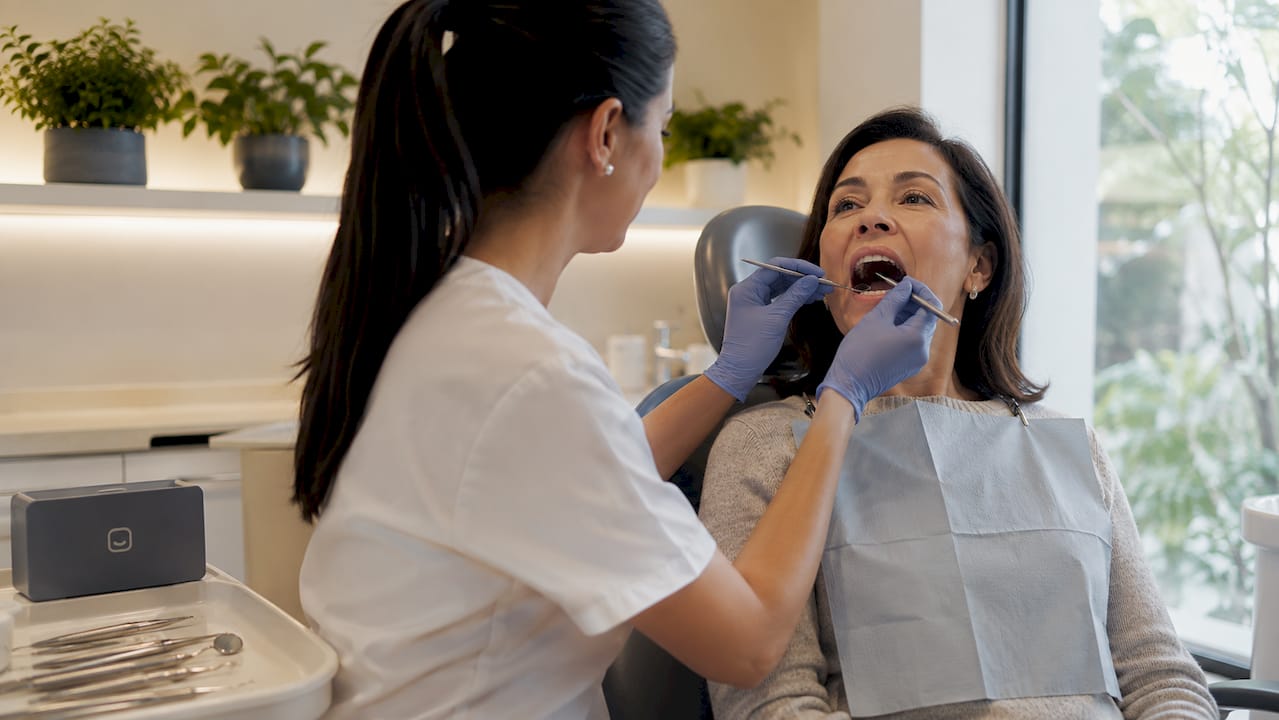
Gum health matters equally. Active periodontal disease or uncontrolled infection must be treated before any implant surgery. Systemic conditions like uncontrolled diabetes or autoimmune disorders can reduce healing capacity and must be managed in advance. Your surgeon will review your full medical history before recommending a treatment path.
Bone loss does not automatically disqualify you. Angled implant placement techniques like All-on-4 and All-on-X bypass areas of severe resorption, often eliminating the need for bone grafting entirely. When grafting is required, it adds a healing phase before implant placement but remains a viable path forward. Digital planning tools have expanded candidacy significantly, allowing surgeons to place implants safely in patients who would have been turned away a decade ago.
Here is what your pre-treatment evaluation will typically assess:
- Bone volume and density via CBCT imaging
- Gum tissue health and presence of active infection
- Systemic health factors including diabetes, blood thinners, and smoking history
- Existing denture fit and how long you have worn them
- Need for bone grafting or sinus lift procedures before implant placement
Pro Tip: Bring your current dentures and any prior dental X-rays to your consultation. This gives your surgeon a baseline for how much bone loss has occurred and speeds up the planning process.
What are the procedural steps for switching to permanent implants?
The transition from removable dentures to fixed implants follows a structured sequence. Understanding each phase removes the uncertainty and helps you plan realistically.
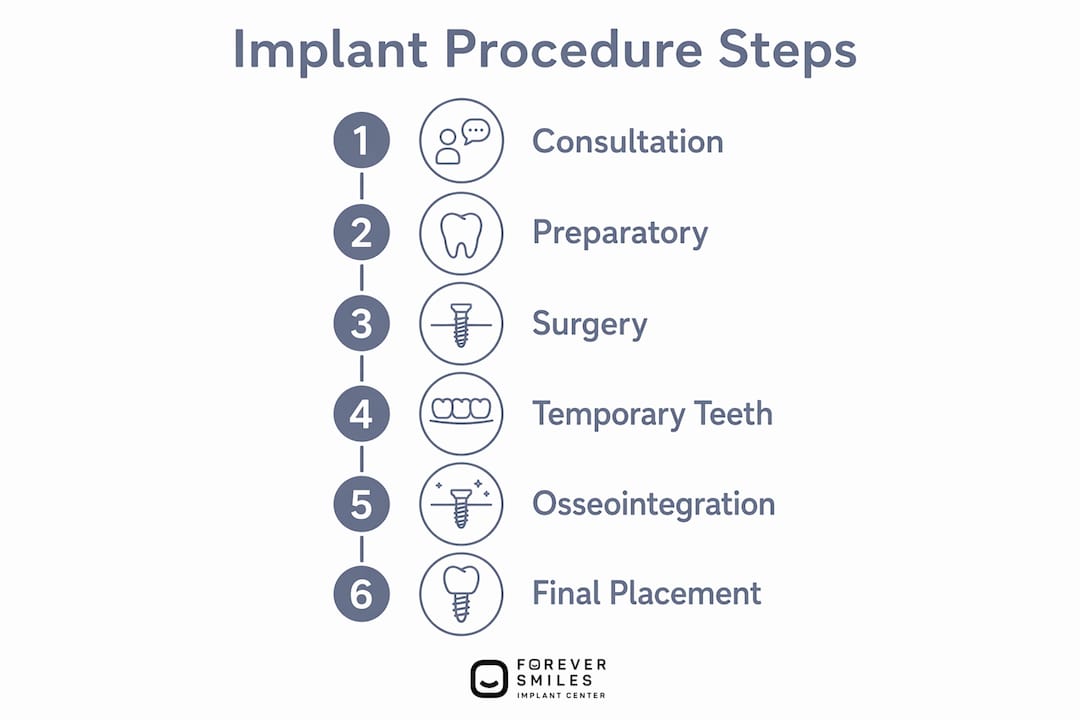
Step 1: Consultation and imaging
Your first appointment includes a 60-minute consultation with CBCT imaging. The 3D scan maps your bone structure in detail. Your surgeon reviews the scan, discusses your goals, and presents a treatment plan with a clear timeline and cost.
Step 2: Preparatory procedures (if needed)
Patients with significant bone loss may require bone grafting or a sinus lift before implants can be placed. These procedures add a healing window of 4–6 months. Patients with adequate bone move directly to surgery.
Step 3: Implant surgery
Surgery typically lasts 1–3 hours per arch. The surgeon places titanium implant posts directly into the jawbone. For full-arch cases, this means 4–8 implants per arch for a fixed bridge, or 2–4 implants for an overdenture design. At Forever Smiles Implant Center, a board-certified MD anesthesiologist manages sedation, so patients are comfortable throughout.
Step 4: Immediate temporary teeth
Immediate loading protocols allow a temporary fixed bridge to be attached the same day as surgery. You leave the office with teeth. You do not go through a period of being toothless in public. This is one of the most important practical advantages of modern implant surgery.
Step 5: Osseointegration
The healing phase lasts 3–6 months. During this time, the implant posts fuse with the surrounding bone in a process called osseointegration. Follow-up appointments are scheduled at weeks 1, 3, and month 3 to monitor healing. If you opted for an overdenture design, your modified existing denture can function as a temporary implant-retained device during this phase.
Step 6: Final prosthesis placement
Once osseointegration is confirmed, your final custom teeth are fabricated and attached. At Forever Smiles Implant Center, final restorations are custom zirconia arches, made in the in-house lab for precise fit and natural appearance.
| Phase | Duration | Key Action |
|---|---|---|
| Consultation and imaging | 1 appointment | CBCT scan, treatment planning |
| Preparatory procedures | 4–6 months (if needed) | Bone graft or sinus lift |
| Implant surgery | 1–3 hours per arch | Implant post placement |
| Osseointegration | 3–6 months | Bone fuses with implants |
| Final restoration | 1–2 appointments | Custom zirconia teeth attached |
The total treatment timeline runs 4–10 months for most patients. Cases without grafting complete in 4–6 months. Cases requiring grafting add another 4–6 months to the front end.
Pro Tip: Ask your surgeon specifically whether you qualify for immediate loading. Not every case allows it, but when it does, you avoid wearing a removable temporary during healing entirely.
How do permanent implants improve function and quality of life?
Fixed implants outperform dentures on every functional measure that matters to daily life. The difference is not subtle. Patients who make this transition consistently describe it as one of the best decisions they have ever made.
Chewing ability improves dramatically. Dentures restore roughly 20–25% of natural bite force. Fixed implants restore bite force close to that of natural teeth, which means you can eat steak, raw vegetables, and hard fruits without hesitation or pain. Diet restrictions that denture wearers accept as permanent simply disappear.
Fixed implant bridges eliminate the slipping and clicking that make social situations stressful for denture wearers. Patients report that the psychological relief of knowing their teeth will not move is as significant as the physical improvement. Confidence in conversation, laughing, and eating in public returns quickly after the final restoration is placed.
Permanent implants preserve jawbone and facial contours over time. Dentures sit on top of the gum and provide no root stimulation, so bone resorption continues. Implants act as artificial roots, transmitting chewing forces into the bone and halting that loss. The facial collapse and sunken appearance that long-term denture wearers develop does not occur with implants.
Maintenance is also simpler than most patients expect. Fixed implants are cleaned like natural teeth: brushing, flossing, and regular professional cleanings. There are no adhesives, no overnight soaking, and no removal routines. The long-term investment in quality of life is real and measurable.
Key functional and lifestyle benefits at a glance:
- Full bite force restoration for unrestricted diet
- No slipping, clicking, or adhesive use ever again
- Bone preservation preventing facial structure changes
- Simple maintenance identical to natural teeth care
- Permanent result designed to last decades with proper care
"The moment patients realize they can eat whatever they want and laugh without thinking about their teeth, something shifts. It is not just physical. It is the return of a confidence they thought was gone for good."
What challenges should you anticipate during the transition?
The transition from dentures to implants is not without obstacles. Knowing them in advance lets you plan for them rather than be surprised by them.
Bone loss is the most common complication that extends timelines. Patients who have worn dentures for many years often need grafting before implant placement is possible. This adds months to the process and additional cost. The solution is to act sooner rather than later. Every year of continued denture wear means more bone loss and a more complex surgical case.
Oral hygiene and post-surgical care directly determine long-term implant success. Implants do not decay, but they can fail due to peri-implantitis, an infection of the tissue surrounding the implant. Patients who skip professional cleanings or neglect home care put their investment at risk. The discipline required is no greater than caring for natural teeth, but it is non-negotiable.
Systemic health factors are frequently underestimated. Uncontrolled blood sugar, heavy smoking, and certain medications all reduce healing capacity and implant survival rates. Proper case planning that accounts for these factors before surgery is what separates predictable outcomes from avoidable failures.
Cost surprises catch patients off guard when they have not asked the right questions upfront. A complete treatment quote should include planning, surgery, temporary teeth, the final restoration, and follow-up care. At Forever Smiles Implant Center, full-mouth treatment starts at $19,000 per arch and includes all of those components.
Common pitfalls to avoid during your transition:
- Skipping the full evaluation and assuming you are not a candidate without expert assessment
- Choosing a provider based on price alone rather than surgical experience and case volume
- Ignoring systemic health management before and during treatment
- Underestimating the healing timeline and expecting results faster than biology allows
- Neglecting follow-up appointments during osseointegration
"The patients who struggle most are the ones who chose their surgeon based on the lowest quote. The patients who do best are the ones who chose based on experience, volume, and a clear surgical plan."
Pro Tip: During the osseointegration phase, stick to a soft diet and avoid hard, crunchy, or sticky foods. Putting excessive force on healing implants before they fully integrate is one of the most preventable causes of early implant failure.
Key Takeaways
Switching from dentures to permanent implants delivers lasting functional and quality-of-life gains, but success depends on proper evaluation, experienced surgical care, and committed post-treatment maintenance.
| Point | Details |
|---|---|
| Candidacy is broader than expected | Digital planning and angled implant techniques qualify many patients previously turned away. |
| Timeline runs 4–10 months | Cases without grafting finish in 4–6 months; grafting adds another 4–6 months upfront. |
| Immediate loading prevents toothlessness | Most patients receive temporary fixed teeth the same day as surgery. |
| Implants halt bone loss | Fixed implants stimulate the jawbone; dentures do not, causing continued resorption. |
| Provider experience is the top variable | Surgeon case volume and surgical training determine outcomes more than any other factor. |
What I have learned from 20 years of switching patients from dentures to implants
The patients who walk into my practice after years in dentures share a common experience. They have adapted. They have changed what they eat, how they laugh, and how they present themselves in public. They have accepted limitations that were never permanent. What I find most rewarding about this work is showing them that the adaptation was never necessary.
The functional transformation is real and measurable. But the psychological shift is what I remember most. Patients who have worn dentures for a decade sit in the chair expecting to be told they are not candidates. When the CBCT scan shows a viable path forward, and when they leave surgery the same day with fixed teeth, something changes in how they carry themselves. That is not a clinical metric. It is the whole point.
My advice to anyone considering this transition: do not let a single consultation at a general dental office be your final answer. Full-arch implant reconstruction is a surgical specialty. The surgeon's daily case volume, training, and experience with complex cases matter more than any other variable in your outcome. Ask how many full-arch cases your surgeon performs per week. Ask what happens if something goes wrong. Ask whether they handle the planning, surgery, and final restoration under one roof. The answers tell you everything.
This is a once-in-a-lifetime investment. Do it once. Do it right.
— Dr. Brian Young
Permanent implant options at Forever Smiles Implant Center
Forever Smiles Implant Center is a surgical specialty practice in Jacksonville, Florida, built exclusively around full-arch implant reconstruction. Dr. Brian Young has placed over 28,000 implants and performs full-arch surgery daily, including complex cases involving severe bone loss and previously failed implants.
Every patient receives a complete treatment plan developed from 3D CBCT imaging, with surgery, an in-house dental lab, and a board-certified MD anesthesiologist all under one roof. If you are ready to stop managing dentures and want to understand your options, visit the dental implants FAQ page or learn more about full-mouth implant replacement. Schedule a consultation to get a clear, personalized answer on whether you qualify and what your treatment would involve.
FAQ
How long does it take to switch from dentures to implants?
The full process takes 4–10 months depending on whether bone grafting is needed. Cases without grafting typically complete in 4–6 months; grafting adds another 4–6 months before implant placement.
Will I be without teeth during the implant process?
Most patients are not. Immediate loading protocols allow a temporary fixed bridge to be placed the same day as surgery, so you leave the office with teeth already attached.
How many implants are needed to replace a full arch of teeth?
Full-arch fixed bridges require 4–8 implants per arch. Implant-supported overdentures use 2–4 implants per arch. The exact number depends on your bone anatomy and the prosthesis design your surgeon recommends.
Can I get implants if I have had bone loss from wearing dentures?
Yes, in most cases. Angled implant placement techniques like All-on-4 bypass areas of bone loss, and bone grafting can rebuild volume when needed. A CBCT scan determines which path applies to your specific anatomy.
What is the success rate for dental implants?
Dental implant success rates exceed 95% with proper maintenance and follow-up care. Long-term success depends on oral hygiene, systemic health management, and regular professional cleanings.
Recommended
- Can Full-Mouth Dental Implants Replace Dentures Permanently? - Forever Smiles Dental Implant Center
- Replacing All Teeth with Implants: The Specialist’s Guide to Full-Mouth Reconstruction
- Dentures vs Implants: Benefits Comparison Guide
- Full Mouth Dental Implants Jacksonville, FL | Forever Smiles Implant Center