
Most patients recover from zygomatic implant surgery in overlapping stages, not one straight line: acute swelling and discomfort improve over the first 1 to 2 weeks, while the implants themselves need roughly 3 to 6 months to fuse fully with bone. Temporary teeth typically go in the same day or within 24 hours, so patients rarely go without a smile. The final prosthesis usually waits for that 3 to 6 month mark, and outcomes hinge on following the rules your surgical team gives you, especially around smoking and nose-blowing.
TL;DR:
- Swelling peaks between days 1 and 3, and most tissue healing occurs over the first two to six weeks, but the implant takes 3 to 6 months to fully fuse.
- Smoking significantly delays osseointegration, often requiring at least three weeks of cessation for better implant stability, especially in non-controlled diabetic or thin-bony patients.
- Pain generally subsides within a week to ten days with over-the-counter medications, but worsening pain after day 4 should prompt immediate contact with the surgical team.
- Sinus precautions include avoiding forceful rinsing and nose-blowing for about three weeks to reduce infection and sinus complications.
- Regular follow-up visits assess implant stability, tissue healing, and bite alignment, with final prosthesis placement occurring once osseointegration is confirmed.
Table of Contents
- What Happens in the First Week After Zygomatic Implant Surgery?
- How Does Healing Progress Over Weeks 2 Through 6?
- When Do Zygomatic Implants Reach Full Strength?
- How Should You Manage Pain After Zygomatic Implant Surgery?
- What Are the Rules for Oral Hygiene and Sinus Care?
- What Warning Signs Mean You Should Call Your Surgical Team?
- What Happens at Follow-Up Visits Before the Final Prosthesis?
- What Does Dr. Brian Young Say About Predictable Recovery?
- How Do You Handle Dry Mouth or Numbness During Recovery?
- Can Physiotherapy or Lymphatic Drainage Speed Up Swelling Reduction?
- A Word of Encouragement Before Surgery
- How Forever Smiles Implant Center Supports Your Zygomatic Recovery
- Sources
What Happens in the First Week After Zygomatic Implant Surgery?
The first seven days set the tone for everything that follows. Your body is forming a blood clot, calming inflamed tissue, and beginning to seal the surgical sites. Skip a step here and you risk delayed healing or a dislodged clot, which is why clinics hand out such specific instructions.
Here's what a typical week looks like:
- Day 0 (surgery day): Bite on gauze to control bleeding, keep your head elevated even while sleeping, and ice your face in 20-minute intervals for the first 24 to 48 hours. Skip straws entirely and avoid rinsing your mouth with any force.
- Days 1 to 3: Swelling usually peaks here, often looking worse than it feels. Take your first pain pill before the local anesthetic fully wears off so you're never chasing pain that's already ramped up. Nausea is common if you're on stronger medication, so pair pills with a small amount of food. Rest matters more than most patients expect.
- Days 3 to 7: Bruising can appear on the cheeks, jaw, or even the neck. This is normal blood settling under the skin, not a sign of infection. Once your surgeon clears it, gentle warm salt-water rinses can begin. Follow whatever suture guidance you're given, since some stitches dissolve and others need removal.
A tea bag applied with light pressure can help control minor oozing if bleeding restarts. Call your surgical team immediately if bleeding soaks through gauze repeatedly, if swelling suddenly worsens after day 3, or if you spike a fever.
How Does Healing Progress Over Weeks 2 Through 6?
Soft tissue does most of its visible healing in this window, even though the bone underneath is still working. Sutures typically come out or dissolve within 7 to 14 days, and the gum tissue looks noticeably better by then, even though the implants aren't structurally strong yet.
- Weeks 2 to 3: Swelling drops off substantially, sutures come out if they haven't dissolved, and you can usually move from liquids to thicker soft foods like scrambled eggs, mashed potatoes, or soft pasta.
- Weeks 4 to 6: Tissue continues thickening and toughening around the temporary prosthesis. Hard, crunchy, or sticky foods (think nuts, chips, or caramel) stay off the menu until your clinician gives explicit clearance.
- Activity: Light walking is fine almost immediately. Save cardio that raises your heart rate significantly, along with any heavy lifting or contact sports, for when your surgeon signs off, usually somewhere around week 3 to 4.
- Hygiene upgrades: Chlorhexidine or other antimicrobial rinses sometimes get added to your routine, but only start these on your clinician's advice, since some formulations are too harsh for early tissue.
When Do Zygomatic Implants Reach Full Strength?
The gum tissue healing you see in the first two weeks is not the same thing as the implant being load-ready. What's happening underneath is called osseointegration: your jawbone (or in this case, the dense zygomatic bone in the cheek) physically bonds to the titanium implant at a cellular level. That process is slower than soft-tissue repair and generally takes 3 to 6 months before a surgeon considers the implant fully stable.
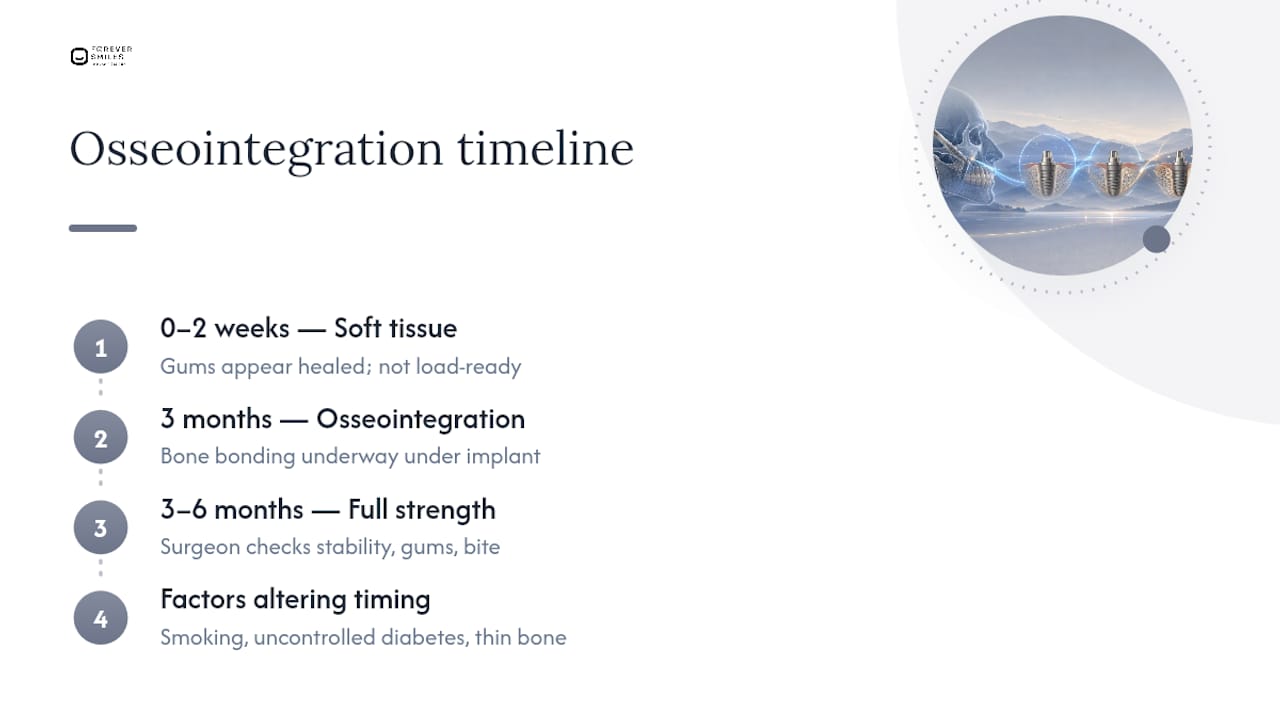
Several factors stretch or shrink that window. Smoking is the biggest one. It restricts blood flow to healing tissue and measurably raises implant failure rates, which is why most surgical teams push patients to stop for at least three weeks around surgery, ideally longer. Diabetes that isn't well controlled and naturally thin or soft bone can also slow the process down.
Before delivering the final prosthesis, your surgical team checks implant stability, evaluates how the gum tissue has matured, and confirms your bite alignment. During this stretch, expect occasional sensitivity or a strange tingling near the surgical sites. That fades as nerves settle and life with your temporary teeth starts to feel routine.
How Should You Manage Pain After Zygomatic Implant Surgery?
Pain typically peaks in the first 48 to 72 hours, then drops off steadily. Most patients are off prescription medication and managing comfortably on over-the-counter options within a week to ten days.
- Alternating acetaminophen and ibuprofen (when there's no medical reason to avoid either) covers most of the discomfort for many patients.
- Opioid prescriptions are usually reserved for the first few days only, when swelling and tissue trauma are at their worst.
- Take your first dose before the numbing from surgery fully wears off. Waiting until pain sets in makes it harder to catch up.
- Eat something small before taking medication, and sip water regularly. Nausea from empty-stomach dosing is one of the most preventable complaints after surgery.
Pro Tip: Set a phone alarm for your medication schedule during the first three days. Pain that's allowed to spike is much harder to bring back down than pain that's managed proactively.
If pain gets worse after day 4 or 5 instead of better, that's not typical healing. Treat it as a signal to call your surgical team rather than push through.
What Are the Rules for Oral Hygiene and Sinus Care?
Zygomatic implants anchor into the cheekbone and often pass near or through the maxillary sinus, which is why sinus precautions matter more here than with standard implants. Post-op guides are consistent on this point: avoid rinsing forcefully in the first 24 hours, then move to warm salt-water rinses three to four times daily once cleared.
- Brush other teeth normally right away, but keep the brush away from surgical sites until your team gives the go-ahead, following standard gentle brushing technique.
- Skip nose-blowing entirely for about three weeks. If you need to sneeze, do it with your mouth open to avoid building sinus pressure.
- Interdental brushes can wait until tissue around the prosthesis has toughened, usually a few weeks in.
- Progress your diet in stages: liquids first, then soft, fork-tender foods, building toward normal textures as bone healing allows. Protein-rich foods support tissue repair during this stretch.
What Warning Signs Mean You Should Call Your Surgical Team?
Most recoveries are uneventful, but knowing the red flags matters. Fever, increasing (not decreasing) pain past day 4, or visible pus around the implant sites points to infection and needs same-day attention. Bright, heavy bleeding that continues past 24 to 48 hours, rather than tapering off, also warrants a call, though biting on gauze for 20 minutes is a reasonable first step while you reach the office.
Persistent congestion, pressure behind the cheekbones, or a sinus infection that doesn't resolve can signal sinusitis or a rare oroantral connection between the mouth and sinus. A temporary tooth that suddenly feels loose, or numbness that's getting worse instead of fading, both deserve a prompt call rather than a wait-and-see approach.
What Happens at Follow-Up Visits Before the Final Prosthesis?
Most practices follow a predictable rhythm: a check at 1 week, another around 1 month, then periodic visits until the final teeth go in. At each one, the team examines soft-tissue health, hygiene, how well the implants are holding steady, and how your bite lines up.
Temporaries often get adjusted along the way, both to protect healing tissue and to shape gums into the profile the final restoration will need. Immediate temporaries placed on day one typically give way to the final zirconia bridge once osseointegration is confirmed, generally in the 3 to 6 month range, with some interim food restrictions lifting gradually as each visit clears you for more.
What Does Dr. Brian Young Say About Predictable Recovery?
Dr. Brian Young has placed more than 28,000 implants and performs full-arch surgery daily at Forever Smiles Implant Center, which shapes how he talks about recovery: as something engineered in advance, not left to chance. Team-based planning, including 3D imaging, an in-house lab, and a dedicated MD anesthesiologist, removes many of the surprises that make recovery unpredictable elsewhere.
Patients who follow their aftercare plan closely, especially around sinus precautions and smoking cessation, consistently track closer to the shorter end of healing timelines and benefit from post-op care ensuring the longevity of your dental implants. That pattern shows up often enough in daily practice to be treated as a real signal. Anyone weighing this procedure can review the zygomatic implant process or ask about scheduling a consultation to see how a tailored plan would apply to their own bone structure and health history.
How Do You Handle Dry Mouth or Numbness During Recovery?
Dry mouth after zygomatic implant surgery usually comes from a combination of mouth-breathing while swelling limits nasal airflow, medication side effects, and simply drinking less water than usual while eating is uncomfortable. It's common in the first couple of weeks and generally fades as swelling drops.

Sipping water consistently throughout the day helps more than gulping large amounts occasionally. Sugar-free lozenges or a humidifier at night can ease the dryness without irritating surgical sites. Avoid alcohol-based mouthwashes during this period, since they tend to dry tissue further right when it needs moisture to heal.
Altered sensation, tingling, numbness, or an odd "asleep" feeling around the cheek, lip, or gum, is also common given how close zygomatic implants sit to sensory nerves in the midface. For most patients, this improves gradually over weeks as inflammation around the nerve pathways settles. Mild tingling that slowly fades is expected. Numbness that's worsening, spreading, or still present unchanged well past a month is different and should get evaluated rather than assumed to resolve on its own.
Keeping a rough log, noting whether sensation feels better, the same, or worse each week, gives you and your surgical team something concrete to discuss at follow-up visits instead of relying on memory alone.
Can Physiotherapy or Lymphatic Drainage Speed Up Swelling Reduction?
Facial swelling after zygomatic implant surgery follows a fairly predictable arc: it builds for the first 2 to 3 days, then recedes steadily over the following two weeks. Some patients look for ways to shorten that curve, and a few adjunctive approaches have earned a place in post-surgical care for exactly that reason.
Manual lymphatic drainage, a light, specific massage technique aimed at moving fluid out of swollen tissue, is sometimes recommended starting around day 3 or 4, once the initial clot has stabilized and acute inflammation has passed its peak. Applying it too early can aggravate fresh surgical sites, so timing matters more than enthusiasm here. A trained practitioner familiar with facial and oral surgery should perform it, not a generic massage therapist.

Gentle facial exercises, opening and closing the jaw within a comfortable range, can also help circulation once your surgeon confirms it's safe, usually beyond the first week. These aren't a substitute for ice and elevation in the acute phase. They're a supplement once the highest-risk window has passed.
If you're considering either approach, mention it at your one-week follow-up rather than starting on your own. Your surgical team can confirm that swelling is progressing normally and that your tissue is ready for added manipulation.
A Word of Encouragement Before Surgery
Most patients adapt to temporary teeth faster than they expect, and swelling resolves sooner than the horror stories suggest. Recovery success comes down to following instructions, not avoiding surgery. If something feels wrong, call your surgical team. That's what they're there for.
— Dr. Brian Young
How Forever Smiles Implant Center Supports Your Zygomatic Recovery
Forever Smiles Implant Center approaches zygomatic implant recovery the way a surgical specialist should: with a plan built before day one, not improvised after. Because Dr. Brian Young and his team perform full-arch and zygomatic procedures daily, aftercare instructions come from repetition and pattern recognition, not a generic handout.
A consultation here covers 3D imaging and surgical planning, an honest look at your candidacy for zygomatic versus traditional implants, a realistic timeline for your specific bone structure, and a clear pricing overview from the start. Every stage, planning, surgery, same-day temporary teeth, and the in-house lab crafting your final zirconia restoration, happens under one team, which is exactly what keeps recovery predictable instead of fragmented across multiple offices. If you're weighing whether zygomatic implants fit your situation, explore the zygomatic implant program or check the dental implant FAQs to see candidacy questions answered before you book a consult.
This article is general information, not a substitute for advice from a qualified doctor. Consult a qualified healthcare professional about your own circumstances before acting on anything here.
Sources
- Effect of smoking on dental implant survival: a systematic review and meta-analysis
- Post-Operative Instructions:All-on-4®/ Zygomatic Implant
- Post-Operative Instructions: Zygomatic Implant
- Zygomatic Dental Implants: Procedure guide