
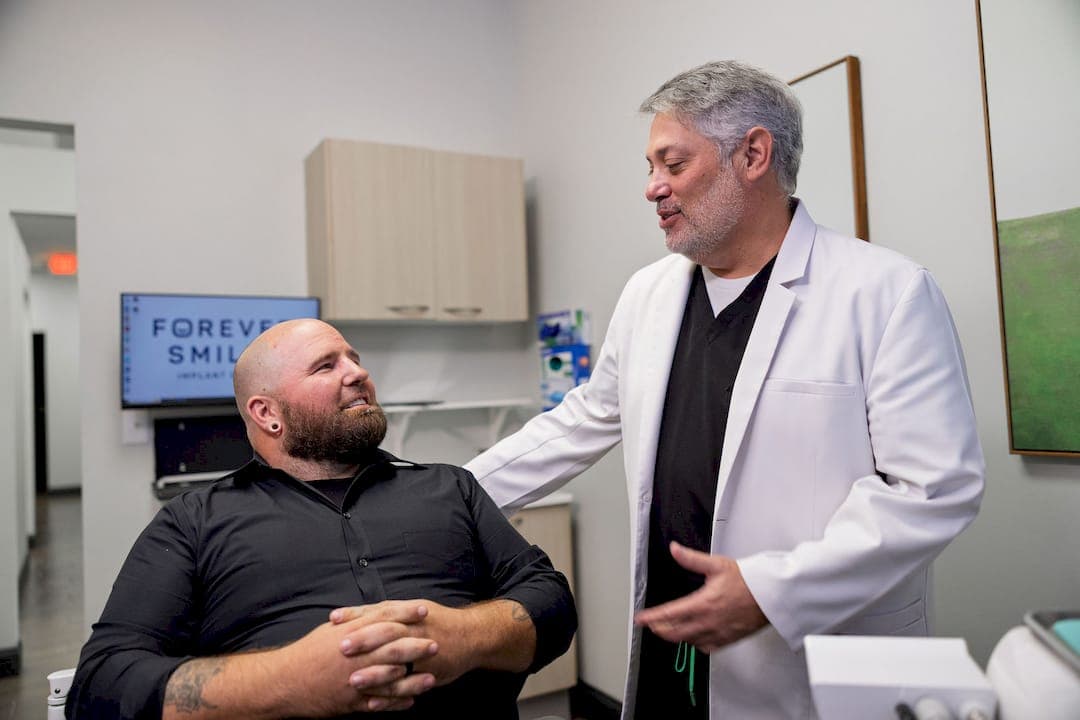

Surgeon experience and procedure-specific volume are the single strongest predictors of safer, more predictable dental implant outcomes. A 2026 Springer meta-analysis found that patients treated by low-volume surgeons faced considerably higher risk of intraoperative and postoperative complications compared to those treated by high-volume providers. NEJM analyses confirm the same pattern across high-risk surgical procedures: surgeon volume often explains most of the outcome advantage attributed to high-volume hospitals. At Forever Smiles Implant Center, the entire practice model is built around this evidence.
The short answer:
- Higher surgeon volume consistently links to improved outcomes and more predictable placement.
- Specialization matters independently of raw case counts, per BMJ retrospective analysis.
- Practical benchmarks exist: audits reference thresholds like 50+ lifetime placements as a minimum competence floor.
- Use the checklist in this article before any consult.
Table of Contents
- Why does surgical experience improve implant outcomes?
- What does the research actually show?
- How much experience is actually enough?
- What should you look for when choosing an implant surgeon?
- When is a less-experienced clinician acceptable?
- How experience affects your timeline, risk, and costs
- How Forever Smiles Implant Center applies these principles
- Key Takeaways
- The case for demanding more from your surgeon
- Forever Smiles Implant Center: a high-volume specialist option
- Selected sources and further reading
Why does surgical experience improve implant outcomes?
The mechanism is straightforward: repetition builds technical precision and faster intraoperative judgment. A surgeon who performs full-arch reconstruction daily develops motor memory that a generalist performing occasional implants simply cannot replicate. Precise osteotomy placement, reading bone density in real time, controlling bleeding before it becomes a problem, and recognizing early nerve proximity signals are all skills that sharpen through volume, not coursework.
A 2024 MDPI review confirms that surgical experience is inversely associated with complication rates, with advanced judgment and anatomical familiarity mattering most in complex reconstructions. Procedure-specific specialization amplifies this further. A surgeon focused exclusively on implants develops device familiarity and case-pattern recognition that a general dentist rotating through multiple procedure types cannot accumulate at the same rate.
Team and system factors compound the individual surgeon's skill. An in-house lab eliminates the communication gap between surgery and prosthetics. 3D imaging and computer-assisted implant surgery workflows reduce placement error. A board-certified anesthesiologist on-site allows deeper sedation options and tighter intraoperative monitoring. None of these advantages fully substitute for surgeon experience, but they extend it.
Pro Tip: Ask specifically about the surgeon's personal case count, not the clinic's total. Hospital or practice volume can mask a junior surgeon performing most of the work under loose supervision.
What does the research actually show?
Research consistently links higher surgeon and center volume to fewer complications. The findings hold across specialties and study designs.
The 2026 Springer meta-analysis is the most direct: low-volume surgeons produced considerably higher complication risk across intraoperative, postoperative, and in-hospital categories. Analyses show that for a range of high-risk procedures, the surgeon's own case count explains much of what gets credited to the hospital. The BMJ specialization study adds a critical nuance: procedure focus predicts better outcomes independently of volume, meaning a surgeon who does nothing but implants outperforms a surgeon with equivalent raw numbers spread across multiple procedure types.
"Surgical experience and procedure-specific volume are associated with lower complication rates because experienced teams combine technical skill with faster judgment and better team coordination." — MDPI review, 2024
A 2025 systematic review on dCAIS found that clinicians experienced with dynamic computer-assisted implant surgery showed lower angular deviations than inexperienced users, though the magnitude of difference may not always be clinically perceptible. Technology helps, but only in trained hands.
One important nuance: a PMC clinical audit of supervised trainees reported high implant survival rates, attributing the strong outcomes to careful case selection and experienced oversight rather than the trainees' individual skill. Supervision works when it is genuine and structured.
How much experience is actually enough?
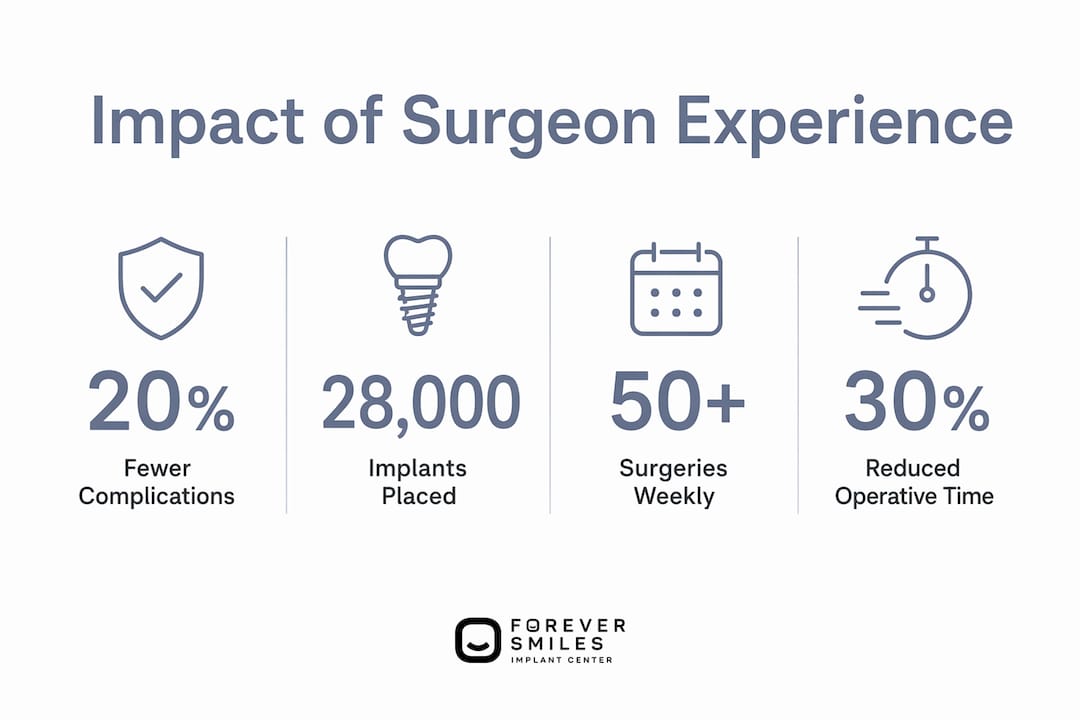
Volume thresholds are useful reference points, not guarantees. Clinical audits reference a lifetime placement threshold as a floor for basic competence, with findings suggesting surgeons below that threshold may have higher failure rates. That number is a starting point for a straightforward single-tooth case in healthy bone. For full-arch reconstruction, zygomatic implants, or salvage of previously failed implants, the bar is substantially higher.

| Annual Volume Band | Typical Context | Research Implication |
|---|---|---|
| — | Occasional or part-time implant provider | Higher complication risk; limited pattern recognition |
| — | General dentist with implant training | Adequate for simple cases; limited complex-case experience |
| — | Dedicated implant practice | Associated with more predictable outcomes in research |
| 50+ lifetime placements | Minimum competence threshold (audits) | Floor benchmark; complex cases require far more |
Case complexity changes everything. A full-arch reconstruction on a patient with severe bone loss, a history of implant failure, or systemic health factors demands a surgeon whose daily practice consists of exactly those cases. The lifetime case benchmarks that matter for complex reconstruction are measured in thousands, not dozens.
What should you look for when choosing an implant surgeon?
Choose a surgeon with documented procedure-specific volume, verifiable outcomes, and a team built around implant surgery. Then verify it.
Checklist before you commit:
- Documented lifetime and annual implant case counts (ask for the surgeon's personal number)
- Examples of cases similar to yours, with before-and-after documentation
- Complication and revision rates, and how complications are handled
- Use of 3D imaging and computer-assisted planning
- In-house dental lab for prosthetic coordination
- On-site anesthesia support
- Published case studies, editorial involvement, or peer-reviewed contributions
Questions to ask at your consult:
- How many full-arch cases have you personally performed in the last 12 months?
- Can you show before-and-after cases for patients with my specific situation?
- Who will be in the room during surgery, and what are their roles?
- Do you have an in-house lab, or is prosthetic work sent out?
- What is your complication rate, and how do you handle revisions?
Red flags: evasive answers about personal case counts, no outcome documentation, no specialist support on-site, and pressure to decide before you have reviewed case examples. A surgeon who cannot answer the volume question specifically is telling you something. You can also review consultation questions to bring to your first appointment.
When is a less-experienced clinician acceptable?
Supervised trainees can be appropriate for straightforward cases when an experienced lead plans the case and stays in the room. The PMC clinical audit cited earlier showed 100% survival rates for trainee-placed implants under those exact conditions: careful case selection, experienced supervision, and a structured training program.
The conditions that make trainee involvement reasonable:
- Routine single-tooth implants in patients with healthy bone and no complicating history
- Direct, hands-on supervision by a high-volume specialist (not just sign-off)
- A documented training program with tracked outcomes
The conditions that make it unacceptable: full-arch reconstruction, severe bone loss, previous implant failure, systemic disease affecting healing, or any case requiring real-time surgical judgment calls. Surgical literature shows complication rates peak in a clinician's first year and decline by the third, and that structured mentorship is the primary factor reducing early-career risk.
Pro Tip: If a less-experienced surgeon will be involved, ask directly: "Who is making the surgical decisions, and will the supervising surgeon be physically present for the entire procedure?" A yes to both is the minimum standard.
How experience affects your timeline, risk, and costs
Experienced teams typically shorten operative time, reduce complication-related delays, and deliver more predictable prosthetic workflows. That efficiency has a direct cost implication: fewer re-operations, fewer grafting revisions, and a cleaner path from surgery to final teeth.
The typical patient timeline runs from planning and imaging through surgery, healing, and final prosthesis delivery. Each stage carries risk of delay, and most delays trace back to complications that experienced surgeons are more likely to anticipate and prevent. A nerve injury, an implant placed at the wrong angle, or a prosthetic mismatch from an off-site lab can add months and thousands of dollars to a case.
The math on cost is worth thinking through carefully. A lower upfront fee from a lower-volume provider can become the most expensive option if it produces a failed implant requiring removal, bone grafting, and replacement. Long-term implant value depends heavily on getting the first surgery right. Ask any provider about their warranty terms, documented success rates, and what happens if an implant fails within the first year.
How Forever Smiles Implant Center applies these principles
A high-volume, team-based center integrates procedure-specific volume, 3D planning, in-house lab, and anesthesia support in ways that directly reduce the risks the research identifies.
Dr. Brian Young is a residency-trained surgical specialist with more than 20 years of experience and over 28,000 implants placed. He performs full-arch surgery daily, not occasionally. Beyond his own caseload, he trains surgeons nationally, lectures on full-arch technique, and sits on the editorial board of Implant Practice US. That combination of volume, specialization, and peer involvement is exactly what the research identifies as the profile associated with better outcomes.
Forever Smiles Implant Center operates with an in-house zirconia lab, a board-certified MD anesthesiologist, and 3D imaging integrated into every case plan. The practice specializes in complex cases, including zygomatic implants and salvage of previously failed implants, which means the daily caseload skews toward the situations where experience matters most. The smile gallery documents case types and outcomes for patients who want to review before-and-after results before committing.
Key Takeaways
Surgeon experience and procedure-specific volume are the primary drivers of safer, more predictable dental implant outcomes, and patients who verify both before committing are making the most consequential decision in their implant process.
| Point | Details |
|---|---|
| Volume predicts outcomes | Low-volume surgeons carry higher complication risk per the 2026 Springer meta-analysis and NEJM analyses. |
| Specialization adds independent value | BMJ data shows procedure focus predicts better outcomes beyond raw case counts alone. |
| 50+ placements is a minimum competence threshold | Audits cite 50+ lifetime implants as a floor benchmark; complex cases demand far more. |
| Supervision makes trainees safer | Supervised trainees achieve high survival rates when case selection is careful and oversight is hands-on. |
| Forever Smiles Implant Center | Dr. Brian Young's 28,000+ implants and daily full-arch practice align directly with the evidence-based profile for complex cases. |
The case for demanding more from your surgeon
Most patients spend more time researching a car purchase than they spend vetting the surgeon who will place titanium into their jaw. The volume-outcomes relationship in surgery is one of the most replicated findings in health services research, and it applies directly to dental implants. Yet the majority of patients never ask their surgeon a single question about personal case counts.
The conventional wisdom that "any licensed dentist can place implants" is technically true and practically misleading. Licensure sets a legal floor, not a clinical standard. The gap between a surgeon who has placed 200 implants over a decade and one who places that many in a year is not a credential gap. It is a judgment gap, a pattern-recognition gap, and a complication-management gap that shows up in outcomes.
What patients should demand is simple: the surgeon's personal case count, examples of similar cases, and a straight answer about what happens when something goes wrong. If a provider cannot or will not answer those questions, that is the answer.
Forever Smiles Implant Center: a high-volume specialist option
Patients who need full-arch reconstruction, have been told they are not candidates elsewhere, or are dealing with failed prior implants need a center where complex cases are the daily norm, not the exception.
Forever Smiles Implant Center in Jacksonville, Florida handles full-mouth dental implant reconstruction as its exclusive focus. Every case includes 3D planning, same-day teeth, final custom zirconia, and follow-up care under one roof. Cost and financing details are available for patients planning around a budget, with full-arch treatment starting from $19,000 per arch. For patients traveling from outside Jacksonville, the practice provides dedicated out-of-town patient support to make the logistics manageable. Bring your medical history, any prior imaging, and the consult questions from this article to your first appointment.
Selected sources and further reading
The studies below form the evidence base for this article. Each addresses a distinct dimension of the surgeon experience question.
"Few studies have investigated the relationship between surgeon experience and implant survival rates. These authors found that specialist training was not correlated with clinical success; rather, experience with at least 50 implant placements was cited as the minimum competence threshold." — PMC Clinical Audit on Dental Implant Outcomes
- Springer 2026 meta-analysis — volume-outcomes link in reconstructive surgery; directly supports the complication-risk differential between low- and high-volume providers.
- NEJM surgeon-volume analyses — establishes that surgeon-specific volume, not just hospital volume, drives outcome differences across high-risk procedures.
- BMJ specialization study — shows procedure focus predicts outcomes independently of volume; the strongest argument for choosing a dedicated implant specialist.
- dCAIS systematic review (2025) — quantifies the experience effect on angular deviation in computer-assisted placement; relevant for evaluating technology-plus-experience claims.
- PMC clinical audit — five-year audit of supervised trainee outcomes; the primary source for understanding when and why supervised settings can be safe.
- JAMA Surgery cohort study — acute care surgeon experience and complication rates; supports the early-career risk pattern and mentorship argument.
- PMC early-career transition review — complication rates in early surgical careers peak in year one and decline with structured mentorship; directly relevant to trainee oversight requirements.
This article is general educational information, not medical or dental advice. Confirm your specific situation and treatment options with a qualified implant specialist.
Recommended
- How Many Dental Implants Should an Experienced Surgeon Have Placed? - Forever Smiles Dental Implant Center
- Why Choose Forever Smiles | Forever Smiles, Jacksonville FL
- Dr. Brian Young – Dental Implant Surgeon in Jacksonville, Florida - Forever Smiles Dental Implant Center
- Implant Recovery Best Practices: Your 2026 Guide