
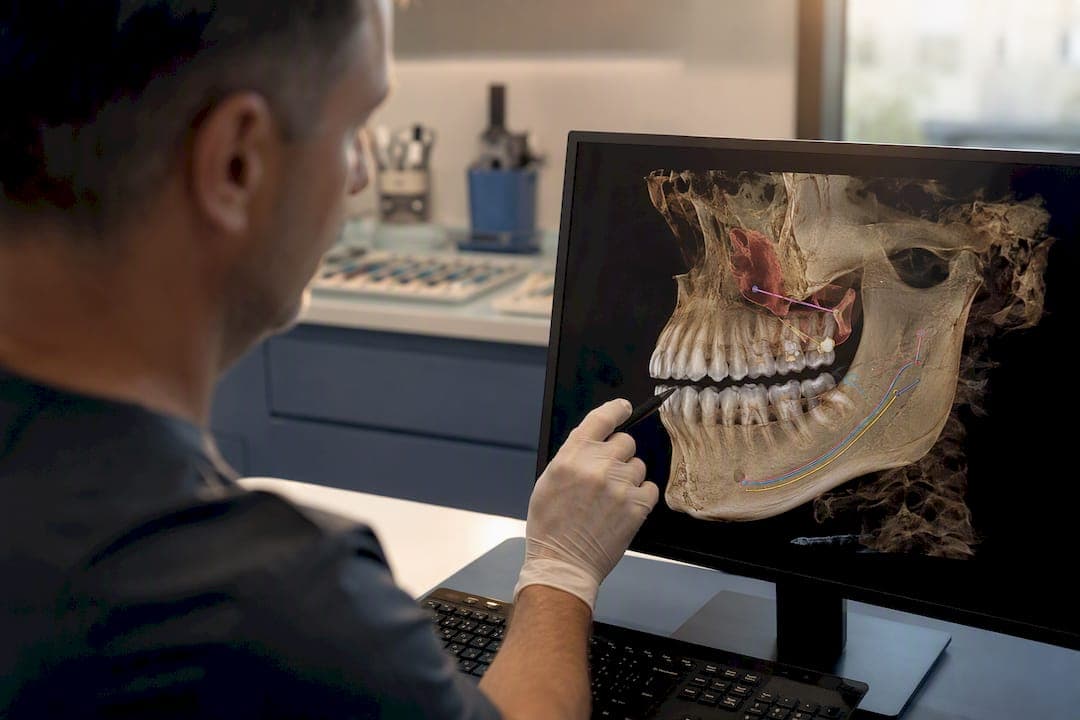
Yes, for many patients, dental implants without a bone graft are entirely possible. The right answer depends on how much jawbone you have left and which surgical technique your specialist chooses to work around it. Several graftless pathways now exist, each suited to a different pattern of bone loss:
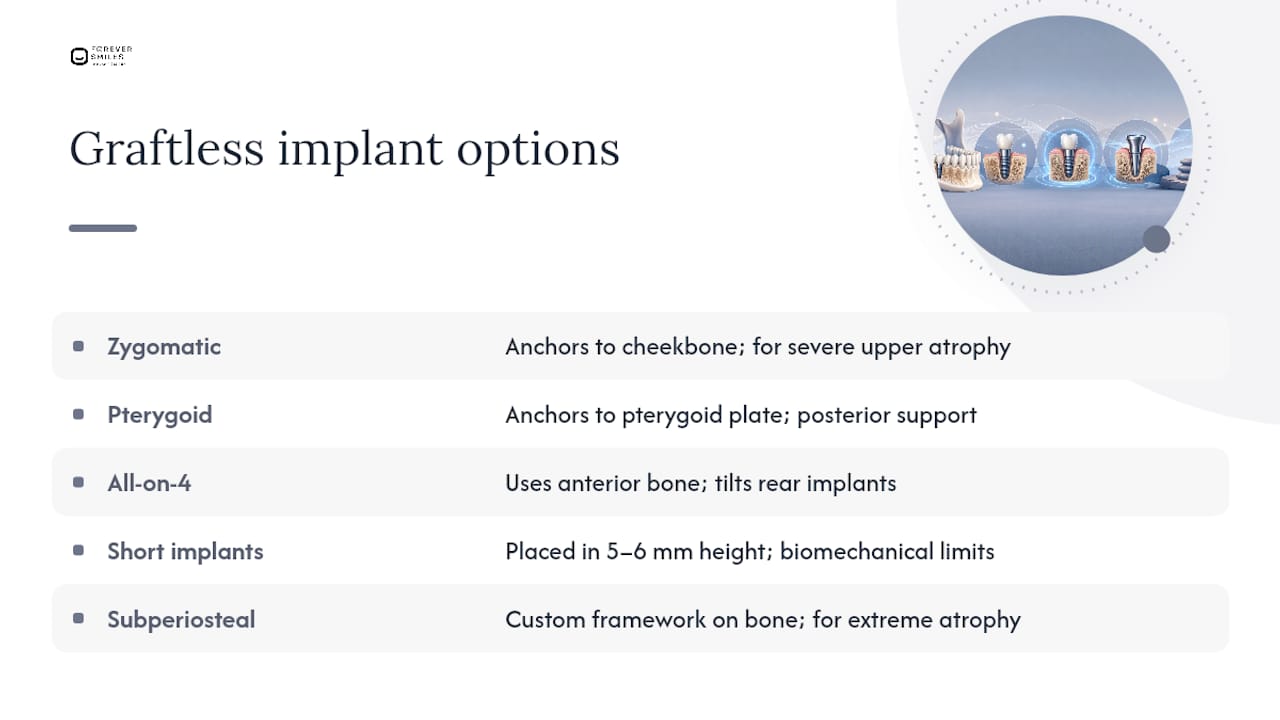
- Short implants work in sites with limited vertical height, often around 5 to 6 millimeters.
- Angled placement (the All-on-4 concept) uses whatever anterior bone remains, tilted to avoid grafting.
- Zygomatic implants anchor into the cheekbone when the upper jaw has little bone left.
- Pterygoid implants anchor into a bone plate near the back of the mouth for posterior support.
- Customized subperiosteal implants sit on top of the remaining bone rather than inside it, built from a digital scan of your exact anatomy.
A CBCT scan and an in-person evaluation by a specialist are what actually determine which path fits your case. Every graftless option trades some surgical simplicity for added complexity elsewhere, whether that's a steeper learning curve for the surgeon or stricter hygiene demands for you afterward.
Key Takeaways
Graftless implant options now cover nearly every pattern of bone loss, but which technique fits depends entirely on a CBCT-guided evaluation by a surgeon experienced in that specific method.
| Point | Details |
|---|---|
| Graftless is often possible | Short implants, angled placement, zygomatic, pterygoid, and subperiosteal frameworks each address a different bone loss pattern. |
| CBCT drives every decision | Height, width, density, and nerve/sinus position determine which technique is realistic for your case. |
| Evidence favors modern methods | Digitally designed subperiosteal implants show 5-year survival rates above 90% in clinical reviews. |
| Grafting still has a role | When no anatomical anchor point exists for any graftless technique, grafting remains the more predictable route. |
| Specialist experience matters most | Forever Smiles Implant Center evaluates zygomatic, pterygoid, and subperiosteal options using in-house CBCT planning and a residency-trained surgical team. |
This article is general information, not a substitute for advice from a qualified doctor. Consult a qualified healthcare professional about your own circumstances before acting on anything here.
Table of Contents
- Dental Implants Without Bone Graft: How Candidacy Gets Decided
- Which Graftless Implant Options Actually Exist?
- Weighing Graftless Options Against Bone Grafting
- How to Choose a Specialist for Graftless Implants
- What a Specialist Surgical Team Brings to Severe Bone Loss Cases
- The Real Question Isn't Whether You Qualify
- Graftless Options at Forever Smiles Implant Center
- Sources
Dental Implants Without Bone Graft: How Candidacy Gets Decided
Nobody can tell you if you qualify for a graftless implant by looking at your smile. It takes a cone beam CT (CBCT) scan, which builds a 3D map of your jaw down to the millimeter. Surgeons use it to measure three things: bone height, bone width, and bone density, while also tracking where your sinus floor and nerve canals sit so nothing gets nicked during surgery.
Numbers matter here, but only as a starting point. Height around 5 to 6 millimeters is a common general threshold where short implants start becoming an option, though every case still depends on width and density too. There is no single number that applies to every patient or every implant brand.
Beyond the scan, a specialist is checking:
- Whether your gums show active periodontal disease that could undermine long-term stability.
- How hard you bite and whether you clench or grind at night.
- Whether smoking, diabetes, or other systemic factors could slow healing.
- Whether your home hygiene habits can support the maintenance an implant requires.
Pro Tip: *If one office tells you flatly that you have "no bone" and no options, get a second CBCT-based opinion before you believe it.
Which Graftless Implant Options Actually Exist?
Every graftless technique solves the same underlying problem, insufficient bone, but they get there in different ways depending on where the deficiency sits and how severe it is, as detailed in Dental Implants vs. Dentures: Choosing the right tooth replacement option.
Zygomatic implants skip the upper jaw altogether and anchor straight into the zygomatic bone, the dense cheekbone that rarely resorbs even after years of missing teeth. This makes them the standard graftless fallback for severe upper-arch atrophy, and full-arch cases often allow same-day teeth at the time of surgery.
Pterygoid implants work from the opposite direction, anchoring into the pterygoid plate at the back of the mouth to support the posterior segment of a full-arch restoration. They're frequently paired with anterior implants rather than used alone, filling in support where the back of the jaw has thinned out too much for a standard fixture.
Angled placement, the concept behind All-on-4, uses the bone you already have in the front of the jaw and tilts the rear implants to avoid the sinus cavities and nerve canals that limit straight placement. It's become a default full-arch approach precisely because it sidesteps grafting for a large share of patients.
Short implants trade length for simplicity. Placed in sites with as little as 5 to 6 millimeters of height, they reduce surgical complexity but carry biomechanical limits. A short implant in a heavy-clenching patient faces more stress per square millimeter than a longer one, so case selection matters more than with standard-length fixtures.
Customized subperiosteal implants represent the newest shift in this space. Rather than sitting inside the bone, a custom-milled framework sits on top of it, designed from your own CBCT data using CAD/CAM and 3D printing. For patients with extreme atrophy, the kind classified as Cawood-Howell V through VIII, these frameworks can anchor to alternative structures like the pterygoid process or lateral skull base when there simply isn't enough native ridge left to work with.
Same-day temporary teeth are achievable with several of these techniques, particularly zygomatic and All-on-4 approaches. Subperiosteal cases sometimes call for a staged restoration instead, since the framework needs time to integrate against soft tissue before the final prosthetic goes on.
Weighing Graftless Options Against Bone Grafting
Skipping the graft has real upside. You avoid a second surgical site (often the hip or chin, if an autologous graft is used), you're not waiting three to nine months for grafted bone to mature before implants go in, and you sidestep the donor-site pain that comes with harvesting your own bone.
The tradeoffs are just as real:
- Techniques like zygomatic and subperiosteal implants demand more surgical skill and a longer learning curve than a standard implant placement.
- Prosthetic design and daily hygiene routines get more demanding with off-axis anchor points.
- Evidence quality varies. Systematic reviews note that support for newer techniques still leans heavily on case series rather than large randomized trials.
That said, the survival numbers on record are encouraging. Modern customized subperiosteal frameworks built through digital workflows have shown 5-year survival rates exceeding 90% in clinical reviews of severely atrophic jaws, a marked improvement over the older subperiosteal designs from decades past. Grafting still wins when the bone geometry genuinely can't support any alternative anchor, no zygoma to reach, no pterygoid plate available, and not enough anterior ridge for angled placement.
How to Choose a Specialist for Graftless Implants
Credentials separate the surgeons who can execute these techniques from the ones who just talk about them. Look for residency-trained oral surgeons or prosthodontists, not general dentists who added implants to their service menu after a weekend course. Case volume matters even more for zygomatic and subperiosteal work, since these aren't procedures most offices perform often enough to build real proficiency.
A serious specialist's planning workflow should follow a consistent sequence:
- A CBCT scan reviewed with you, not just filed away.
- Digital planning software mapping the exact implant trajectory before surgery.
- A prosthetic preview showing roughly what your final teeth will look like.
- A documented anesthesia plan appropriate to the surgery's length and complexity.
Ask directly: how many zygomatic or subperiosteal cases has this surgeon completed, what's their complication rate, and can they show you real before-and-after cases similar to yours? Vague answers are the biggest red flag you'll encounter. So is a consult that skips CBCT imaging entirely, or one where price gets discussed before your anatomy does.
Pro Tip: Bring any prior scans or panoramic X-rays to your first consult. A specialist reviewing existing imaging on the spot tells you more about their competence than any brochure will.
Costs run higher for zygomatic and subperiosteal cases than standard implants, reflecting the added surgical time and lab work, though a graft-plus-implant sequence often costs comparably once you add up staged procedures and healing time. Financing plans are common at specialty centers and worth asking about upfront.
What a Specialist Surgical Team Brings to Severe Bone Loss Cases
Volume changes what a surgeon can offer you. A doctor who has placed a few dozen implants in a career approaches severe atrophy differently than one who has placed over 28,000 and performs full-arch surgery daily. That repetition builds pattern recognition, spotting which patients are genuine zygomatic candidates versus which need a pterygoid approach or a customized subperiosteal framework instead.
The workflow matters as much as the surgeon. When CBCT imaging, digital planning, surgery, an in-house dental lab, and an MD anesthesiologist all sit under one roof, fewer things get lost between appointments and specialists.
A patient who was told elsewhere that there was "nothing to work with" often just needed a surgeon who has actually planned around that exact anatomy before. Severe atrophy is a planning problem, not a dead end.
What should you expect from a center built around this kind of case?
- Informed consent that walks through your specific CBCT findings, not a generic implant brochure.
- Documented outcomes for cases resembling your own bone pattern.
- A follow-up structure that doesn't end at the surgical suite door.
The Real Question Isn't Whether You Qualify
Most patients who get told they're not implant candidates were given that answer by someone without the surgical toolkit to treat them, not because their anatomy was truly hopeless. That's the gap the conventional advice glosses over. "You don't have enough bone" is often shorthand for "I don't perform zygomatic or subperiosteal surgery," which is a very different statement.
The evidence on newer graftless techniques, particularly customized subperiosteal frameworks, is still building. Survival data past five years remains thinner than we'd like, and I won't pretend otherwise. But dismissing these options because the evidence base is younger than grafting's decades-long track record misses the point for a patient facing years of ill-fitting dentures right now.
What should you prioritize first? Not price, not turnaround speed. Get the CBCT scan read by someone who has actually placed zygomatic or subperiosteal implants themselves. That single step separates a real evaluation from a guess.
— Dr. Brian Young
Graftless Options at Forever Smiles Implant Center
If bone loss has left you searching for teeth implants alternatives to a lengthy graft-and-heal timeline, Forever Smiles Implant Center approaches your case with the full surgical toolkit rather than a single technique. That means zygomatic implants, pterygoid anchorage, angled full-arch placement, and customized subperiosteal frameworks are all genuinely on the table, evaluated against your actual CBCT scan rather than ruled out by default.
Every case runs through in-house digital planning, surgery, an in-house dental lab, and an MD anesthesiologist, all under one roof in Jacksonville. Dr. Brian Young has placed more than 28,000 implants over 20-plus years and works daily with patients who were told elsewhere they had no bone left to work with. If you've been given that answer before, bring your prior imaging to a consultation and get a second, specialist-level read on what your anatomy actually allows. Start by reviewing full-mouth reconstruction options or check the practice's implant FAQ page to see what a consult involves.
Sources
- Customized subperiosteal implants re-emergence (Open Dentistry Journal)
- Innovative landing zones for rigidly fixated patient-specific subperiosteal implants (PMC)
- Customized Subperiosteal Dental Implants: A state-of-the-art narrative review (DOI)