
Dental implants need no relines because they anchor directly to the jawbone through a biological process called osseointegration, creating a fixed foundation that never shifts with tissue changes. Dentures, by contrast, rest on gum tissue that shrinks over time, forcing patients into a cycle of relining, refitting, and replacement. Implants restore 90–95% of natural bite force, while conventional dentures restore only 20–25%. That gap explains everything: implants function like natural teeth because they are structurally integrated with bone, not balanced on top of it. Forever Smiles Implant Center treats this distinction as the foundation of every full-arch case it performs.
Why implants need no relines: the bone connection explained
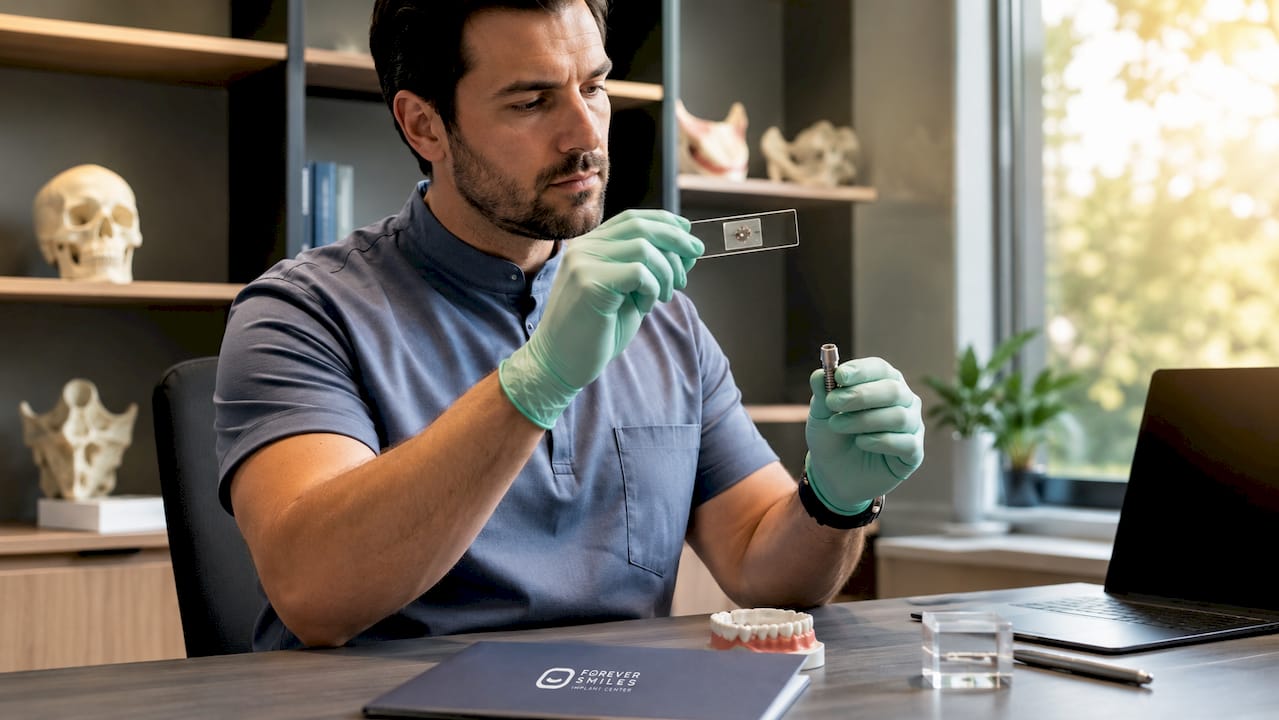
Dental implant stability comes in two phases, and understanding both explains why relining never enters the picture. Primary stability is mechanical. The moment a titanium implant is placed, it grips the surrounding bone through friction and thread engagement. Optimal insertion torque falls between 20 and 35 N·cm, and an implant stability quotient (ISQ) of 55–65 confirms the implant is locked in place before any healing begins.
Secondary stability is biological. Over the following weeks, bone cells grow directly onto and into the implant surface, a process called osseointegration. The implant becomes part of the skeleton. This mechanobiological equilibrium means the implant adapts chewing forces to the bone rather than to soft tissue, actively promoting bone remodeling and preservation rather than allowing it to erode.
This is the core reason why implants versus dentures is not a close comparison on fit stability. A denture sits on gum tissue that changes shape constantly. An implant sits in bone that remodels around it. One foundation moves; the other does not. The fit of an implant-supported prosthesis does not drift because the structure beneath it does not drift.
Pro Tip: Ask your surgeon for your ISQ reading at placement. A score above 60 signals strong primary stability and a reliable foundation for osseointegration.
The transition from mechanical to biological stability is a dynamic process, but properly designed implants maintain stability throughout. There is no window of instability that requires compensating adjustments the way a denture requires relining. The implant simply integrates and holds.
Why do dentures require relining in the first place?
Bone resorption is the root cause. When natural teeth are lost, the jawbone no longer receives the stimulation it needs to maintain its density and shape. Without that signal, the body reabsorbs bone tissue, and the ridge that once supported teeth gradually shrinks. This process does not stop. It continues for years, and in some patients, for decades.
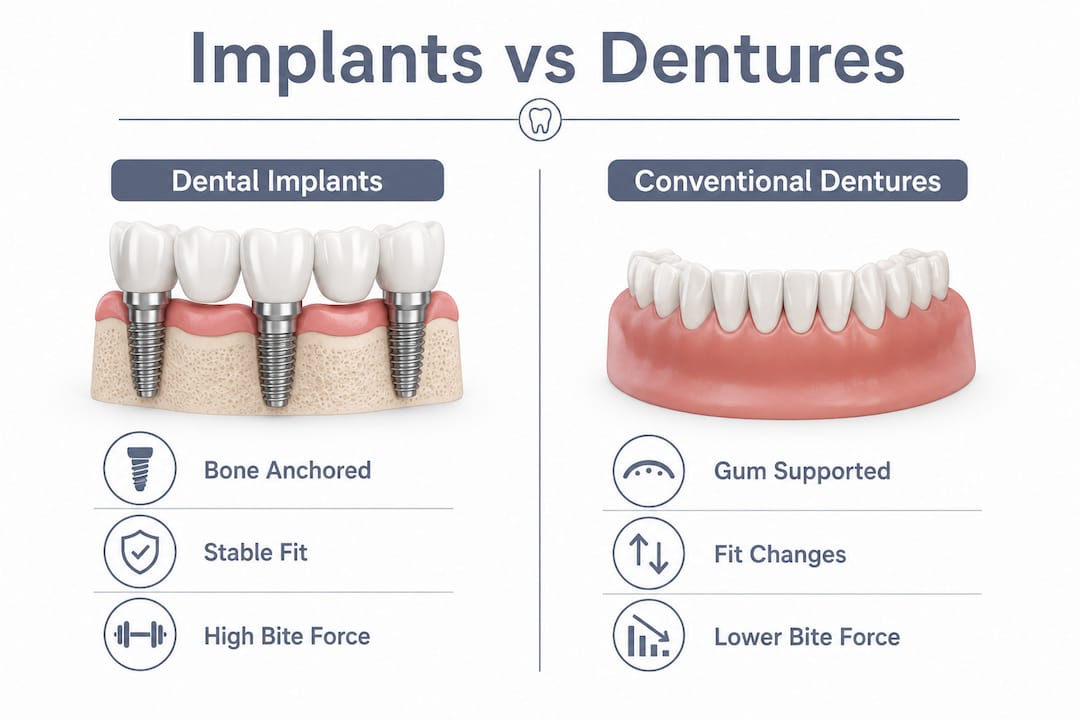
Dentures rest on this shrinking ridge. As the ridge changes shape, the denture fit degrades. Patients experience slipping, sore spots, difficulty chewing, and eventually an inability to keep the denture in place without adhesive. Bone resorption from dentures leads to a condition called "denture face," where collapsed lip support and an altered chin-to-nose distance become visible signs of the underlying bone loss.
Relining addresses the symptom, not the cause. A reline adds material to the tissue-facing surface of the denture to restore contact with the changed ridge. It works temporarily. Then the ridge continues to shrink, and the fit degrades again. This is why relines compensate for constantly changing oral anatomy rather than solving the underlying problem.
The typical denture maintenance cycle looks like this:
- Soft reline: Performed in-office or at home, lasts weeks to months, used when the ridge changes moderately.
- Hard reline: A more durable adjustment performed by a dental lab, lasts 1–2 years before fit degrades again.
- Replacement: Dentures generally require full replacement every 5–8 years as bone loss accumulates beyond what relining can correct.
- Adhesive dependency: Between relines, most patients rely on denture adhesive daily to maintain any functional fit.
Each step in this cycle costs money, time, and comfort. None of it stops the bone loss driving the cycle.
Implants versus dentures: what the maintenance gap really costs
The practical difference between implants and dentures is not just biological. It shows up in time, money, and quality of life over decades. Over a 25-year span, denture wearers may face multiple replacements and relines, with cumulative costs reaching $12,000–$22,000. That figure does not include adhesive purchases, emergency visits for broken dentures, or the indirect cost of food restrictions that affect nutrition and social confidence.
Implants carry a higher upfront investment. Full-arch treatment at Forever Smiles Implant Center starts at $19,000 per arch and includes surgical planning, same-day teeth, final custom zirconia teeth, and follow-up care. The long-term cost-effectiveness of implants becomes clear when that single investment is compared against decades of denture maintenance.
| Feature | Dental implants | Conventional dentures |
|---|---|---|
| Bite force restored | 90–95% of natural | 20–25% of natural |
| Bone preservation | Yes, through force distribution | No, accelerates bone loss |
| Relining required | Never | Every 1–2 years (hard reline) |
| Replacement cycle | Lifetime with proper care | Every 5–8 years |
| Adhesive needed | No | Daily for most patients |
| Facial structure preserved | Yes | No, "denture face" develops |
Pro Tip: When comparing costs, calculate the 20-year total for dentures including relines, replacements, and adhesive. Most patients are surprised to find implants are the more affordable option over time.
Implants also eliminate the reline alternatives for implants conversation entirely. There is no alternative needed because the fit does not change. The prosthesis attached to an implant stays stable because the bone it anchors to stays stable, or in many cases, actually improves in density over time.
Do implants ever need adjustments or maintenance?
Implants do not require relining, but they do require care. Understanding the difference matters. Relining is a structural correction forced by tissue change. Implant maintenance is routine hygiene and monitoring, the same category of care you give natural teeth.
Here is what long-term care for implants actually involves:
- Daily cleaning. Implant-supported teeth require brushing and flossing just like natural teeth. Plaque accumulates at the gumline around implants the same way it does around natural teeth.
- Professional cleanings. Twice-yearly visits allow a hygienist to clean areas a toothbrush cannot reach and check for early signs of inflammation.
- Peri-implantitis monitoring. Peri-implantitis is a bacterial infection of the tissue surrounding an implant. It is the primary risk to implant longevity and is preventable with consistent hygiene. Caught early, it is treatable. Left unchecked, it can cause bone loss around the implant.
- Screw torque checks. The small screws that connect the prosthesis to the implant can loosen over years of chewing. A quick in-office check and retightening takes minutes and is not a sign of implant failure.
- Prosthesis inspection. Zirconia crowns and full-arch prostheses are durable, but they can chip under extreme force. Periodic inspection catches minor wear before it becomes a larger issue.
Implants require hygiene and maintenance but not relining. That distinction is the key point. None of the maintenance steps above involve correcting for tissue shrinkage or bone loss, because implants prevent those changes rather than succumb to them. The fit you have on day one is the fit you have on year ten, assuming proper care.
Key Takeaways
Dental implants need no relines because osseointegration anchors them to bone, eliminating the tissue-driven fit changes that force denture wearers into repeated relining cycles.
| Point | Details |
|---|---|
| Bone anchoring prevents relines | Implants fuse to the jawbone, so fit never drifts the way it does with tissue-supported dentures. |
| Osseointegration is the mechanism | Primary stability (20–35 N·cm torque) transitions to biological bone integration, creating a permanent anchor. |
| Dentures cause bone loss | Bone resorption under dentures progressively worsens fit, requiring relines every 1–2 years and full replacement every 5–8 years. |
| Long-term cost favors implants | Cumulative denture costs over 25 years can reach $12,000–$22,000; implants require no relining expense. |
| Implant maintenance is hygiene, not refitting | Routine cleaning and monitoring keep implants healthy; no structural corrections for tissue change are ever needed. |
What I've seen after 28,000 implants that no article tells you
The "no relines" benefit sounds clinical on paper. In the exam room, it hits differently. Patients who have worn dentures for years arrive carrying a specific kind of exhaustion. Not just physical discomfort, though that is real. It is the mental load of managing a prosthesis that never quite works. The adhesive every morning. The foods they stopped eating years ago. The way they hold their mouth differently in public. The reline appointments that buy them a few months of relief before the cycle starts again.
What surprises most of them after implant placement is not the bite force, even though restoring that is significant. It is the absence of management. They stop thinking about their teeth. That is something denture wearers cannot imagine until they experience it, because dentures demand constant attention. Implants demand almost none.
I have also seen patients who delayed implants for years because they were told they were not candidates due to bone loss. That is where zygomatic implants change the equation. By anchoring to the cheekbone rather than the jaw, they give patients with severe resorption a fixed, reline-free solution that was not available to them through conventional implant pathways. The facial structure that "denture face" had begun to collapse starts to recover. That is not a cosmetic observation. It reflects real bone preservation and load distribution happening beneath the surface.
The no-reline advantage is not a feature. It is the result of getting the biology right. When an implant is placed correctly by a surgeon who does this every day, the bone responds, integrates, and holds. The prosthesis fits on day one and fits the same way a decade later. That is what done right looks like.
— Dr. Brian Young
Full-arch implants at Forever Smiles Implant Center
Patients who are tired of relining cycles, adhesives, and dentures that never quite fit have a permanent alternative. Forever Smiles Implant Center in Jacksonville, Florida, specializes exclusively in full-mouth dental implants, performing full-arch procedures every day with a team that includes a residency-trained surgical specialist, an in-house dental lab, and a board-certified MD anesthesiologist.
Every case includes 3D surgical planning, same-day teeth, and final custom zirconia teeth, all under one roof with one accountable team. For patients who have been told they are not candidates due to bone loss, Forever Smiles also offers zygomatic implants for cases where conventional implant placement is not possible. If you are ready to understand your specific options and what a reline-free solution looks like for your situation, the next step is a consultation with Dr. Brian Young.
FAQ
Why don't dental implants need to be relined?
Implants fuse directly to the jawbone through osseointegration, so the fit never changes with tissue shrinkage. Relining is only needed when a prosthesis rests on gum tissue that shifts over time, which implants bypass entirely.
How long do dental implants last without relining?
Dental implants can last a lifetime with proper hygiene and routine monitoring. Unlike dentures, which need relining every 1–2 years and full replacement every 5–8 years, implants maintain their fit indefinitely because bone integration does not degrade the way soft tissue does.
Do implants ever need any adjustments at all?
Implants do not need relines, but minor maintenance such as screw torque checks and prosthesis inspections may occur over time. These are not corrections for fit loss; they are routine checks unrelated to the tissue changes that drive denture relining.
What happens to bone under dentures that makes relining necessary?
Bone resorption begins immediately after tooth loss and accelerates under denture pressure. The shrinking ridge changes the shape of the gum surface the denture rests on, degrading fit progressively and requiring relines to compensate.
Can patients with severe bone loss still get implants and avoid relines?
Yes. Patients with significant jawbone loss who cannot support conventional implants may qualify for zygomatic implants, which anchor to the cheekbone. This approach restores full function and eliminates relining needs even in advanced bone loss cases.