

Dental implants are defined clinically as the leading tooth replacement solution for restoring both oral function and psychological well-being. The evidence is striking: before implant treatment, 67.7% of patients report that tooth loss affects their quality of life, with 45.8% experiencing psychological discomfort and 46.7% reporting social disability. After treatment, only 3.8% report any ongoing impact. That shift is not cosmetic. It is a measurable change in how patients experience themselves and the world around them. Forever Smiles Implant Center sees this transformation daily, and the clinical research confirms what patients describe in their own words.
How implants improve confidence: the core mechanisms
Dental implants restore confidence through three distinct channels: appearance, function, and emotional safety. Each one removes a specific barrier that tooth loss creates.
Restored aesthetics rebuild body image
A natural-looking smile is the most immediate change patients notice. Implants are designed to match surrounding teeth in color, shape, and proportion. Patients who previously covered their mouths when laughing or avoided photos report a rapid shift in body image once their smile looks complete again. This is not vanity. Research confirms a positive correlation between dental self-confidence and overall self-esteem, with a correlation coefficient of r=0.323. Improving how your teeth look measurably improves how you feel about yourself overall.

Implants also maintain facial bone structure in a way no other replacement option does. When a tooth root is missing, the jawbone beneath it begins to shrink. Implants stimulate that bone the same way natural roots do, preserving the facial contours that give a person a youthful appearance. Patients often notice this benefit gradually, as their face retains its shape rather than developing the sunken look common with long-term tooth loss.
Functional restoration reduces self-consciousness
Bite strength and clear speech are functional outcomes that directly affect social confidence. Patients with missing teeth often avoid certain foods, speak carefully to hide gaps, or decline social invitations involving meals. Implants restore full chewing function and eliminate the speech distortions that partial tooth loss can cause. The result is that patients stop managing their behavior around their teeth and start living normally again.
- Patients eat without restriction, removing a major source of daily anxiety
- Speech clarity improves, eliminating the self-monitoring that comes with gaps or loose dentures
- Smiling, laughing, and speaking in public become automatic rather than calculated
- Social meals and professional settings no longer feel like obstacles to navigate
Pro Tip: If you currently avoid certain foods or social situations because of your teeth, track those behaviors before treatment. Patients who document their pre-treatment limitations report a much clearer sense of how much their confidence has grown after implants.
What does research reveal about implants and psychological well-being?
Clinical studies on the psychological effects of implants show consistent, measurable improvements across multiple quality-of-life indicators.
"Dental implants restore, not create, confidence. They remove the physical and emotional obstacles that tooth loss places in front of a person. What emerges is the confidence that was already there, waiting." Dental implants and the psychology of confidence
The distinction in that quote matters. Implants do not manufacture a new personality. They remove the friction that tooth loss creates, and the patient's natural confidence re-emerges. This framing helps set realistic expectations while still communicating the depth of the change.
Research on implant-supported prostheses shows significant reductions in both situational and general anxiety after treatment. The same research identifies preoperative dental anxiety as a factor that can affect postoperative outcomes, which is why psychological assessment before treatment is part of responsible implant planning. Patients who understand what to expect recover with fewer setbacks and greater satisfaction.
| Psychological measure | Pre-treatment | Post-treatment |
|---|---|---|
| Quality of life impact | 67.7% affected | 3.8% affected |
| Psychological discomfort | 45.8% | Significantly reduced |
| Social disability | 46.7% | Significantly reduced |
| Overall self-esteem correlation | Baseline | r=0.323 improvement with dental confidence |
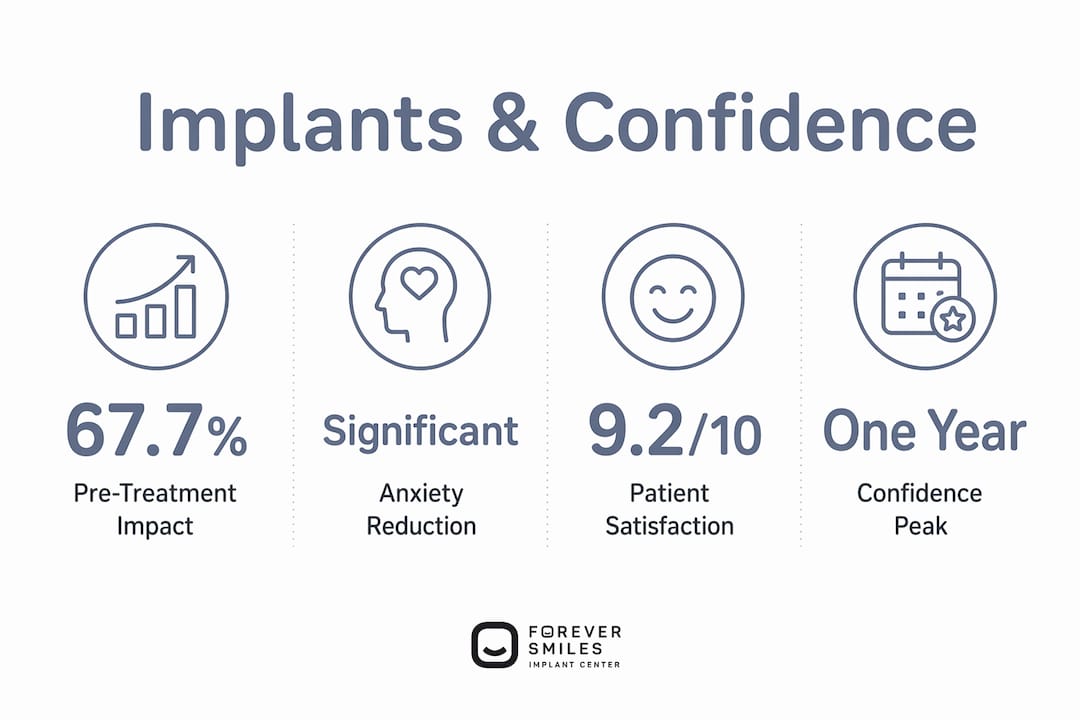
The numbers in that table represent real patients whose daily experience changed after treatment. A person who previously felt disabled socially by their teeth now functions without that weight. That is a clinical outcome, not a marketing claim.
Patients also report less social anxiety and improved mood related to self-image after implant treatment. They become more willing to engage socially, accept invitations, and participate in conversations without the background noise of self-consciousness. These are not trivial changes. They affect relationships, career performance, and overall mental health.
How does confidence evolve over time after implants?
The psychological timeline after implant treatment follows a predictable pattern, and understanding it helps patients set realistic expectations.
- Weeks 1–8: Physical focus. Healing dominates attention. Patients are aware of the implants as foreign objects and monitor their comfort closely. Confidence gains are present but secondary to recovery.
- Months 2–6: Functional integration. Patients begin eating, speaking, and smiling with less conscious effort. They notice the absence of old coping behaviors, like covering their mouth or ordering soft foods only.
- Months 6–12: Emotional shift. Social anxiety decreases. Patients stop projecting negative judgments onto others and start engaging more openly. Mood improves as self-image stabilizes.
- After one year: Identity rebranding. This is the most significant milestone. Around one year after surgery, patients report that they no longer think about their teeth. Confidence becomes the absence of self-doubt rather than an active feeling. The implants have become part of who they are.
The one-year mark is where the deepest psychological transformation occurs. Patients stop identifying as someone with a dental problem and start identifying as a healthy, confident person. That internal shift is what makes implant treatment different from other dental procedures. It is not just a physical fix. It is a change in how a person understands themselves.
Pro Tip: Keep a simple journal during your first year with implants. Note when you stop avoiding a food, a social event, or a photo. Those small moments add up to a clear picture of how much your confidence has grown.
How do implants compare to other tooth replacement options for confidence?
Not all tooth replacement options deliver the same psychological benefit. The key difference is fixation.
Removable dentures require daily removal, adhesives, and constant awareness of potential slipping. That awareness creates a background level of social anxiety that never fully disappears. Patients with dentures often fear embarrassment in social situations, particularly during meals, laughter, or public speaking. Implants eliminate that fear entirely because they are fixed permanently in the jaw. There is nothing to slip, nothing to remove, and nothing to worry about.
The satisfaction data supports this clearly. Implant patients report a satisfaction score of 9.2 out of 10, compared to 7.6 out of 10 for fixed bridge patients. Aesthetics scores follow the same pattern: 9.1 out of 10 for implants versus 8.0 out of 10 for bridges. Speech and chewing satisfaction also favor implants consistently.
| Feature | Dental implants | Removable dentures | Fixed bridges |
|---|---|---|---|
| Risk of slipping | None | Present | None |
| Bone preservation | Yes | No | No |
| Patient satisfaction | 9.2/10 | Lower | 7.6/10 |
| Aesthetics score | 9.1/10 | Variable | 8.0/10 |
| Psychological comfort | High | Moderate | Moderate |
Fixed bridges are a step up from dentures in terms of stability, but they do not preserve bone and they require grinding down adjacent healthy teeth. For patients who want the long-term investment in both oral health and confidence, implants are the only option that addresses all three dimensions: aesthetics, function, and bone structure. You can read more about how the two options compare in this implants vs. dentures guide.
What I've learned after 28,000 implants about confidence and patients
After placing more than 28,000 implants over two decades, the pattern I see most clearly is this: the patients who gain the most confidence are not always the ones with the most dramatic physical transformations. They are the ones who were quietly suffering the longest.
A patient who has worn ill-fitting dentures for 15 years does not just gain teeth when we complete their full-arch reconstruction. They gain back a version of themselves they thought was gone. I have watched patients cry in the chair, not from pain, but from relief. That is not something you see in a satisfaction survey. It is something you carry with you as a clinician.
What I tell every patient before surgery is this: the implants will do their job. Your job is to give yourself permission to stop hiding. The physical barrier will be gone, but the habit of hiding takes a little longer to unlearn. That is normal. The one-year milestone is real. Patients who understand that timeline arrive at it with patience instead of frustration.
The other thing I have learned is that preoperative anxiety matters more than most patients realize. Patients who come in with high anxiety and no preparation tend to have a harder recovery, not because the surgery is more difficult, but because their nervous system is already working against them. We address that directly at Forever Smiles Implant Center, because a well-prepared patient is a confident patient from day one.
Experience is not expensive. Inexperience is. That applies to the surgeon, and it applies to the patient's preparation.
— Dr. Brian Young
Renewed confidence starts with the right team
Choosing to pursue dental implants is a significant decision. The clinical outcome and the confidence that follows depend heavily on the expertise behind the procedure.
Forever Smiles Implant Center is a specialized surgical center in Jacksonville, Florida, focused exclusively on full-arch implant reconstruction. Dr. Brian Young has placed over 28,000 implants and performs full-arch surgery every day. The center handles everything under one roof: 3D imaging, surgical planning, in-house lab, and a board-certified MD anesthesiologist. Patients who have been told they are not candidates elsewhere often find a path forward here, including through zygomatic implants for cases with severe bone loss. Start with the dental implants FAQ to get clear answers before your first conversation with the team.
Key takeaways
Dental implants restore confidence by removing the aesthetic, functional, and emotional barriers that tooth loss creates, with the deepest psychological gains stabilizing around the one-year mark.
| Point | Details |
|---|---|
| Dramatic quality-of-life shift | Pre-treatment, 67.7% of patients report impact; post-treatment, only 3.8% do. |
| Three confidence channels | Implants restore appearance, oral function, and emotional safety simultaneously. |
| One-year identity shift | Around 12 months post-surgery, patients stop thinking about their teeth and self-doubt fades. |
| Higher satisfaction than alternatives | Implant patients score satisfaction at 9.2/10 versus 7.6/10 for fixed bridge patients. |
| Bone preservation adds long-term value | Implants maintain jawbone structure, preserving facial appearance and self-image over time. |
FAQ
Do dental implants really improve self-esteem?
Yes. Research shows a positive correlation of r=0.323 between dental self-confidence and overall self-esteem, meaning improvements in dental aesthetics produce measurable gains in broader psychological well-being.
How long does it take to feel confident after implants?
Most patients notice functional confidence within the first few months, but the deepest shift occurs around one year after surgery, when implants become part of natural function and self-doubt fades.
Are implants better than dentures for confidence?
Implants offer a psychological advantage that dentures cannot match. Their fixed, permanent nature eliminates the fear of slipping and the social anxiety that removable options create, and patient satisfaction scores confirm the difference.
Can implants reduce social anxiety?
Yes. Clinical research on implant-supported prostheses shows significant reductions in both situational and general anxiety after treatment, with patients reporting greater willingness to engage socially.
Who is a good candidate for dental implants?
Most adults with missing teeth, failing teeth, or ill-fitting dentures qualify. Patients with severe bone loss who have been turned away elsewhere may still have options, including zygomatic implants. Visit the candidacy page at Forever Smiles Implant Center for a detailed overview.