

Natural-looking implant teeth are custom-crafted restorations that replicate real teeth in color, shape, translucency, and gumline emergence for a seamless blend with surrounding teeth. The industry term is implant-supported crown or prosthesis, and it describes a three-part system: a titanium or zirconia post placed in the jawbone, an abutment connector, and a visible crown designed to match your natural teeth. Understanding what is natural looking implant teeth means understanding how biology, materials, and surgical design work together. This guide covers every factor that determines whether your final result looks real or obvious.
What makes implant teeth look natural?
Natural-looking implant teeth combine a surgically placed post with a visible crown matched to neighboring teeth in shade, shape, and gumline emergence. No single element creates the natural result. Color, translucency, contour, and tissue integration all contribute equally.
The crown material carries the most visible weight. Zirconia and lithium disilicate ceramics are the gold standard because they mimic the optical depth of natural enamel. A shade guide match alone is not enough. The crown must also reflect light the way a real tooth does, which requires the right ceramic thickness and layering technique.
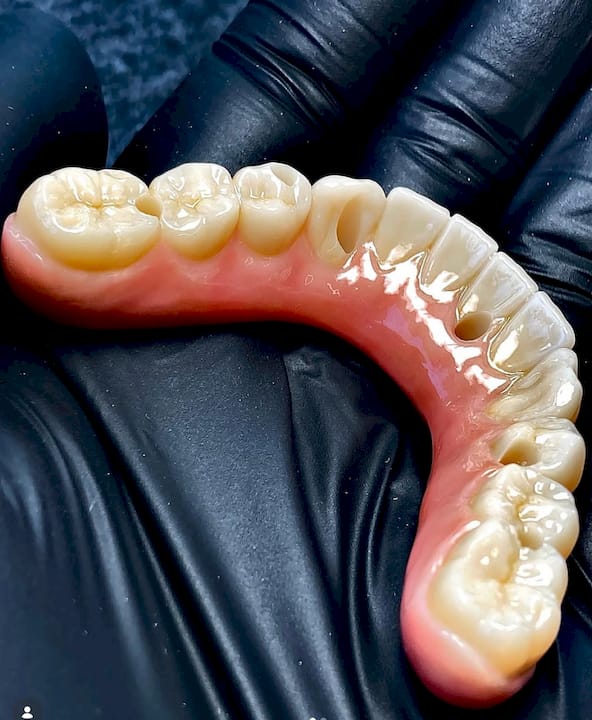
Gumline emergence is the factor most patients overlook. The point where the crown exits the gum tissue must mirror the angle and contour of a natural tooth root. When that angle is wrong, the restoration looks like a post sticking out of the gum rather than a tooth growing from it. Surgical placement depth and abutment shape both control this outcome.
How does biology support a natural implant appearance?
Bone healing is the foundation of every realistic tooth implant. After the post is placed, bone heals around the implant and the gumline is stitched closed, creating a stable tissue base that removable dentures never achieve. That integration is what gives an implant the feel and look of a tooth rooted in your jaw.
The gum tissue goes through its own maturation process after surgery. Soft tissue takes weeks to months to settle into its final shape around the abutment. The contour you see at six weeks is not the contour you will see at six months.
Key biological factors that shape the final natural appearance:
-
Integration: Bone fusing to the titanium or zirconia post creates the stable anchor that holds the crown at the correct depth.
-
Soft tissue maturation: Gum tissue gradually forms a collar around the abutment, defining the emergence profile.
-
Papilla preservation: The small triangles of gum tissue between teeth must be maintained to avoid dark gaps that signal an artificial restoration.
-
Tissue thickness: Patients with thicker gum tissue biotypes tend to develop more stable, natural-looking gumlines post-healing.
Pro Tip: Do not judge your final result at the two-week mark. Soft tissue maturation shapes the natural gumline over months, and the definitive aesthetic emerges only after that healing stabilizes.
What materials make implant crowns look lifelike?
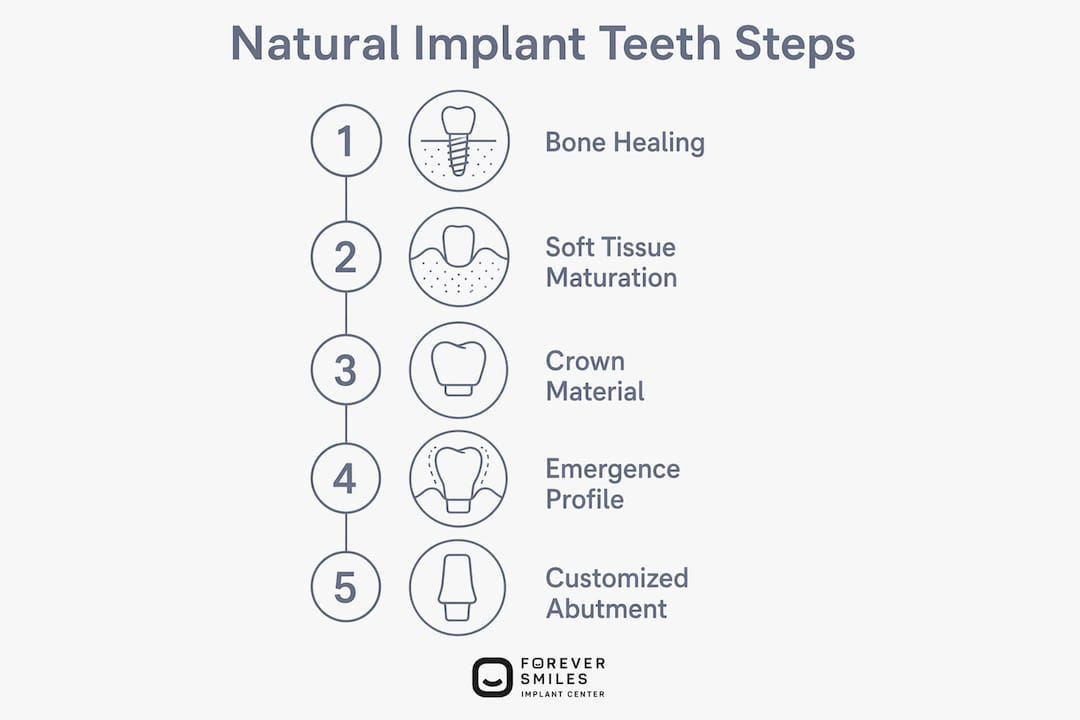
Material selection determines whether a crown looks like a tooth or a tooth-shaped object. Ceramic translucency, substrate type, resin cement shade, and opaquer liner use all influence the final color and optical performance of the crown. A skilled lab technician manages every layer of this optical stack.
The four material decisions that affect how realistic a crown looks:
-
Crown material: Zirconia offers strength and a natural white base. Layered zirconia adds translucency at the incisal edge to mimic natural enamel depth. Lithium disilicate is highly translucent and works well for anterior teeth where light transmission matters most.
-
Substrate color: The abutment beneath the crown affects what shows through. A gray metal abutment under a translucent ceramic can create a dark shadow at the gumline. A tooth-colored zirconia abutment eliminates that problem.
-
Resin cement shade: The cement used to seat the crown contributes to the final color. Using the wrong shade shifts the result away from the target, even when the crown itself is correctly matched.
-
Opaquer liner: When the substrate is dark or the crown is highly translucent, an opaquer liner blocks unwanted color transmission. Opaque liners and correct cement shades stabilize color outcomes for long-term consistency.
Pro Tip: Ask your provider specifically what abutment material they plan to use. A zirconia abutment paired with a layered zirconia crown gives the most natural optical result for front teeth, where translucency is visible in every smile.
How does the emergence profile affect gumline appearance?
The emergence profile is the shape of the crown as it exits the gum tissue. It is defined by two measurements: the emergence angle (how steeply the crown rises from the implant) and the subcritical contour (the shape of the crown just below the gumline). Both measurements directly control whether the gum tissue stays stable or recedes over time.
Research confirms that an emergence angle of 30° or greater and a subcritical contour of 0.5 mm or more are the thresholds needed to prevent labial tissue recession on anterior implants. Missing those thresholds leads to gum recession that exposes the crown margin, making the restoration look artificial and shortening its lifespan.
| Emergence profile factor | Target threshold | Effect if missed |
|---|---|---|
| Emergence angle | ≥ 30° | Tissue recession, exposed crown margin |
| Subcritical contour | ≥ 0.5 mm | Unstable gumline, unnatural tooth shape |
| Abutment material | Zirconia preferred | Dark shadow visible through gum tissue |
| Customization level | Patient-specific | Poor fit, asymmetric gumline |
A customized abutment shaped to the individual patient’s anatomy produces the most stable gumline. Stock abutments are designed for average anatomy. They work in straightforward cases but fall short when the gumline needs precise contouring to match adjacent teeth. The long-term aesthetic impact of getting this right is significant. A well-designed emergence profile holds its shape for years. A poorly designed one shows recession within months.
How do implants compare to dentures and bridges for natural appearance?
Implants are fixed in the jawbone. Dentures rest on the gums and may shift, which creates visible movement and changes how the face looks over time. That distinction in stability is the single biggest reason implants look and feel more natural than removable options.
The key differences in appearance and function:
-
Stability: Implants do not move during eating or speaking. Dentures can shift, creating an unnatural look and feel that patients and observers both notice.
-
Bone preservation: Implants stimulate the jawbone the way natural tooth roots do. Dentures do not. Bone loss under a denture changes facial structure over years, making the face appear sunken.
-
Adjacent teeth: A traditional bridge requires grinding down the two teeth on either side of the gap to serve as anchors. Implants leave neighboring teeth untouched.
-
Gum integration: Implant crowns emerge from the gum tissue like natural teeth. Dentures sit on top of the gum surface, which looks and feels different.
-
Maintenance: Implants are cleaned like natural teeth. Dentures require removal and separate cleaning routines.
Patients who replace dentures with implants consistently report that the fixed, stable result changes how they eat, speak, and feel about their appearance. The difference is not subtle.
Key Takeaways
Natural-looking implant teeth require coordinated decisions across biology, materials, and surgical design. No single factor determines the outcome.
| Point | Details |
|---|---|
| Biology drives the foundation | Bone integration and soft tissue maturation create the stable base for a natural emergence profile. |
| Materials determine optical realism | Zirconia abutments, layered ceramic crowns, and correct cement shades control how light passes through the restoration. |
| Emergence profile prevents recession | An emergence angle of ≥ 30° and subcritical contour of ≥ 0.5 mm are the clinical thresholds for stable gumline tissue. |
| Implants outperform dentures long-term | Fixed implants preserve bone, stabilize facial structure, and integrate with gum tissue in ways dentures cannot. |
| Healing takes time | Final aesthetic results appear only after soft tissue fully matures, which takes months, not weeks. |
What I have learned placing over 28,000 implants
Patients come to me asking whether implants will look real. My honest answer is: they can look completely indistinguishable from natural teeth, but only when every decision in the process is made correctly. The outcome is not determined in surgery. It is determined in planning.
The single biggest mistake I see from cases that arrive at Forever Smiles Implant Center after failing elsewhere is that the provider treated implant placement as a surgical problem and ignored the prosthetic design. They placed the post in the bone and handed the crown work to someone who had no input on implant depth or angle. The result looks mechanical because it was designed mechanically.
3D imaging and guided placement are not optional for natural aesthetics. They are the only way to position the implant at the correct depth and angle to support the emergence profile the crown requires. When I plan a case, I am thinking about where the gumline needs to be at the final restoration, and I am placing the implant to support that outcome from day one.
Patients also need to understand that patience is part of the process. I tell every patient that what they see at two months is not what they will see at six months. Soft tissue is still forming. The gumline is still settling. Rushing to the final crown before tissue matures produces a result that looks good in the short term and disappoints at the one-year mark.
Ask your provider two questions before you commit: How will you manage my bone and gum tissue together? And what abutment material are you planning to use? If they cannot answer both questions with specifics, that tells you something important about how they approach aesthetic outcomes.
— Dr. Brian Young
Natural implant results at Forever Smiles Implant Center
Forever Smiles Implant Center in Jacksonville, Florida, is built around one focus: full-mouth implant reconstruction done right the first time. Every case begins with advanced 3D imaging and smile design so that implant position, abutment shape, and crown material are planned together before surgery begins.

The in-house dental lab fabricates custom zirconia crowns matched to each patient’s natural tooth color and optical profile. Dr. Brian Young, with over 28,000 implants placed, performs full-arch surgery daily and oversees every stage from planning through final restoration. Patients who want to understand their options in detail can review common implant questions or contact the team directly to schedule a consultation.
FAQ
What is a natural-looking dental implant made of?
A natural-looking dental implant consists of a titanium or zirconia post, a custom abutment, and a ceramic crown made from zirconia or lithium disilicate. These materials replicate the color and translucency of natural enamel.
How long does it take for implants to look natural?
The final natural appearance develops over several months as soft tissue matures around the abutment. Patients should not evaluate their aesthetic result until gum tissue has fully stabilized, typically at the six-month mark.
Are implant teeth as natural-looking as real teeth?
When properly planned and placed, implant crowns are visually indistinguishable from natural teeth. Coordinated decisions across implant positioning, abutment design, and crown material determine whether the result blends completely.
What is the cost of natural-looking implant teeth?
Full-mouth implant treatment at Forever Smiles Implant Center starts from $19,000 per arch, which includes planning, surgery, same-day teeth, final zirconia crowns, and follow-up care. Pricing varies based on individual case complexity.
Do implants look better than dentures?
Implants look and function more like natural teeth than dentures because they are fixed in the jawbone, preserve bone volume, and integrate with gum tissue. Dentures rest on the gum surface and can shift, which changes both appearance and facial structure over time.