
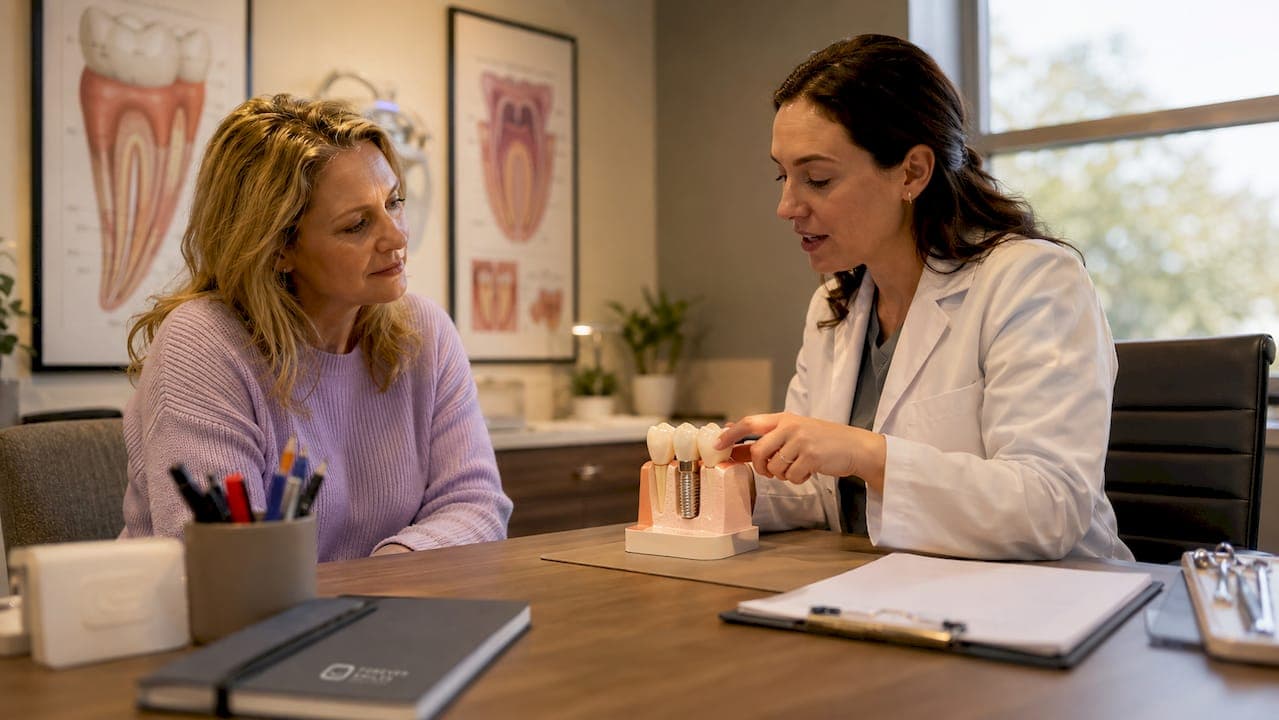
Dental implants restore bite force by fusing directly with the jawbone through a biological process called osseointegration, giving artificial teeth the same stable root-like foundation as natural ones. Clinical literature confirms that implants restore 80–100% of natural bite strength, compared to roughly 25% for traditional removable dentures. That gap is not a minor difference. It determines what you can eat, how well you absorb nutrients, and whether your jawbone stays intact over the decades ahead. Understanding how implants restore bite force is the first step toward making a fully informed treatment decision.
How do dental implants mechanically restore bite force?
Dental implants work by replacing the tooth root, not just the visible crown. A titanium post is placed directly into the jawbone, where it fuses with surrounding bone tissue over several months. That fusion is what gives implants their strength. The crown attached on top then receives and transmits chewing loads straight into the jaw, just as a natural root would.
Natural teeth have a periodontal ligament, a thin layer of connective tissue that cushions each tooth and provides sensory feedback during chewing. Implants lack this ligament entirely. As a result, implants transmit forces more rigidly, without the natural shock absorption or the subtle sensory signals that tell you how hard you are biting. Patients notice this difference early in recovery and must consciously adapt their chewing habits during the transition period.
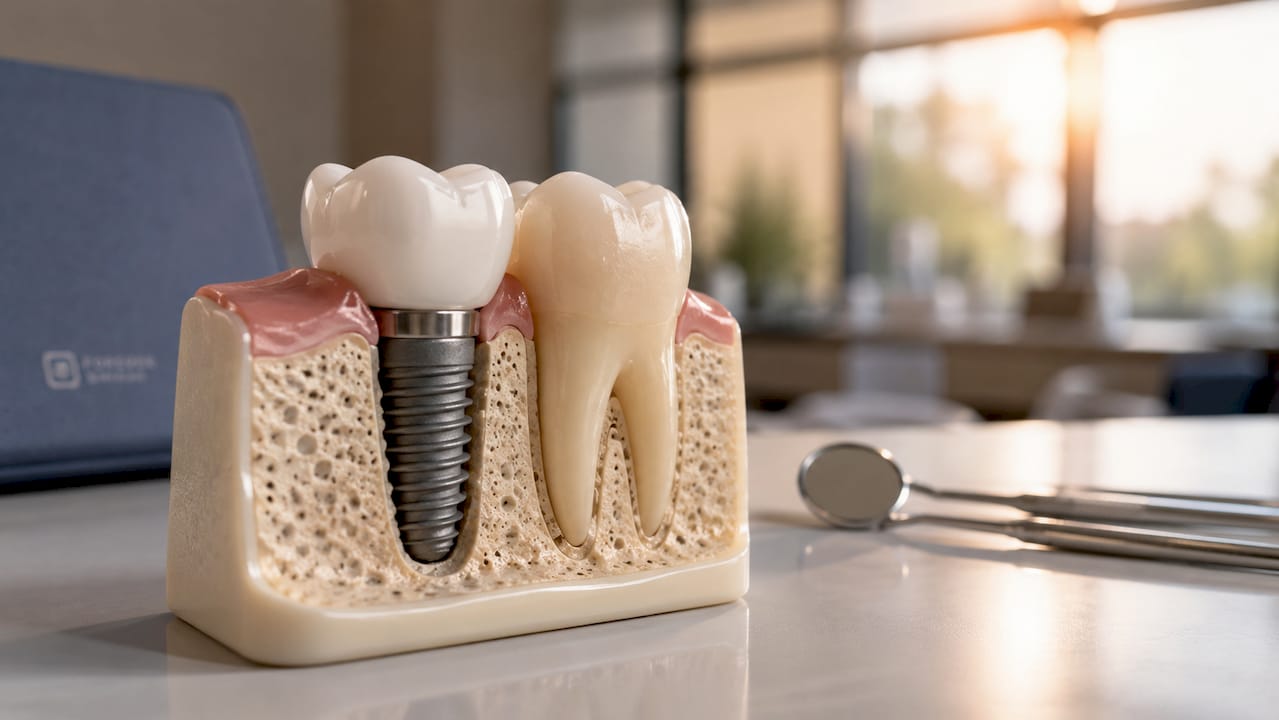
Removable dentures sit on top of the gum tissue and rely on suction or adhesive for stability. They transfer almost no force into the jawbone. That is why dentures restore only about 25% of natural bite strength, while implants approach full restoration. Fixed implant-supported bridges distribute chewing loads across multiple implant posts, which improves stability over a single-tooth implant but still depends on the same osseointegration principle.
Pro Tip: If you are comparing tooth replacement options, ask your surgeon specifically about bite force values for each option relative to your bone density and jaw position. The numbers vary more than most patients expect.
| Replacement type | Approximate bite force restored | Bone preservation |
|---|---|---|
| Natural teeth | 100% (baseline) | Full |
| Single dental implant | 80–100% | Yes |
| Implant-supported bridge | 70–90% | Yes, at implant sites |
| Removable full denture | ~25% | No |
What does clinical data show about bite force recovery after implant surgery?
Recovery after implant surgery follows a predictable sequence, though the timeline varies by patient. Most patients eat soft foods within 24 hours of surgery. By two weeks, textured foods become manageable. Full functional bite force typically returns between three and six months post-surgery, once osseointegration is well established.
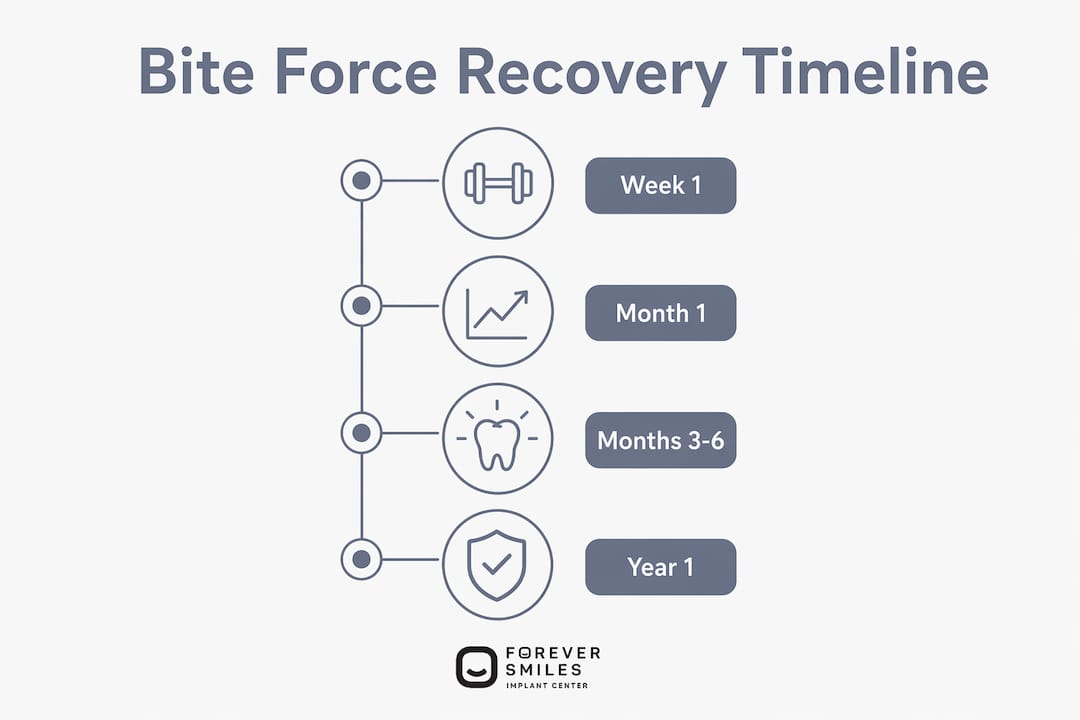
The subjective experience of chewing improves dramatically over the first year. One study tracking 70 patients found that chewing scores rose from 4.1 to 8.7 out of 10 within 12 months of implant placement. That nearly doubles the patient's self-reported chewing ability. The improvement reflects both the physical maturation of the bone-implant interface and the patient's growing confidence and adaptation to the new bite.
Measurable bite force increases continue beyond the six-month mark. A 2026 systematic review found that bite force keeps improving up to 18 months after surgery, with patient gender and implant location both influencing the rate of recovery. Men tend to recover higher absolute bite force values, and posterior implants consistently outperform anterior ones due to denser bone in the back of the jaw.
Key factors that affect how quickly and fully bite force returns include:
- Implant position. Posterior (back) implants sit in denser bone and bear higher forces naturally.
- Patient age and bone density. Younger patients with denser bone typically integrate faster.
- Surgical technique. Precise placement and proper torque at insertion affect early stability.
- Loading protocol. Gradual progression from soft to firm foods protects the healing interface.
- Oral hygiene. Infection around an implant (peri-implantitis) slows or reverses recovery.
The recovery timeline after implant surgery is not a straight line. Patients who follow their surgeon's food progression guidelines consistently reach higher long-term bite force values than those who rush the process.
How do implants improve bite distribution and long-term oral health?
Restoring bite force is only part of what implants accomplish. The deeper benefit is what happens to the jawbone and surrounding teeth over time. When a tooth is lost, the bone that once supported it begins to shrink. This process, called resorption, is progressive and permanent without intervention. Osseointegration halts bone resorption by providing the mechanical stimulation the bone needs to maintain its density, the same stimulation a natural root once provided.
Preserved bone volume does more than keep the implant stable. It maintains the vertical height of the jaw, which determines facial structure, lip support, and the alignment of your remaining teeth. Patients who wear dentures for years often develop a sunken facial appearance as bone gradually disappears beneath the gum line. Implants prevent that progression entirely.
Even force distribution is another structural advantage. Implants redistribute masticatory forces evenly across the dental arch, reducing the overload that missing teeth place on neighboring natural teeth. When one section of the arch is missing, adjacent teeth compensate by absorbing more force than they were designed to handle. Over years, that overload causes accelerated wear, cracking, and tooth loss. Implants interrupt that cycle.
"Restoring bite force with implants is not just about eating steak again. It is about stopping a decade-long chain reaction of bone loss, tooth damage, and facial change before it starts. The patients who understand this make better long-term decisions about their care."
The nutritional implications are real and measurable. Patients with severely reduced bite force tend to avoid hard, fibrous foods like raw vegetables, lean meats, and whole grains. Those are exactly the foods associated with lower rates of cardiovascular disease and better metabolic health. Restoring full chewing function expands dietary range in ways that directly affect overall health outcomes.
What factors influence bite force outcomes and long-term implant success?
Implant location is the single biggest anatomical variable in bite force outcomes. Posterior implants achieve higher bite force because the bone in the back of the jaw is denser and the jaw muscles generate more force at that position. Anterior implants in the front of the mouth serve a different mechanical role, primarily cutting and guiding food rather than crushing it. Surgeons account for this when planning implant positions for full-arch cases.
Progressive loading is the clinical standard for protecting the bone-implant interface during healing. Gradual food texture progression over several months allows osseointegration to mature before the implant faces full chewing loads. Skipping this phase by eating hard or crunchy foods too early risks microfractures at the interface, which can lead to implant loosening or failure. The protocol is not overly conservative. It reflects the actual biology of bone healing.
Long-term implant success depends on consistent maintenance. Peri-implantitis, an infection of the tissue around the implant, is the leading cause of late implant failure. Professional cleanings every six months, combined with daily brushing and flossing around the implant crown, keep the surrounding tissue healthy and the bone-implant bond intact.
- Follow the food progression schedule your surgeon provides. Soft foods for the first two weeks, then gradual introduction of firmer textures through month six.
- Attend every follow-up appointment. Early signs of peri-implantitis are reversible when caught quickly.
- Use an implant-safe oral hygiene routine. Interdental brushes and water flossers reach areas a standard toothbrush cannot.
- Avoid habits that stress the implant. Bruxism (teeth grinding) places extreme force on implant crowns and should be managed with a night guard.
- Understand the sensory difference. Because implants lack a periodontal ligament, you will not feel the same feedback as with natural teeth. Chew deliberately until your brain recalibrates.
Pro Tip: Patients who grind their teeth at night should tell their surgeon before implant placement. A custom night guard protects both the implant crown and the bone-implant interface from excessive nocturnal force.
Key Takeaways
Dental implants restore bite force by anchoring into the jawbone through osseointegration, recovering 80–100% of natural bite strength while preventing bone loss and protecting adjacent teeth from overload.
| Point | Details |
|---|---|
| Bite force restoration | Implants recover 80–100% of natural bite strength; dentures restore only about 25%. |
| Recovery timeline | Soft foods within 24 hours; full bite force typically returns between 3 and 6 months. |
| Ongoing improvement | Bite force continues increasing up to 18 months as osseointegration matures. |
| Bone preservation | Osseointegration prevents jawbone resorption, maintaining facial structure long term. |
| Long-term maintenance | Professional cleanings and progressive loading protocols protect bite force over decades. |
What I've learned from 28,000 implants about bite force recovery
Patients ask me constantly whether implants "feel like real teeth." The honest answer is: close, but not identical. The absence of a periodontal ligament means the sensory feedback is different. You will not feel the same subtle pressure signals you had with natural teeth. Most patients adapt within a few months and stop noticing the difference. A small number never fully stop noticing. That is worth knowing before surgery, not after.
What surprises patients most is how gradual the improvement is. They expect to leave surgery with a fully functional bite. The reality is that the first few months are about healing, not performance. The performance comes later, and when it does, it tends to exceed what patients imagined. Chewing scores nearly doubling over 12 months is not a statistical abstraction. I see it in the room. Patients who were eating soft foods exclusively start talking about foods they had not eaten in years.
The cases I find most rewarding are the ones where patients were told elsewhere that they were not candidates, usually because of severe bone loss. With zygomatic implants and advanced surgical planning, many of those patients achieve full bite force restoration that a standard approach could not deliver. The full-mouth reconstruction process is more nuanced than most patients realize, and the outcome depends heavily on who is doing the planning and the surgery.
My advice to anyone researching implants is to treat the healing phase as an investment, not a delay. Every week of following the food progression protocol is a week of building the bone-implant bond that will carry your bite force for decades. Rushing it costs more than it saves.
— Dr. Brian Young
Restoring your bite at Forever Smiles Implant Center
Forever Smiles Implant Center in Jacksonville, Florida, specializes exclusively in full-mouth dental implant reconstruction. Every case is planned with 3D imaging before surgery, and the in-house dental lab fabricates custom zirconia teeth on-site. Patients receive surgical planning, surgery, and final teeth from one accountable team under one roof.

Dr. Brian Young has placed over 28,000 implants and performs full-arch surgery daily. The practice handles complex cases, including patients with severe bone loss who have been turned away elsewhere. Full-mouth treatment starts at $19,000 per arch and includes planning, surgery, same-day teeth, final zirconia restorations, and follow-up care. For answers to common questions about treatment and outcomes, visit the implant FAQs page or explore full-mouth implant options to learn what is possible for your specific situation.
FAQ
How much bite force do dental implants restore?
Dental implants restore approximately 80–100% of natural bite strength, compared to about 25% for removable dentures. The exact value depends on implant location, bone density, and how fully osseointegration matures.
How long does it take to regain full bite force after implant surgery?
Most patients achieve functional bite force between three and six months post-surgery, with continued improvement up to 18 months. Soft foods are manageable within 24 hours of surgery, and firmer textures are introduced gradually as healing progresses.
Do dental implants feel the same as natural teeth when biting?
Implants feel close to natural teeth but not identical. Because they lack a periodontal ligament, the sensory feedback during chewing is more rigid. Most patients adapt within a few months and report high satisfaction with their restored chewing function.
Can implants prevent jawbone loss after tooth extraction?
Yes. Osseointegration preserves jawbone density by providing the mechanical stimulation the bone needs to stay intact. Removable dentures do not provide this stimulation, which is why bone loss continues under dentures over time.
Why do posterior implants achieve higher bite force than anterior implants?
The bone in the back of the jaw is denser, and the jaw muscles generate more force at that position. Posterior implants bear higher forces by design, which is why surgical placement planning accounts for implant position when targeting optimal bite force outcomes.