
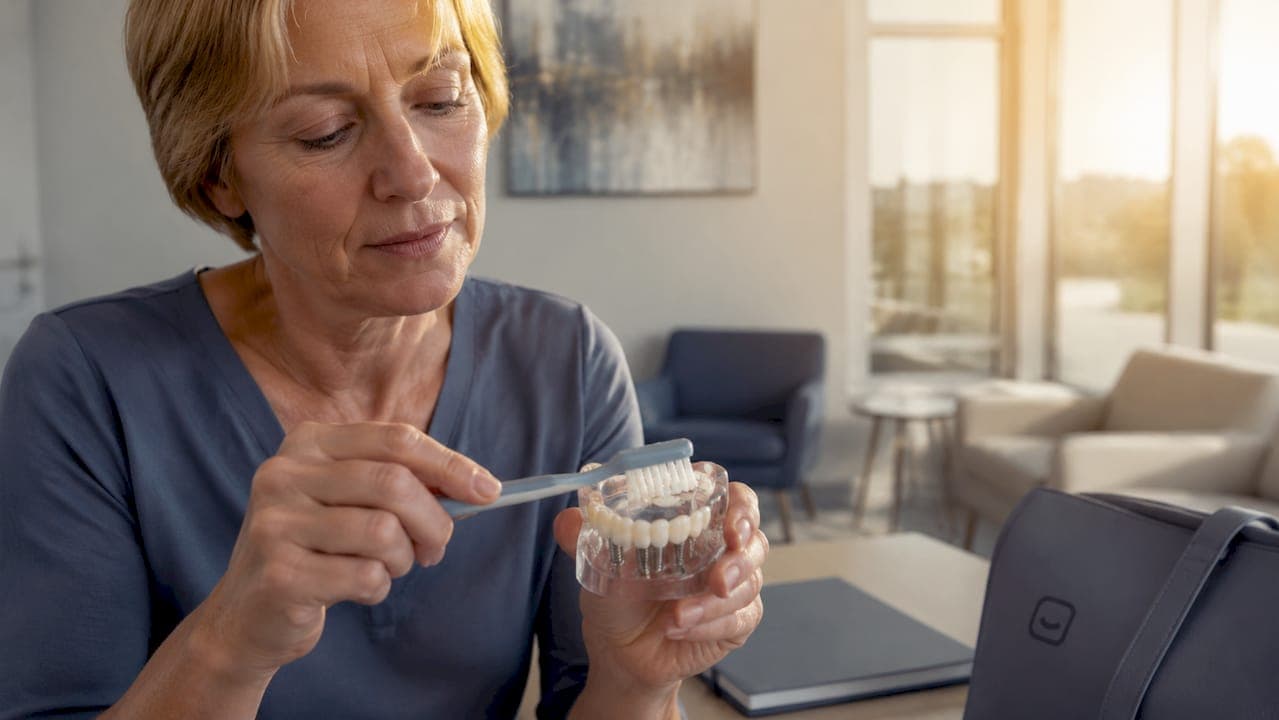
Cleaning an implant-supported arch is defined as the daily removal of biofilm from the prosthesis, abutments, and surrounding gum tissue to prevent peri-implant disease. Unlike natural teeth, implants lack a periodontal ligament, which makes the surrounding tissue more vulnerable to bacterial damage. Treated implants relapse at high rates within one year without consistent care. The gold-standard routine combines a soft-bristle toothbrush, super floss, and a water flosser, supported by professional maintenance visits every 3–6 months. Knowing how to clean an implant supported arch correctly protects your investment and keeps your gums healthy for the long term.
What are the essential daily tools for cleaning an implant-supported arch?
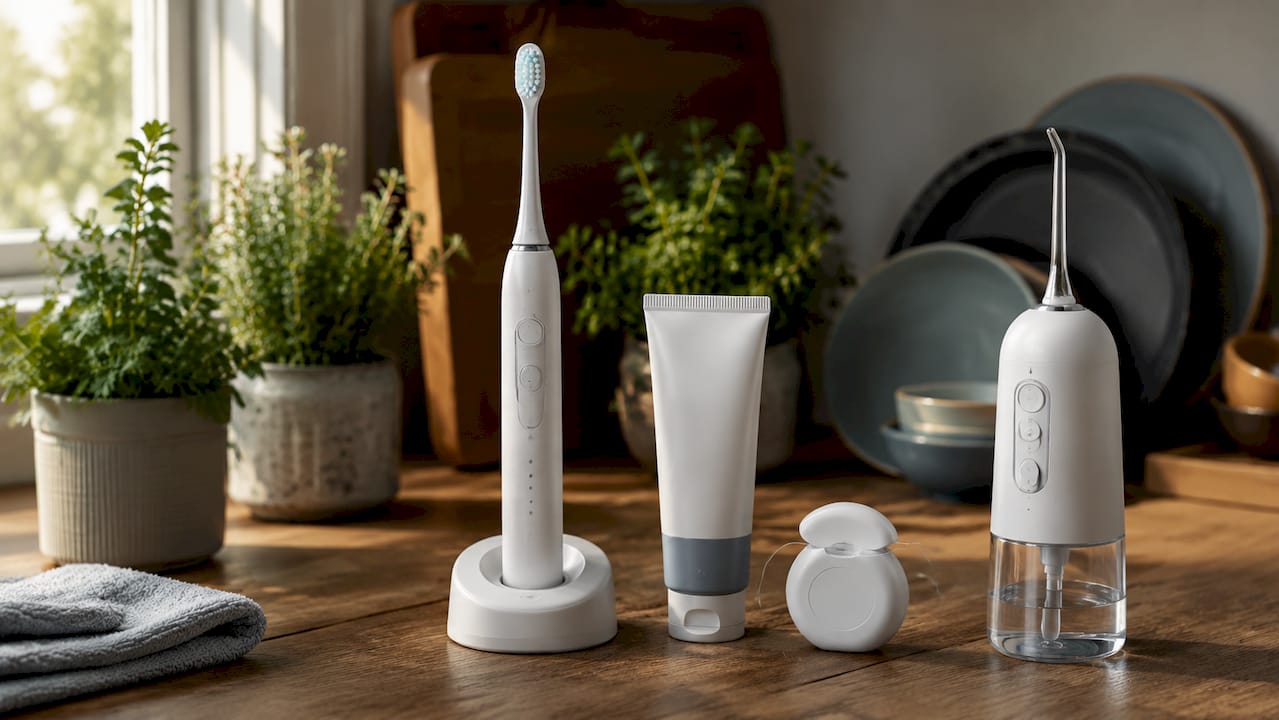
The gold-standard home care routine includes four tools: a soft-bristle or electric toothbrush, non-abrasive toothpaste, super floss, and a water flosser. Each tool targets a different zone of the arch. Together, they disrupt biofilm at the gum line, under the bridge, and between abutments.
Brushing technique
Brush at least twice daily using a soft-bristle manual or electric toothbrush. Angle the bristles toward the gum line and use short, circular strokes. Electric toothbrushes with oscillating heads remove more plaque per stroke than manual brushing, which matters when you are cleaning a full arch. Use a low-abrasive toothpaste formulated for implants or a gel-based paste without baking soda or charcoal. Gritty or whitening pastes scratch the prosthetic surface and increase bacterial adhesion over time.
Flossing under the arch
Super floss is the most effective tool for cleaning under a fixed arch. It has a stiff threader end, a spongy middle section, and regular floss. Thread the stiff end under the arch between two abutments, then work the spongy section back and forth along the underside of the bridge. This removes the soft biofilm that a toothbrush cannot reach. Repeat this process at every abutment site.
Water flosser use
A water flosser flushes the junction between the gum and the prosthesis. Set the pressure to low or medium to avoid forcing bacteria deeper into the tissue. The 90-degree rule is the key technique: aim the tip at a right angle to the implant surface, not parallel to it. Incorrect angulation pushes bacteria subgingivally and worsens inflammation. Trace the entire arch slowly, pausing at each abutment for two to three seconds.
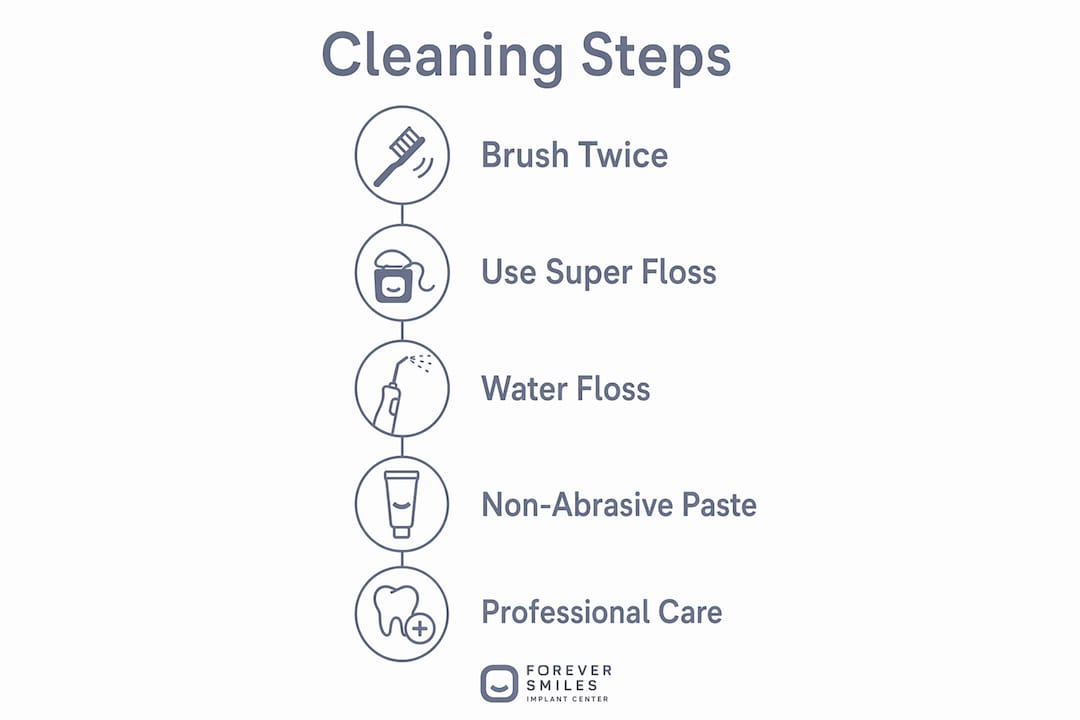
Pro Tip: Run the water flosser before brushing, not after. Flushing debris first allows the toothbrush to contact the surface directly, which improves plaque removal efficiency.
Key mistakes to avoid in your daily routine:
- Using metal interdental brushes with uncoated wires, which scratch implant surfaces
- Applying whitening or charcoal toothpaste, which is too abrasive for zirconia and acrylic
- Skipping the underside of the arch, where biofilm accumulates fastest
- Using the water flosser at maximum pressure, which can traumatize gum tissue
- Rushing the flossing step, which leaves plaque at the abutment margins
How often should professional maintenance be part of implant care?
Professional maintenance every 3–6 months is the clinical standard for implant-supported arch patients. The exact interval depends on your risk level. Patients with a history of gum disease, smoking, or diabetes require more frequent visits than patients with no risk factors. Skipping professional care is the single most common reason implants fail after the first year.
A professional maintenance visit covers more than a cleaning. Here is what a thorough protocol includes:
- Clinical examination. The clinician probes around each implant to measure pocket depth and check for bleeding. Bleeding on probing is the earliest sign of peri-implant mucositis, which is reversible if caught early.
- Radiographic assessment. Periodic X-rays track bone levels around each implant. Bone loss that progresses more than 2mm after the first year of loading signals peri-implantitis, which requires active treatment.
- Screw torque check. The clinician verifies that retaining screws are at the correct torque. Loose screws cause micro-movement, which damages the implant-abutment interface and accelerates bone loss.
- Subgingival cleaning with non-metallic instruments. Metal scalers scratch titanium and zirconia surfaces. Clinicians use plastic, carbon fiber, or ultrasonic tips designed for implant surfaces to remove calculus without causing damage.
- Prosthesis removal every 18 months. Removing the full-arch prosthesis periodically allows the clinician to clean areas that are completely inaccessible from outside, inspect the retaining screws directly, and assess the health of the tissue underneath.
Routine professional care shifts treatment from reactive to proactive. Catching mucositis at a three-month visit costs far less in time, money, and tissue than treating peri-implantitis at an emergency visit two years later.
What are the common pitfalls in cleaning implant-supported arches?
The most damaging misconception is that implants do not need maintenance because they cannot decay. Implants are not maintenance-free. The titanium post does not decay, but the surrounding tissue absolutely can develop infection. Peri-implant mucositis affects the soft tissue. Peri-implantitis destroys the bone. Both conditions are caused by biofilm that was not removed consistently.
The second most common pitfall is using the wrong tools. Metal interdental brushes and abrasive toothpastes damage the implant surface at a microscopic level. Scratches create rough areas where bacteria attach more easily. This accelerates plaque accumulation and raises infection risk. Use only plastic-coated interproximal brushes if you use them at all, and confirm with your clinician that the brush diameter fits your specific arch design.
Pro Tip: Check the abrasivity rating of your toothpaste before buying. Look for a Relative Dentin Abrasivity (RDA) value below 70. Most standard toothpastes list this on the manufacturer's website. Anything above 100 is too abrasive for implant prosthetics.
Additional pitfalls to watch for:
- Applying too much pressure with the water flosser, which pushes bacteria into the sulcus
- Ignoring the posterior abutments because they are harder to reach
- Using alcohol-based mouthwash daily, which can irritate peri-implant tissue over time
- Waiting for pain before calling your clinician, since peri-implant disease is often painless until advanced
- Assuming a clean-looking arch is a healthy one, since biofilm is invisible to the naked eye
How can you tailor your cleaning routine to your arch type and lifestyle?
The cleaning approach for a fixed full-arch bridge differs from a bar-retained overdenture. A fixed arch stays in place at all times, so you clean it in the mouth using the tools described above. A bar-retained overdenture is removable, which means you can take it out, clean the bar and the tissue underneath directly, and soak the prosthesis in a non-effervescent cleaner. Removable designs offer a cleaning advantage, but they require their own discipline.
Physical limitations change the equation. Patients with reduced hand dexterity benefit from electric toothbrushes with larger handles and water flossers instead of manual flossing. Patients who had recent surgery or illness should increase cleaning frequency temporarily, since the immune response during recovery can accelerate biofilm accumulation. The 2026 maintenance checklist from Forever Smiles Implant Center provides a structured reference for adapting care across different recovery stages.
Antimicrobial rinses containing chlorhexidine gluconate are appropriate for short-term use after procedures or when early mucositis is detected. Long-term daily use is not recommended because chlorhexidine stains the prosthesis and disrupts the oral microbiome. Ask your clinician for the right rinse and the right duration based on your specific situation.
Practical steps to build a consistent routine:
- Attach cleaning to an existing habit, such as brushing immediately after breakfast and before bed
- Keep all tools visible on the counter rather than stored away, since out-of-sight tools get skipped
- Set a phone reminder for the water flosser step, which patients skip most often
- Schedule your next professional visit before leaving the office after each appointment
- Review your technique with your clinician annually, since habits drift over time
Key Takeaways
Consistent daily cleaning combined with professional maintenance every 3–6 months is the most effective way to prevent peri-implant disease and protect a full-arch implant investment long term.
| Point | Details |
|---|---|
| Clean twice daily | Use a soft toothbrush, non-abrasive toothpaste, super floss, and a water flosser every day. |
| Follow the 90-degree rule | Aim the water flosser tip at a right angle to the implant to flush plaque without pushing bacteria deeper. |
| Avoid abrasive tools | Metal brushes and gritty toothpastes scratch implant surfaces and increase infection risk. |
| See a clinician every 3–6 months | Professional visits include screw checks, probing, and subgingival cleaning that home care cannot replicate. |
| Remove the prosthesis every 18 months | Periodic removal by a professional allows deep cleaning and inspection of tissue and hardware underneath. |
What I've learned after 28,000 implants about patient cleaning habits
The patients who lose implants years after a successful surgery almost always share one trait: they believed the hard part was over once the final teeth were delivered. I understand that instinct. The surgery is intense, the recovery takes effort, and the new teeth feel and look great. It is natural to want to move on. But the biology does not stop working just because the procedure is finished.
What I have seen repeatedly is that peri-implant mucositis develops quietly. There is no pain in the early stages. Patients come in for a routine visit and we find bleeding, pocket depth changes, and early bone loss that they had no idea was happening. The ones who attend every three to six months give us the chance to reverse it. The ones who disappear for two or three years often face a much harder conversation.
The other pattern I notice is that patients clean what they can see. They brush the front of the arch well and skip the back. They floss the easy spots and rush past the posterior abutments. A full arch is a full arch. Every abutment carries load and every abutment needs attention. I tell every patient the same thing: your implants are a long-term investment in your quality of life. Treat the maintenance the same way you would treat maintaining anything else you spent serious money on and expected to last a lifetime.
The technology has improved significantly. Zirconia prosthetics are more resistant to surface damage than older acrylic designs. But better materials do not replace better habits. The patients with the best long-term outcomes are the ones who combine good daily technique with consistent professional care. That combination is not complicated. It just requires showing up.
— Dr. Brian Young
Implant care support at Forever Smiles Implant Center
Forever Smiles Implant Center in Jacksonville, Florida, provides professional maintenance protocols built specifically for full-arch implant patients. Every visit includes clinical probing, radiographic review, screw torque verification, and subgingival cleaning with implant-safe instruments.
The team at Forever Smiles Implant Center also educates patients on the exact tools and techniques that match their specific prosthesis design. Whether you have a fixed zirconia arch or a bar-retained overdenture, the maintenance plan is tailored to your anatomy and risk profile. Patients who want to protect their full-mouth dental implants long term can schedule a maintenance visit or a full consultation directly through the Forever Smiles Implant Center website. The practice serves patients across Jacksonville and throughout Florida who want expert-level care from a team that works exclusively with implants every day.
FAQ
What tools do I need to clean an implant-supported arch at home?
The four core tools are a soft-bristle or electric toothbrush, non-abrasive toothpaste, super floss with a stiff threader end, and a water flosser set to low or medium pressure. These tools together address every surface of the arch that biofilm can colonize.
How often should I visit a clinician for implant maintenance?
Professional maintenance visits every 3–6 months are the clinical standard, with the exact interval based on your personal risk factors such as gum disease history or smoking. Patients who attend regular recalls have significantly better long-term outcomes than those who skip appointments.
Can I use any toothpaste on my implant-supported arch?
No. Whitening, charcoal, and baking soda toothpastes are too abrasive for implant prosthetics. Use a gel-based or low-abrasive paste with an RDA value below 70 to avoid scratching the prosthetic surface and increasing bacterial adhesion.
What is peri-implant mucositis and how do I prevent it?
Peri-implant mucositis is inflammation of the soft tissue around an implant caused by biofilm accumulation. It is reversible when caught early through consistent daily cleaning and professional monitoring at three to six-month intervals.
Does a fixed arch need different care than a removable overdenture?
A fixed arch is cleaned in the mouth using super floss and a water flosser to reach the underside of the bridge. A removable overdenture can be taken out for direct cleaning of the bar and tissue underneath, which offers additional access but requires its own daily discipline.