
Denture conversion to implants is the clinical process of replacing a removable denture with implant-supported teeth that stay fixed in your mouth. The full transition typically spans 4 to 6 months, driven almost entirely by how long your jawbone needs to fuse with the implant posts. Patients who successfully navigate the dental implant process from dentures gain back up to 90% of their original bite force, which means eating foods that dentures made impossible. This guide walks you through every stage, from your first evaluation through final restoration, using 2026 clinical standards and the expertise of Forever Smiles Implant Center in Jacksonville, Florida.
How to navigate the dental implant process from dentures
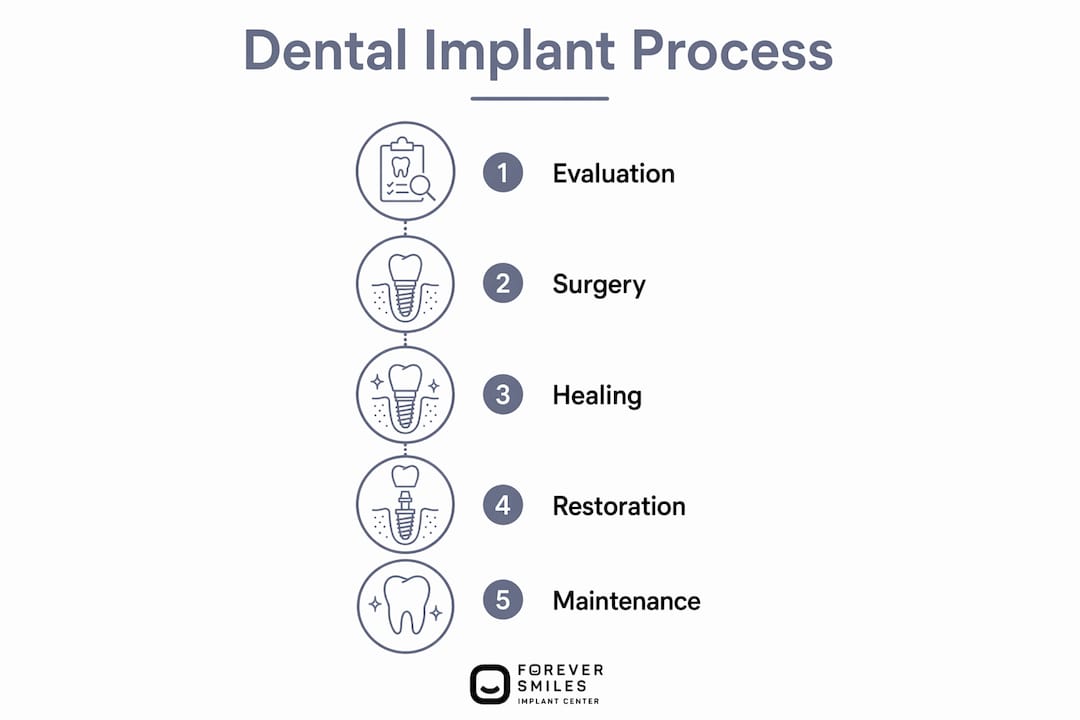
The first step is a thorough clinical evaluation, and it goes much deeper than a standard dental exam. Your surgeon needs to assess the volume and density of your jawbone, because implants require enough bone to anchor securely. A 3D cone beam computed tomography scan, known as a CBCT scan, is the gold standard for this assessment. It gives your surgical team a three-dimensional map of your jaw, revealing bone height, width, and the location of nerves and sinuses.
Denture wearers often arrive with significant bone loss. This happens because the jawbone shrinks when it no longer has tooth roots stimulating it. The good news is that bone loss rarely disqualifies you from treatment. Modern techniques like bone grafting, sinus lifts, and angled implant placement have expanded candidacy dramatically. Patients who were told "no" elsewhere frequently qualify at a specialized center.
Your existing denture plays a more important role in this evaluation than most patients expect. Clinicians use it as a diagnostic record for bite height and facial proportions. The denture shows your surgeon where your teeth sit relative to your lips, what your bite looks like, and how much vertical space exists between your jaws. That information directly shapes the design of your final implant-supported teeth.
- CBCT 3D imaging: Maps bone volume, nerve position, and sinus location before any surgery is planned.
- Bone assessment: Identifies areas of resorption and determines whether grafting or angled implants are needed.
- Denture analysis: Your current denture is measured for bite height and tooth position to guide prosthetic design.
- Medical history review: Conditions like uncontrolled diabetes or active smoking affect healing and must be addressed first.
- Treatment sequencing: Some patients need extractions, grafting, or gum treatment before implant placement can begin.
Pro Tip: Bring your current denture to every consultation appointment. Your surgeon can learn more from examining it than from almost any other single piece of information you provide.
What happens during implant surgery and the healing phase?
The surgical appointment is more straightforward than most patients anticipate. Here is what the process looks like from start to finish.
- Anesthesia and sedation: Your team administers local anesthesia, IV sedation, or general anesthesia depending on your case. At Forever Smiles Implant Center, a board-certified MD anesthesiologist manages this in-house.
- Implant placement: The surgeon creates small openings in the gum tissue and places titanium implant posts directly into the jawbone at planned positions. A full arch typically uses four to six implants.
- Site closure: Gum tissue is sutured around the implants. The entire surgical appointment for a full arch usually takes two to four hours.
- Denture modification: Your existing denture is adjusted to fit over the healing sites. You leave with teeth that day.
- Osseointegration begins: Over the next 3 to 6 months, your jawbone grows around and fuses with each implant post. This biological process is called osseointegration, and it cannot be rushed.
- Follow-up monitoring: Your team schedules check-ins to monitor healing, adjust your temporary denture, and confirm integration is progressing correctly.
Most patients are surprised to learn they are never without teeth during healing. The modified denture sits over the healing implant sites and lets you speak, eat soft foods, and go about your normal life. You are not hiding at home for six months.
"The multi-stage nature of implant treatment is not a flaw in the process. It is the process. Osseointegration is a biological event, and biology sets the schedule. Patients who understand this upfront report far higher satisfaction with their outcomes."
For patients who qualify, immediate loading is an option. This means a fixed temporary prosthesis is attached to the implants on the day of surgery, rather than using a modified removable denture. Not every patient is a candidate. Bone density, implant stability at placement, and the number of implants all factor into that decision.
Pro Tip: Follow a soft diet strictly during the first 8 weeks after surgery. Hard or crunchy foods can apply lateral pressure to healing implants and disrupt osseointegration before the bone has fully fused.
What does the final restorative phase involve?
Once your surgeon confirms that osseointegration is complete, the restorative phase begins. This is where your permanent teeth take shape.
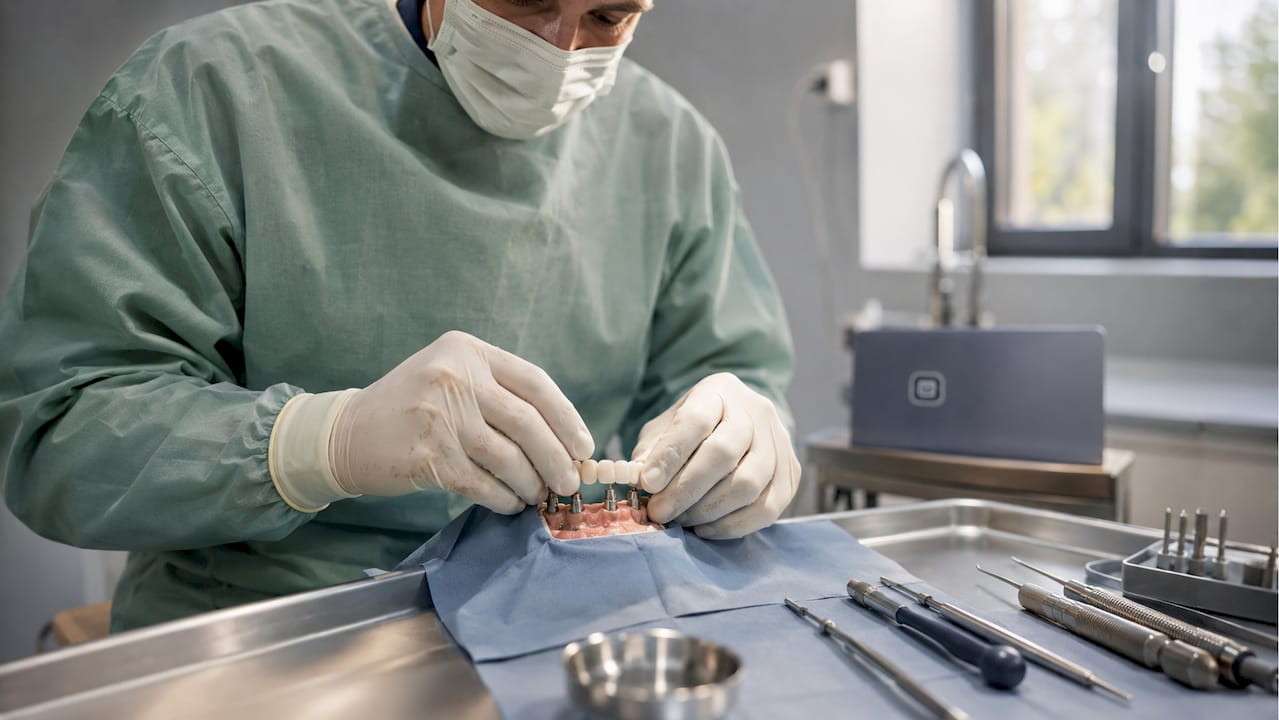
Your surgeon places abutments, which are small connector pieces that attach to the top of each implant post and protrude slightly above the gum line. These serve as the anchoring points for your final prosthesis. Impressions or digital scans of your mouth are taken at this stage to fabricate the final teeth to exact specifications.
Patients choose between two main prosthetic designs. A snap-in overdenture clips onto the implants and can be removed for cleaning. A fixed full-arch prosthesis, often made from zirconia, is permanently screwed to the implants and does not come out. Fixed prostheses feel the most like natural teeth and require no daily removal.
The final fitting appointment involves placing the prosthesis, checking your bite from multiple angles, and making micro-adjustments until everything feels right. Bite verification is not optional. An uneven bite creates pressure points that can damage implants over time.
New hygiene routines replace the denture care habits you have used for years. Key changes include:
- Interdental brushes: Slide under and around the prosthesis to clean implant surfaces that a regular toothbrush cannot reach.
- Water flossers: Oral irrigators like Waterpik devices flush debris from around abutments and under the prosthesis.
- Low-abrasive toothpaste: Avoid gritty formulas that scratch implant surfaces and prosthetic materials.
- Regular professional cleanings: Your implant team schedules cleanings every 3 to 6 months to monitor tissue health and implant stability.
The adjustment period for hygiene typically takes two to three weeks before the new routine feels natural. Patients who re-learn oral hygiene correctly protect their investment for decades.
Common challenges and how to handle them
The most common mistake in the denture to implant conversion process is trying to retrofit an old, worn denture onto new implants. Retrofitting a structurally compromised denture locks in existing bite problems and often leads to discomfort, implant stress, and the need for costly corrections later. A new implant-specific prosthesis, designed from scratch using your diagnostic records, produces better long-term results.
Managing your expectations around the timeline is equally important. The multi-stage process is not a sign that something is wrong. It reflects the biological reality of how bone heals. Patients who understand this from day one report significantly higher satisfaction.
The transition diet during the denture to implant switch is a real adjustment. During healing, you move to soft foods: scrambled eggs, yogurt, mashed potatoes, fish, and cooked vegetables. After osseointegration is confirmed and your final prosthesis is placed, you can gradually reintroduce harder foods. Most patients with fixed implant-supported teeth eventually eat foods they had avoided for years.
- Swelling and soreness after surgery: Normal for the first 3 to 5 days. Ice packs and prescribed medications manage this effectively.
- Temporary denture fit changes: As swelling resolves, your modified denture may feel loose. Your team adjusts it at follow-up visits.
- Implant mobility during healing: Any movement in an implant post during osseointegration is a red flag. Contact your surgeon immediately.
- Gum irritation around abutments: Usually caused by inadequate cleaning. Correct technique resolves this quickly.
Pro Tip: Keep a simple log of how your healing progresses, noting any pain, swelling, or changes in how your temporary denture fits. This information helps your surgical team make faster, more accurate adjustments at each follow-up visit.
For patients dealing with significant bone loss, options like permanent teeth with bone resorption are worth exploring before assuming you are not a candidate.
Key Takeaways
Successful denture conversion to implants requires a structured multi-stage process guided by biological healing timelines, modern imaging, and prosthetic planning built around your existing bite records.
| Point | Details |
|---|---|
| Timeline is biology-driven | The full process takes 4–6 months because osseointegration cannot be shortened. |
| Bone loss rarely disqualifies you | CBCT imaging and techniques like grafting or angled implants expand candidacy significantly. |
| Your denture is a diagnostic tool | Surgeons use your current denture to map bite height and tooth position for the final prosthesis. |
| You keep teeth throughout healing | A modified denture maintains function and appearance during the entire osseointegration phase. |
| New hygiene habits protect the investment | Interdental brushes, water flossers, and regular professional cleanings are non-negotiable long-term. |
What I have learned after 28,000 implants
The biggest misconception I encounter is that bone loss is a dead end. Patients arrive convinced they cannot have implants because another provider told them their bone was "too far gone." In most of those cases, we find a path forward. CBCT imaging reveals options that a standard X-ray simply cannot show. Angled implants, zygomatic implants, and staged grafting procedures have changed what is possible. Bone loss is a complication to plan around, not a disqualifier.
The second thing I want patients to understand is that their existing denture is not the enemy. It is information. When I evaluate a patient's denture, I am reading years of data about where their bite sits, how their facial muscles have adapted, and what their aesthetic preferences are. Treating that denture as a starting record rather than a retrofit target produces final results that feel natural from day one.
What I find most rewarding is watching patients eat a steak or bite into an apple for the first time in years. The bite force recovery that implants deliver is not just a clinical metric. It changes how people live. They stop ordering the soft option at restaurants. They stop avoiding social meals. That shift in confidence is what this process is really about.
The patients who do best are the ones who treat this as a partnership. They follow the soft diet, they show up to follow-up appointments, and they ask questions when something feels off. The process is multi-stage by design, and every stage has a purpose. Trust the timeline.
— Dr. Brian Young
Full-arch implant care at Forever Smiles Implant Center
Forever Smiles Implant Center in Jacksonville, Florida, specializes exclusively in full-mouth implant reconstruction. Every patient receives surgical planning, in-house 3D imaging, implant surgery, and final custom zirconia teeth under one roof with one accountable team.
Dr. Brian Young has placed over 28,000 implants and performs full-arch surgery daily. The center accepts patients who have been told they are not candidates elsewhere, including complex cases involving severe bone loss and previously failed implants. If you are ready to move from dentures to a permanent solution, the dental implants FAQ page answers the most common questions patients ask before their first consultation. For patients ready to explore whether implants can permanently replace their dentures, the full-mouth implants page outlines exactly what is possible.
FAQ
How long does the denture to implant conversion process take?
The full process typically takes 4 to 6 months. Most of that time is the osseointegration healing phase, during which your jawbone fuses with the implant posts.
Will I be without teeth during the implant healing phase?
No. Your existing denture is modified to fit over the healing implant sites, so you have functional teeth throughout the entire healing period.
Can I get implants if I have significant bone loss from wearing dentures?
Bone loss does not automatically disqualify you. Modern techniques including bone grafting, sinus lifts, and angled implant placement allow many patients with significant bone loss to receive implants successfully.
What is the difference between a snap-in overdenture and a fixed implant prosthesis?
A snap-in overdenture clips onto implants and can be removed for cleaning. A fixed prosthesis is permanently attached to the implants and functions like natural teeth, with no daily removal required.
What diet changes are needed during the healing phase?
Soft foods are required for the first 6 to 8 weeks after implant surgery. Scrambled eggs, yogurt, mashed vegetables, and fish are good options. Hard or crunchy foods can disrupt osseointegration before the bone has fully integrated with the implant.