
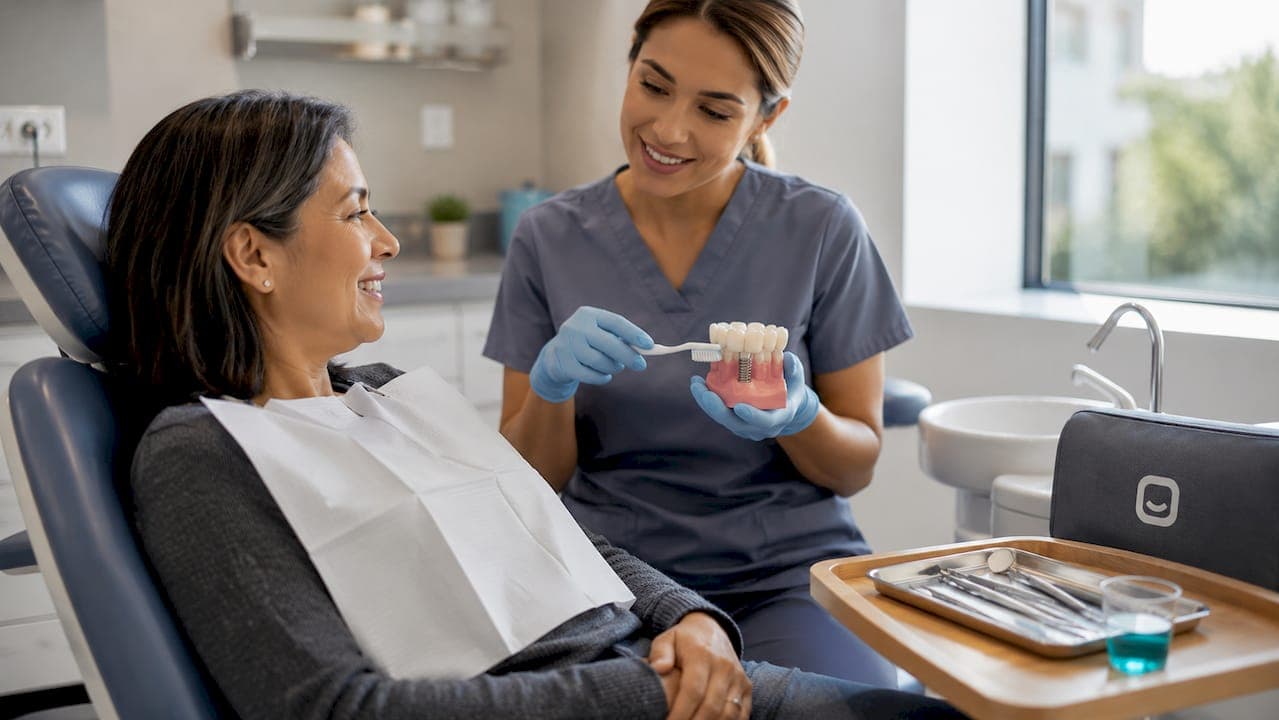
A dental implant is defined as a titanium post surgically placed in the jaw to replace a missing tooth root, and caring for implant-supported teeth requires a structured routine that most patients underestimate. The implant supported teeth maintenance checklist covers daily hygiene, professional monitoring, and lifestyle habits that directly determine whether your implants last decades or fail prematurely. Dental implants carry a 97.83% clinical success rate across more than 158,000 implants studied, but that number depends on consistent upkeep. Forever Smiles Implant Center treats maintenance as part of the implant investment, not an afterthought.
1. What is the implant supported teeth maintenance checklist?
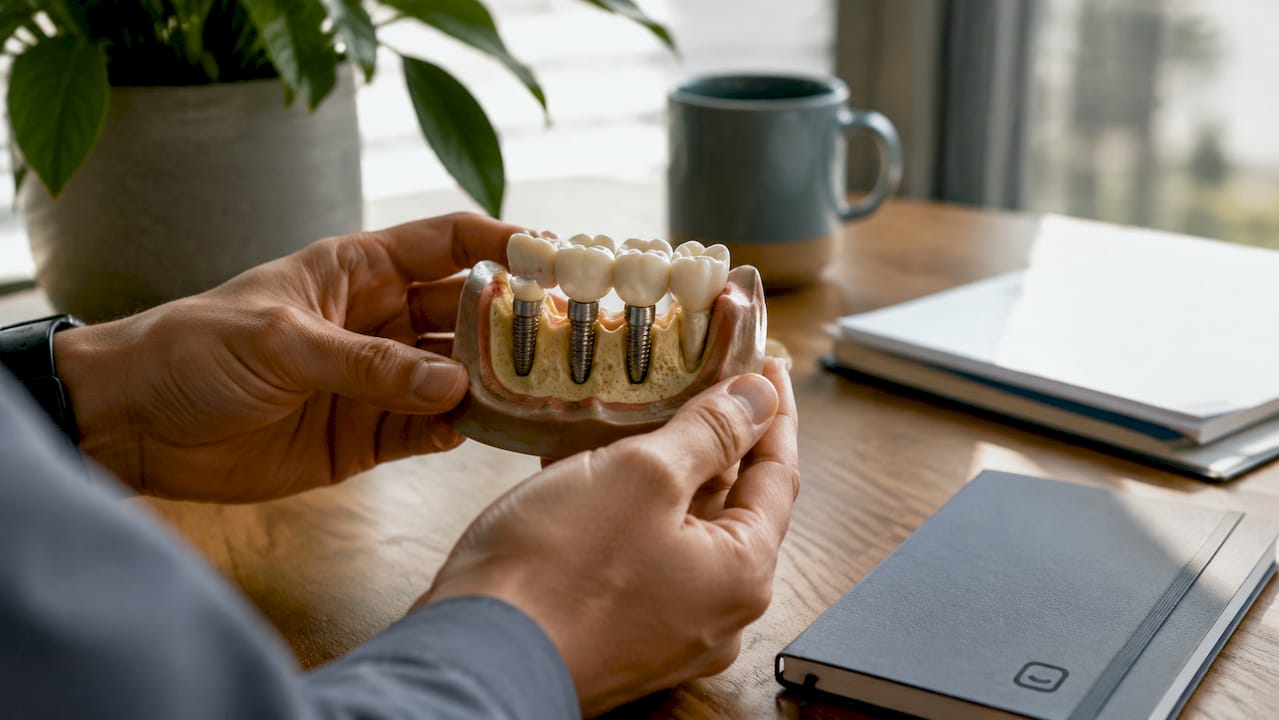
The implant dental hygiene checklist is the structured set of daily, monthly, and professional care steps that protect the titanium post, the surrounding gum tissue, and the prosthetic crown or bridge above it. Unlike natural teeth, implants do not decay. The surrounding gum and bone, however, are fully vulnerable to infection if biofilm builds up unchecked. Think of the checklist as two layers: what you do at home every day, and what your clinical team does every few months.
The checklist exists because implant failure rarely happens suddenly. It builds slowly through neglected plaque, skipped appointments, or unmanaged habits like grinding. Catching problems at the earliest stage is always cheaper, faster, and less painful than treating advanced peri-implantitis or replacing a failed implant.
2. Daily brushing: the foundation of implant care
Twice-daily brushing with a soft-bristle or sonic toothbrush is the single most important daily step for caring for implant-supported teeth. Sonic brushes reduce plaque more effectively near implant margins than manual brushes. The key is angle: hold the brush at 45 degrees toward the gum line and use gentle circular strokes.
Abrasive whitening toothpastes scratch titanium abutments and zirconia surfaces over time. Use a non-abrasive, fluoride-based toothpaste instead. Gel formulas work well. Avoid anything labeled "whitening" or "baking soda formula" unless your clinician specifically approves it.
Pro Tip: If you have a full-arch prosthesis, a sonic brush with a round oscillating head reaches the back margins far better than a flat manual brush. Spend at least 30 seconds per quadrant.
3. Flossing and interdental cleaning around implants
Regular floss tears on implant hardware and misses the curved spaces around abutments. Implant-specific floss such as Super Floss and interdental brushes clean the embrasure spaces that a toothbrush cannot reach. Super Floss has a stiff threader end, a spongy middle section, and regular floss, making it ideal for threading under a bridge or around a crown.
Interdental brushes come in numbered sizes. Match the brush size to the gap between your implant crown and the adjacent tooth. Too small and it misses plaque. Too large and it forces the gum tissue.
- Super Floss or implant-specific floss: Thread under the prosthesis and move in a shoe-shine motion around the abutment.
- Interdental brushes: Insert at a slight angle and move in and out without forcing. Use daily, not just when food is caught.
- Floss picks: Acceptable for single-crown implants but less effective for full-arch cases.
Pro Tip: For implant-supported bridges, a floss threader or a pre-threaded floss needle makes the process faster and more consistent. Do this before brushing, not after, so the brush clears the debris you loosen.
4. Water flosser use: technique matters more than frequency
A water flosser adds real value to oral hygiene for implants, but technique determines whether it helps or harms. Use a water flosser on low-to-moderate pressure and angle the tip toward the implant at roughly 45 degrees. High pressure drives biofilm and bacteria into the peri-implant sulcus, which can cause irritation or slow healing after surgery.
For patients in the first weeks after implant surgery, avoid water flossers entirely unless your surgeon clears them. Once healed, a water flosser used correctly after brushing and flossing removes residual debris from areas no tool reaches easily. It is a supplement, not a replacement for mechanical cleaning.
5. Mouthwash selection: what to avoid
Not every mouthwash is safe for long-term implant care. Long-term chlorhexidine mouthwash use is discouraged for implant patients because it discolors titanium abutments and alters the surface biology around the implant. Chlorhexidine is reserved for short-term post-surgical rinsing only, typically one to two weeks after placement.
For daily use, choose an alcohol-free antimicrobial rinse. Cetylpyridinium chloride (CPC) rinses and essential-oil-based rinses are well-tolerated options. Ask your implant team which formula they recommend for your specific prosthetic materials.
6. How often professional maintenance visits should happen
Patients with implants need professional cleanings every 3–6 months, with higher-risk groups requiring visits every 3–4 months. Higher-risk patients include smokers, those with a history of periodontal disease, and patients with diabetes or other systemic conditions that affect healing.
A standard maintenance visit for implants includes:
- Probing depth measurement: The clinician checks pocket depth around each implant. Increasing depth signals early peri-implant disease.
- Bleeding on probing check: Bleeding is not normal around implants. It signals inflammation that needs attention.
- Oral hygiene review: The clinician assesses plaque levels and adjusts your home care instructions.
- Prosthetic integrity check: Screws, crowns, and bridges are examined for looseness or wear.
- Occlusion assessment: Bite forces are checked to catch uneven pressure before it causes mechanical damage.
- Radiographic bone level monitoring: X-rays track bone levels around the implant post to catch bone loss before it becomes irreversible.
This structured clinical approach is what separates a true implant maintenance visit from a standard cleaning. General cleanings do not include all of these steps.
7. Lifestyle factors that affect implant longevity
Implant posts do not decay, but the habits surrounding them determine how long the entire system lasts. Smoking increases implant failure risk 2–3 times compared to non-smokers. Nicotine restricts blood flow to the gums, slows healing, and creates an environment where bacteria thrive.
Bruxism (tooth grinding) is the other major threat. Excessive bite forces from bruxism cause screw loosening and prosthetic fractures even when the implant post itself is fully stable. A custom night guard distributes those forces and protects the prosthesis.
- Smoking: Quit or reduce significantly. Even cutting back lowers failure risk.
- Grinding: Wear a night guard every night if your clinician has identified bruxism.
- Diet: Prioritize protein and calcium for bone health. Avoid hard foods like ice, hard candy, and crusty bread that stress the crown.
- Sticky foods: Caramel, gummy vitamins, and similar foods can dislodge or stress the prosthetic connection.
Pro Tip: If you wake up with jaw soreness or notice your crowns feel "off" in your bite, tell your implant team immediately. Bite changes are often the first mechanical warning sign before a screw loosens.
8. Warning signs that require immediate attention
Peri-implant inflammation is always a warning sign and should never be dismissed as normal sensitivity. Catching problems early is the difference between a simple treatment and a complex surgical revision. Run through this self-inspection checklist monthly:
- Redness or swelling around the implant crown or along the gum line
- Bleeding when brushing or flossing around the implant
- Changes in gum level: recession or tissue pulling away from the crown
- Loose crown or prosthesis: any movement when you bite or press on it
- Persistent pain or sensitivity that lasts more than a few days
- Bad taste or odor that does not resolve with brushing
"Early detection of peri-implant inflammation is the most powerful tool in long-term implant success. Bleeding on probing and increasing pocket depth during routine checkups are the two clearest signals that disease is progressing. Neither should be ignored or normalized." — ITI Clinical Insights
If you notice any of these signs, contact your implant provider before your next scheduled visit. Waiting for a routine appointment when symptoms are present accelerates damage. For a deeper look at why implants fail and how to prevent it, the Forever Smiles Implant Center blog covers the clinical causes in detail.
Key takeaways
Consistent daily hygiene combined with professional monitoring every 3–6 months is the most effective approach to long-term implant success, protecting both the titanium post and the surrounding bone.
| Point | Details |
|---|---|
| Daily brushing is non-negotiable | Use a soft-bristle or sonic toothbrush twice daily at a 45-degree angle to the gum line. |
| Floss type matters | Super Floss and interdental brushes outperform regular floss for cleaning around implant abutments. |
| Professional visits every 3–6 months | High-risk patients need visits every 3–4 months; each visit must include probing, bleeding checks, and X-rays. |
| Lifestyle habits drive failure risk | Smoking multiplies failure risk 2–3 times; bruxism requires a night guard to prevent mechanical damage. |
| Act on warning signs immediately | Bleeding, swelling, or a loose prosthesis requires prompt evaluation, not a wait-and-see approach. |
What I've learned after 28,000 implants: maintenance is the procedure most patients forget
By Dr. Brian Young, Forever Smiles Implant Center
Patients spend months deciding on implants, then assume the hard part is over once the surgery is done. The surgery is actually the easy part for me. What determines whether that implant is still thriving at 20 years is what happens in the months and years after.
The most common misconception I see is that implants are maintenance-free because they cannot decay. That thinking leads patients to skip professional visits and stop flossing around the implant because "it's not a real tooth." The bone and gum tissue around that implant are very real, and they respond to neglect the same way they always have.
The patients who keep their implants for life treat their maintenance appointments the same way they treat the implant itself: as a non-negotiable investment. They show up every four months, they use the right tools at home, and they call us the moment something feels different. That partnership between patient and clinician is what makes the 97.83% success rate a reality rather than just a statistic.
My honest advice: build your maintenance routine before you leave the surgical chair. Do not wait until something hurts to take it seriously.
— Dr. Brian Young
Professional implant care at Forever Smiles Implant Center
Forever Smiles Implant Center in Jacksonville, Florida, provides structured implant maintenance as part of its full-arch care model. Every patient receives detailed home care instruction tailored to their specific prosthesis, whether that is a single crown, a bridge, or a full-arch zirconia restoration. The clinical team monitors probing depth, bone levels, and prosthetic integrity at every follow-up visit, not just at annual checkups.
If you are unsure whether your current routine is protecting your implants, or if you have questions about implant care and long-term outcomes, the Forever Smiles team is the right place to start. Patients who want their implants done once and maintained correctly choose a team that does this every single day.
FAQ
How often should implant-supported teeth be professionally cleaned?
Professional cleanings every 3–6 months are the standard for implant patients. Smokers and patients with a history of gum disease need visits every 3–4 months.
Can I use regular toothpaste on my implants?
Avoid abrasive whitening toothpastes, which scratch titanium and zirconia surfaces. Use a non-abrasive, fluoride-based or gel toothpaste instead.
What is peri-implantitis and how is it prevented?
Peri-implantitis is a bacterial infection of the tissue and bone surrounding an implant. It is prevented through consistent daily cleaning, regular professional monitoring, and prompt treatment of early inflammation signs.
Is a water flosser safe for implants?
Yes, when used correctly. Angle the tip at low-to-moderate pressure toward the implant. High pressure can drive bacteria into the peri-implant sulcus and cause irritation.
Do implants last a lifetime with proper care?
The implant post itself carries a 97.83% clinical success rate and is designed to be permanent. The prosthetic crown or bridge may need attention after 15–20 years, depending on wear and maintenance.