

Yes, you can use HSA funds for dental implants when the treatment restores function lost to disease, trauma, or missing teeth rather than serving a purely cosmetic goal. The IRS treats implants like any other dental procedure under its medical expense rules, so eligibility hinges on why you need them, not the fact that they're implants. Keep your paperwork tight and check your plan's specific documentation rules before you commit to treatment.
TL;DR:
- HSA funds can cover the cost of dental implants if they restore function caused by disease, trauma, or missing teeth, but not if they are purely cosmetic.
- Qualified expenses include components like implant posts, abutments, crowns, bone grafts, imaging, anesthesia, and lab fees, but exclude aesthetic upgrades such as whitening.
- Proper documentation, including itemized bills and a medical necessity letter, is essential for reimbursement, especially for high-cost procedures.
- Paying out of pocket and reimbursing later from the HSA can maximize tax advantages, provided all paperwork and timing conditions are met.
- Implants often cost several thousand to over ten thousand dollars, with costs varying widely; plan contributions accordingly and verify specific documentation requirements.
Table of Contents
- What the IRS Says About HSA Eligibility for Dental Implants
- Which Parts of Implant Treatment Qualify for HSA Funds
- How Do You Pay for Implants and Get Reimbursed?
- Coordinating HSA Funds With Dental Insurance
- Cost Planning: Implant Prices and HSA Contribution Limits
- Specialist Tips on Documentation and Complex Cases
- Pre-Appointment Checklist for HSA-Funded Implants
- A Practical Take on Using HSA Funds for Major Dental Work
- How Forever Smiles Implant Center Simplifies HSA Documentation
- Sources
What the IRS Says About HSA Eligibility for Dental Implants
The IRS doesn't have a special rule for implants. They fall under the same standard that covers fillings, crowns, and root canals: IRS Topic No. 502 allows medical expenses "for the diagnosis, cure, mitigation, treatment, or prevention of disease," and dental treatment is explicitly listed. Publication 969 lays out the parallel rules for how your HSA reimburses those qualified expenses.
The dividing line is restorative versus cosmetic, and it's worth understanding because it decides your reimbursement outcome:
- Restorative (qualifies): replacing a tooth lost to decay, gum disease, an accident, or congenital absence.
- Cosmetic (doesn't qualify): purely aesthetic upgrades with no functional or disease-related basis, like whitening bundled into the same visit.
The American Academy of Implant Dentistry describes the typical restorative candidate: someone missing teeth from trauma, decay, or periodontal disease who needs implants to eat and speak normally again. That's squarely inside IRS Topic 502's language. Your HSA administrator may still ask for an itemized statement or a specific claim form before releasing funds for a high-dollar procedure, so don't assume the debit card swipe is the end of the paperwork.
Which Parts of Implant Treatment Qualify for HSA Funds
Full-arch and single-tooth implant treatment involves several billed components, and nearly all of them clear the restorative bar. According to HSA Store's eligibility listing, the following line items are commonly treated as qualified medical expenses:
- The implant post (the titanium or zirconia root anchor)
- The abutment connecting post to crown
- The prosthetic crown or full-arch bridge
- Bone grafts and sinus lifts needed to support the implant
- Diagnostic imaging, including CBCT scans
- Anesthesia and sedation during surgery
- Lab fees for fabricating the final restoration
Cosmetic add-ons are a different story. Teeth whitening, elective veneer upgrades on unrelated teeth, or a shape change purely for appearance won't pass muster if questioned.
Pro Tip: Ask your provider's billing office to itemize any cosmetic add-ons separately from the restorative charges on your invoice. A single lumped total makes it harder to prove which portion was medically necessary if your HSA administrator ever asks.
How Do You Pay for Implants and Get Reimbursed?
You have two payment routes, and both are legitimate. Swipe your HSA debit card at the time of service, or pay out of pocket with a personal card and reimburse yourself later once the claim clears. Here's how to run either one cleanly:
- Save every document as you go: the itemized statement with procedure codes, the insurance Explanation of Benefits (EOB) if you have coverage, proof of payment, and a letter of medical necessity if your dentist offers one.
- Submit or retain the paperwork. If you used the HSA card, file the documents away in case of an audit. If you paid separately, submit through your administrator's reimbursement portal.
- Know your timing flexibility. IRS Publication 969 confirms there's no federal deadline to reimburse yourself, as long as the HSA existed when you incurred the expense. That means you can let the account grow, invested or in cash, and pull the reimbursement years later.
- Expect a short processing window. Most administrators clear straightforward dental claims within a few business days once documentation is complete.
That reimbursement-later approach is one of the more underused HSA strategies. Pay implants out of pocket now if you can afford it, invest the HSA balance, and reimburse yourself from a larger account down the road.
Coordinating HSA Funds With Dental Insurance
Your HSA can only cover the portion insurance doesn't pay. That's the core rule, and your EOB is the document that proves it. Once your dental plan processes the claim, the EOB shows exactly what was covered and what's left as your responsibility, which is the number you should be reimbursing against.
Insurance caps complicate this fast. Many dental plans cap annual benefits at relatively low amounts, and implants often exceed that, leaving most of the bill uncovered and HSA-eligible. A few pitfalls to watch:
- If your insurer later adjusts or pays a delayed claim, amend the reimbursement amount rather than keeping the original figure.
- Don't submit for HSA reimbursement on an amount insurance already paid; that's the double-dipping the IRS disallows.
- If cosmetic work happens in the same visit as restorative work, get it billed separately so it doesn't muddy the eligible balance.
Cost Planning: Implant Prices and HSA Contribution Limits
Single-tooth implants typically run several thousand dollars depending on the case and region, while full-arch reconstruction, replacing an entire row of teeth, can cost significantly more because it involves surgical planning, bone grafting when needed, and custom prosthetics. Costs vary widely by geography and case complexity, so treat any number you see online as a starting point for a conversation, not a quote.
Pro Tip: HSA contribution limits are set annually by the IRS and adjust for inflation, with an additional catch-up amount for account holders 55 and older. Check the IRS's current guidance each year before you plan, since the figures shift.
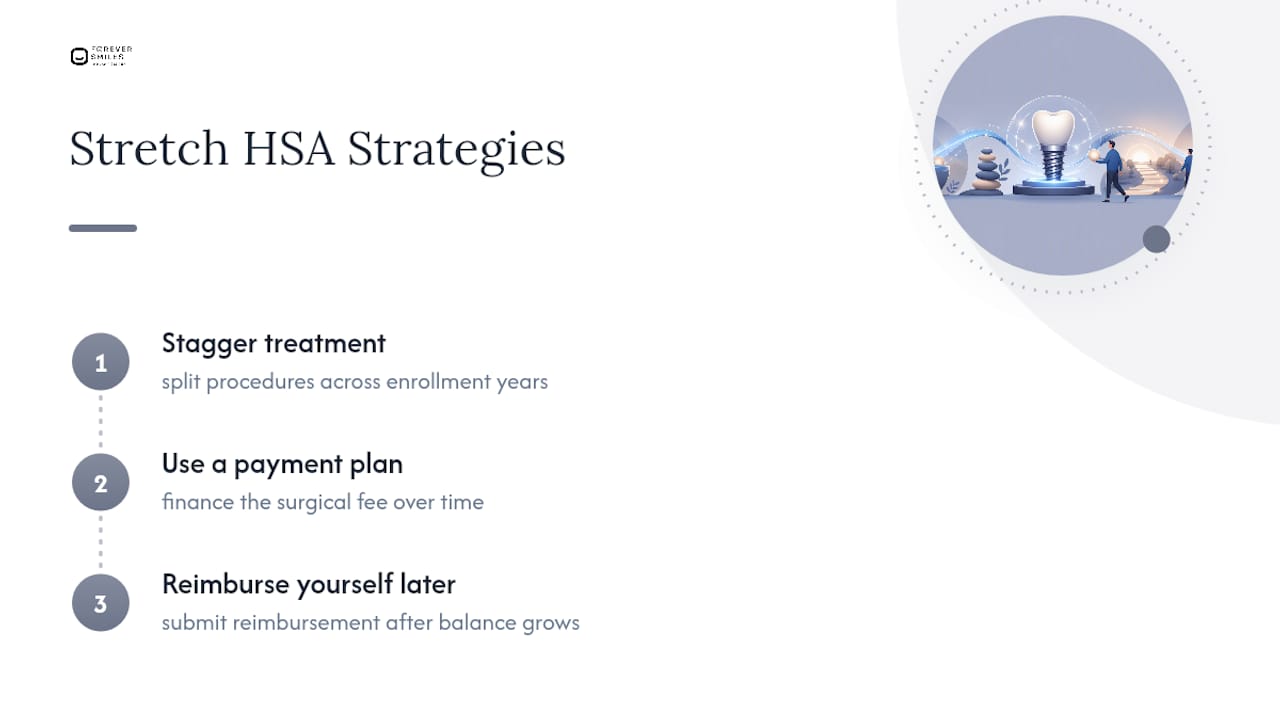
Because implants often outpace what most people have sitting in an HSA, staggering treatment across enrollment years, using a payment plan for the surgical fee, and reimbursing yourself later after your balance has had time to grow are three practical ways to make the tax advantage stretch further.
Specialist Tips on Documentation and Complex Cases
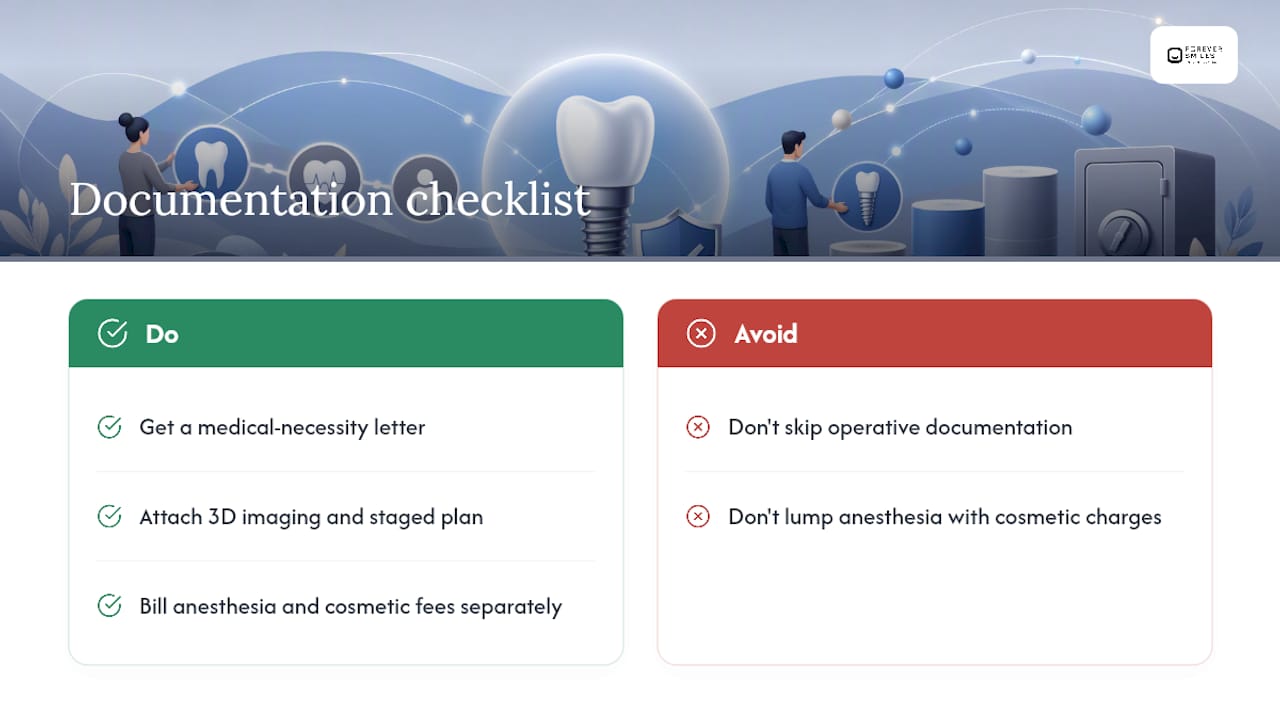
Complex cases, previously failed implants, severe bone loss, zygomatic implants, benefit from a letter of medical necessity that states the diagnosis, why implants are the appropriate treatment, and how the procedure restores function. Dr. Brian Young notes that 3D imaging and staged surgical planning generate exactly the kind of operative documentation that supports a restorative-necessity claim if an administrator pushes back. Clear separation of anesthesia charges and any cosmetic add-ons on the invoice also heads off delays before they start.
Pre-Appointment Checklist for HSA-Funded Implants
Run through this before your first procedure date:
- Confirm your current HSA balance and ask your administrator what documentation they require for large dental claims.
- Ask whether pre-authorization or a specific reimbursement form applies to your plan.
- Request an itemized treatment plan with procedure codes and cosmetic items separated out.
- Decide upfront whether you're using the HSA card or paying out of pocket and reimbursing later.
- Set aside a folder, physical or digital, for EOBs and payment proof from day one.
Pro Tip: Bring a list of consultation questions to your first visit so billing and documentation get addressed before treatment starts, not after the invoice arrives.
A Practical Take on Using HSA Funds for Major Dental Work
Treating your HSA as a long-term account rather than a debit card for this year's bills changes the math on implants. Pay out of pocket when you can, let the account compound, and reimburse yourself when it benefits you most. High-cost restorative cases move faster when the provider hands you clean, itemized documentation up front. Confirm your administrator's specific requirements early, before treatment, not after the invoice lands.
— Dr. Brian Young
How Forever Smiles Implant Center Simplifies HSA Documentation
Forever Smiles Implant Center is the alternative to piecing together implant billing yourself across multiple offices and a general dentist's part-time schedule. Because the team plans, operates, and fabricates every restoration under one roof, your claim comes with one consolidated, itemized invoice instead of scattered receipts from a lab, a surgeon, and an anesthesiologist billed separately.
Every case includes 3D imaging and specialist surgical planning, the same records that support a letter of medical necessity if your HSA administrator asks for one. Similar imaging protocols are described in this overview of CBCT planning, which shows why detailed pre-surgical documentation matters for restorative claims. Forever Smiles Implant Center also separates cosmetic upgrades from restorative charges on request and offers financing for the portion your HSA and insurance don't cover. Review cost and financing details or check answers to common questions on the dental implants FAQ page, then book a consultation to see how your specific case would be documented and billed before you commit to treatment.
This article is general information, not a substitute for advice from a qualified doctor. Consult a qualified healthcare professional about your own circumstances before acting on anything here.