
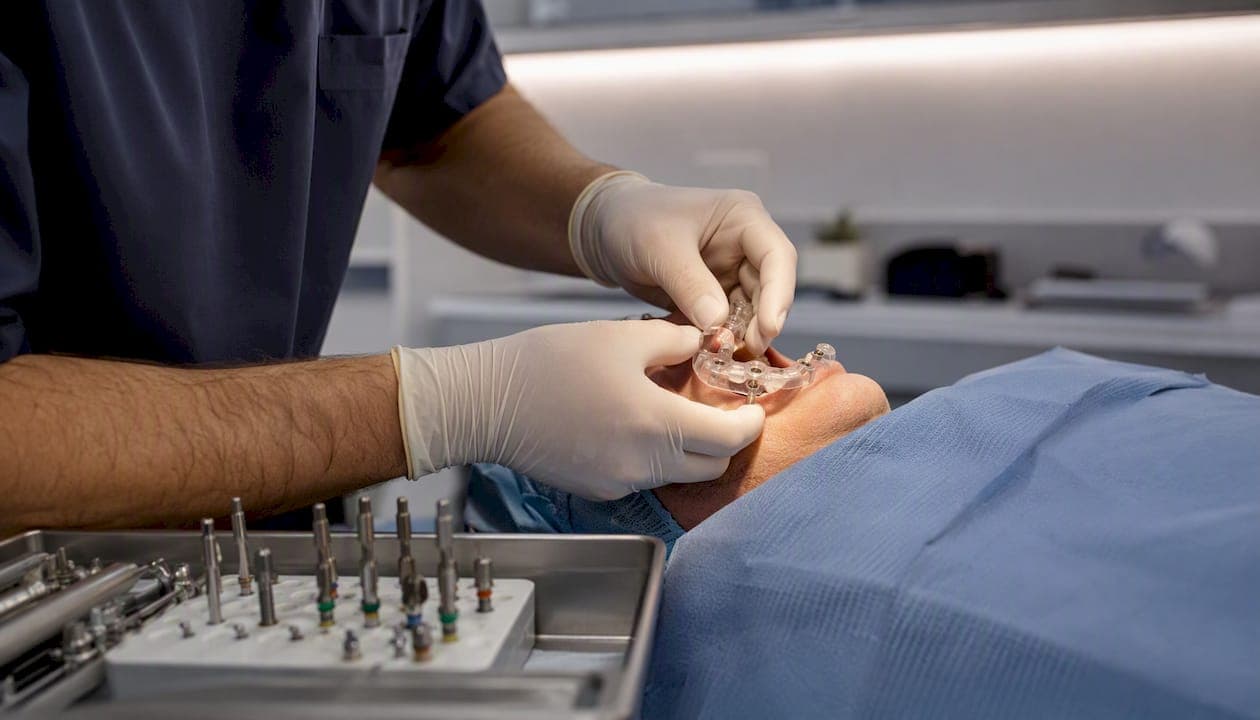
All-on-4 is a graftless, four-implant approach that replaces a full arch of removable denture teeth with a fixed prosthesis, often on the same day as surgery. For many long-term denture wearers, it is the most direct path to permanent teeth without bone grafting. A multicenter retrospective cohort study of 250 patients reported overall implant survival of approximately 94.8% at a mean follow-up of 3.6 years. If you are tired of adhesives, slipping plates, and the slow bone loss that removable dentures accelerate, All-on-4 dental implants are worth a serious conversation with a specialist.
Before that conversation, three steps matter most:
- Schedule a CBCT (cone beam CT) scan to assess your available bone volume and density
- Get a medical review to confirm any systemic conditions (diabetes, blood thinners, smoking history) are documented
- Book a consultation with a full-arch implant specialist who reviews your CBCT in your presence and presents written alternatives
Key Takeaways
All-on-4 gives most denture wearers a realistic path to fixed, permanent teeth in a single surgery, but material choice and specialist experience determine how well it holds up over time.
| Point | Details |
|---|---|
| What All-on-4 is | Four implants support a fixed full-arch prosthesis, replacing removable dentures without bone grafting in most cases. |
| Survival and evidence | A multicenter cohort reported 94.8% implant survival at 3.6 years; long-term high-quality evidence remains limited. |
| Material matters | Zirconia prostheses showed 8.9% complication rates versus 26.9% for metal-acrylic in medium-term follow-up. |
| Main risks | Implant failure, peri-implant infection, and prosthetic fracture are manageable with proper planning and a nightguard. |
| Forever Smiles Implant Center | A Jacksonville specialist center offering same-day teeth, in-house zirconia lab, and full-arch surgery from $19,000 per arch. |
Table of Contents
- What is All-on-4 for denture wearers, and how does it work?
- What should you expect before, during, and after All-on-4 surgery?
- Who is a good candidate for All-on-4, and who should wait?
- What are the real benefits, and what does the evidence actually show?
- What risks should denture wearers know about?
- What does All-on-4 cost, and how long does the process take?
- How do you care for All-on-4 teeth long term?
- Questions to ask your surgeon and red flags to watch for
- Why a specialist full-arch center changes your outcome
- A surgeon's perspective on patient selection
- Forever Smiles Implant Center: full-arch planning built around your case
- Sources
What is All-on-4 for denture wearers, and how does it work?
All-on-4 replaces every tooth in one arch using exactly four dental implants anchored in the jawbone. Two anterior implants sit vertically at the front of the jaw. Two posterior implants are tilted at roughly 30–45 degrees to reach denser bone further back, bypassing the sinus cavity in the upper jaw and the nerve canal in the lower. That tilt is the key mechanical insight: it distributes load across a longer implant surface and avoids the anatomical structures that would otherwise require bone grafting.
The result is a fixed, screw-retained prosthesis that does not come out at night, does not need adhesive, and does not rest on soft tissue. According to clinical treatment guidelines, the graftless approach and immediate provisionalization are the two principal advantages over older full-arch protocols that required multiple surgeries and months of waiting.
Defining features of the All-on-4 concept:
- Four implants per arch (two axial anterior, two tilted posterior)
- No bone graft required in most cases
- Fixed provisional teeth delivered the same day or within 48 hours
- Final prosthesis typically a monolithic zirconia or metal-acrylic bridge
- Screw-retained: no adhesives, no removal for cleaning
Compared with a removable denture, the difference is structural. Dentures sit on the gum ridge and accelerate bone resorption because they apply pressure to soft tissue rather than the bone itself. All-on-4 implants transmit chewing forces directly into the jaw, which slows or stops that bone loss.
What should you expect before, during, and after All-on-4 surgery?
The typical pathway runs: consultation and CBCT imaging, surgery with same-day provisional teeth, a healing phase, then delivery of the final prosthesis at roughly 3–6 months.
Preoperative steps include a full medical review, CBCT imaging to map bone volume and locate nerves and sinuses, impressions or digital scans for lab planning, and anesthesia planning. For complex cases or patients with medical comorbidities, a board-certified MD anesthesiologist manages sedation.
Day of surgery: any remaining failing teeth are extracted, four implants are placed (two axial, two tilted), multi-unit abutments are attached, and a fixed provisional bridge is delivered. Nobel Biocare's procedural documentation confirms that provisional fixed teeth can be delivered the day of surgery when implant stability criteria are met.
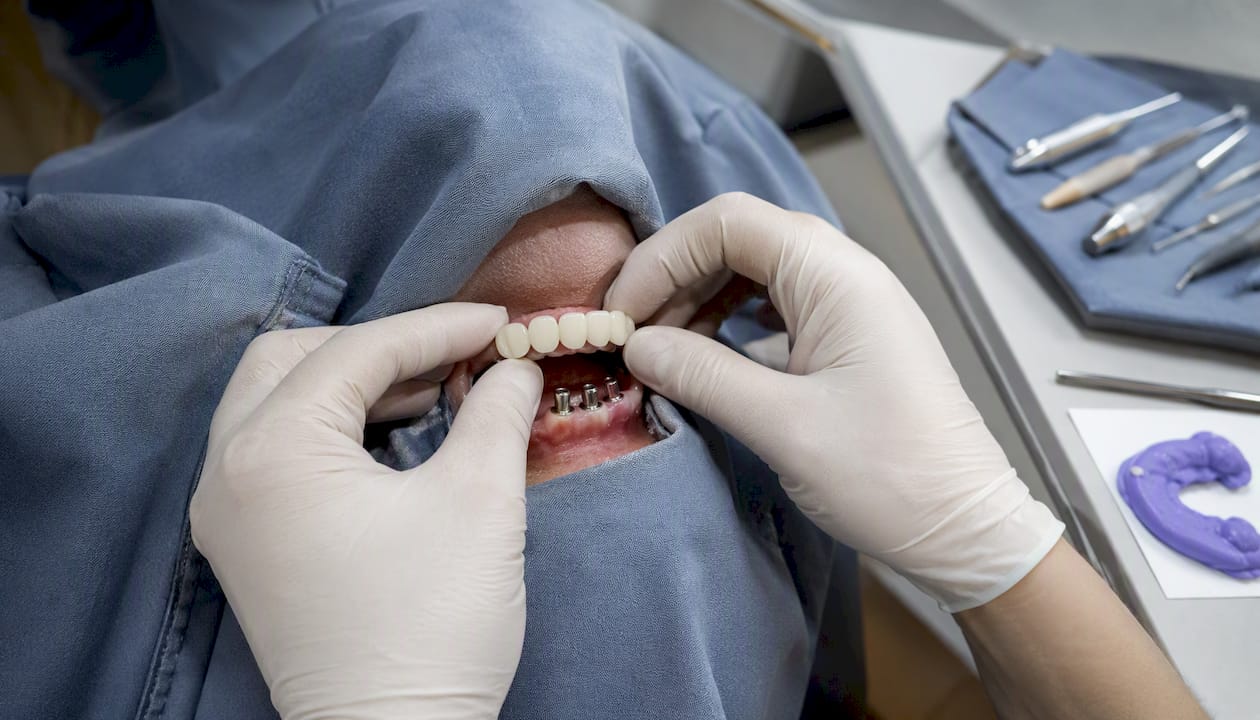
Pro Tip: Bring your current denture to the preoperative appointment. The lab team can use it as a reference for tooth position, vertical dimension, and smile line when designing your provisional.
Postoperative phase: soft foods for 6–8 weeks, regular follow-up visits, and gradual return to a normal diet as osseointegration progresses. The final zirconia prosthesis is typically delivered at 3–6 months.
| Milestone | Typical Timing |
|---|---|
| Consultation and CBCT | Week 1 |
| Surgery and same-day provisional | Day of procedure |
| Suture removal and early check | 1–2 weeks post-op |
| Soft-tissue healing check | 4–6 weeks post-op |
| Osseointegration assessment | 3–4 months post-op |
| Final prosthesis delivery | 3–6 months post-op |
Who is a good candidate for All-on-4, and who should wait?
Most long-term denture wearers qualify, but candidacy depends on three things: available bone at the planned implant sites, controlled systemic health, and realistic expectations about maintenance.
Good candidates typically have:
- Sufficient bone volume confirmed by CBCT (even moderate resorption is often workable with tilted implants)
- Controlled chronic conditions (well-managed diabetes, no active infection)
- Commitment to hygiene and follow-up appointments
- Willingness to stop smoking before and after surgery
Common contraindications include:
- Uncontrolled diabetes (impairs healing and osseointegration)
- Heavy active smoking without a cessation plan
- Severe untreated bruxism (grinding) without a mitigation strategy
- Active periodontal infection at the implant sites
- Certain medications affecting bone metabolism (bisphosphonates, some immunosuppressants)
Patients with very low bone density (Type 4 bone) face higher implant failure risk, as the multicenter cohort data confirms. That does not automatically disqualify them, but it does require more careful planning and may shift the conversation toward zygomatic implants for the upper jaw.
What are the real benefits, and what does the evidence actually show?
All-on-4 typically improves chewing force, eliminates adhesive dependence, stabilizes speech, and stops the progressive bone loss that removable dentures accelerate. Patient-facing clinical guidance consistently highlights improved comfort, easier home care, and the psychological benefit of teeth that feel permanent.
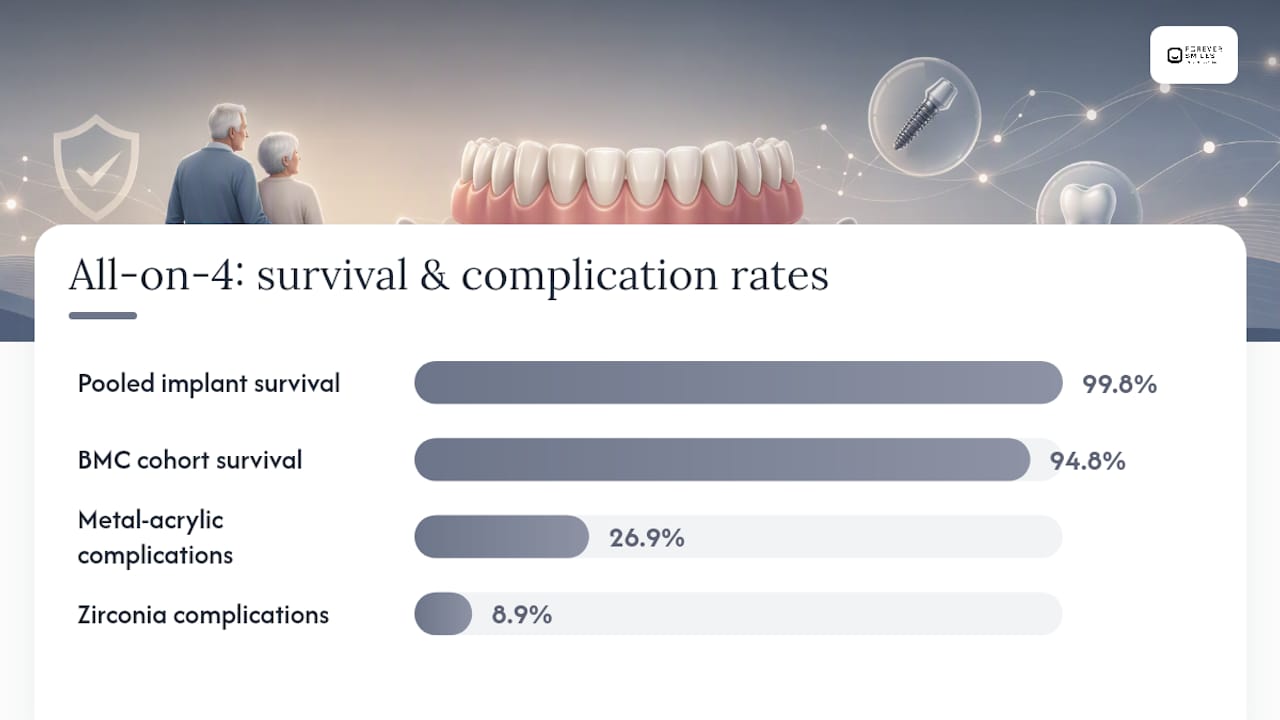
On the evidence side, a systematic review published in PMC reported pooled short- to medium-term implant survival as high as 99.8% in some summarized series, while explicitly cautioning that long-term high-quality evidence remains limited and follow-up periods in many studies are short. That caveat matters: medium-term data is encouraging, but All-on-4 is not a procedure with 20-year randomized trial data behind it.
Survival rate note: The BMC Oral Health multicenter cohort reported 94.8% overall implant survival at a mean 3.6-year follow-up, with prosthetic complication rates of 26.9% for metal-acrylic prostheses versus 8.9% for monolithic zirconia.
Material choice is not cosmetic. Zirconia's lower complication rate in medium-term follow-up means fewer repair visits, less chair time, and a more durable long-term result. For patients comparing full-mouth reconstruction options, that difference in prosthetic complication rates is a practical cost and convenience factor, not just a clinical footnote.
Benefits summary:
- Fixed teeth with no adhesive or nightly removal
- Improved chewing efficiency and speech stability
- Slows or stops jawbone resorption
- Single surgical procedure in most cases
- Zirconia prosthesis reduces mechanical complication risk versus metal-acrylic
What risks should denture wearers know about?
The main risks are implant failure, peri-implant infection, prosthetic fracture or loosening, and occlusal overload. Most are manageable with good planning and consistent follow-up.
Prosthodontic reviews emphasize that biomechanical planning, specifically implant spread, implant length, and occlusal scheme, directly reduces crestal bone strain and prosthetic overload. Cantilever reduction and proper occlusal design are not optional refinements; they are core to long-term success.
Pro Tip: Ask your surgeon specifically about the occlusal scheme planned for your prosthesis and whether a nightguard will be fabricated. Bruxers who receive an All-on-4 without a nightguard put the prosthesis and the implants under forces they were not designed to absorb alone.
Risks and management:
- Implant failure: higher in Type 4 bone; managed by careful site selection, longer implants, or zygomatic alternatives
- Peri-implant infection: treated with debridement, antibiotics, and improved home care; prevented by hygiene adherence
- Prosthetic fracture: more common with metal-acrylic; zirconia reduces this risk substantially
- Screw loosening: managed by torque checks at recall visits
- Occlusal overload: mitigated by nightguard use and proper cantilever design
What does All-on-4 cost, and how long does the process take?
The full timeline from consultation to final teeth typically runs 4–7 months. Surgery and provisional teeth happen on the same day; the waiting period is osseointegration, not additional procedures.
U.S. costs vary widely depending on geography, prosthetic material, and practice type, with lower-cost options involving acrylic-over-titanium prostheses and higher-cost options using zirconia at specialist centers. For a detailed breakdown of pricing factors, the All-on-4 cost guide covers what drives the range and what financing options exist.
Cost note: Zirconia's higher upfront cost often offsets itself over time. A metal-acrylic prosthesis with a 26.9% medium-term complication rate generates repair and replacement costs that a more durable zirconia prosthesis at 8.9% complication rate typically does not.
| Phase | Typical Timing |
|---|---|
| Consultation, CBCT, lab planning | Week 1–2 |
| Surgery and same-day provisional | Day of procedure |
| Healing and osseointegration | Months 1–4 |
| Final prosthesis impressions | Month 4–5 |
| Final prosthesis delivery | Month 5–6 |
How do you care for All-on-4 teeth long term?
Daily care is closer to natural teeth than to denture maintenance. Brush twice daily with a soft-bristle brush, clean under the bridge with a water flosser or interdental brushes, and avoid hard or extremely chewy foods during the first 8 weeks of healing.
Pro Tip: Zirconia prostheses cannot be relined the way acrylic ones can. If your bite shifts or the prosthesis feels off, the fix is a lab adjustment, not a chairside reline. Report any changes in fit early.
| Visit | Timing | What Happens |
|---|---|---|
| Suture removal | 1–2 weeks | Wound check, oral hygiene instruction |
| Early healing check | 4–6 weeks | Soft tissue assessment, occlusal check |
| Osseointegration check | 3 months | Implant stability, provisional assessment |
| Final prosthesis delivery | 3–6 months | Fit, occlusion, esthetics confirmed |
| Annual maintenance | Yearly | Screw torque check, prosthesis inspection, hygiene |
A nightguard is strongly recommended for any patient with a history of grinding. The prosthesis is durable, but no material is immune to the cumulative force of parafunction without protection.
Questions to ask your surgeon and red flags to watch for
Use this checklist at your consultation to evaluate fit, experience, and safeguards. A prepared list of questions for your All-on-4 provider covers the full range, but these are the non-negotiables:
Questions to ask:
- Will you review my CBCT with me during the consult?
- What alternatives did you consider, and why is All-on-4 the right fit for my case?
- How many full-arch cases have you completed, and what is your implant survival rate?
- What prosthetic material do you recommend, and why?
- What is your warranty and repair policy for the prosthesis?
- Who manages anesthesia, and what is the plan if I have medical comorbidities?
- What does your follow-up schedule look like for the first year?
Red flags:
- Pressure to sign a treatment agreement the same day
- No CBCT offered or reviewed before treatment planning
- Vague answers about outcomes or no documented case volume
- No in-house lab or clear prosthetic partner
- No aftercare plan or follow-up schedule discussed
For a deeper look at provider qualifications, who should not perform All-on-4 surgery outlines the credential gaps that put patients at risk.
Why a specialist full-arch center changes your outcome
Specialist centers reduce risk by combining surgical volume, planning protocols, and prosthetic control under one roof. The difference between a general dentist who places occasional implants and a residency-trained surgical specialist who performs full-arch cases daily is not a marketing distinction. It shows up in complication rates, revision rates, and the ability to handle the unexpected.
At Forever Smiles Implant Center, Dr. Brian Young brings more than 20 years of experience and over 28,000 implants placed to every case. He trains dentists and surgeons nationally, lectures on full-arch technique, and sits on the editorial board of Implant Practice US. The center's in-house dental lab means the surgical team and the lab technicians work from the same plan, not separate interpretations of it. A board-certified MD anesthesiologist manages sedation for complex cases, which matters for patients with medical histories that make IV sedation or general anesthesia necessary.
What to verify in any specialist provider:
- Residency-trained surgical credentials (not a weekend course)
- Documented full-arch case volume and implant survival data
- In-house or tightly integrated dental lab
- CBCT imaging reviewed with the patient before treatment planning
- Clear warranty and repair policy for the prosthesis
- Dedicated follow-up program through the first year and beyond
- Anesthesia plan appropriate for your medical history
A surgeon's perspective on patient selection
All-on-4 is one of the most powerful tools in reconstructive dentistry, but it is not the right answer for every patient who walks in wearing dentures. The cases that go wrong almost always share a common thread: inadequate selection, rushed planning, or a prosthetic material chosen for cost rather than durability.
Two points I return to with every patient: first, if any teeth are restorable, preserving them is worth a serious conversation before committing to full extraction. Second, the material and occlusal plan you choose on day one will determine how much maintenance you face over the next decade. Zirconia costs more upfront. It also breaks less often, which means fewer emergency visits and a more predictable long-term result. The evidence on that point is clear enough that it should be part of every informed consent conversation.
Forever Smiles Implant Center: full-arch planning built around your case
Permanent fixed teeth as a denture alternative, planned and delivered by a specialist surgical team, is exactly what Forever Smiles Implant Center does every day in Jacksonville, Florida.
The workflow covers every step in one place: CBCT imaging and smile design, specialist surgical planning, same-day provisional teeth, an in-house dental lab for final zirconia fabrication, and a board-certified MD anesthesiologist for complex cases. Dr. Brian Young has 20+ years of experience and 28,000+ implants placed, which means the team has seen and solved the cases that other practices turn away. Full-mouth implant treatment starts from $19,000 per arch, with financing options available.
If you are ready to find out whether All-on-4 is the right fit for your bone structure and health history, book a consultation with the Forever Smiles team and get a CBCT-based treatment plan built around your specific case.
Sources
The sources below informed this article's clinical claims. Each is linked to the specific finding it supports.
- Medium‑term outcomes and evidence caveats for All‑on‑4 (PMC)
- Medium-term clinical outcomes of the all-on-4 system in different bone types: a retrospective analysis | BMC Oral Health | Springer Nature Link
- All-on-4® treatment concept
- All-on-4
- All-on-4® treatment concept
- Benefits of All-on-4 Implants for Denture Wearers
This article is general information, not a substitute for advice from a qualified doctor. Consult a qualified healthcare professional about your own circumstances before acting on anything here.