
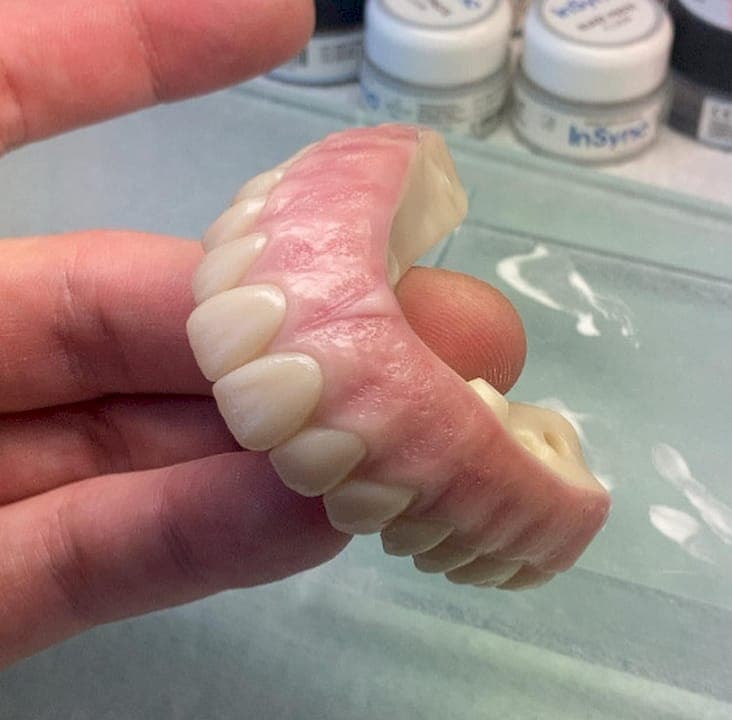
A palate-free implant prosthesis is an upper-arch tooth replacement that leaves the roof of the mouth open, held in place entirely by dental implants instead of suction against your palate. There are two clinical paths to get there: a fixed full-arch bridge that stays in your mouth permanently, or an implant-retained removable overdenture that snaps in and out.
-
Fixed bridge: Permanent, closest to natural teeth, cleaned like real teeth but requires threading floss under the bridge.
-
Removable overdenture: Snaps out for cleaning, often costs less upfront, and needs periodic attachment replacement.
If your current denture no longer fits, or you’re tired of a plate covering your palate, the right next step is a CBCT-based evaluation with an implant specialist who can map your bone and tell you which design fits your anatomy.
Key Takeaways
A palate-free implant prosthesis replaces palatal suction with implant support, and the choice between a fixed bridge and a removable overdenture depends on bone position, not just implant count.
| Point | Details |
|---|---|
| Two main designs | A fixed full-arch bridge stays permanent; a removable overdenture snaps out for cleaning and often costs less. |
| Position beats count | Anterior-posterior implant spread often determines whether a fully open palate is possible, more than implant number alone. |
| Four implants can suffice | Case reviews show four maxillary implants can match higher implant numbers in satisfaction and survival rates for palateless overdentures. |
| Costs vary by complexity | Bone grafting, material choice, and anesthesia level all shift price; always request an itemized quote. |
| Specialist centers handle complex cases | Forever Smiles Implant Center offers CBCT planning, an in-house lab, and MD anesthesia for complex full-arch and zygomatic cases. |
Table of Contents
Why Traditional Dentures Cover the Palate
A full upper denture relies on suction to stay put. Covering the entire palate maximizes surface area contact, which creates the seal that keeps the denture from dropping when you talk or chew. That physics works, but it comes at a cost.
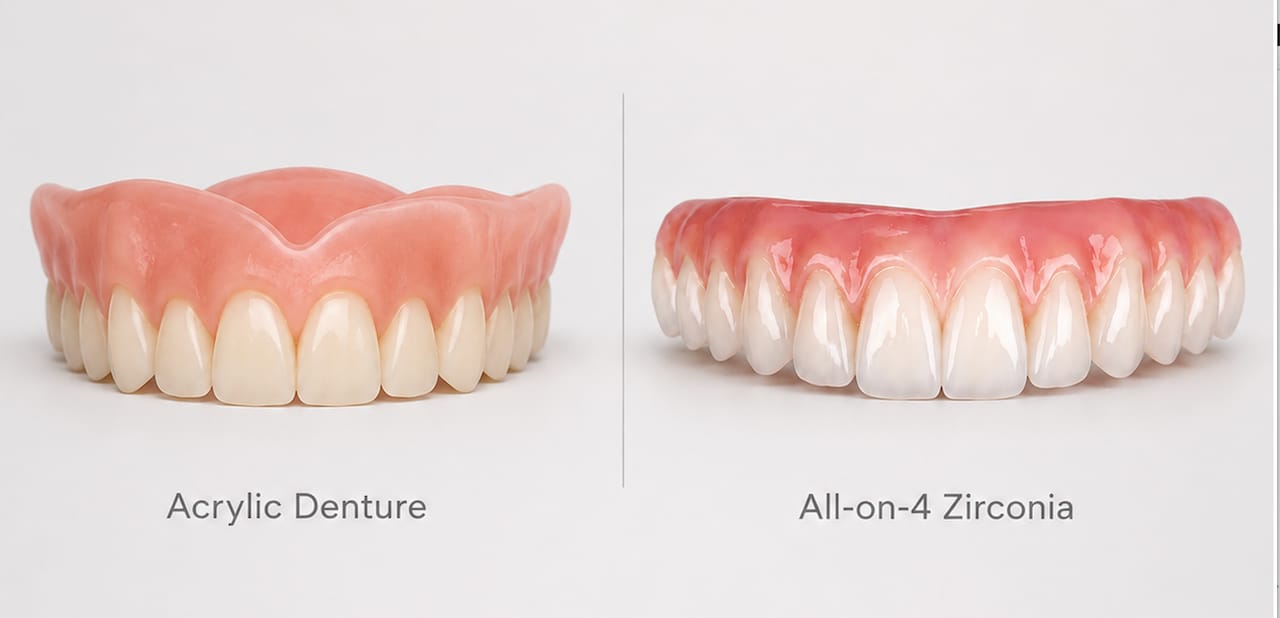
Palatal coverage muffles taste, since most taste and temperature receptors that matter for full flavor perception sit on the palate. It can also trigger a gag reflex in people with a sensitive soft palate, and it changes how the tongue contacts the roof of the mouth during speech, which is why some denture wearers develop a subtle lisp or feel like their words come out thick.
Pro Tip: When a clinician designs a palate-free prosthesis, the tuberosity area (the pad of tissue behind your last upper molar) and posterior ridge often carry as much load-bearing importance as the implants themselves. Skipping that assessment is a common reason palate-free designs fail early.
What Are the Two Main Palate-Free Prosthesis Designs?
Every palate-free option falls into one of two categories, and the difference between them shapes daily life more than almost any other decision in the process.
A fixed full-arch bridge attaches permanently to four to six implants, commonly following an All-on-4 style layout, and only a dentist can remove it. It feels closest to natural teeth, chews with near-normal force, and never needs to come out at night. The tradeoff is hygiene: you clean it in place with a water flosser or specialty floss threaders, and repairs require a dental visit rather than a bathroom counter fix.
An implant-retained removable overdenture (sometimes called a snap-in or horseshoe denture because the palate is cut away, leaving a horseshoe shape) usually relies on four implants, though some designs work with fewer depending on bone support. Attachments come in three main types: locator studs, ball attachments, or a connecting bar, and Cleveland Clinic’s overview of implant-retained dentures notes implant counts commonly range from two to six depending on the arch and design chosen. You pop it out to clean it, which many patients find easier, and it’s typically the more budget-friendly palate-free route.
-
Sensation: Fixed bridges feel more like natural teeth; removable overdentures still open the palate but sit slightly bulkier near the gumline.
-
Maintenance: Fixed needs professional cleaning tools; removable needs nightly removal and occasional attachment swaps.
-
Same-day potential: Both designs can sometimes receive a provisional prosthesis the day of surgery if bone and implant stability allow it.
Pro Tip: Ask specifically whether you’re a candidate for a same-day provisional. Not every case qualifies, and finding out during the planning visit, not after surgery, avoids a frustrating surprise.
Who Is a Candidate for a Palate-Free Implant Prosthesis?
Candidacy comes down to bone, health history, and how much of your palate a clinician can safely remove without sacrificing stability. A thorough evaluation typically covers:
-
Full medical history review, including diabetes control, blood thinners, and bisphosphonate use.
-
Intraoral exam checking gum health, remaining teeth, and bite alignment.
-
CBCT 3D imaging to measure bone height, width, and density in three dimensions.
-
Digital or physical impressions and an occlusion (bite) review.
Bone quantity matters, but position matters more. The 1998 clinical review on palatal design found that implant location and anterior-posterior spread determine whether a fully open palatal design is even possible, independent of how many implants you have. Implants placed too far forward, without enough spread toward the back of the arch, can force a clinician to keep some palatal coverage for stability regardless of implant count.
Common red flags include bone loss too severe for standard implants without grafting, uncontrolled diabetes or autoimmune disease, heavy smoking, and a history of head or neck radiation. None of these automatically disqualify you, but they change the plan. A specialist center that combines CBCT-based surgical planning with interdisciplinary input from oral surgery and prosthodontics catches these issues before surgery day, not during it.
What Is the Treatment Timeline From Consult to Final Teeth?
Most patients move through five distinct stages, though the pace between them depends heavily on bone health and healing response.
-
Consultation and exam (day one): history review, bite check, discussion of goals.
-
3D imaging and digital planning (same visit or within one to two weeks): CBCT scan maps bone volume and implant sites.
-
Implant placement surgery (planned separately, often weeks later): implants are placed under anesthesia, sometimes with same-day provisional teeth.
-
Healing and provisionalization (three to six months): bone integrates with the implants while you wear a temporary prosthesis.
-
Final custom prosthesis (after healing confirms implant stability): the permanent fixed bridge or overdenture is delivered.
The biggest fork in that timeline is whether you get a same-day fixed provisional bridge or a delayed-load removable overdenture while healing finishes. That choice depends on implant stability at placement, measured by the surgeon during surgery, not decided in advance. Clinical workflows describe several chairside conversion techniques for turning an existing denture into an immediate provisional, and each comes with different chair time and cost.
Pro Tip: Ask your surgeon which conversion technique they plan to use before surgery day. Guided, closed-mouth systems tend to preserve your bite better but may add cost compared to a traditional open conversion.
What Are the Benefits of a Palate-Free Prosthesis?
Patients who switch report four benefits consistently: fuller taste perception, a calmer gag reflex, more natural speech, and steadier chewing.
The clinical evidence backs this up, with limits. A review of palateless maxillary overdentures supported by at least four implants found favorable patient satisfaction along with survival rates comparable to designs using six implants, while retention, stability, and chewing efficiency held steady once the palate was removed. That’s a meaningful finding for anyone assuming more implants automatically means a better outcome.
-
Improved taste sensation and temperature awareness.
-
Reduced gag reflex, especially helpful for patients who struggled with traditional denture impressions.
-
More natural speech patterns since the tongue regains palatal contact.
-
Comparable chewing stability to designs that keep the palate covered, when implant number and position are adequate.
The evidence base leans on case series and smaller clinical reviews rather than large randomized trials, and patient-reported adaptation varies. Some people notice the sensory change within days, others take longer to adjust; a patient-experience discussion of palateless dentures frames this variability honestly rather than promising uniform results.
When Is Palatal Coverage Still Necessary?
Palate-free designs aren’t automatic for every patient, and understanding the limits keeps expectations realistic.
-
Implant failure or loosening: occurs in a small percentage of cases and may require replacement or added support.
-
Attachment wear: locator and ball attachments in removable overdentures lose retention gradually and need periodic replacement.
-
Ongoing maintenance needs: removable designs generally need more frequent professional check-ins than fixed bridges.
Clinically, palatal coverage may still be required when the anterior-posterior spread between implants is too narrow, when posterior bone loss is severe enough to limit implant placement toward the back of the arch, or when bite forces are unusually heavy and need broader distribution. Watch for warning signs at follow-up visits: a removable prosthesis that feels looser than it did last visit, chronic sore spots that don’t resolve, or any sensation of a specific implant moving. Any of those deserves a call to your surgical team before the next scheduled recall.
How Much Does a Palate-Free Implant Prosthesis Cost?
Price depends on several variables that shift the total significantly from patient to patient:
-
Number and type of implants placed (four versus six, standard versus zygomatic in complex bone loss cases).
-
Fixed bridge versus removable overdenture (fixed generally costs more due to lab complexity and material volume).
-
Need for bone grafting or a sinus lift before implant placement.
-
Lab material choice: acrylic teeth cost less than milled zirconia, which resists staining and wear longer.
-
Anesthesia level and facility fees, especially for IV sedation with a dedicated anesthesiologist.
As an illustrative range, full-arch implant treatment often starts around several thousand dollars per arch, and full-mouth reconstruction at a specialized center like Forever Smiles Implant Center can run from about $19,000 per arch depending on case complexity, with that figure covering planning, surgery, same-day provisional teeth, final zirconia, and follow-up care. Treat any number you see online as a starting point, not a quote, and ask every provider for an itemized breakdown before committing. Most centers offer financing plans or third-party payment options, which is worth raising at your very first consultation rather than after treatment planning is finished.
How Do You Care for a Palate-Free Prosthesis?
Daily habits differ slightly between fixed and removable designs, but both need consistent attention to last.
-
Morning and night: brush the prosthesis and all exposed implant abutments with a soft brush; removable wearers take the appliance out to clean it fully.
-
Daily: use a water flosser or floss threader under a fixed bridge to clear food debris from beneath the arch.
-
Weekly: inspect attachment areas on a removable overdenture for looseness or wear.
-
Every six to twelve months: professional cleaning and checkup, including attachment or O-ring replacement if retention has weakened.
Repair visits usually involve either a reline (adjusting the fit of a removable base), a pickup repair for a cracked denture tooth, or swapping worn locator inserts, all quick chairside procedures rather than major rebuilds.
How Do You Choose an Implant Provider?
The team you choose matters more for a palate-free case than for almost any other dental procedure, because implant position drives the entire design.
Ask directly: how many full-arch cases has this surgeon completed, is the surgeon residency-trained in implant surgery, does the practice have an in-house dental lab, and what anesthesia options are available for longer surgical appointments? Also ask for a written, itemized treatment plan and a realistic timeline before you agree to anything.
Red flags to walk away from: no CBCT imaging offered, a vague or shifting timeline, no written treatment plan, or high-pressure guarantees about results. A trustworthy provider treats these questions as normal, not intrusive.
Pro Tip: Request a written maintenance schedule along with your treatment plan. If a provider can’t tell you when attachments get replaced or how often you’ll need checkups, that’s a planning gap worth questioning before surgery.
When Does a Specialist Surgical Center Change the Outcome?
Not every palate-free case is straightforward, and complexity is exactly where experience separates outcomes. A patient with significant bone loss, a previously failed implant, or a case requiring zygomatic implants anchored in the cheekbone instead of the jaw needs a residency-trained surgical specialist, not a general dentist handling an occasional case.
Centers built around full-arch work daily, rather than as a side service, typically offer:
-
CBCT-based guided surgery for precise implant placement.
-
In-house labs that shorten turnaround on provisional and final prostheses.
-
Same-day provisional workflows for patients who qualify.
-
On-site anesthesia support for longer, more complex surgical appointments.
What Do Patients Notice After Switching to Palate-Free?
The most common thing people describe after healing isn’t the appliance itself. It’s food tasting like food again, and a wine or coffee suddenly having depth they hadn’t noticed missing for years. Speech often feels less effortful within weeks, and the gag reflex that made denture visits miserable tends to fade.

One practical adjustment: the palate is now exposed to direct heat, so early on it helps to ease back into hot soups and coffee rather than diving in at full temperature. Bring these day-to-day observations to your follow-up visits. Patient-reported changes like taste and comfort are exactly the kind of feedback that helps a provider fine-tune fit and function.
Ready to Explore a Palate-Free Option?
If everything above sounds like the upgrade your current denture never delivered, the next step is a real evaluation, not another generic dental visit. Forever Smiles Implant Center is built entirely around full-arch implant reconstruction, meaning the surgical team, in-house lab, and MD anesthesiologist all work under one roof instead of being scattered across referrals and separate appointments.
Dr. Brian Young has placed over 28,000 implants and specializes in the complex cases many other practices turn away, including previously failed implants and patients with minimal bone who need zygomatic implant solutions. Every case starts with CBCT imaging and a written, staged treatment plan, so you know exactly what to expect before surgery day. If your current denture is uncomfortable or you’re wondering whether a palate-free fixed bridge or overdenture fits your situation, request a consultation and get an itemized plan built around your own bone and goals.
Frequently Asked Questions
Can dentures be converted to implants? Yes. An existing denture can often be converted chairside into a temporary implant-supported provisional on the day implants are placed, though the technique used affects cost and fit precision.
My dentures don’t fit anymore. Is that normal? Bone naturally reshapes after tooth loss, so a denture that fit well a year ago often loosens over time. That shift is one of the most common reasons patients start exploring implant-supported alternatives.
Can you eat normally with a palate-free implant prosthesis? Yes, and many patients report chewing feels more stable than with a traditional denture, since implants anchor the bite force instead of relying on suction and gum pressure.
Do palate-free prostheses stay in place better than traditional dentures? Implant support generally provides more stability than a conventional denture resting on gum tissue alone, whether the final prosthesis is fixed or removable.
Can you have a palate-free prosthesis without implants? No. Removing palatal coverage without implant support would leave the upper prosthesis without enough retention to function, which is why implants are the defining feature of a palate-free design.
This article is general information, not a substitute for advice from a qualified doctor. Consult a qualified healthcare professional about your own circumstances before acting on anything here.
Sources
-
Implant-Retained vs Traditional Dentures: Honest Guide (Cleveland Clinic)
-
Clinical scenarios for palatal design and implant placement (1998 DOI)
Bring these sources to your consultation for a more informed discussion.