

Yes, dental implants typically improve speech for most people with missing teeth. The mechanism is straightforward: implants restore stable tooth positions that give your tongue and lips fixed reference points for forming sounds correctly. Unlike removable dentures, which can shift mid-sentence, fixed implant restorations stay put.
- Stability is the core benefit. Fixed prostheses eliminate the movement that causes slurring and mumbling with conventional dentures. Clinical practice summaries consistently list more natural speech as a primary patient-reported outcome.
- Tongue placement drives pronunciation. Implant-supported teeth recreate the palatal contours and tooth positions your tongue uses to produce fricatives like /s/, /z/, and /th/ — the sounds most disrupted by tooth loss.
- Short-term distortions are normal. Most patients notice some sibilant whistling or slight lisping immediately after restoration. Adaptation typically takes days to weeks for minor changes, and a longer period for full-arch cases.
- Persistent problems have clinical fixes. If speech issues remain past the three-month mark, prosthesis contouring, palatal volume reduction, or a referral for speech therapy can resolve them in most cases.
Table of Contents
- How your oral anatomy shapes the sounds you make
- Which missing teeth affect speech the most
- How dental implants restore speech clarity
- Short-term speech changes and the adaptation timeline
- When implants don't immediately fix speech — clinical fixes and therapy
- Procedure stages and aftercare that influence speech outcomes
- Cost expectations and overall timeline (U.S. context)
- Patient outcomes: confidence, communication, and quality of life
- When should you choose a specialist for complex cases?
- Key Takeaways
- What patients with speech concerns often get wrong about implants
- Full-arch reconstruction at Forever Smiles Implant Center
- Useful sources and further reading
How your oral anatomy shapes the sounds you make
Every consonant you produce is a collaboration between moving parts: the tongue, teeth, alveolar ridge (the bony shelf just behind your upper front teeth), hard palate, lips, and airflow. Linguists and phoneticians call these the articulators, and the Cambridge Handbook of Phonetics describes how each consonant class depends on precise contact between specific articulators.
Fricatives — /s/, /z/, /sh/, /th/ — are the most sensitive. Producing a clean /s/ requires the tongue tip to approach the alveolar ridge at a very specific distance, creating a narrow channel that shapes the airstream into a high-frequency hiss. Move that ridge even a few millimeters (as missing teeth do), and the acoustic result changes noticeably. Stops like /t/ and /d/ are slightly more forgiving but still depend on the tongue contacting the ridge behind the upper incisors.

The palate matters too. A prosthesis that adds bulk to the roof of the mouth changes the resonance chamber, affecting vowel quality and the perceived "fullness" of speech. This is why prosthesis design — not just implant placement — is central to speech outcomes.
Which missing teeth affect speech the most
Front teeth are the biggest culprits. Upper incisors and canines anchor the tongue's reference points for the sounds most people notice when someone has a gap.
- Upper central and lateral incisors: Loss here most directly disrupts /s/, /z/, /th/, and /f/ sounds. The tongue has nowhere to aim, and air escapes in the wrong direction.
- Upper canines: These guide the tongue for /s/ and help define the arch shape that supports lip position for labial sounds.
- Lower incisors: Less dramatic than upper loss, but still affect /th/ and /d/ production.
- Posterior teeth (molars and premolars): Missing back teeth rarely change consonants directly, but they reduce the vertical dimension of the bite, which compresses the space available for tongue movement and can alter resonance and vowel quality over time.
The Coalition for Dentist-Patient Relations notes that even a single missing front tooth can produce noticeable changes in articulation. Denture coverage adds another layer: a full upper denture that covers the palate changes the resonance chamber even when all teeth are present in the prosthesis, which is why palatal design matters as much as tooth position.
How dental implants restore speech clarity
The single biggest speech advantage of implants over removable dentures is that they don't move. A denture that shifts even a millimeter during speech forces the tongue to compensate constantly, producing the slurring and mumbling that many denture wearers describe. Fixed implant restorations eliminate that variable entirely.
Beyond stability, implant-supported prostheses can be designed to match the palatal contours and tooth positions of natural dentition. The emergence profile (the angle at which the crown meets the gum), tooth height, and palatal bulk are all adjustable during the design phase. Get those right, and the tongue remaps to the new positions quickly. Get them wrong, and speech problems persist regardless of how well the implant itself integrates.
Comparing fixed implant restorations to implant-retained overdentures on speech-relevant dimensions: fixed restorations win on stability and palatal coverage (they can be designed with minimal palatal bulk), while overdentures still cover some palate but anchor firmly enough to prevent the gross movement of conventional dentures, as explained by Dental Implants Amsterdam. A prospective multicenter study found that reduced palatal coverage designs lowered speech problems significantly, with overall speech satisfaction rising to above 80% after final loading. Both are meaningfully better than conventional removable dentures for speech, but the gap between them matters for patients with severe sibilant sensitivity.
Pro Tip: During your planning consultation, ask specifically about palatal contour and tooth position in the provisional prosthesis. Getting those details right at the provisional stage costs far less than remaking a final prosthesis.
Short-term speech changes and the adaptation timeline
Almost everyone notices something different about their speech immediately after a new implant restoration. That's expected, not alarming.
Common short-term effects include:
- Sibilant whistling or sharpness — the /s/ and /z/ sounds may whistle or sound "too crisp" because the tongue is hitting a new surface at a slightly different angle.
- Mild lisping — especially with full-arch restorations, where the entire tooth architecture has changed.
- Altered resonance — vowels may sound slightly different to the patient, though listeners often notice less than the patient does.
These effects occur because the tongue has spent years (sometimes decades) mapping to a specific set of tooth positions. New teeth, even perfectly designed ones, require remapping. The timeline generally follows this pattern:
- Days 1–7: Most noticeable distortions. The tongue is still using old reference points.
- Weeks 2–4: Significant improvement for most patients as the tongue adapts to the provisional prosthesis.
- Months 1–3: Continued refinement, especially for full-arch cases. A retrospective study of 50 patients found that adaptation time was one of the primary factors correlated with speech improvement after complete-arch implant restorations.
- Final prosthesis delivery: A brief re-adaptation period is common when switching from provisional to final teeth, but it's typically shorter than the initial adjustment.
Practical exercises that accelerate adaptation: read aloud for 10–15 minutes daily, focusing on sentences loaded with /s/ and /z/ sounds; repeat target words slowly, then at normal speed; record yourself and compare weekly. These drills work because active use speeds the tongue's remapping to new positions.
Pro Tip: At your three-month follow-up, bring a short list of specific words or sounds that still feel off. That's far more useful to your clinician than a general "something sounds weird."
When implants don't immediately fix speech — clinical fixes and therapy
Some patients still have noticeable speech problems after the initial adaptation window. The causes are usually identifiable and fixable.
Common clinical causes:
- Excessive palatal bulk in the prosthesis, reducing tongue mobility
- Incorrect anterior tooth position (too far forward or back relative to the alveolar ridge)
- Inadequate anterior support, leaving the tongue without a clear contact reference
- Anatomy constraints from significant bone loss, which limits where teeth can be positioned
The most studied fix is palatal volume reduction. In a 10-patient clinical series, selective reduction of palatal bulk restored baseline speech in 5 of 7 patients with persistent problems, and improved speech in the remaining two.
| Intervention | Patients with persistent problems | Outcome |
|---|---|---|
| Palatal volume reduction | 7 | Baseline speech restored in 5; improved in 2 |
| No further intervention needed | 3 | Resolved during adaptation |
Other options when contouring alone isn't enough: remaking the provisional with adjusted tooth positions, targeted occlusal adjustments, or a referral to a speech-language pathologist for targeted articulation therapy. The American Speech-Language-Hearing Association provides guidance on finding qualified speech therapists for adults with acquired articulation changes.
Clinicians should test provisional reductions before altering the final prosthesis. It's a low-risk step that often resolves the problem without a full remake.
Procedure stages and aftercare that influence speech outcomes
Speech results don't happen at surgery. They're shaped across the entire treatment arc.
- Diagnostic planning (wax-up/try-in): This is where tooth position and palatal contour are set. Ask to see and test the wax-up before anything is fabricated. If the provisional doesn't feel right for speech, say so.
- Provisional prosthesis phase: The most speech-critical stage. The provisional is your test drive. Wear it for several weeks, speak in real-world situations, and document specific sounds that feel off. Clinical studies emphasize that many speech issues are detected and resolved during this phase — not after the final prosthesis is delivered.
- Final prosthesis delivery: Expect a brief re-adaptation period. If new speech problems emerge, report them within the first two weeks.
- Follow-up adjustments: Most practices schedule follow-ups at one week, one month, and three months. Use those appointments.
Questions to bring to every follow-up: Is the palatal bulk appropriate for my tongue movement? Are my anterior teeth positioned to support /s/ and /th/ sounds? How long should I wait before requesting an adjustment? What's the process if I need a remake?
Cost expectations and overall timeline (U.S. context)
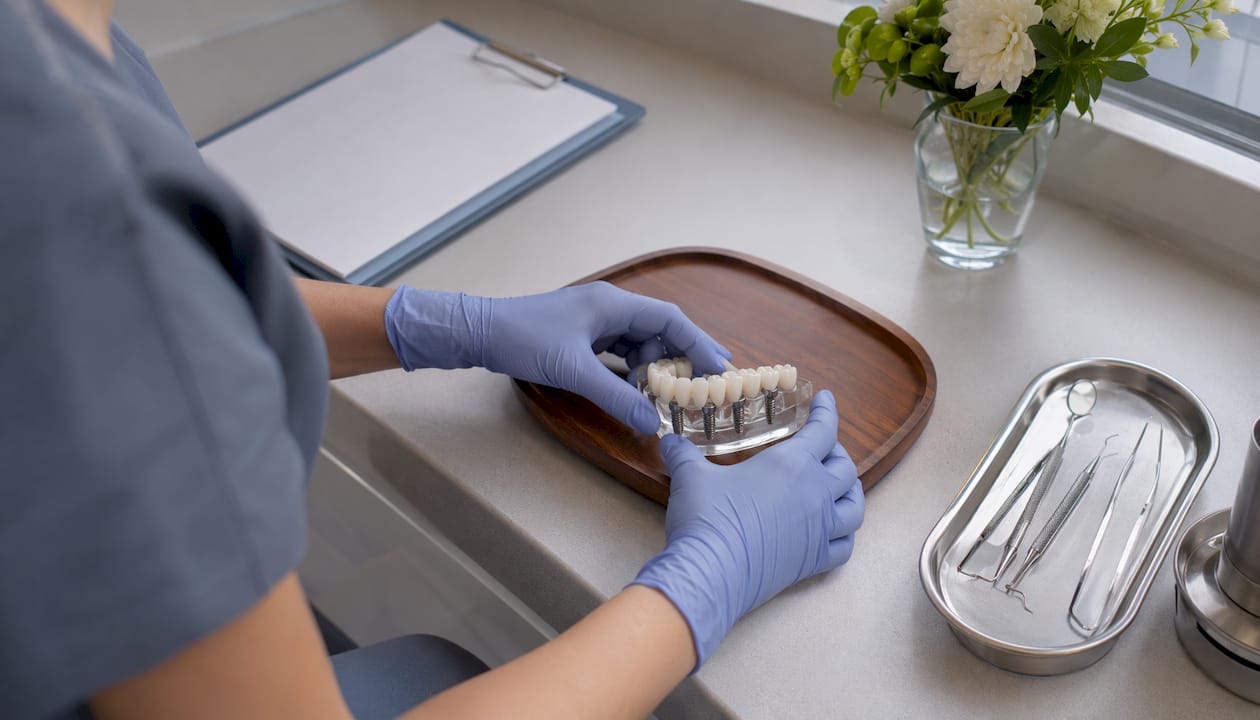
Implant treatment in the U.S. spans a wide range depending on the number of teeth replaced and the complexity of the case.
| Treatment pathway | Typical U.S. cost range | Typical timeline |
|---|---|---|
| Single implant + crown | — | 3–6 months |
| Implant-supported overdenture (2–4 implants) | $19,000 per arch | 4 months |
| Full-arch fixed (All-on-4 / full reconstruction) | $19,000+ per arch | 6 months |
- Bone grafts add cost and time (typically 3–6 months of healing before implant placement).
- Systemic health factors — uncontrolled diabetes, active smoking, certain medications — can extend healing timelines.
- Insurance rarely covers implants fully, but some plans cover portions of the surgical or restorative phase. Flexible spending accounts (FSAs) and health savings accounts (HSAs) can offset out-of-pocket costs.
- Financing through third-party lenders (CareCredit, Lending Club Health) is widely available at implant practices.
The full-arch pathway at Forever Smiles Implant Center starts at $19,000 per arch and includes planning, surgery, same-day teeth, final zirconia teeth, and follow-up care. That's a single, all-in price rather than a series of itemized bills.
Patient outcomes: confidence, communication, and quality of life
The functional gains from implant-based speech improvement tend to produce a cascade of social and psychological benefits that patients often describe as more significant than the physical restoration itself.
Patient-reported outcome themes from the literature are consistent: improved speech clarity, reduced self-consciousness in conversation, greater willingness to speak in professional and social settings, and less fatigue from the constant mental effort of compensating for unstable teeth. Prospective studies show speech satisfaction scores rising to above 80% after final loading for implant-retained prostheses, compared with pre-treatment levels.
Measurable functional benefits patients report:
- Fewer sibilant slips and whistles in daily conversation
- Clearer telephone communication (where visual cues don't compensate for unclear articulation)
- Improved ability to speak in noisy environments without over-articulating
- Reduced avoidance of words or situations that previously exposed speech difficulties
- Better chewing efficiency, which supports clearer resonance by restoring proper vertical dimension
The psychology of confidence after implants runs deeper than most people expect before treatment. Patients who avoided speaking in meetings, on the phone, or in social settings often describe the change as getting a part of their personality back.
When should you choose a specialist for complex cases?
Not every implant case is straightforward, and speech outcomes in complex cases depend heavily on the surgeon's experience with anatomy-constrained situations.
Clinical red flags that warrant a specialist:
- Extensive bone loss in the anterior maxilla (upper front jaw), which limits where teeth can be positioned for optimal speech
- Previously failed implants requiring removal and reconstruction
- Maxillofacial defects, cleft palate-related anatomy, or prior radiotherapy to the jaw
- Need for zygomatic implants (anchored in the cheekbone when jaw bone is insufficient)
- Velopharyngeal insufficiency requiring implant-retained obturators or palatal lifts
For complex structural cases, implants can serve as anchors for prosthetic devices — obturators and palatal lifts — that directly manipulate airflow and tongue placement as part of a multidisciplinary speech rehabilitation plan. Clinical reports describe this approach for cleft and acquired palatal defects.
What to ask a prospective provider:
- How many full-arch cases do you perform per week (not per year)?
- Do you have an in-house lab, or does design happen off-site?
- Is a board-certified MD anesthesiologist available for surgery?
- Can you show me cases similar to mine, including the speech outcomes?
- What is your protocol when a patient has persistent speech problems after final delivery?
Dr. Brian Young at Forever Smiles Implant Center has placed over 28,000 implants over more than 20 years of full-arch specialization. He trains surgeons nationally, sits on the editorial board of Implant Practice US, and is specifically known for taking on cases other providers have declined, including severe bone loss and previously failed implant reconstructions. The practice includes an in-house dental lab and a board-certified MD anesthesiologist, which means speech-relevant prosthesis adjustments happen without sending work to an outside lab and waiting weeks for results.
Pro Tip: At a specialist consultation, ask specifically: "What do you anticipate my speech adaptation timeline will be, and what's your plan if I have persistent sibilant issues after the provisional?" A surgeon who can answer that question specifically has thought about speech outcomes as a clinical metric, not an afterthought.
Key Takeaways
Dental implants improve speech for most patients by restoring stable tooth positions, eliminating prosthesis movement, and allowing precise palatal design — with short-term adaptation expected and clinical fixes available for persistent problems.
| Point | Details |
|---|---|
| Implants usually improve speech | Fixed restorations restore tongue reference points and eliminate the movement that causes slurring with dentures. |
| Adaptation takes time | Expect days to weeks for minor cases; full-arch adaptation can take up to three months per clinical evidence. |
| Short-term distortions are normal | Sibilant whistling and mild lisping are common immediately after restoration and typically resolve with practice. |
| Persistent problems have fixes | Palatal volume reduction restored baseline speech in 5 of 7 patients with persistent issues in a published clinical series. |
| Forever Smiles Implant Center | Specializes in full-arch reconstruction with in-house lab and daily surgical volume — including complex cases where speech outcomes depend on advanced anatomy management. |
What patients with speech concerns often get wrong about implants
Most people assume the implant placement is where speech outcomes are decided. It isn't. The surgery creates the foundation, but the prosthesis design — tooth position, palatal contour, emergence profile — is what actually determines how you sound afterward. A perfectly integrated implant under a poorly designed crown still produces speech problems.
The other thing patients underestimate is the provisional phase. Many want to skip it or rush through it to get to the final teeth. That's a mistake. The provisional is the only stage where you can test speech in real life, identify specific sounds that feel off, and have adjustments made before anything is permanent. Clinicians who take the provisional phase seriously — who ask patients to read aloud, record themselves, and report back — consistently produce better speech outcomes than those who treat it as a formality.
For patients with significant bone loss or previously failed implants, the stakes are higher. Anatomy constraints limit where teeth can be positioned, which means the surgeon's experience with complex cases directly affects what speech outcomes are achievable. That's not a reason to avoid treatment. It's a reason to choose the right provider the first time.
Full-arch reconstruction at Forever Smiles Implant Center
For patients dealing with full-arch tooth loss, failing teeth, or dentures that have changed how they speak and communicate, Forever Smiles Implant Center offers a focused alternative to the fragmented, multi-provider implant experience. The entire process — 3D surgical planning, implant surgery, in-house lab fabrication, and follow-up adjustments — happens under one roof with one accountable team. That matters for speech outcomes specifically, because prosthesis refinements that affect sound don't require weeks of back-and-forth with an outside lab.
The practice starts at $19,000 per arch for full-arch reconstruction, covering planning, surgery, same-day teeth, final custom zirconia teeth, and follow-up care. For patients with severe bone loss who have been told they aren't candidates elsewhere, zygomatic implants are available as part of the surgical repertoire. If you have questions about what to expect for your specific situation, the dental implants FAQ page covers the most common concerns about the process, timeline, and speech adaptation. Schedule a consultation to discuss your case directly with Dr. Young.
This article provides general information about dental implants and speech outcomes. It is not a substitute for professional dental or medical advice. Confirm treatment options and expectations with a qualified implant specialist for your specific situation.
Useful sources and further reading
-
Factors influencing speech improvement following maxillary complete-arch implant-supported restorations — A retrospective study of 50 patients that identifies anterior residual bone volume and adaptation time as the primary predictors of speech improvement after full-arch implant restorations. Useful for understanding why outcomes vary and what to discuss in pre-op counseling.
-
Impact of fixed implant prosthetics using the All-on-Four treatment concept on speech intelligibility — Documents early speech changes after All-on-4 rehabilitation and the adaptation timeline. Good background for patients preparing for full-arch treatment.
-
On speech problems with fixed restorations on implants in the edentulous maxilla — Introduces the palatal volume reduction concept and reports outcomes in a 10-patient series. The most directly actionable clinical study for patients with persistent post-restoration speech problems.
-
Speech evaluation during maxillary mini-dental implant overdenture treatment — Prospective multicenter study on speech satisfaction after implant-retained overdentures. Useful for comparing overdenture and fixed restoration speech outcomes.
-
American Speech-Language-Hearing Association — Speech and Language — The professional body for speech-language pathologists in the U.S. Use this to find a qualified therapist if persistent articulation problems require targeted intervention after implant restoration.
-
American Academy of Implant Dentistry — Benefits of Dental Implants — Patient-oriented overview of implant benefits including speech and quality of life. A good starting point for readers new to the topic who want a broad overview before diving into clinical literature.