
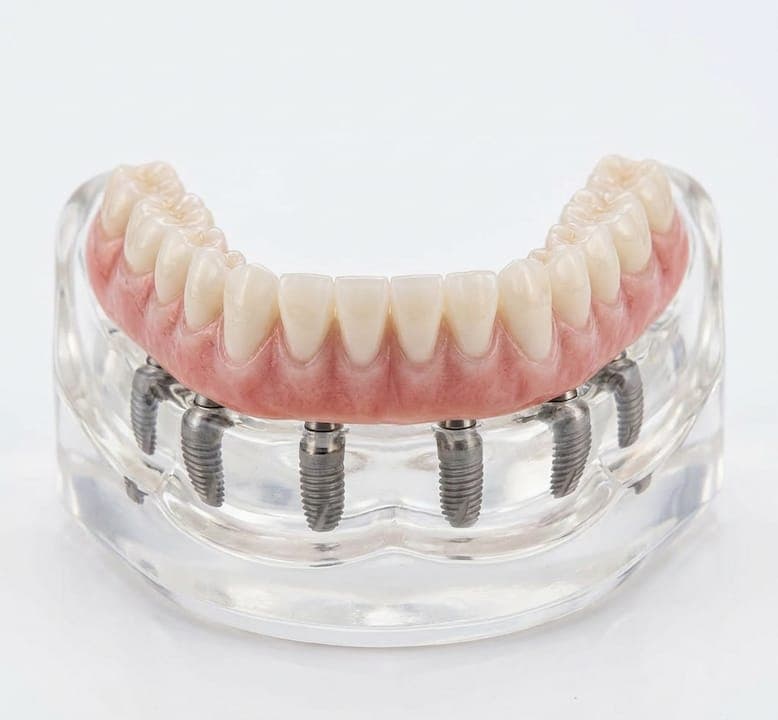
An implant fixed bridge is a non-removable dental restoration anchored directly into the jawbone by titanium implants. It restores chewing, speech, and appearance without touching the healthy teeth on either side of the gap. The benefits run well past aesthetics. Clinical data shows chewing scores climb from 4.1 to 8.7 on a 10-point scale after treatment, and overall patient satisfaction rises from 48% to 92% at 12 months. For anyone dealing with multiple missing teeth, failing teeth, or dentures that will not sit right, this kind of restoration offers a permanent, bone-preserving solution that works like natural teeth around the clock.
1. What are implant fixed bridges and how do they work?
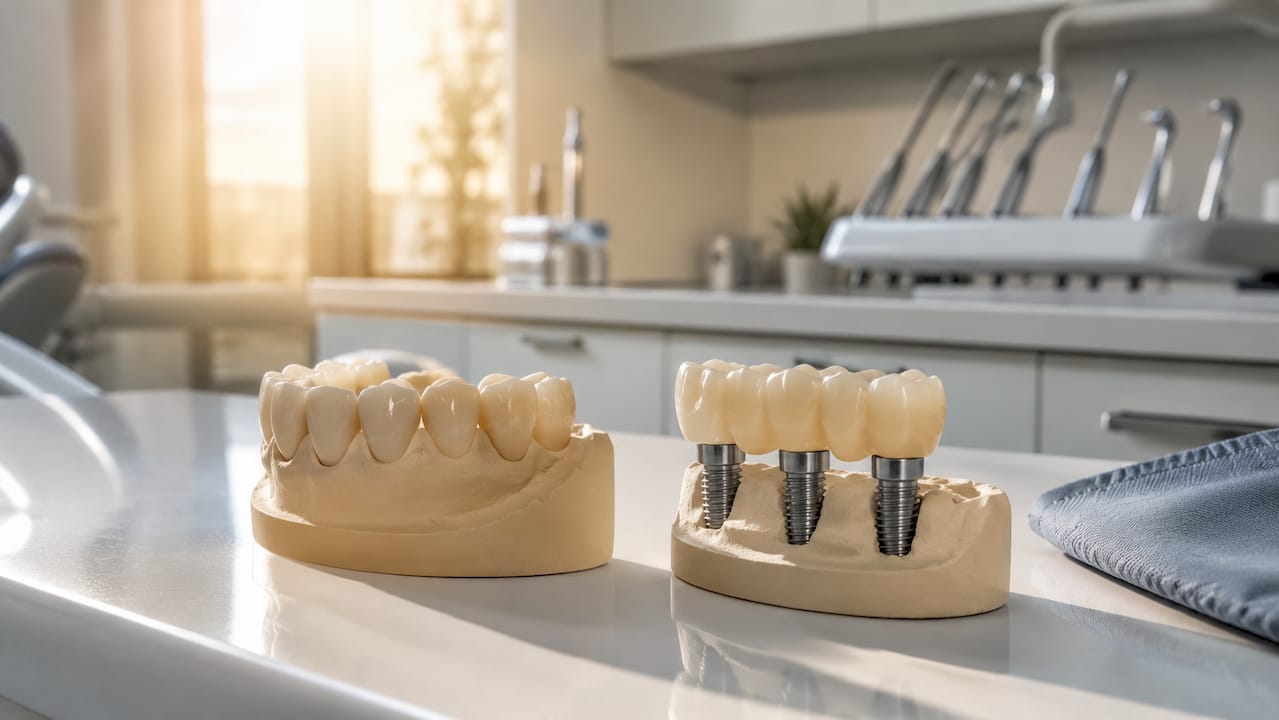
An implant-supported fixed bridge replaces multiple missing teeth by anchoring a prosthetic arch to two or more titanium implants set directly in the jawbone, instead of leaning on natural teeth for support. The clinical term is “implant-supported fixed prosthesis,” though “implant fixed bridge” is the phrase most people use and recognize. Both describe the same non-removable result.
The treatment follows a clear sequence:
-
Implant placement: A surgeon inserts titanium posts into the jawbone at precise positions. The bone fuses to the implant surface through a process called osseointegration, typically over three to six months.
-
Healing phase: The implants integrate with the bone. Many patients wear a temporary prosthesis during this period, so they are never without teeth.
-
Bridge fitting: Once integration is confirmed, a custom-fabricated bridge is attached to the implants by screws or cement. Only a dentist can remove it.
-
Final delivery: The permanent bridge, often made from zirconia, is seated and adjusted for bite and esthetics.
The mechanical difference from a traditional tooth-supported bridge comes down to anchorage. A conventional bridge grinds down the two teeth flanking the gap to use them as anchors. An implant-supported version is self-supporting by design, so the neighboring teeth are left completely alone. That one structural difference is behind most of the clinical advantages below.
2. Top benefits of implant fixed bridges vs. traditional options
The advantages of dental implants as anchors for fixed restorations are well documented. Here are the benefits that matter most clinically, roughly in order of how much patients feel them.
-
No damage to adjacent teeth. Traditional tooth-supported bridges require filing down healthy neighboring teeth to create anchor crowns. Implant-supported bridges leave those teeth entirely intact. That matters, because grinding down a healthy tooth weakens it permanently and raises its long-term risk of decay and nerve damage.
-
Jawbone preservation. When a tooth root is lost, the jawbone beneath it starts to shrink. Titanium implants mimic a natural root and keep stimulating the bone, which slows or stops that resorption. Removable dentures sit on top of the gum and provide no such stimulation, which is why long-term denture wearers so often develop the sunken facial look associated with bone loss.
-
Stability and natural feel. Fixed implant bridges are non-removable and function like natural teeth every hour of every day. Patients do not take them out at night, do not reach for adhesives, and do not deal with the rocking or slipping that removable dentures cause. That stability feeds directly into confidence in social and professional settings.
-
Dramatically improved chewing function. The chewing data is concrete. In one study of 70 patients, scores rose from 4.1 to 8.7 after implant fixed bridge treatment, better than a doubling of functional chewing ability. Patients who had been steering clear of apples, nuts, or steak can go back to eating normally.
-
Better speech. Removable dentures can shift while you talk, producing slurring or clicking. A fixed implant prosthesis stays put, so phonetics improve right after the adjustment period.
-
High esthetic quality. Custom zirconia bridges are built to match the color, shape, and translucency of natural teeth. The result looks natural because the restoration emerges from the gumline the same way a real tooth does.
-
Proven patient satisfaction. Overall satisfaction reaches 92% at 12 months post-treatment, a figure that rolls functional improvement, esthetic outcome, and quality-of-life gains into one.
Pro Tip: Ask your surgeon specifically about zirconia as the bridge material. Zirconia is harder, more stain-resistant, and more lifelike than older acrylic options, and it is the standard at high-volume implant centers like Forever Smiles Implant Center.
3. Long-term outcomes and what maintenance actually looks like
Durability is one of the strongest arguments for choosing a fixed implant restoration. Across multiple clinical studies, full-arch implant-supported fixed prostheses show cumulative survival rates of 84.3% to 100% over four to ten years. The All-on-4 protocol specifically reports a 92.5% implant survival rate and 96.2% prosthetic survival at 12 years, with average marginal bone loss of just 1.19 mm. By the standards of any medical device, those are durable numbers.
Complications do still happen. Screw loosening, chipping of the prosthetic material, and wear on provisional bridges are the usual ones. Building those adjustments into the plan is part of responsible treatment, and not a sign that something has gone wrong.
Maintenance for a fixed implant bridge differs from both natural teeth and removable dentures:
-
Daily cleaning: Patients use interdental brushes, water flossers, or specialized floss threaders to clean beneath the bridge where a standard toothbrush cannot reach.
-
Professional check-ups: Regular visits let the surgeon check implant stability, assess bone levels with X-rays, and tighten or replace any hardware as needed.
-
Bite management: Patients who grind their teeth (bruxism) put extra stress on the prosthesis. A night guard or bite adjustment is often part of the long-term protocol.
-
No soaking or adhesives: Unlike removable options, fixed bridges need no overnight soaking and no daily adhesive.
Fixed bridges prioritize stability and natural function over the easy at-home cleaning that removable prostheses offer. For most patients that trade is worth making, as long as they stay consistent with a daily hygiene routine.
Pro Tip: A water flosser used at medium pressure is the single most effective daily tool for cleaning under a fixed implant bridge. It reaches areas that brushing and string floss simply cannot.
4. How to choose between implant fixed bridges and other dental restoration options
Choosing the right tooth replacement comes down to four factors: bone volume, adjacent tooth health, lifestyle priorities, and budget. The table below compares the three main options.
| Factor | Implant fixed bridge | Traditional tooth bridge | Removable denture |
|---|---|---|---|
| Adjacent teeth affected | None | Yes, filed down | None |
| Bone stimulation | Yes | No | No |
| Removable by patient | No | No | Yes |
| Cleaning method | Interdental brush, water flosser | Floss threader | Remove and soak |
| Longevity | 10+ years with maintenance | 10–15 years | 5–8 years typically |
| Bone requirement | Adequate bone or bone graft | Natural teeth present | Minimal |
| Cost range | Higher upfront | Moderate | Lower upfront |
Choosing between fixed and removable implant prostheses comes back to individual priorities, stability against ease of cleaning, cost against feel. Patients who care most about stability, a natural feel, and bone health tend to land on fixed options whenever their clinical situation allows. For those with severe bone loss, a bone graft or zygomatic implants may need to come first before a fixed bridge is even on the table.
Cost is a real factor. A fixed implant restoration asks for a higher upfront investment than removable dentures. But dentures usually need replacing every five to eight years, plus the running cost of adhesives, while a well-maintained implant bridge can last well past a decade. Look at it over a 15-year horizon and the gap between the two often narrows far more than people expect.
In suitable cases, implant-supported fixed prostheses are favored over removable dentures for retention, stability, and phonetics. The clinical consensus on that is steady: when the bone and the patient's health support it, fixed delivers the better functional outcome. A good surgeon will tell you honestly which option suits your anatomy, rather than which one is simply easier to place.
For patients weighing the full picture, a detailed dentures vs. implants comparison covers the stability, cost, and maintenance trade-offs in depth. Patients unsure whether they are candidates for a fixed restoration should also review what the full mouth implant process involves before their first consultation.
Key takeaways
Implant fixed bridges deliver superior function, bone preservation, and long-term durability compared to traditional bridges and removable dentures, making them the preferred restoration when clinical conditions allow.
| Point | Details |
|---|---|
| Bone preservation | Titanium implants stimulate the jawbone, preventing the shrinkage that removable dentures cannot stop. |
| Adjacent teeth protected | No neighboring teeth are filed down, unlike traditional tooth-supported bridges. |
| Patient satisfaction | Clinical data shows satisfaction rises to 92% at 12 months after implant fixed bridge treatment. |
| Long-term survival | Full-arch fixed prostheses show survival rates of 84.3%–100% over 4–10 years in clinical studies. |
| Maintenance commitment | Daily interdental cleaning and regular professional check-ups are required for lasting results. |
What I’ve learned after placing over 28,000 implants
Patients often come to me after years of struggling with dentures or after a failed implant placed elsewhere. The question I hear most is: “Why didn’t someone tell me about this sooner?” The answer is usually that they saw a generalist who offered what was easiest to provide, not what was best for the patient’s long-term outcome.
Fixed implant restorations are not right for every patient on day one. Some people need bone grafting first. Some need zygomatic implants because their upper jaw has lost too much bone for standard placement. But the goal is always to get the patient to a fixed result if their health allows it. Removable is a compromise. Fixed is the standard.
What I find most underappreciated is the psychological shift patients experience. Chewing function and confidence are deeply connected. When someone can eat a meal without thinking about their teeth, their entire relationship with food and social situations changes. That is not a minor quality-of-life improvement. It is a fundamental one.
The other thing I tell every patient: the surgery is one day. The result is the rest of your life. Choosing a surgeon based on price alone is the most expensive decision you can make. A failed implant costs more to fix than it would have cost to do correctly the first time. Experience is not expensive. Inexperience is.
— Dr. Brian Young
Full-arch implant care at Forever Smiles Implant Center
Forever Smiles Implant Center in Jacksonville, Florida, performs full-arch implant procedures every single day. The practice is built around one specialty: dental implant reconstruction. Every patient receives surgical planning, in-house lab fabrication, and a board-certified MD anesthesiologist under one roof.
Dr. Brian Young has placed over 28,000 implants and trains surgeons nationally on full-arch technique. The practice handles complex cases, including patients with severe bone loss and previously failed implants. Treatment starts from $19,000 per arch and includes planning, same-day teeth, final zirconia restoration, and follow-up care. For answers to the most common questions about implant procedures, visit the dental implants FAQ or schedule a consultation with 3D imaging to see exactly what your case requires.
FAQ
What is an implant fixed bridge?
An implant fixed bridge is a non-removable dental prosthesis anchored to two or more titanium implants in the jawbone. It replaces multiple missing teeth and functions like natural teeth without relying on adjacent teeth for support.
How long do implant fixed bridges last?
Clinical studies report cumulative survival rates of 84.3%–100% over 4–10 years for full-arch fixed prostheses. With proper maintenance and regular professional check-ups, results at 12 years show over 92% implant survival.
Do implant fixed bridges require special cleaning?
Yes. Patients use interdental brushes, water flossers, or floss threaders daily to clean beneath the bridge. Standard brushing alone is not sufficient, and regular professional maintenance visits are required.
How is an implant fixed bridge different from a traditional bridge?
A traditional bridge files down healthy adjacent teeth to serve as anchors. An implant fixed bridge is anchored entirely by implants, leaving neighboring teeth completely untouched and preserving their structure.
Who is a candidate for an implant fixed bridge?
Patients with adequate jawbone volume and good general health are strong candidates. Those with significant bone loss may qualify after bone grafting or with zygomatic implants. A 3D imaging consultation determines candidacy accurately.