

Denture wearer implant candidacy is defined as the clinical assessment process that determines whether a denture patient qualifies for dental implants based on general health, jawbone quality, and oral condition. Surgeons evaluate these factors before recommending any implant procedure, because placing implants in an unprepared patient leads to preventable failure. The core criteria include systemic health classification, bone volume, gum health, and lifestyle habits. Understanding what is denture wearer implant candidacy gives you a realistic picture of where you stand and what steps, if any, can move you closer to a permanent solution.
What is denture wearer implant candidacy, and who qualifies?
Implant candidacy for denture wearers is not a simple yes or no. It is a spectrum determined by a combination of medical, dental, and behavioral factors. Patients who meet all criteria may proceed directly to surgery. Patients who fall short on one factor often qualify after targeted treatment.
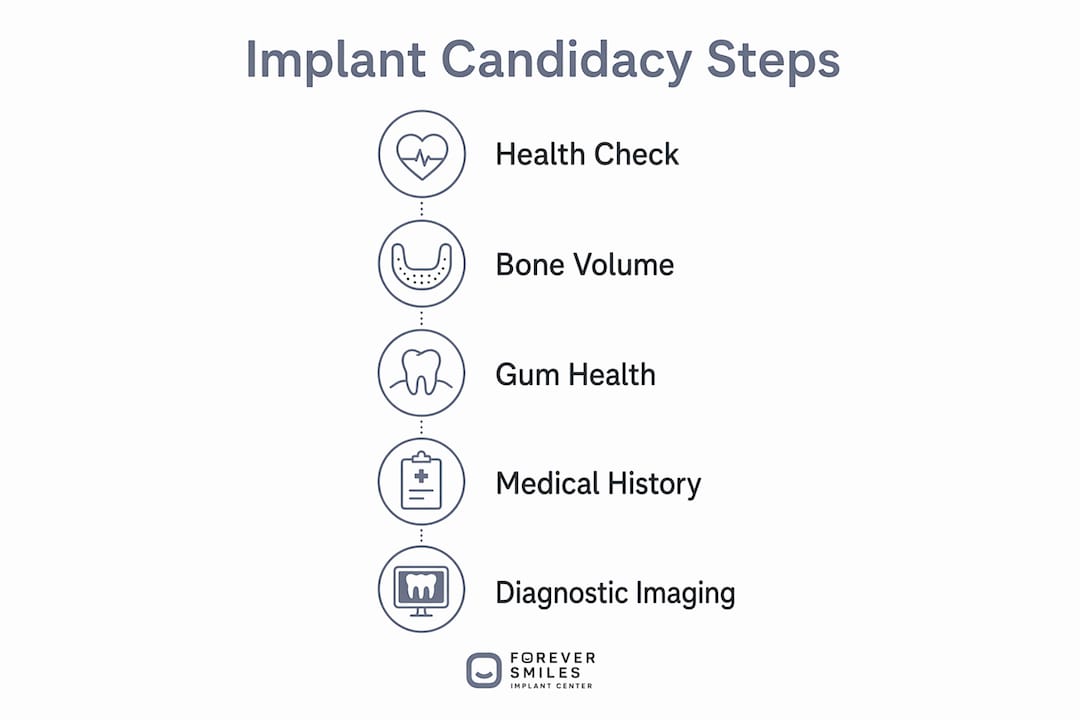
The most important starting point is general health. Surgeons classify patients using the American Society of Anesthesiologists (ASA) physical status scale. Good general health is defined as ASA I or ASA II, meaning no serious systemic disease or a well-controlled condition. This classification directly predicts how well your body will heal after implant surgery.
Bone volume is the second pillar. Implants need sufficient jawbone to anchor into. Long-term denture wear accelerates bone resorption, which can reduce available bone over time. The good news is that modern grafting techniques and specialized implant approaches have expanded candidacy well beyond what was possible a decade ago.
What medical and health factors influence implant candidacy?
Systemic health conditions carry the most weight in the candidacy decision. Some conditions are absolute barriers to implant surgery. Others are manageable with proper preparation.
Absolute contraindications include:
- Active chemotherapy or radiation therapy directed at the jaw
- Untreated blood clotting disorders
- Uncontrolled autoimmune diseases
These conditions prevent safe implant placement because they severely impair healing or increase the risk of serious surgical complications. Patients in active cancer treatment should wait until their oncologist clears them.
Relative contraindications are conditions that raise risk but do not automatically disqualify a patient:
- Heavy smoking, defined as more than 10 cigarettes per day
- Poorly controlled diabetes with an HbA1c above 8.0
- Long-term bisphosphonate use for osteoporosis
Diabetes is a clear example of a manageable barrier. Patients with an HbA1c below 7.0 generally heal well and carry acceptable implant risk. Patients above 8.0 face significantly higher complication rates. Bringing blood sugar under control before surgery can shift a patient from ineligible to eligible.
Bisphosphonate medications present a specific concern because they affect bone metabolism and can impair healing at the implant site. Your surgeon needs to know the duration and dosage of any bisphosphonate use before planning treatment.
Pro Tip: Disclose every medication, supplement, and health condition during your consultation. Surgeons cannot plan safely around information they do not have. Incomplete disclosure is the single most avoidable cause of implant complications.
How does jawbone condition determine eligibility for dental implants?
Bone is the foundation of every implant. Without adequate volume and density, an implant has nothing to fuse with. This is the factor that disqualifies the most denture wearers initially, and it is also the factor most often corrected with modern techniques.
3D Cone Beam CT imaging is the current standard for implant planning. It replaces traditional 2D X-rays by mapping bone volume, density, and nerve location with a level of detail that makes safe, precise placement possible. For patients who have worn dentures for years, this scan often reveals the extent of bone loss that has occurred silently beneath the surface.
Bone loss from long-term denture wear is predictable. Dentures sit on top of the gum and do not stimulate the underlying bone the way natural tooth roots do. Over time, the jawbone shrinks in both height and width. This is why patients who have worn dentures for 10 or more years often present with significantly reduced bone volume. The full-mouth implant process accounts for this by beginning with a thorough bone assessment before any surgical planning.
When bone volume is insufficient, bone grafting and sinus lift procedures can restore enough structure to support implants. These are not experimental techniques. They are established surgical procedures performed routinely at specialized centers. Patients with severe bone loss who were told they were not candidates elsewhere often qualify after grafting. For the most extreme cases of upper jaw bone loss, zygomatic implants anchor into the cheekbone entirely, bypassing the need for a grafted upper jaw.
The number of implants required depends on the prosthesis type and the arch being treated. The table below summarizes the standard requirements:
| Prosthesis type | Arch | Implants typically needed | Bone condition required |
|---|---|---|---|
| Fixed full-arch bridge | Upper | 6–8 implants | Moderate to good bone volume |
| Fixed full-arch bridge | Lower | 4–6 implants | Moderate to good bone volume |
| Implant-stabilized overdenture | Upper | 4 implants minimum | Reduced bone acceptable with grafting |
| Implant-stabilized overdenture | Lower | 2–4 implants | Minimal bone often sufficient |
Fixed prostheses often use 8 implants for the upper arch, while overdentures are typically successful with 4. That difference reflects the load-bearing demands of a fixed versus removable restoration. Patients with less bone are often better served by an overdenture approach initially, with the option to upgrade later.
What oral health factors affect implant candidacy for denture wearers?
Gum health is a non-negotiable requirement for implant candidacy. Active periodontal disease, meaning gum infection with bone loss around remaining teeth or implant sites, must be fully treated before any implant is placed. Placing an implant into an infected environment is a predictable path to failure.
Oral hygiene habits matter just as much after surgery as before. Daily brushing, flossing, and professional cleanings are required to prevent peri-implantitis, which is a gum infection around the implant that can cause bone loss and implant failure. Patients who struggle with consistent oral hygiene need to address that before committing to implants.
Behavioral factors also carry real clinical weight:
- Smoking restricts blood flow to the gums. Smokers face 2 to 3 times higher implant failure risk compared to non-smokers. Quitting before surgery and during healing significantly improves outcomes.
- Bruxism, or chronic teeth grinding, places excessive force on implants and prosthetic components. Patients with bruxism are not automatically disqualified, but they require a protective night guard and careful prosthetic design.
- Commitment to follow-up care is as critical as the surgery itself. Patients who skip maintenance appointments put their implants at risk regardless of how well the surgery went.
Pro Tip: Ask your surgeon for a realistic timeline before you commit. Full-mouth implant treatment from evaluation to final teeth typically spans several months. Patients who understand this upfront heal better and report higher satisfaction.
What diagnostic steps determine candidacy for denture wearers?
The candidacy determination follows a structured clinical process. No reputable surgeon makes a candidacy decision based on a phone call or a photograph. The evaluation requires direct examination and imaging.
The standard diagnostic workflow at a specialized center like Forever Smiles Implant Center includes:
- Comprehensive clinical examination. The surgeon examines gum tissue, remaining teeth, bite alignment, and the overall condition of the mouth. This visit establishes the baseline.
- CBCT scan. 3D imaging maps bone volume and nerve location with precision that 2D X-rays cannot match. This scan is non-negotiable for safe implant planning.
- Medical and dental history review. The surgeon reviews all medications, past surgeries, systemic conditions, and previous dental work. This step identifies contraindications and informs anesthesia planning.
- Treatment planning and prosthetic design. The surgeon and lab team determine implant number, placement angles, and prosthesis type based on the scan and examination findings.
- Expectation alignment. The surgeon walks the patient through the proposed timeline, healing phases, and what the final result will look like and feel like.
Candidacy is a continuum, not a binary pass or fail. A patient who does not qualify for a fixed full-arch bridge today may qualify for an implant-stabilized overdenture now and transition to a fixed restoration after grafting. The goal is to find the best solution available for each patient's current condition, not to apply a single standard to everyone. Patients who have been told "no" at a general dental office should seek a second opinion from a full-arch surgical specialist before accepting that answer. Many patients initially told they are not implant candidates qualify after bone grafting or advanced implant techniques.
Key Takeaways
Denture wearer implant candidacy is determined by a combination of systemic health, bone volume, gum condition, and patient commitment to long-term maintenance.
| Point | Details |
|---|---|
| Health classification matters | Patients classified as ASA I or ASA II with controlled systemic conditions are the strongest candidates. |
| Bone loss is often correctable | Grafting and sinus lifts restore bone volume for patients initially disqualified by insufficient jaw structure. |
| Smoking triples failure risk | Smokers face 2 to 3 times higher implant failure rates; quitting before surgery significantly improves outcomes. |
| Candidacy is a spectrum | Patients not ready for fixed implants may qualify for implant-stabilized overdentures as a first step. |
| Maintenance determines long-term success | Daily hygiene and professional follow-up care are as critical as the surgical procedure itself. |
Age is not the barrier most denture wearers think it is
I have evaluated patients in their 80s who were better implant candidates than patients in their 50s. Age is a number. Biological health is what actually determines surgical risk and healing capacity. When I assess a patient, I am looking at bone quality, systemic disease control, and how well their body is likely to respond to surgery. A healthy 75-year-old with good bone density and controlled blood pressure is a far better candidate than a 55-year-old who smokes heavily and has uncontrolled diabetes.
The other misconception I see constantly is that a "no" from one provider is a permanent answer. It is not. I have treated hundreds of patients who were told they had too little bone for implants. In many of those cases, we used bone grafting, sinus lifts, or zygomatic implants to give them a fixed result they never thought was possible. The difference is surgical specialization. A general dentist evaluating a complex bone loss case is working at the edge of their training. A surgeon who performs full-arch reconstruction every single day sees options that others miss.
What I want denture wearers to understand is this: the consultation is where candidacy is determined, not before it. You cannot know where you stand until a qualified specialist has examined you, reviewed your scan, and mapped out your options. Seeking that evaluation costs you nothing except the time it takes to show up. Not seeking it costs you years of living with a solution that does not work.
— Dr. Brian Young
Full-mouth implant options for denture wearers at Forever Smiles Implant Center
Denture wearers who are ready to explore a permanent solution deserve a center built specifically for that purpose.
Forever Smiles Implant Center in Jacksonville, Florida, performs full-arch implant reconstruction every day, with every element of care handled under one roof. That includes 3D imaging and surgical planning, surgery, an in-house dental lab, and a board-certified MD anesthesiologist. Patients receive custom zirconia teeth and complete follow-up care as part of a single, accountable process. For patients who have been told they are not candidates elsewhere, Forever Smiles specializes in complex cases including severe bone loss and previously failed implants. Full-mouth dental implants start at $19,000 per arch and include everything from planning through final teeth. Schedule a consultation to find out exactly where you stand.
FAQ
What is denture wearer implant candidacy?
Denture wearer implant candidacy is the clinical determination of whether a denture patient qualifies for dental implants based on health status, bone volume, and oral condition. Surgeons assess these factors through examination, 3D imaging, and medical history review before recommending treatment.
Can I get implants if I have significant bone loss from wearing dentures?
Bone loss from long-term denture wear does not automatically disqualify you. Bone grafting, sinus lift procedures, and zygomatic implants are established techniques that restore candidacy for many patients previously told they had insufficient bone.
Does age affect whether I can get dental implants?
Age alone is not a contraindication for dental implants. Surgeons prioritize biological health, bone quality, and systemic disease control over chronological age when determining candidacy.
How does smoking affect my chances of qualifying for implants?
Smoking restricts blood flow to the gums and increases implant failure risk by 2 to 3 times compared to non-smokers. Quitting before surgery and during the healing period significantly improves your candidacy and long-term outcomes.
What is the first step to finding out if I am a candidate?
The first step is a comprehensive consultation that includes a clinical examination and a CBCT scan. A thorough treatment plan requires imaging, medical history review, and direct evaluation by a qualified implant surgeon before any candidacy determination can be made.