
Dental implants genuinely change lives. Not in the vague, marketing-brochure sense, but in the specific, measurable ways that matter: a person who couldn’t eat a steak for a decade orders one at dinner. Someone who avoided smiling in photos for years stops thinking about it. A patient told she had “no bone left” walks out of surgery with fixed teeth the same day.
The examples of implant life transformations below cover same-day restorations, All-on-4 full-arch reconstructions, and zygomatic cases for patients with severe bone loss. Each one follows a real procedural pathway, and the outcomes are grounded in clinical evidence, not wishful thinking. CBCT-guided planning, prosthetic-driven design, and same-day implant restoration protocols at practices like Forever Smiles Implant Center have made these results reproducible, not exceptional.
-
What same-day restoration looks like: a patient with failing front teeth receives a fixed provisional the day of surgery and leaves the office smiling.
-
What All-on-4 delivers: a long-term denture wearer regains stable chewing, stops removing teeth at night, and re-enters social situations they had been avoiding for years.
-
What zygomatic implants make possible: a patient with near-total bone loss, previously turned away elsewhere, receives fixed teeth without bone grafting.
Key Takeaways
Dental implants produce reliable, life-changing improvements in function, confidence, and quality of life when placed by a qualified specialist using prosthetic-driven planning and appropriate patient selection.
| Point | Details |
|---|---|
| Real outcomes are specific | Patients report restored chewing, normalized speech, and reduced social anxiety after fixed implant restorations. |
| Same-day and All-on-4 deliver fast change | Qualified patients receive fixed provisional teeth the day of surgery; full-arch cases eliminate dentures immediately. |
| Candidacy determines the protocol | Bone volume, health status, and smoking history shape which procedure fits; severe bone loss often qualifies for zygomatic approaches. |
| Recovery takes at least one week | Swelling and bruising are normal; plan downtime and soft-food nutrition for early healing before function returns. |
| Forever Smiles Implant Center | Dr. Brian Young’s team handles full-arch, same-day, and zygomatic cases daily with an in-house lab and MD anesthesiologist. |
Table of Contents
-
What do real implant life transformations actually look like?
-
Ready to find out if a full-arch transformation is right for you?
What do real implant life transformations actually look like?
The most compelling implant success examples share a common structure: a specific functional loss, a clear procedural solution, and a concrete change in daily life afterward. Here are five cases that illustrate the range.
Case 1: Same-day restoration after years of dental avoidance
A patient in her mid-40s had been living with multiple failing upper teeth for several years, avoiding social events and eating only soft foods. After CBCT imaging confirmed adequate bone volume, she underwent same-day implant restoration. Implants were placed and a fixed provisional was delivered the same afternoon. Within a week, she was eating normally. At her final zirconia restoration appointment months later, she described the experience as the first time in years she felt comfortable introducing herself to strangers.

Straumann case data confirms that fully guided immediate restoration in the esthetic zone, when primary stability is achieved, can produce stable functional and esthetic results with multi-year follow-up.
Case 2: All-on-4 full-arch reconstruction for a denture wearer
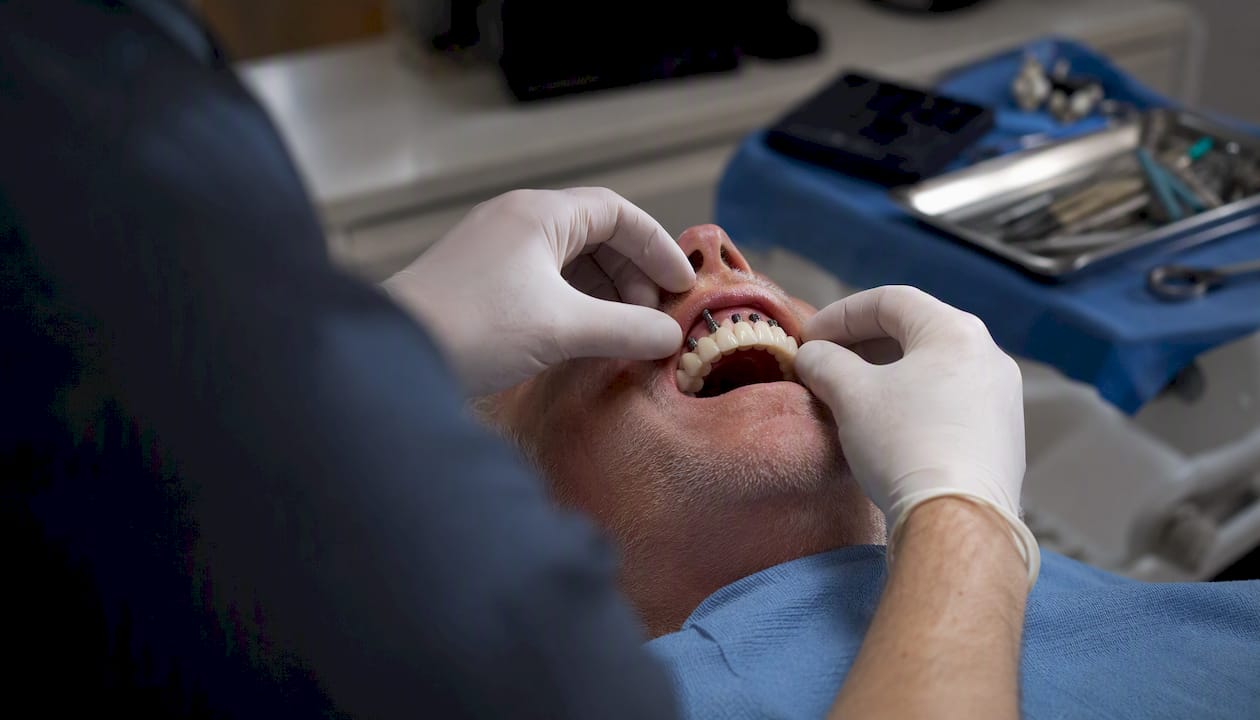
A man in his late 50s had worn upper and lower dentures for over a decade. He described the dentures as “never fitting right” and admitted he stopped eating at restaurants because he was afraid they would slip. After a full-arch evaluation, he received All-on-4 implants on both arches. His provisional fixed teeth were placed the day of surgery. At his six-month follow-up, he reported eating foods he had avoided for years, including corn on the cob and apples. The social confidence shift was immediate. For patients considering this route, the full-mouth dental implants page at Forever Smiles Implant Center outlines the process from start to finish.
Case 3: Zygomatic implants for severe bone loss
This is the case type that surprises people most. A patient in her early 60s had been told by two other providers that she lacked sufficient bone for standard implants and would need extensive grafting, followed by a year-long wait. She arrived at a zygomatic implant specialist with near-total maxillary bone loss. Using a combination of zygomatic and standard implants, her surgical team placed a fixed provisional the same day, with no bone grafting required. She left with teeth. The emotional weight of that moment, after years of being told “no,” is difficult to overstate. Documented clinic cases show that zygomatic and hybrid protocols allow fixed solutions for patients previously considered non-candidates, enabling immediate provisional fixed teeth and a rapid return to function.
Case 4: Single-tooth implant resolving speech and comfort issues
A younger patient, a teacher in her 30s, lost a lower molar to fracture. The gap caused her to unconsciously alter her speech pattern and avoid certain words. A single implant restored the tooth position, eliminated the speech compensation, and resolved the discomfort she had attributed to “just getting older.” She described it as a small change with an outsized effect on her daily confidence.
Case 5: Correcting a previously failed implant case
Patient stories from specialty implant clinics consistently show a recurring theme: patients who had implants placed elsewhere, experienced failure, and arrived at a specialist practice feeling hopeless. In these re-do cases, the transformation is often as much psychological as physical. Successful revision surgery, when performed by a high-volume specialist, restores both function and the patient’s trust in the process.
How do implants actually change your daily life?
The functional changes are specific, and understanding the mechanism helps set realistic expectations.
Chewing force and diet. Natural teeth generate substantial bite force. Removable dentures recover only a fraction of that. Fixed implant-supported prostheses restore chewing mechanics close to natural dentition, which directly expands diet. Patients who had been eating soft foods for years report returning to raw vegetables, lean meats, and foods they had quietly written off. Clinic case reports and patient accounts repeatedly describe improved nutrition as a secondary benefit, including easier food choices that support management of conditions like diabetes.
Speech. Removable dentures shift. That movement alters tongue placement and produces the subtle slurring or clicking that denture wearers learn to manage but never fully eliminate. Fixed implant prostheses don’t move, so speech mechanics normalize. Most patients notice the difference within days of receiving their provisional.
Facial structure. Bone loss after tooth loss is progressive. Without the stimulation of tooth roots, the jaw resorbs, which collapses facial height and causes the “sunken” appearance common in long-term denture wearers. Implants provide that stimulation. They don’t reverse existing bone loss, but they halt further resorption and preserve the facial support that remains.
Emotional and social impact. This is where the numbers get harder to cite but the patient reports are consistent. Reduced social anxiety, willingness to laugh openly, returning to work situations that involve face-to-face interaction, and a general sense of normalcy are themes that appear across patient accounts documented in national media and specialty clinic testimonials alike.
Which procedure produces which kind of life change?
Not every implant case looks the same, and the procedure that changes your life depends on what you’re starting with.
Single-tooth implants address one missing tooth with a titanium post and a crown. The life impact is proportional: restored bite function in that area, no gap affecting speech or adjacent teeth, and a restoration that looks and feels like a natural tooth. For a teacher, a salesperson, or anyone whose face is their professional tool, a single implant in a visible position can matter more than its size suggests.
Same-day (immediate-load) restorations are what most patients mean when they say “teeth in a day.” The implants are placed and a fixed provisional is attached before the patient leaves the office. Not everyone qualifies. Primary stability, adequate bone density, and precise pre-surgical planning are non-negotiable. When those conditions are met, Straumann case evidence shows that immediate placement in the esthetic zone, combined with digital planning and guided surgery, produces reliable short-term esthetic and functional outcomes.
All-on-4 and full-arch reconstruction replace an entire arch with four to six implants supporting a fixed prosthesis. This is the procedure that most directly replaces dentures. The life change is immediate and substantial: no more adhesive, no more removal at night, no more slippage. For patients who have worn dentures for years, the psychological shift of having fixed teeth is often described as more significant than the physical one. A detailed breakdown of the full-mouth reconstruction process helps patients understand what each phase involves.
Zygomatic and hybrid approaches serve patients with severe maxillary bone loss. Standard implants require bone volume that these patients don’t have. Zygomatic implants anchor into the cheekbone instead, bypassing the resorbed jaw entirely. Combined with standard implants in available bone, they support a full fixed arch. The zygomatic implant protocol at Forever Smiles Implant Center is specifically designed for patients who have been told they are not candidates elsewhere.
Fixed zirconia prostheses matter because the material does. Zirconia is strong, biocompatible, and esthetic. It doesn’t stain, doesn’t flex, and doesn’t degrade the way acrylic does over time. Patients who receive a final zirconia restoration are getting a prosthesis designed to last decades with proper care, not one that needs replacement every few years.
Are you a candidate, and what might hold you back?
Most adults in reasonable general health are candidates for some form of implant treatment. The question is which protocol fits their situation.
Factors that support candidacy:
-
Adequate bone volume and density at the implant sites (or sites amenable to grafting)
-
Controlled systemic health: blood pressure, blood sugar, and immune function within normal ranges
-
Non-smoker or willing to quit before and during healing
-
Realistic expectations and commitment to post-surgical care
Factors that may delay or alter treatment:
-
Uncontrolled diabetes: elevated blood sugar impairs healing and increases infection risk; controlled diabetes is generally manageable
-
Active smoking: significantly increases implant failure rates; most specialists require cessation before surgery
-
Certain bisphosphonate medications (used for osteoporosis): can affect bone healing; a medication review is required before planning
-
Severe bone loss: doesn’t disqualify a patient, but changes the protocol (grafting, zygomatic approach, or hybrid design)
-
Active periodontal disease: must be treated before implant placement
What to bring to your first consult:
-
Prior dental records and any existing X-rays or CBCT scans
-
A complete medication list, including supplements and over-the-counter drugs
-
A summary of relevant medical history (surgeries, chronic conditions, current treatments)
-
A clear description of your goals: what you want to be able to do that you currently can’t
-
Questions about the surgeon’s experience, the lab workflow, and what happens if something goes wrong
The dental implant candidacy checklist at Forever Smiles Implant Center covers complex cases in detail and is worth reviewing before your appointment.
What should you expect from timeline to long-term outcomes?
The timeline varies by procedure, but the general arc is consistent.
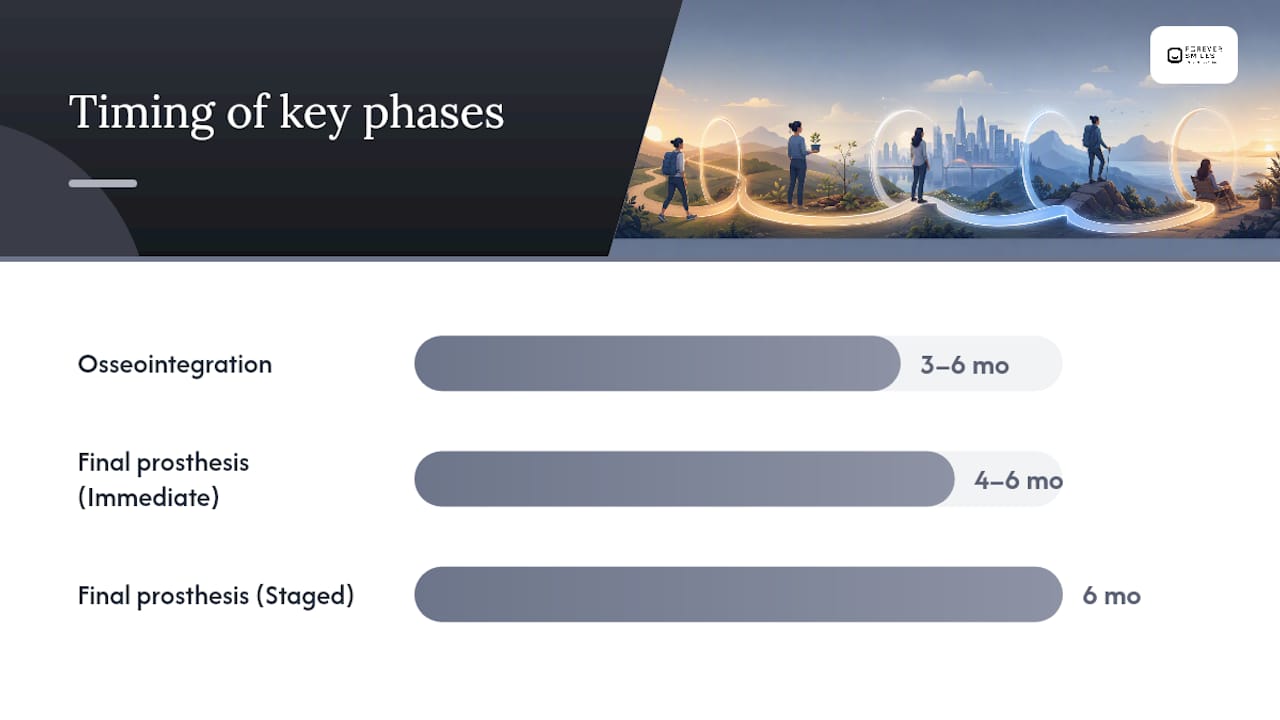
| Phase | Same-Day / Immediate Load | Staged Protocol |
|---|---|---|
| Consult and CBCT planning | 1–2 appointments | 1–2 appointments |
| Surgery and provisional teeth | Day of surgery | Surgery, then healing period |
| Osseointegration / healing | 3–6 months | 3–6 months |
| Final zirconia prosthesis | 4–6 months post-surgery | 6 months post-surgery |
| Follow-up and maintenance | Ongoing | Ongoing |
Immediate post-op reality. Swelling and bruising are normal and often more significant than patients expect. Plan for at least one week away from work and social obligations. Nutrition during early healing is limited to soft foods and liquids. Patient accounts in national media document this recovery honestly: the first week is uncomfortable, and the outcome is worth it.
Maintenance. Fixed implant prostheses require cleaning around the implant margins with interdental brushes or a water flosser. Professional hygiene visits every three to six months are standard. The prosthesis itself should be checked annually for fit and wear. Practical guidance on maximizing implant longevity after surgery covers the specific care routines that protect long-term results.
Long-term outcomes. Peer-reviewed literature indexed on PubMed examines implant survival and success factors and consistently underscores that long-term outcomes depend heavily on patient selection and protocol adherence. Implants placed by experienced specialists in well-selected patients, maintained properly, routinely function for 15–20 years and beyond. The prosthesis may need adjustment or replacement before the implants themselves do.
Statistic callout: Clinical literature and long-term case follow-up consistently show that implants placed with proper patient selection and protocol adherence can remain functional well beyond 10 years, with prosthetic components typically requiring earlier attention than the implants themselves.
Why are modern implant outcomes so predictable?
The short answer: the technology and planning protocols have made guesswork nearly impossible when used correctly.
CBCT imaging gives the surgical team a three-dimensional map of bone volume, nerve position, and sinus anatomy before a single incision is made. Prosthetic-driven planning means the final tooth position is designed first, and the implant placement is engineered to support it, not the other way around. Guided surgical templates translate that digital plan into the operating field with millimeter precision.
Immediate restoration depends on all of these working together. Straumann’s 5-year follow-up case data shows that implants placed and immediately provisionalized in posterior sites perform well with healthy soft tissues and high patient satisfaction at five-year recall, when primary stability is confirmed and the protocol is followed precisely.
Soft-tissue management is a detail that separates average outcomes from excellent ones. Provisional contour management during the first months after placement directly shapes how the gum tissue heals around the implant. Adjustments made during this window materially affect the final esthetic result. This is why an in-house lab, one that can fabricate and modify provisionals quickly, matters more than most patients realize.
At Forever Smiles Implant Center, Dr. Brian Young brings over 20 years of experience and more than 28,000 implants placed to every case. He performs full-arch surgery daily, trains surgeons nationally, and sits on the editorial board of Implant Practice US. The practice includes an in-house dental lab and a board-certified MD anesthesiologist, which means the entire process, from planning through final restoration, happens under one roof with one accountable team.
Pro Tip: Ask your implant provider whether they use a static computer-aided implant surgery (S-CAIS) template for guided placement. This single detail, combined with prosthetic-driven planning and CBCT diagnostics, is one of the strongest predictors of esthetic and functional stability in immediate-load cases.
What questions should you ask your implant team?
A good consult gives you answers, not just reassurance. Here is what to ask.
Experience and volume:
-
How many full-arch cases do you place per month?
-
Are you a residency-trained surgical specialist, or a general dentist who performs implants?
-
What is your protocol for complex cases, including patients with significant bone loss?
Lab and prosthetics:
-
Is your lab in-house or external? How does that affect turnaround and adjustments?
-
What material is used for the final prosthesis, and why?
-
What does the provisional look like, and how long will I wear it?
Anesthesia and medical management:
-
Who administers anesthesia? Is there a board-certified MD anesthesiologist on site?
-
How do you manage patients with medical comorbidities like diabetes or cardiovascular conditions?
Aftercare and warranties:
-
What is your complication policy? If an implant fails, what happens next?
-
What does follow-up care include, and for how long?
-
Is there a warranty on the prosthesis?
Same-day and prosthetic specifics:
-
Am I a candidate for same-day restoration, and what determines that?
-
What are the dietary restrictions during the provisional phase?
-
How many appointments does the final prosthesis require?
-
What maintenance will the final zirconia restoration need?
A provider who answers these questions directly, with specifics, is one worth trusting. Vague answers or pressure to decide quickly are the red flags. Understanding who should perform All-on-4 surgery helps patients recognize the difference between a qualified specialist and a provider who has taken a weekend course.
Why patient stories matter more than statistics alone
The clinical data on implant survival is compelling. But the number that stays with me after years of performing this surgery is simpler: the number of patients who walk in looking at the floor and walk out making eye contact.
Statistics tell you that implants work. Patient stories tell you what “working” actually means in a person’s life. It means a grandfather eating at the holiday table without anxiety. A woman laughing in a photo without covering her mouth. A man returning to a job interview with confidence he hadn’t felt in a decade. These outcomes don’t appear in survival curves, but they are the reason this work matters.
What I’ve learned from planning thousands of cases is that the outcome is shaped long before the surgery begins. The CBCT, the prosthetic design, the patient conversation about realistic expectations, the lab coordination: these are where the transformation is built. Surgery is the execution of a plan that was already made. When the plan is right, the result is predictable. When it isn’t, no amount of surgical skill fully compensates.
The patients who do best are the ones who ask hard questions, understand what recovery actually involves, and choose a team with the experience to handle complexity when it arises. That combination, good planning, honest communication, and surgical expertise, is what produces the stories worth telling.
Ready to find out if a full-arch transformation is right for you?
Full-arch implant treatment at Forever Smiles Implant Center starts at $19,000 per arch and includes everything: CBCT planning, surgery, fixed teeth the same day, final custom zirconia restoration, and follow-up care. There are no hidden fees and no external lab delays. The entire process happens under one roof, with Dr. Brian Young performing surgery and an in-house lab fabricating your teeth.
The first step is a consult. You’ll bring your records, discuss your goals, and leave with a clear picture of what your specific case involves, including candidacy, timeline, and financing options. Same-day and All-on-4 options are available for qualified patients. Zygomatic protocols are available for patients with severe bone loss who have been told they don’t qualify elsewhere.
For patients ready to move forward or who want answers to specific questions before committing, the dental implants FAQ page at Forever Smiles Implant Center covers the most common concerns in detail. To learn more about replacing all teeth with implants or to schedule a consult, contact the practice directly.
Sources
This article is general information, not a substitute for advice from a qualified doctor. Consult a qualified healthcare professional about your own circumstances before acting on anything here.