
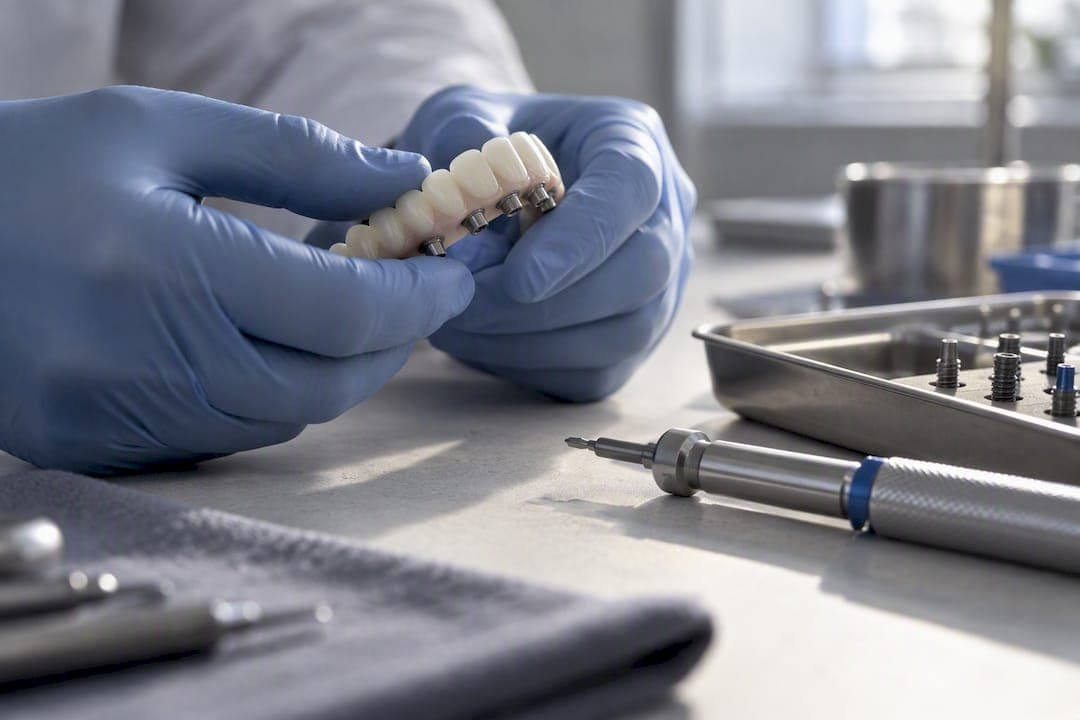
A loose All-on-4 is usually mechanical, not the death of your implants. Most cases trace to a loosened abutment screw or a stressed prosthesis, both fixable in a dental chair. But if the movement comes with pain, swelling, or bleeding gums, that points to infection or bone loss and needs urgent evaluation. Either way, stop biting hard on that side and call your implant dentist today.
TL;DR:
- Most loose All-on-4 instances are caused by a loose abutment screw or prosthesis stress, both easily fixable in a dental chair unless associated with pain or swelling.
- Mechanical issues often occur within the first year, with screw loosening representing 5.6% to 7.7% of cases, especially on softer bone or acrylic hybrids.
- Pain, swelling, or bleeding indicates infection or bone loss requiring urgent evaluation, while painless wiggle typically relates to mechanical screw problems.
- Proper diagnosis involves removing the prosthesis, testing each implant, listening for specific sounds, and checking for pain to identify the true source of looseness.
- Persistent loosening after retightening suggests a biological failure or structural problem, often requiring specialist intervention and advanced surgical solutions.
Table of Contents
- Loose All-on-4 Implants: Is It the Bridge, the Screw, or the Implant Itself?
- Common Causes: Mechanical vs Biological Reasons Your All-on-4 Feels Loose
- Symptoms and Red Flags: How Urgent Is It?
- What Your Implant Dentist Will Do to Diagnose the Problem
- Stepwise Treatment: From a Quick Fix to Surgical Rescue
- Preventing the Next Loose All-on-4 Episode
- When a Mechanical Fix Isn't Enough: Knowing When to See a Specialist
- What Actually Matters When Your All-on-4 Feels Loose
- Getting a Second Opinion on a Loose or Failing All-on-4
- Sources
- FAQ
Loose All-on-4 Implants: Is It the Bridge, the Screw, or the Implant Itself?
Not all looseness means the same thing, and figuring out which part is moving changes everything about the fix. The prosthesis, the abutment screw, and the titanium implant fixture itself are three separate components, and only one of them signals real trouble.
Prosthetic or bridge movement. If the entire zirconia arch rocks or you hear a click when you bite down, the issue is often the screws holding the bridge to the implants, not the implants themselves. This is the most common complaint and, in most cases, the easiest to resolve.
Abutment or screw wiggle. A single point of looseness, often felt as a sharp shift under one tooth, usually means one retaining screw has backed off its torque. Abutment screw loosening is one of the most frequent mechanical complications in implant dentistry, and it is rarely a sign the implant has failed. Retightening after the initial settling period often resolves it for good, since screws naturally lose a small amount of tension as the prosthesis seats in during the first weeks of function, according to a literature review on abutment screw loosening.
Implant fixture mobility. This is the one that matters most, and it is rare. If the actual titanium post moves in the jawbone, that implant has not integrated or has lost the bone support holding it in place. There is no tightening a screw to fix this.
Your dentist sorts out which is which with a short, systematic check:
- Remove the full prosthesis to isolate movement to a specific implant
- Test each implant individually for horizontal or rotational give
- Tap and listen for the dull sound that suggests bone loss versus the sharp click of a loose screw
- Check whether pain accompanies movement, since painless wiggle and painful wiggle point to very different problems
Never attempt to remove or adjust the prosthesis yourself. A misdiagnosed screw problem can turn into a fractured component if you force it.
Common Causes: Mechanical vs Biological Reasons Your All-on-4 Feels Loose
Two entirely different categories of problems can make an All-on-4 feel unstable, and they call for opposite responses. Mechanical problems are about hardware. Biological problems are about the living tissue around the implant.
Mechanical causes show up more often, especially in the first year:
- Abutment screw loosening from settling, occlusal load, or manufacturing tolerance
- Prosthesis fracture, usually at a thin connector point in acrylic or older metal-acrylic hybrids
- Component fatigue after repeated removal and reinsertion during adjustments
- Occlusal overload from grinding, clenching, or an uneven bite
- Loss of preload tension, the natural drop in clamping force screws experience during the first weeks of use
Biological causes are less common but more serious:
- Failed osseointegration, where the implant never bonded properly with bone
- Peri-implant mucositis or peri-implantitis, an infection around the implant that mimics gum disease
- Progressive bone loss from untreated infection or excessive force
- Systemic risk factors like smoking or poorly controlled diabetes, both of which slow healing and weaken bone response
Pooled data from a systematic review puts mechanical complications, including screw loosening, at roughly 5.6% to 7.7% of implant prostheses, with the rate skewing higher earlier in the follow-up window. That timing matters: most mechanical issues surface in year one, then taper off as the prosthesis settles.
Bone quality and prosthetic material both shift the odds. Denser bone and monolithic zirconia bridges tend to hold up better over time than acrylic hybrids on softer bone, a pattern confirmed in medium-term outcome data on All-on-4 in different bone types.
Symptoms and Red Flags: How Urgent Is It?
Not every wobble is an emergency, but some symptoms mean you should not wait for your next scheduled visit.
- Painless rocking or clicking is the lowest-urgency sign. It usually points to a mechanical issue like a loose screw or an unseated bridge, and it can typically wait a few days for a regular appointment.
- Pain, swelling, pus, or bleeding around an implant signals possible infection. This needs evaluation within a day or two, not a "wait and see" approach.
- A sudden bite change or new gap between your teeth often means a fracture or a screw that has fully backed out. This warrants a call the same day.
- Food trapping under the bridge that gets progressively worse suggests gradual loosening rather than a single event, and it is worth flagging before it becomes a bigger problem.
- Any mobility in the first six months after surgery carries more weight than mobility years later, since this window is when osseointegration is still establishing and failure risk is highest.
What Your Implant Dentist Will Do to Diagnose the Problem
Diagnosing a loose All-on-4 is a process of elimination, and it usually happens in one visit.
- Clinical exam and prosthesis removal. Your dentist detaches the bridge to test each implant's retention individually rather than guessing at the whole arch.
- Periapical x-rays. These flat images show bone level around each implant and reveal any dark shadow, called radiolucency, that suggests bone loss.
- CBCT imaging. A 3D cone-beam scan gives a fuller picture of bone volume and density when the 2D x-ray raises questions, particularly around the back implants.
- Torque checks. A calibrated driver measures whether each screw is holding at its intended tension, which tells the dentist exactly which screw failed and why.
- Microbial sampling and periodontal charting. If infection is suspected, your dentist may culture the site and measure pocket depth around each implant to grade the severity.
Consensus guidance on All-on-4 treatment recommends insertion torque above 35 Ncm for implants loaded immediately after placement, which is the benchmark your dentist checks against when retightening or troubleshooting a screw, according to clinical recommendations on the All-on-4 protocol.
Stepwise Treatment: From a Quick Fix to Surgical Rescue
Treatment escalates in a predictable order, and most patients never make it past the first step.
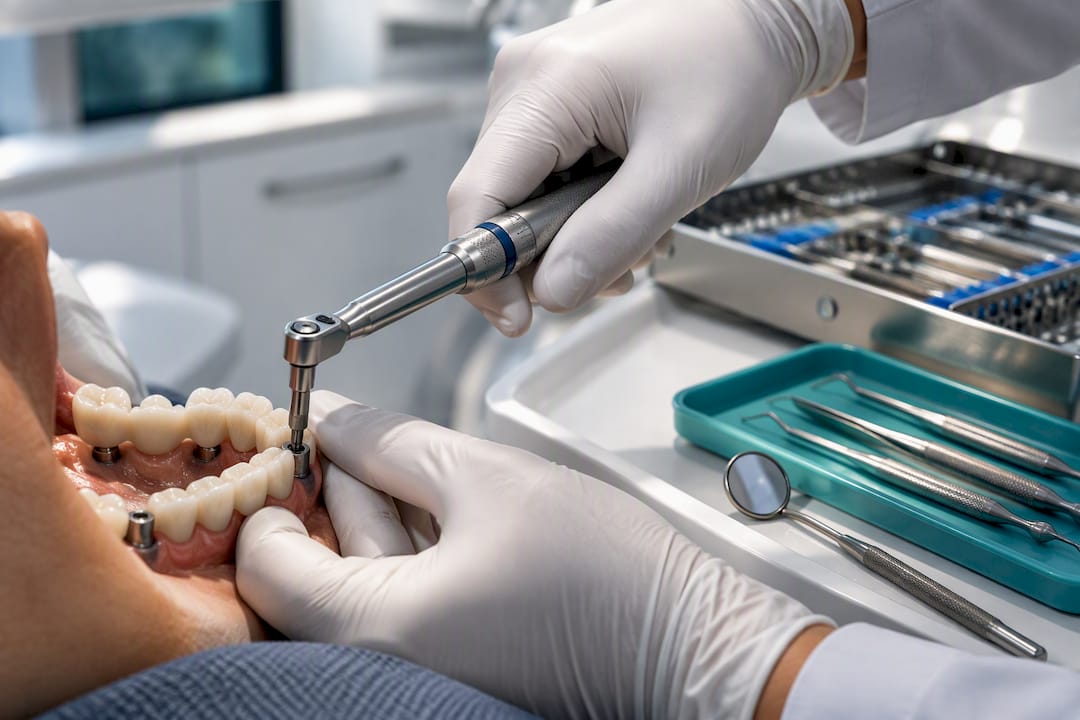
Chairside repairs come first. If a screw has loosened, your dentist retorques or replaces it, often finishing the appointment with a recheck 10 minutes later, since retightening after that short window meaningfully reduces the settling effect that causes screws to loosen again. A cracked prosthesis gets repaired or relined rather than replaced outright when the damage is limited to the appliance. An uneven bite gets adjusted on the spot.
Non-surgical biological care follows for infection. If peri-implant tissue looks inflamed, treatment includes local debridement around the implant, antiseptic rinses, and systemic antibiotics when the infection has spread beyond the surface.
Surgical options are the last resort, reserved for implants that cannot be saved conservatively:
- Flap debridement with regenerative bone therapy for moderate peri-implantitis
- Bone grafting to rebuild lost support before placing a new implant
- Implant removal and staged replacement once the site has healed
- Zygomatic implants or other advanced anchorage methods for patients with severe upper jaw bone loss who cannot support a standard implant, an option detailed further on zygomatic implant rescue cases
Prognosis depends heavily on how many implants are affected, how much bone has been lost, and how long ago the implants were placed. Losing one implant in the middle of the arch is often manageable by redistributing load across the remaining posts, according to the American Academy of Implant Dentistry's breakdown of common implant problems. Losing an end implant is a different story and often forces remaking the entire bridge.
Pro Tip: *Ask your dentist which prosthetic material your bridge uses.
Preventing the Next Loose All-on-4 Episode
Most repeat looseness comes down to habits, not bad luck, and the fixes are straightforward once you know what to watch.
- Clean under the bridge daily with interdental brushes or a water flosser, since food debris trapped at the gum line is a leading driver of peri-implant inflammation
- Keep professional cleaning appointments every three to six months so your dentist can check screw torque before a small problem becomes a big one
- Wear a night guard if you grind or clench, since occlusal overload is one of the top mechanical causes of screw loosening
- Get radiographs at each recall visit to catch early bone loss before it becomes visible mobility
- Manage smoking and blood sugar control if either applies to you, since both slow healing and raise implant failure risk
The FDA's own patient guidance is blunt about this: follow hygiene instructions, keep recall visits, and report a loose or painful implant right away, because delayed treatment sometimes means another surgery down the line. A detailed maintenance checklist for implant-supported teeth can help you build the habit.
Pro Tip: If you already had one screw loosen and get retightened, ask about switching to a rigid provisional or final zirconia prosthesis if you're still in acrylic. Reducing micro-movement across the whole arch lowers the odds the next screw follows the first.
When a Mechanical Fix Isn't Enough: Knowing When to See a Specialist
A restorative dentist can usually handle a single loose screw or a cracked acrylic bridge. What calls for a specialist is a different pattern: repeated screw loosening on the same implant, a prior repair that didn't hold, or bone loss severe enough that a standard implant won't have anything to anchor to.
If the same screw keeps loosening after a proper retorque, that is not bad luck. That is the prosthesis telling you something structural is wrong, whether it's occlusal overload, an ill-fitting framework, or bone that's no longer supporting the implant the way it should. Chasing the same fix a third time rarely ends differently than the first two.
A specialty center brings 3D imaging, an in-house lab, sedation options, and the surgical range to go straight from diagnosis to a zirconia final bridge without bouncing between offices.
What Actually Matters When Your All-on-4 Feels Loose
Most patients panic first and diagnose later, and it's usually the wrong order. The research is fairly consistent: mechanical complications like screw loosening are common, often in the single digits percentage-wise, and they are fixable in an afternoon. Biological failure, the kind involving bone loss or infection, is rarer but far more time-sensitive.
Where conventional advice falls short is treating every loose implant complaint as equally urgent, or equally minor. Telling a patient with a painless click to "come in whenever" is fine. Telling a patient with swelling and a foul taste the same thing is a mistake that costs bone. The distinction is not subtle once you know what to check.
My priority for any patient calling about looseness is always the same: rule out infection first, because that clock runs faster than a hardware problem's clock ever will. Once infection is off the table, the fix is almost always simpler than people fear. Do not let a delay turn a 10-minute retorque into a graft-and-rebuild case.
*— Dr. Brian Young
Getting a Second Opinion on a Loose or Failing All-on-4
If your current provider has already tried a repair or two and the same implant keeps giving trouble, that's the signal to bring in a specialist rather than repeat the same fix a third time. There are surgical centers built specifically for full-arch rescue cases, including patients with minimal bone, previously failed implants, or repairs that didn't hold.
Evaluation starts with your recent x-rays and a clear list of your symptoms, movement, pain, timing, and whatever prior fixes were attempted. From there, the team can determine in one visit whether you're dealing with a mechanical issue, a biological one, or a case that needs advanced solutions like zygomatic implants. Full-mouth reconstruction with All-on-4 zirconia starts at $19,000 per arch, covering planning, surgery, and your final teeth, and financing details are outlined on the cost and financing page. If your current arch is failing, book an evaluation and bring your imaging.
This article is general information, not a substitute for advice from a qualified doctor. Consult a qualified healthcare professional about your own circumstances before acting on anything here.
Sources
- Abutment screw loosening in implants: A literature review
- Dental implants: What you should know | FDA
- Medium‑term clinical outcomes of the All‑on‑4 system in different bone types
FAQ
Is It Possible to Tighten a Loose Implant?
You cannot tighten the implant itself, but the abutment screw connecting it to your prosthesis can often be retightened in one office visit. Retightening after the initial settling period is a well-documented fix for screw loosening, and it usually resolves the wobble for good.
How Do You Know If Your Implant Is Loose?
Rocking, clicking, or shifting when you bite down are the main signs, along with food getting trapped in new spots. Pain, swelling, or bleeding alongside the movement suggests infection rather than a simple hardware issue, and that combination needs prompt evaluation.
What Are the Downsides of All-on-4 Dental Implants?
The main risks are mechanical complications like screw loosening or prosthesis fracture, both common and fixable, and less frequent biological complications like peri-implantitis or bone loss. Medium-term studies report implant survival around 94.8%, with complications more common in low-density bone.
My Dental Implant Is Wiggling. Should I Be Concerned?
Painless wiggle in the prosthesis or a single screw is usually mechanical and not an emergency, but it still needs attention before it worsens. Movement in the implant fixture itself, especially with pain or swelling, is more serious and should prompt a same-week evaluation with your implant dentist or a specialist center like Forever Smiles Implant Center.