
Yes, All-on-4 restorations can fail. Most failures trace back to peri-implant inflammation eating away at supporting bone or mechanical overload cracking screws and prosthetics loose. If your bridge feels loose, hurts, or smells wrong, stop wearing any removable backup and get evaluated within days, not weeks. Bone loss caught early is often manageable; bone loss caught late frequently requires full explantation and a specialist rebuild.
TL;DR:
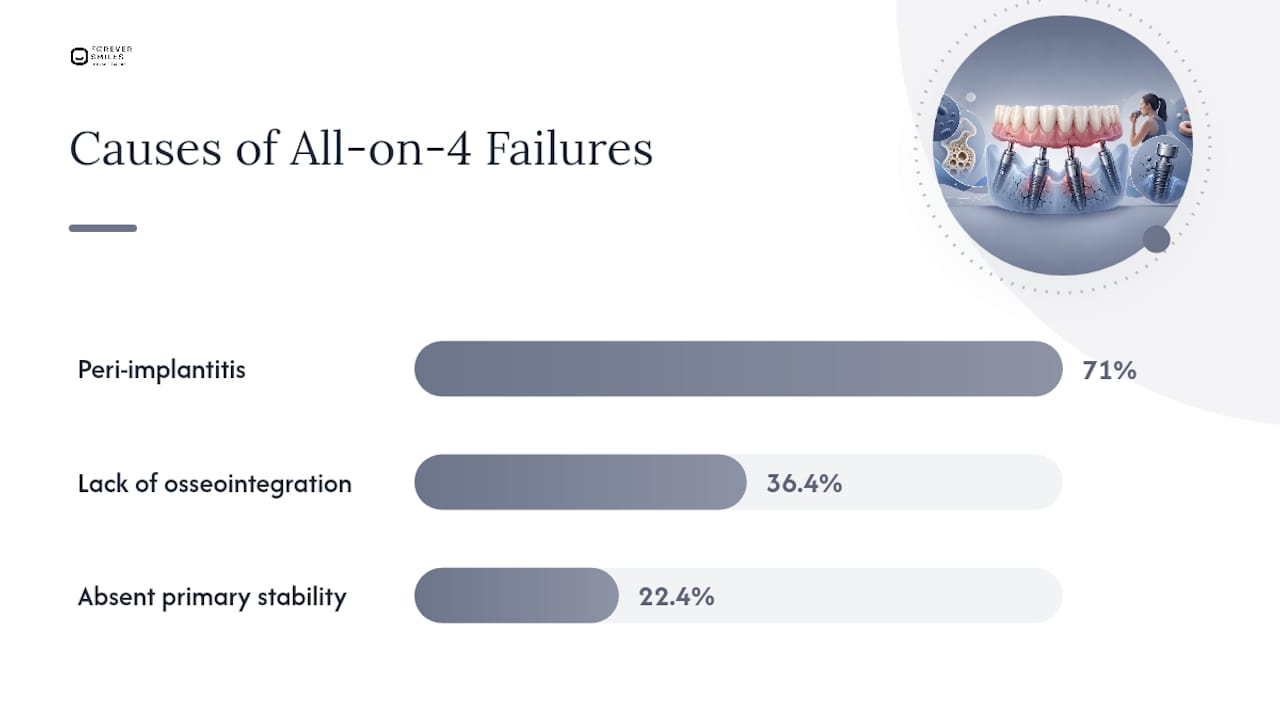
Most All-on-4 failures are caused by peri-implantitis, which accounts for 71% of implant removals and involves around 51% bone loss at removal.
Mechanical failures, such as screw loosening or cracking, typically occur early and are often fixable within a single visit if caught promptly.
Bone quality, especially Type 4 soft bone, reduces implant survival to about 89%, emphasizing the importance of proper planning for bone density.
Watch for warning signs like implant mobility, persistent pain, swelling, or gum bleeding, and confirm failure through clinical exams and radiographic assessments.
Prevention and successful revision require specialized experience, including advanced imaging, proper surgical planning, and addressing risk factors like smoking, diabetes, and poor hygiene.
Table of Contents
Why All-on-4 Implants Fail: The Real Causes
Peri-implantitis is the leading cause of late-stage All-on-4 failure, and it is not close. A retrospective analysis of 738 implant removals found that peri-implant inflammation accounted for 71% of all removals, with mean radiographic bone loss at the time of removal sitting around 51%. That single figure reframes how you should think about a failing implant: by the time symptoms are obvious, the bone underneath may already be half gone.
Bacterial buildup around the implant collar triggers inflammation that migrates into bone, mimicking how untreated gum disease destroys the jaw around natural teeth, just faster and often silently. It rarely announces itself with pain until significant damage has already occurred.
Statistic: In that same cohort, most implant removals occurred a few years after placement, which tells you failure is rarely an overnight event. It is a slow burn that surfaces once bone support crosses a critical threshold.
Mechanical failure is the second major pathway, and it looks different from biological failure. Screws loosen from repeated chewing forces, especially on cantilevered sections of the bridge that extend beyond the last supporting implant. Titanium fatigue can crack a screw outright. A prosthesis that never fit passively in the first place puts constant torque on the implants underneath it, and that torque adds up over years until something gives.
Patient-level risk factors compound both pathways:
-
Smoking restricts blood flow to healing gum tissue and is consistently linked to higher failure rates.
-
Uncontrolled diabetes slows bone healing and weakens the body’s ability to fight the bacteria that cause peri-implantitis.
-
Poor oral hygiene around the prosthesis lets bacterial plaque colonize areas a toothbrush can’t reach.
-
Type 4 bone quality, the softest and least dense bone classification, correlates with meaningfully worse outcomes.
A retrospective analysis of 250 patients and 1,000 implants found overall survival of 94.8%, but survival dropped to 89.1% in patients with Type 4 bone. That gap is entirely about bone density, not surgical skill, though it does mean patients with soft bone need a surgeon who plans for it rather than treats every jaw the same.
Procedural causes round out the list: implants placed without adequate primary stability, angulation errors that concentrate force unevenly, or a prosthetic plan that never accounted for the patient’s bite forces. A separate analysis of implant failures found that lack of osseointegration and absent primary stability accounted for 36.4% and 22.4% of failures respectively, and these tend to show up early, within the first few months, rather than years later.
The practical takeaway: mechanical problems like a loose screw are often fixable in an afternoon. Bone loss from peri-implantitis is a different animal entirely, and how much bone remains determines whether an implant can be saved or needs to come out.
Signs of a Failing All-on-4 and How Dentists Diagnose It
Your body usually gives warning signs before an implant fails outright. Watch for these:
-
Mobility in the bridge or in an individual implant, even slight rocking when you bite down.
-
Persistent pain or pressure around one or more implant sites, especially pain that worsens with chewing.
-
Swelling, redness, or bleeding gums around the implant collar that doesn’t resolve with brushing.
-
A bad taste or persistent bad breath that signals bacterial buildup or drainage beneath the gum line.
-
Difficulty chewing on one side, or a sense that your bite has shifted.
-
Visible gum recession exposing more of the implant than you remember seeing before.
A clinician confirms failure through a structured exam: probing depths around each implant, checking for bleeding on probing, testing for mobility, and evaluating your bite for high spots or uneven contact. Periapical X-rays or a CBCT scan measure crestal bone height directly, and this is where the diagnosis gets concrete rather than subjective. Some clinics also use resonance frequency analysis (ISQ testing) or torque testing to gauge how firmly an implant is anchored.
The bone-loss threshold matters here. Many clinicians use roughly 50% radiographic bone loss as a practical decision point, since that figure matches the average bone loss seen at the time of implant removal in large cohort data. Below that threshold, salvage therapy has a reasonable shot. Above it, the odds shift toward explantation. Early failures from poor osseointegration look different on imaging than late peri-implantitis: the bone loss pattern in early failure tends to be diffuse and immediate, while peri-implantitis carves a distinct crater-shaped defect around the implant neck over time.
What Happens After Failure: Complications and Outlook
Untreated inflammation follows a predictable arc: mucositis (inflamed gum tissue with no bone involvement yet) progresses to peri-implantitis (active bone loss) if it isn’t caught early. That progression is why routine checkups matter more for implants than for natural teeth. Your gums can’t send the same pain signals a nerve-filled tooth would.
The functional fallout is real. A failing implant often means:
-
Temporary removable prosthesis while the site heals or gets rebuilt.
-
Bone grafting to rebuild lost volume before new implants can go in.
-
A longer overall rehabilitation timeline, sometimes six months to a year for staged cases.
-
Additional cost beyond the original treatment, particularly when grafting or zygomatic implants enter the picture.
Statistic: Data on implant removal timing shows most extractions happen around three years post-placement, with mean bone loss at removal near 51%. That clustering suggests a real window where surveillance matters most, roughly years two through four, when early inflammation either gets controlled or turns into structural bone loss.
Smoking, poorly controlled diabetes, and Type 4 bone all push the odds toward explantation rather than conservative salvage. Combine two or more of those factors and a clinician will usually recommend moving straight to removal and staged reconstruction rather than spending months on therapy that has a low chance of holding.
How Dentists Fix a Failed All-on-4
Treatment depends entirely on what’s actually broken, biology or hardware, and how much bone remains.
Prosthetic-level repairs come first when the implants themselves are stable. Tightening or replacing a loose abutment screw, adjusting a high bite spot, or repairing a fractured tooth on the bridge can resolve the issue in one or two visits. This is the best-case scenario, and it’s more common than patients expect when problems get caught early.
Peri-implantitis therapy targets the bacterial and bone-loss side of failure. Non-surgical debridement (deep cleaning around the implant surface) is the first line for mild cases. More advanced cases need surgical access: flapping back the gum, decontaminating the implant surface, and sometimes attempting bone regeneration with grafting material. Success rates here vary widely depending on how much bone was already lost before treatment started, which is exactly why the 50% threshold discussed earlier matters clinically, not just academically.
Explantation becomes necessary when bone loss is severe or the implant has no realistic chance of re-integrating. A scoping review of retrieval techniques catalogs several approaches, each with real tradeoffs:
-
Trephine removal is the most established method but sacrifices a ring of surrounding bone, which complicates immediate re-implantation.
-
Reverse-torque kits unscrew the implant along its original path when the connection allows it, preserving more bone.
-
Piezoelectric and ultrasonic devices cut selectively around the implant with less thermal damage to adjacent bone.
-
Laser-assisted techniques are newer and less established, but a growing option in select cases.
Pro Tip: Ask any surgeon proposing explantation which specific technique they plan to use and why. A surgeon who can’t explain the tradeoff between bone preservation and procedure speed probably hasn’t done many of these.
Reconstruction after explantation follows one of two paths. If enough bone remains, single-stage re-implantation with a new implant is possible during the same procedure. When bone volume is compromised, staged grafting comes first, healing for several months, followed by a second surgery to place new implants. For patients with severe bone atrophy where standard implants aren’t an option, zygomatic implants anchor into the cheekbone instead of the jaw, opening up reconstruction options for people who would otherwise be told no. Recovery timelines for staged cases run longer, and a temporary removable prosthesis usually bridges the gap. For context on what full-arch treatment costs when you’re rebuilding after failure, this overview of All-on-4 pricing breaks down where the money actually goes.
Preventing All-on-4 Failure Before and After Surgery
Prevention starts before surgery and never really stops.
-
Optimize your health first. Quit smoking before surgery if at all possible, and get diabetes under tight glycemic control. Both factors directly affect how well bone integrates with the implant.
-
Choose prosthetic materials carefully. Cohort data shows monolithic zirconia prostheses had mechanical complication rates of 8.9%, versus 26.9% for metal-acrylic. That gap is significant enough to factor into your material decision upfront.
-
Demand a passive fit and minimal cantilever length. A bridge that doesn’t fit perfectly puts chronic stress on every implant underneath it.
-
Keep up daily hygiene around the prosthesis using tools designed for implant-supported bridges, not just a regular toothbrush.
-
Schedule professional checkups every three to six months, with periodic X-rays to catch bone loss before it becomes visible or painful.
Pro Tip: Mucositis is reversible. Peri-implantitis with bone loss usually isn’t. The entire goal of a maintenance schedule is catching inflammation while it’s still in the reversible stage. This maintenance checklist walks through the daily routine that makes the biggest difference.
Choosing the Right Specialist for All-on-4 Revision
Revision cases are harder than first-time placements, and not every general dentist or even every implant provider is set up to handle them. Look for:
-
A surgeon with residency-level surgical training, not a weekend-course certificate, and a high volume of full-arch cases specifically.
-
Direct experience with explantation techniques and, when needed, zygomatic implant placement for severe bone loss.
-
In-house 3D imaging and a lab on-site, so provisional and final prosthetics can be adjusted without shipping cases out and waiting weeks.
-
An anesthesia team qualified for complex, longer procedures, ideally an MD anesthesiologist for cases involving significant grafting or explantation.
During your consultation, expect a full imaging review, a clear staged plan if grafting is needed, an honest timeline, and realistic numbers on what success looks like for your specific bone situation. Walk away from anyone who quotes a flat low price without reviewing your scans first, or who deflects questions about how they’d handle explantation if it comes to that. For a deeper look at why credentials matter this much in revision cases specifically, see who should not perform All-on-4 surgery.
Why Specialist Experience Matters for Failed All-on-4 Cases
Revision surgery is unforgiving of inexperience in a way first-time placement isn’t. Dr. Brian Young has placed over 22,000 implants and performs full-arch surgery daily as the founder and lead surgeon at Forever Smiles Implant Center, making him the leading full-arch specialist serving Jacksonville. He trains other dentists and surgeons nationally, lectures on full-arch technique, and sits on the editorial board of Implant Practice US.
That volume matters directly for failed-case patients. Forever Smiles Implant Center built its program around complex and previously failed cases, combining in-house 3D planning, an on-site lab, and an MD anesthesiologist under one roof. For patients who’ve already been told they’re not candidates elsewhere, that combination of case volume and integrated planning often changes what’s actually possible.
The Uncomfortable Truth About All-on-4 Failure
Most articles on failed All-on-4 implants treat every failure like a coin flip, bad luck that could happen to anyone. The research doesn’t support that framing. Peri-implant inflammation causing most late failures, combined with the fact that Type 4 bone patients see notably lower survival, tells a more specific story: failure risk concentrates heavily in identifiable groups, and hygiene compliance plus bone quality assessment before surgery matter more than most patients are told upfront.
The conventional advice, “brush well and see your dentist regularly,” undersells what’s actually protective. A three-to-six month professional maintenance schedule with radiographs is not optional maintenance. It’s the mechanism that catches bone loss while it’s still reversible instead of after it’s cost you the implant.
If you’re facing a failed restoration right now, the single highest-leverage move isn’t researching every explantation technique in detail. It’s getting an accurate bone-loss reading fast, since that number determines almost everything about your treatment path, and finding a surgeon whose caseload proves they’ve navigated this exact situation before.
— Dr. Brian Young
Getting a Second Opinion When Your Implants Are Failing
If a general dentist or a lower-volume provider placed your original All-on-4 and it’s now failing, the fix usually isn’t a return visit to the same office; it’s a team that handles revision cases as a core part of their practice, not an occasional exception. Forever Smiles Implant Center performs full-arch implant surgery every day, with the specific infrastructure failed cases demand: in-house 3D imaging and lab work for faster provisional turnaround, an MD anesthesiologist for longer or more complex procedures, and direct surgical experience with explantation and zygomatic implants when bone loss rules out standard placement.
Full-mouth reconstruction after a failed All-on-4 starts with an honest imaging review, not a generic sales pitch. Forever Smiles Implant Center evaluates your bone loss, your original prosthetic design, and what’s realistically salvageable versus what needs to be rebuilt, then gives you a staged plan with a real timeline. If you’re dealing with a loose bridge, chronic pain, or a diagnosis you’re not confident in, schedule a full-mouth implant consultation and get a second set of eyes on your case before you decide anything.
This article is general information, not a substitute for advice from a qualified doctor. Consult a qualified healthcare professional about your own circumstances before acting on anything here.
Sources
-
Factors Affecting Dental Implant Failure: A Retrospective Analysis
-
Dental implant failure and retrieval techniques; a scoping review