

An implant crown is a custom-fabricated prosthetic tooth attached to a titanium implant post embedded in the jawbone, completing the visible portion of a dental implant system. The full system has three parts: the titanium post that acts as an artificial root, the abutment connector that links post to crown, and the crown itself that sits above the gum line. Together, these components restore chewing, speech, and appearance in a way that closely mimics a natural tooth. Forever Smiles Implant Center treats patients with this system daily, and understanding how it works is the first step toward making a confident decision about tooth restoration.
What is an implant crown system and how does it work?
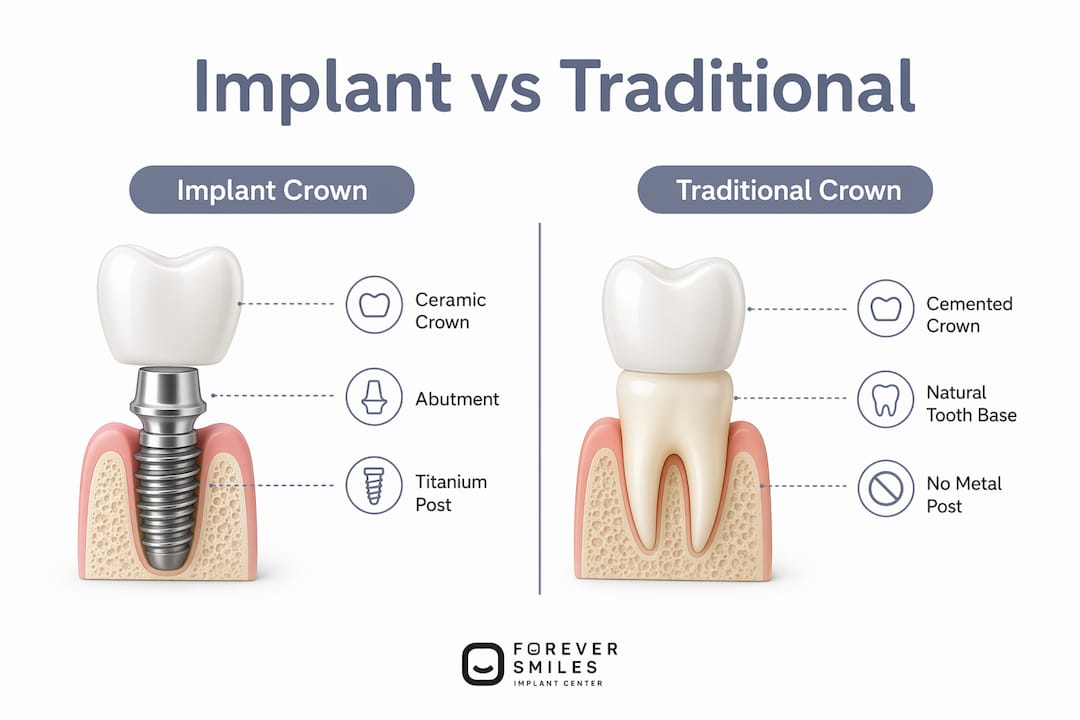
The implant crown system is a three-part structure, and each component has a specific job. The titanium post is surgically placed into the jawbone, where it functions as an artificial tooth root. Over several months, the bone grows around the post in a process called osseointegration, locking it firmly in place. That biological bond is what gives the entire restoration its stability.
The abutment sits on top of the post and extends just above the gum line. It acts as the connector between the buried implant and the visible crown. The crown itself is the part you see and use every day. It is shaped, sized, and shaded to match the surrounding teeth.
This system differs fundamentally from a traditional crown, which relies on a natural tooth structure underneath it for support. A traditional crown caps an existing tooth that has been filed down. An implant crown has no natural tooth beneath it at all. The table below shows the key structural differences.
| Feature | Implant crown | Traditional crown |
|---|---|---|
| Support structure | Titanium implant post in bone | Existing natural tooth (filed down) |
| Adjacent teeth affected | None | None |
| Bone stimulation | Yes, through chewing forces | No |
| Requires healthy tooth root | No | Yes |
| Replaces missing tooth entirely | Yes | No |
Pro Tip: Surgical precision during implant placement directly determines how well the crown performs. A crown built on a poorly placed post will fail over time, regardless of how well it is made.
What are the benefits of implant crowns?
Implant crowns preserve jawbone in a way no other restoration does. When a tooth is lost, the jawbone beneath it begins to shrink because it no longer receives chewing forces. An implant post transmits those forces directly into the bone, preventing bone resorption the same way a natural root does. Bridges do not provide this benefit and can lead to bone shrinkage over time.
The benefits of implant crowns extend well beyond bone health:
- No damage to neighboring teeth. Bridges require grinding down adjacent healthy teeth to anchor the restoration. Implant crowns stand alone.
- Long lifespan. The titanium post can last a lifetime with proper care, while the crown itself typically lasts 10–15 years before needing replacement.
- Natural chewing and speech. Because the implant is anchored in bone, it does not shift or slip during eating or talking.
- Customized appearance. Crowns are shaded and contoured to blend with surrounding teeth, making them nearly indistinguishable from natural ones. Learn more about natural-looking results and what customization involves.
- Easier oral hygiene. You brush and floss an implant crown exactly like a natural tooth. No special removal or soaking required.
Pro Tip: Bone preservation is the most underappreciated benefit of implant crowns. Patients who lose bone after tooth loss often face more complex and expensive procedures later. An implant placed early protects against that outcome.
What is the typical implant crown procedure?
The implant crown procedure unfolds in stages, and the timeline reflects biology, not convenience. Rushing any phase increases the risk of failure. Here is what the process looks like from start to finish:
- Consultation and planning. The surgeon evaluates bone density, gum health, and bite alignment using 3D imaging. This step determines whether the patient is a good candidate and maps the exact implant position.
- Implant post placement. The titanium post is surgically inserted into the jawbone under local anesthesia or sedation. The procedure is not painful during surgery, though mild soreness during recovery is normal.
- Osseointegration. The bone grows around the post over several months. This phase is non-negotiable. Placing the crown before full integration is confirmed leads to failures. The healing period typically runs 3–6 months.
- Abutment placement. Once osseointegration is confirmed, the abutment is attached to the post. This is usually a minor procedure done under local anesthesia.
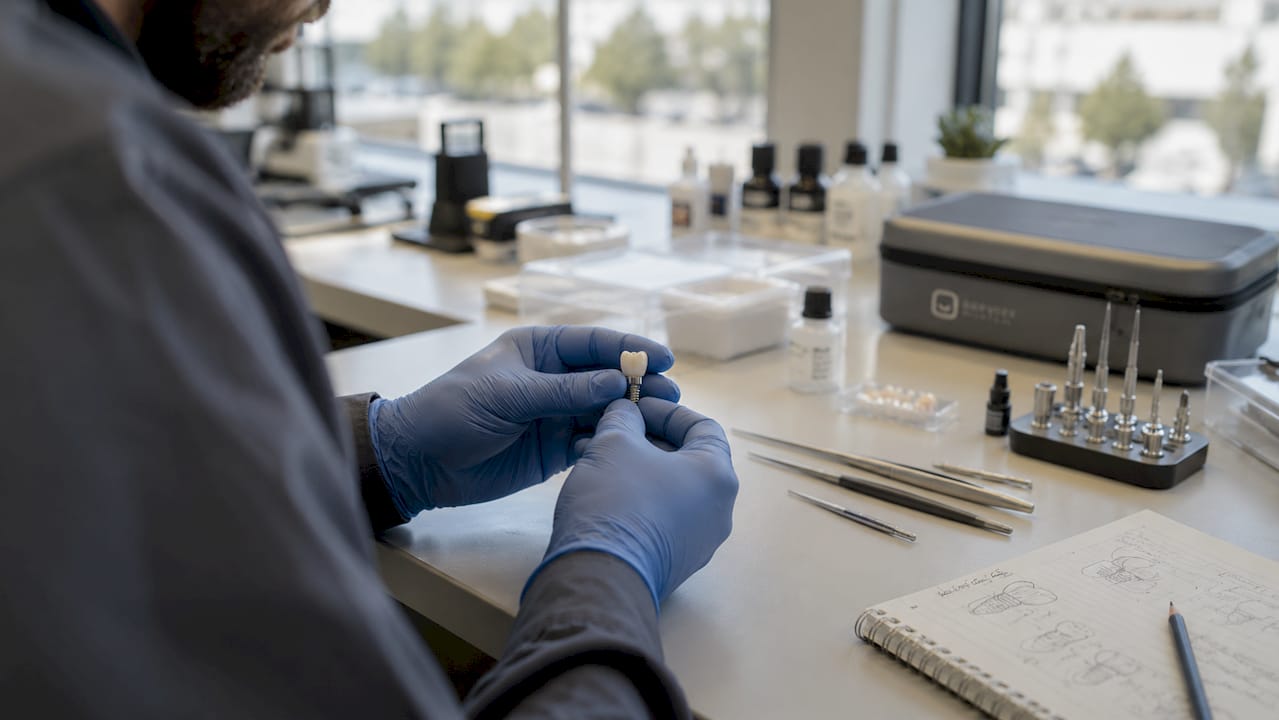
- Impressions and crown fabrication. The dentist or lab technician takes precise impressions of the mouth. A custom crown is fabricated to match the shape, size, and shade of surrounding teeth.
- Final crown placement. The crown is attached to the abutment by screw or dental cement. The bite is checked and adjusted as needed.
The full process from implant placement to final crown typically takes 4–9 months. Patients who want to understand what each appointment involves can review the step-by-step patient expectations at Forever Smiles Implant Center.
What materials are used for implant crowns?
Crown material affects how the restoration looks, how long it lasts, and how it performs under chewing pressure. The three most common implant crown materials are porcelain, zirconia, and porcelain-fused-to-metal (PFM).
- Zirconia. The strongest option available. Zirconia resists chipping and cracking, making it ideal for back teeth that absorb heavy bite forces. Modern zirconia is also highly translucent, so it looks natural. Forever Smiles Implant Center uses custom zirconia teeth as its standard for final restorations.
- Porcelain. Excellent aesthetics and a close match to natural tooth color. Porcelain is more commonly used for front teeth where appearance is the priority. It is slightly more prone to chipping than zirconia under heavy pressure.
- Porcelain-fused-to-metal (PFM). A metal substructure covered with porcelain. PFM crowns offer good strength and decent aesthetics, though a thin dark line may appear at the gum line as gums recede over time.
| Material | Strength | Aesthetics | Best use |
|---|---|---|---|
| Zirconia | Highest | Excellent | Back and front teeth |
| Porcelain | Moderate | Best | Front teeth |
| Porcelain-fused-to-metal | High | Good | Back teeth |
Custom shading and contouring are applied regardless of material. A skilled lab technician matches the crown to the exact color and shape of the patient's remaining teeth.
How long do implant crowns last and how should you care for them?
Implant crowns typically last 10–15 years before the crown itself needs replacement. The titanium post, however, can last a lifetime when properly maintained. The gap between those two lifespans reflects the difference between a biological anchor and a mechanical restoration exposed to daily wear.
Several factors determine how long a crown holds up:
- Daily oral hygiene. Brushing and flossing consistently keeps the gum tissue around the implant healthy and prevents infection that can loosen the post.
- Regular dental visits. Professional cleanings and periodic X-rays catch early problems before they become costly ones.
- Material choice. Zirconia outlasts porcelain under heavy bite forces. Choosing the right material for the location in the mouth matters.
- Habits that damage crowns. Chewing ice, grinding teeth at night, and biting hard objects accelerate crown wear. A night guard protects the crown if grinding is an issue.
- Early warning signs. Sensitivity around the implant, a loose crown, or pain when biting are signals to see a specialist promptly. Ignoring them can turn a minor fix into a full replacement.
Pro Tip: Treat an implant crown like a natural tooth for daily care, but pay closer attention to the gum line around it. Bacteria accumulate there and can trigger peri-implantitis, an infection that threatens the implant post itself.
Key Takeaways
An implant crown restores a missing tooth completely by combining a titanium post, an abutment connector, and a custom-made crown that functions and looks like a natural tooth.
| Point | Details |
|---|---|
| Three-part system | The implant post, abutment, and crown each serve a distinct role in restoring function. |
| Bone preservation | Implant crowns stimulate the jawbone through chewing forces, preventing bone loss over time. |
| Crown lifespan | Crowns last 10–15 years on average; the titanium post can last a lifetime with good care. |
| Material matters | Zirconia offers the best combination of strength and aesthetics for most patients. |
| Osseointegration is non-negotiable | Placing a crown before the bone fully integrates with the post leads to failure. |
What I've learned after placing over 28,000 implants
Patients walk in thinking the crown is the implant. That single misconception causes more confusion and disappointment than anything else I see in this practice. The implant is the root. The crown is the finish. Both have to be done correctly, or neither works the way it should.
The part that surprises most patients is the sensory difference. Implant crowns lack the periodontal ligament that natural teeth have, which means the feedback you feel when biting is different, especially in the first few months. That is not a defect. It is anatomy. The brain adapts, and most patients stop noticing within a year.
What I tell every patient is this: the outcome depends almost entirely on two things. First, the precision of the surgical placement. Second, the quality of the crown fabrication. A beautiful crown on a poorly placed implant will fail. A well-placed implant under a mediocre crown will underperform. Both halves have to be right. That is why we do everything under one roof at Forever Smiles Implant Center, from 3D surgical planning through in-house lab fabrication. Separating those steps introduces variables that compound over time.
Osseointegration timing is the other thing I will not compromise on. I have seen cases where patients pushed for faster timelines and paid for it with failed implants. The bone sets its own schedule. Respecting that schedule is not being slow. It is being correct.
— Dr. Brian Young
Implant crown care at Forever Smiles Implant Center
Forever Smiles Implant Center is a surgical implant center in Jacksonville, Florida, built around one focus: dental implant reconstruction. The team performs implant procedures every day, with an in-house lab that fabricates custom zirconia crowns on site. That means surgical planning, implant placement, crown fabrication, and follow-up care all happen under one roof with one accountable team.

Dr. Brian Young has placed over 28,000 implants over more than 20 years. The practice handles complex cases, including patients with significant bone loss and those whose implants have failed elsewhere. If you want to understand whether you are a candidate or have questions about the process, the dental implants FAQ page covers the most common concerns in plain language. For patients exploring broader restoration options, the full-arch implants page explains what is possible when multiple teeth need replacement.
FAQ
What is an implant crown made of?
Implant crowns are made from porcelain, zirconia, or porcelain-fused-to-metal. Zirconia is the most durable and is used for both front and back teeth at most specialized implant centers.
Is the implant crown procedure painful?
The surgical placement is performed under anesthesia, so patients feel no pain during the procedure. Mild soreness during the healing period is common and manageable with standard post-operative care.
How long does it take to get an implant crown?
The full process from implant post placement to final crown attachment typically takes 4–9 months. Most of that time is the osseointegration phase, where the bone bonds to the titanium post.
Can an implant crown be repaired if it breaks?
Yes. A damaged crown can be replaced without disturbing the implant post beneath it, as long as the post and abutment remain intact and the bone integration is healthy.
How is an implant crown different from a traditional crown?
A traditional crown caps an existing natural tooth that has been filed down. An implant crown attaches to a titanium post in the jawbone and replaces a missing tooth entirely, with no natural tooth structure underneath it.