

What is chewing efficiency with dental implants?
Chewing efficiency, in the clinical sense, measures how effectively your teeth break down food into small enough particles for safe swallowing and proper digestion. For dental implant patients specifically, it is assessed through masticatory performance tests: researchers measure particle size reduction after a set number of chewing strokes, track bite force in Newtons, and sometimes use electromyography to monitor jaw muscle activity. The result is a percentage score called masticatory performance (MP%), where a higher number means smaller, more uniform food particles and better overall function.
Conventional dentures score poorly on these tests. They sit on soft tissue, shift under load, and give patients little confidence when biting into anything firm. Implants anchor directly into the jawbone through osseointegration, which changes the mechanics entirely.
Key aspects of chewing efficiency in implant dentistry:
- Masticatory performance (MP%): the percentage of food particles passing through a standardized sieve after a fixed number of chewing strokes
- Bite force: measured in Newtons; implant patients typically generate forces approaching natural dentition
- Chewing strokes: fewer strokes needed to reach the same particle size indicates higher efficiency
- Particle size reduction: smaller, more uniform particles signal better food breakdown
- Sensory feedback: the presence or absence of periodontal ligament receptors affects how precisely the jaw modulates force
- Patient-reported outcomes: self-assessed chewing ability, food avoidance, and comfort scores complement objective measurements
Clinicians use both objective tests (almond comminution, sieve analysis) and patient questionnaires to get a complete picture, because the two do not always agree.
How dental implants improve chewing function and oral health
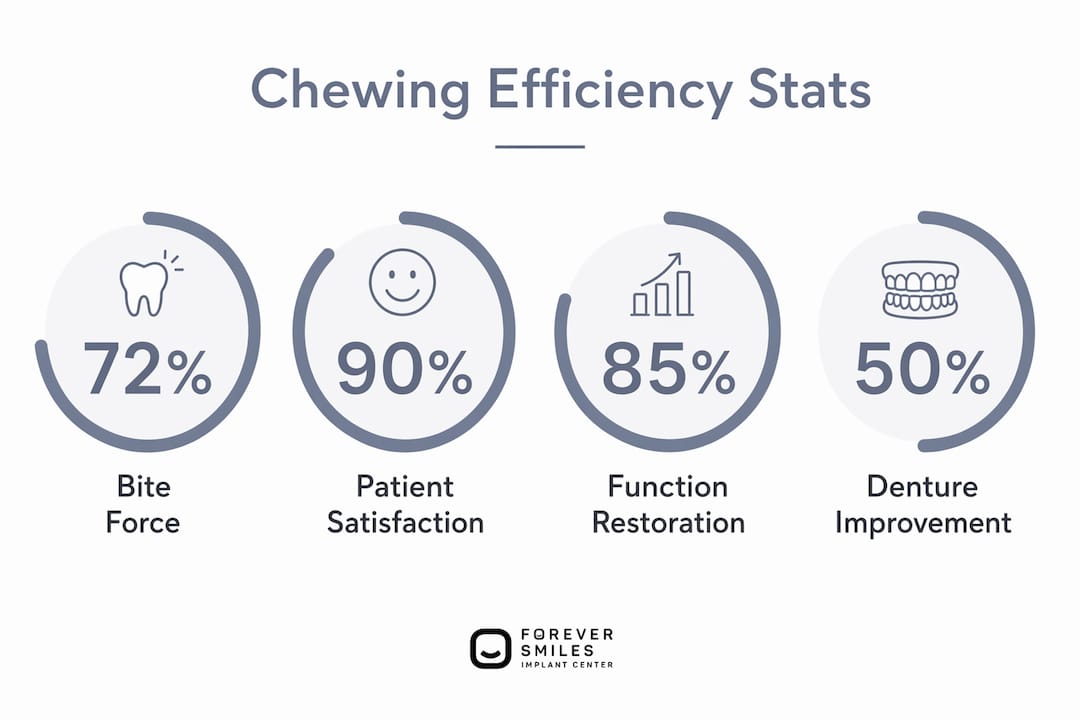
Osseointegrated implants restore chewing function through a combination of rigid anchorage, stable occlusal contact, and preserved jawbone volume. Unlike a denture that rests on the gum, an implant transfers bite load directly to the bone, the same pathway natural teeth use. That direct load transfer is what allows patients to generate bite forces that approach natural dentition levels, something no removable prosthesis can replicate.
The bite force restoration process is not instant. Research shows bite force builds gradually, increasing up to 72% over three months as the nervous system adapts to the new mechanical environment. The brain essentially relearns how hard to bite, a process driven by neuroplasticity rather than the periodontal ligament receptors that guided natural teeth.
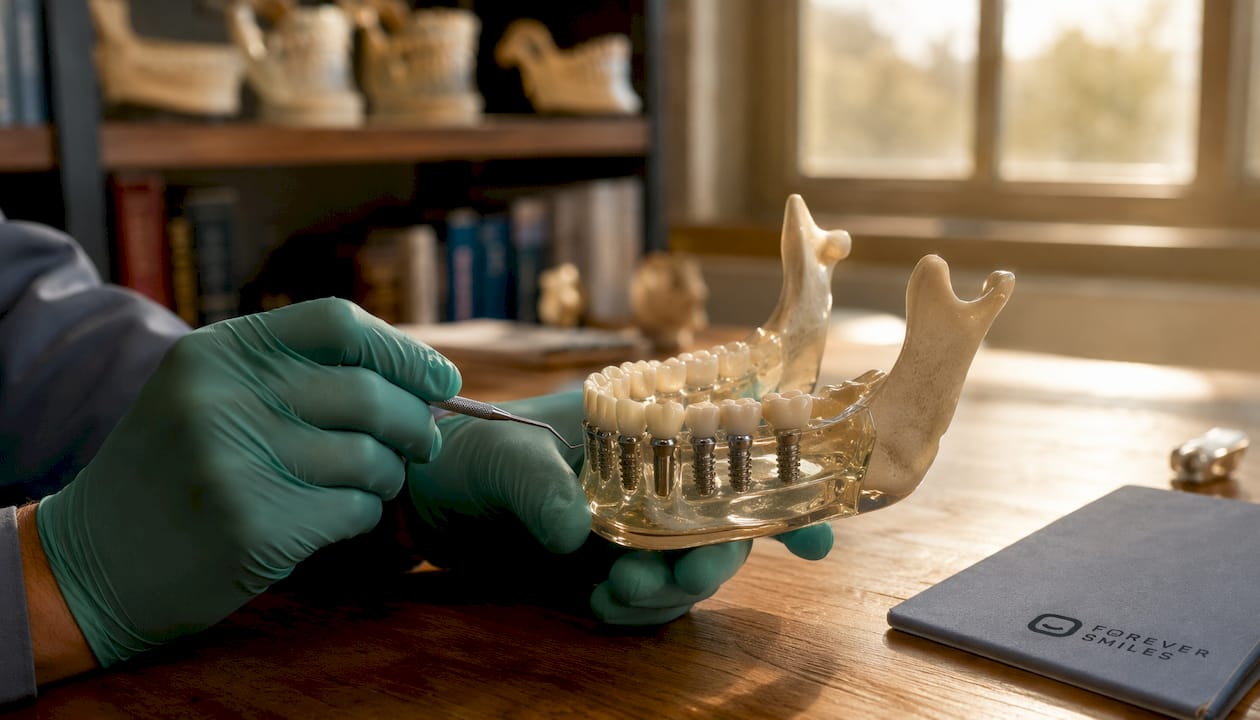
Beyond chewing mechanics, implants prevent the jawbone resorption that accelerates after tooth loss. Bone needs mechanical stimulation to maintain its density, and implants provide exactly that. Patients who lose bone under a conventional denture often find the denture fits worse over time, which compounds chewing problems. Implants interrupt that cycle entirely.
How implants improve chewing function and oral health:
- Rigid bone anchorage: eliminates the rocking and slipping that reduces denture efficiency
- Stable occlusal contact: distributes bite load evenly across the arch without pontics or soft-tissue compression
- Bone preservation: osseointegration maintains jawbone volume, keeping facial structure and prosthesis fit stable over time
- Dietary freedom: patients can return to foods they avoided with dentures, improving nutrition
- Reduced gastrointestinal strain: properly chewed food is easier to digest, reducing bloating and discomfort
- Improved confidence: stable teeth remove the social anxiety that often accompanies removable dentures
Pro Tip: If you are transitioning from dentures, start with softer foods for the first four to six weeks after loading. Your jaw muscles and nervous system need time to calibrate to the new bite forces before you tackle harder foods like raw carrots or crusty bread.
Prosthesis type matters here. Single implant crowns restore function for one missing tooth. Fixed hybrid arches (teeth attached permanently to four or more implants) deliver the highest bite forces for fully edentulous patients. Implant-supported overdentures sit between those two in terms of stability and force generation, but they still outperform conventional dentures by a wide margin.
Clinical evidence: how implants compare to dentures for chewing
The research on this question is consistent and, in some cases, striking. A prospective study published in PMC compared single-piece implant-supported crowns against conventional three-unit fixed partial dentures (FPDs) over 12 months using a standardized almond comminution test. At 12 months, the implant group reached 35.7% MP versus 28.3% for the FPD group, a statistically significant difference at every time point measured.
The gap was already visible at three months, with implant patients scoring higher masticatory performance than FPD patients. Both groups improved over time, but the implant group improved faster and finished higher, suggesting that osseointegrated bone anchorage accelerates functional adaptation.
| Prosthesis type | MP% at 3 months | — | MP% at 12 months |
|---|---|---|---|
| Single-piece implant crown | — | — | 35.7% |
| Conventional FPD (bridge) | — | — | 28.3% |
| Conventional complete denture | Baseline reference | Baseline reference | Baseline reference |
For patients who are fully edentulous, the numbers are even more compelling. Patients using implant-retained overdentures required 40 chewing strokes to reach a comparable particle size, versus 69 strokes for conventional denture wearers, a 42% reduction. Particle size itself dropped by 76.34% in the implant group, meaning the food was broken down far more thoroughly with less effort.
Key finding: Patients with implant-supported overdentures achieved a 76.34% reduction in particle size compared to conventional denture wearers, using 42% fewer chewing strokes to get there.
Chewing difficulty also drops sharply after implant placement. One study tracking patients over six months found that reported chewing difficulty fell from 91.4% to 51.4% after receiving implant-supported overdentures. That is a real-world shift in daily experience, not just a lab measurement.
One nuance worth noting: patients with natural tooth roots retained under overdentures sometimes outperform implant overdenture patients on fine food manipulation tasks. The reason is proprioceptive feedback. Natural periodontal ligament receptors send precise signals about food texture and position, something implants cannot fully replicate. This does not negate the functional gains from implants, but it does explain why some patients notice a difference in how they handle delicate foods early in the adaptation period.
Attachment system choice also affects outcomes for overdenture patients. Telescopic attachment systems produce higher chewing efficiency and maximum bite force than bar attachments, a detail that matters when planning prosthetic design for individual patients.
What patients actually experience when chewing with implants
Most patients describe chewing on implants as fundamentally different from dentures, and almost universally better. The stability alone changes the experience. With a denture, patients unconsciously avoid certain foods, eat more slowly, and sometimes feel embarrassed in social settings. With implants, that constant background management disappears.

That said, the first weeks after loading are an adjustment. Because implants lack periodontal ligament receptors, the brain receives less precise information about food texture and position than it did with natural teeth. Patients often describe this as a slight numbness or unfamiliarity in how food feels between the teeth, particularly with small or slippery items. The sensation is not painful; it is simply different, and it resolves as the nervous system adapts.
Common patient experiences with implant-supported chewing:
- Increased stability: no rocking, clicking, or shifting during meals
- Renewed food confidence: patients return to foods they had avoided for years
- Initial sensory adjustment: fine food manipulation feels slightly different for the first one to three months
- Gradual bite force increase: chewing power builds over weeks, not days
- Higher satisfaction scores: chewing difficulty drops significantly within the first six months for most patients
- Psychological benefit: eating in public without anxiety is consistently cited as a quality-of-life gain
One finding that surprises many clinicians: patient satisfaction and objective chewing scores do not always move together. Some patients report high satisfaction even when their measured MP% is only moderate. The psychological component of feeling stable and confident at the table carries real weight, independent of what a sieve test shows.
Pro Tip: Track your food diary for the first three months after implant loading. Noting which foods you can eat comfortably, and which still feel awkward, gives your surgical team useful data for adjusting your bite and helps you see your own progress objectively.
Expert insights from Dr. Brian Young on chewing efficiency after full-arch implants
Dr. Brian Young, founder and lead surgeon at Forever Smiles Implant Center, has placed over 28,000 implants and performs full-arch reconstruction daily. His perspective on chewing efficiency is grounded in both the clinical literature and the patterns he observes across a high volume of complex cases.
At Forever Smiles Implant Center, every full-arch case begins with 3D imaging and detailed bite analysis before a single implant is placed. That planning phase directly influences chewing outcomes, because implant position determines occlusal contact distribution, and contact distribution determines how evenly bite force spreads across the arch. Patients with atrophied bone, who might be told elsewhere they are not candidates, often qualify for zygomatic implants, which anchor in the cheekbone and restore full-arch function without requiring bone grafting.
Dr. Young also emphasizes the long-term picture. Fixed hybrid prostheses and implant-supported overdentures supported by four implants improve chewing efficiency and masseter muscle activity significantly more than conventional dentures in patients with atrophied mandibles. For patients who have been in dentures for years and have experienced bone loss, that functional recovery is often more dramatic than for patients who transition earlier.
The guiding philosophy at Forever Smiles Implant Center is direct: experience is not expensive, inexperience is. A poorly planned implant case that fails to restore chewing function, or that fails outright, costs far more in revision surgery, time, and quality of life than getting it right the first time.
Key Takeaways
Dental implants consistently outperform conventional dentures on every objective measure of chewing efficiency, from bite force and particle size reduction to patient-reported food confidence and quality of life.
| Point | Details |
|---|---|
| Chewing efficiency defined | MP% measures food particle reduction; implants score higher than dentures at every clinical time point. |
| Stroke reduction with overdentures | Implant overdenture patients require 40 chewing strokes versus 69 for conventional denture wearers, a 42% reduction. |
| Implant crowns vs. bridges | Single-piece implant crowns reached 35.7% MP at 12 months versus 28.3% for conventional fixed partial dentures. |
| Sensory adaptation period | Bite force builds substantially over three months as the nervous system adjusts to the absence of periodontal ligament receptors. |
| Satisfaction vs. objective scores | Patient-reported satisfaction and measured MP% do not always align; psychological confidence is an independent driver of perceived function. |
Why chewing efficiency deserves more attention in implant planning
Most patients walk into an implant consultation focused on aesthetics: how their smile will look, whether the teeth will seem natural, what color to choose. Chewing efficiency rarely comes up until after treatment, when a patient realizes they still cannot eat the foods they wanted to. That gap between expectation and outcome is almost always a planning problem, not a surgical one.
The clinical evidence is clear that implants restore chewing function far better than dentures, but the degree of restoration depends heavily on how the case is designed. Implant number, position, prosthesis type, and attachment system all influence the final MP%. A patient who receives two implants to retain a lower overdenture will chew better than with a conventional denture, but not as well as a patient with four implants supporting a fixed hybrid arch. Neither outcome is wrong; they serve different clinical situations. What matters is that the patient understands the difference before treatment begins, not after.
There is also the bone loss question. Every year a patient spends in a conventional denture, the jawbone resorbs further. That resorption narrows the surgical options and can make it harder to achieve optimal implant position for chewing. Patients who act earlier preserve more bone and, as a result, tend to achieve better functional outcomes. The research on this is consistent, and it is one of the reasons the team at Forever Smiles Implant Center encourages patients not to wait until bone loss becomes severe.
Chewing efficiency is also a nutritional issue. Patients who cannot chew effectively tend to shift toward softer, more processed foods, which affects long-term health in ways that go well beyond the mouth. Restoring proper masticatory function is, in that sense, a systemic health intervention, not just a dental one. That framing changes how patients should think about the value of implant treatment and how clinicians should present it.
If you are weighing your tooth replacement options and want to understand exactly how chewing efficiency factors into the decision, the team at Forever Smiles Implant Center can walk you through the clinical specifics for your case. Dr. Young and his team specialize in complex reconstructions, including patients with significant bone loss who have been turned away elsewhere. Every case starts with a detailed consultation and 3D imaging so you know precisely what your options are before committing to any treatment. Learn more at foreversmilesjax.com/dental-implants-faqs.