
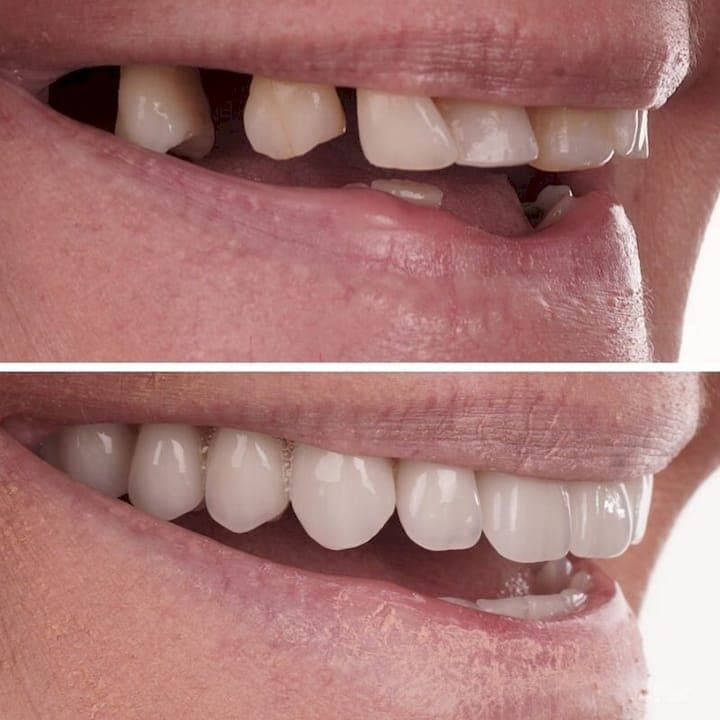
A screw-retained implant arch is a fixed, full-mouth dental prosthesis that attaches directly to dental implants or multi-unit abutments with small hidden screws instead of dental cement. That single design detail changes everything about how the restoration gets maintained: a dentist can remove it nondestructively for cleaning, repair, or adjustment, then screw it right back in.
That retrievability matters more than it sounds like it should. Full-arch prostheses are complex, expensive, and meant to last decades. When something needs attention, whether it’s a chipped tooth, a loose component, or gum tissue that needs checking, a screw-retained design lets your dentist get in there without cutting or damaging the restoration. A cemented arch doesn’t offer that option nearly as cleanly.
Here’s the trade-off in short form:
-
Retrievability: Easy to remove and reinstall for maintenance, repairs, or hygiene checks.
-
Biological risk: Eliminates leftover cement below the gumline, a known driver of gum inflammation around implants.
-
Technical risk: Screws can loosen or, less often, fracture over years of chewing forces.
-
Esthetics: Small screw-access holes are visible unless angled correctly, though patched holes typically blend in well.
Key Takeaways
A screw-retained implant arch attaches to implants with removable screws instead of cement, trading a small esthetic and technical complexity cost for long-term repairability and lower biological risk.
| Point | Details |
|---|---|
| Core definition | A fixed prosthesis secured with screws to implants or multi-unit abutments, removable without damage. |
| Biggest biological advantage | No subgingival cement means fewer cement-related peri-implant inflammation cases. |
| Biggest technical trade-off | Screws can loosen or, rarely, fracture, requiring periodic retorque checks. |
| Passive fit is critical | CAD/CAM-milled frameworks and multi-unit abutments help avoid long-term structural stress. |
| Material choice affects repair | Acrylic hybrids repair faster and cheaper; zirconia arches resist wear and staining better. |
| Specialist planning matters | Forever Smiles Implant Center uses guided surgery, an in-house lab, and MD anesthesiology for complex full-arch and zygomatic cases. |
Table of Contents
-
What Is Screw Retained Implant Arch vs Cement Retained: A Quick Comparison
-
What a Screw Retained Implant Arch Includes and the Types You’ll Hear About
-
Planning a Screw Retained Arch: Position, Space, and Passive Fit
What Is Screw Retained Implant Arch vs Cement Retained: A Quick Comparison
Choosing between screw retention and cement retention comes down to a handful of practical factors, and full-arch cases almost always tilt the decision toward screws.
-
Retrievability and maintenance: Screw-retained arches come off in minutes; cemented restorations often require cutting through material to access anything underneath.
-
Biological risk: Cement retention carries a real risk of excess cement getting trapped below the gum, which has been tied to peri-implant inflammation. Screw retention removes that variable entirely.
-
Technical complications: Screw-retained designs are more prone to loosening or, rarely, fracture. Cemented designs mostly avoid that particular headache.
-
Esthetics: Cement-retained crowns hide the connection completely. Screw-retained restorations need a small access channel, though modern angled systems minimize how visible it is.
-
Passive fit and angulation tolerance: Screw retention demands a more exact, passive fit at the framework level; cement can mask minor discrepancies.
-
Cost: Screw-retained work usually costs more upfront in lab fees and precision milling, but tends to even out with lower long-term repair costs.
Pro Tip: For single crowns, cement retention still has esthetic advantages in visible areas. But for full-arch restorations, most clinicians default to screw retention because retrievability across a dozen or more implants is simply too valuable to give up.
What a Screw Retained Implant Arch Includes and the Types You’ll Hear About
Ask three dentists about screw-retained arches and you might hear three different terms for what’s essentially the same family of restorations. Here’s how to decode them.
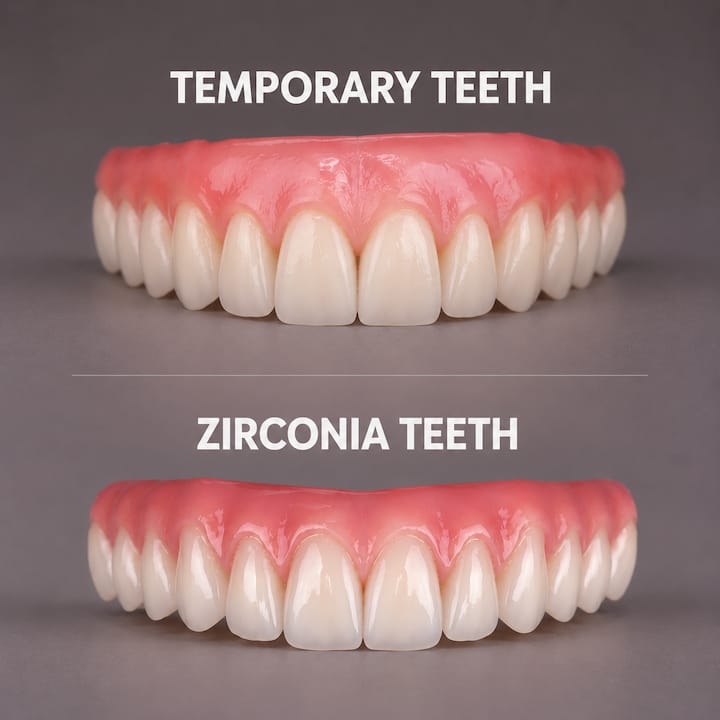
The most common design is the hybrid denture, sometimes called an acrylic-over-metal hybrid. It combines a rigid titanium or cobalt-chromium framework with an acrylic base and denture teeth layered on top. Hybrids are lighter, more forgiving to adjust chairside, and generally the most budget-conscious full-arch option.
A fixed zirconia arch takes a different approach. The entire prosthesis is milled from a solid block of zirconia, sometimes layered with porcelain for a more natural look. Zirconia arches resist staining and wear better than acrylic, feel closer to natural teeth in the mouth, and hold up longer under heavy bite forces. They also cost more to fabricate and are harder to repair chairside if something chips.
Then there’s the screw-cement hybrid approach: individual crowns or segments are cemented onto abutments in the lab, and that entire assembly is then screwed into the mouth as one retrievable unit. This gets clinicians the cosmetic polish of cement-retained margins while preserving the ability to remove the whole prosthesis for maintenance.
You’ll also hear these arches described in the context of specific protocols:
-
All-on-4 concept: Four strategically angled implants support a full-arch screw-retained prosthesis, often loaded with a temporary set of teeth the same day as surgery.
-
Full-arch immediate load: A broader term covering cases where a provisional screw-retained arch is placed right after implant surgery, before the final restoration is ready.
-
Multi-unit abutment constructions: Cases using specialized angled abutments to correct implant positioning before the final framework is attached.
The Anatomy Behind Every Screw Retained Implant Arch
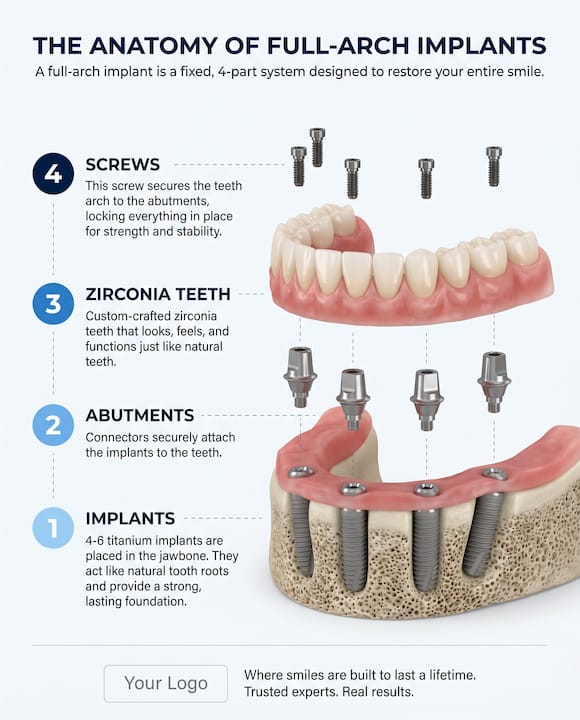
Every screw-retained arch is built on the same mechanical chain: implant, abutment, screw, prosthesis. Understanding each piece helps explain what’s permanent and what’s replaceable.
The implant body is a titanium (or occasionally zirconia) post surgically placed into the jawbone. This is the only part of the system that fuses permanently with bone through a process called osseointegration. It is not the piece that comes out for maintenance, a common point of confusion for new patients.
On top of the implant sits a multi-unit abutment. This small connector piece screws into the implant and does two jobs: it corrects for angulation differences between implants, and it moves the prosthetic connection point up and away from the bone level. Keeping that connection higher up protects the surrounding gum tissue from repeated disturbance every time the prosthesis is removed, according to clinical rationale on multi-unit abutment use.
The prosthetic framework, whether titanium, zirconia, or a hybrid material, sits over the abutments and is secured with prosthetic screws that thread down through access channels in the biting surface of the teeth. Once the screws are torqued to the correct specification, the access holes are filled with composite resin to seal them and restore a natural chewing surface.
When maintenance is needed, a dentist simply drills out that composite filling material, backs out the screws, and lifts the prosthesis free. Nothing surgical happens. The implants and abutments stay exactly where they are.
-
Implant body: permanent, fused to bone
-
Multi-unit abutment: semi-permanent connector, rarely removed
-
Prosthetic screws: removable fasteners, the access point for maintenance
-
Framework and veneering material: the visible, retrievable “teeth” portion
Which Cases Call for a Screw-Retained Approach?
Clinicians reach for screw retention in specific, fairly predictable situations, and understanding them helps you gauge whether your own case is likely to go this route.
Full-arch rehabilitation is the single biggest driver. When a patient is losing most or all of their teeth on an arch, the restoration spans many implants at once, and being able to remove the entire thing as one piece makes ongoing care dramatically simpler.
Immediate loading protocols, where a temporary prosthesis is placed the same day as implant surgery, also favor screw retention. The temporary needs to come off easily for adjustments as the surgical site heals and swelling changes.
Patients at higher risk for peri-implant disease are frequently steered toward screw retention specifically because it removes cement from the equation entirely, cutting off a known pathway to gum inflammation around implants.
-
Full-arch cases spanning multiple implants
-
Cases requiring a cantilevered section beyond the last implant
-
Immediate-load and same-day-teeth protocols
-
Patients with a history of gum disease or peri-implantitis risk
-
Cases anticipating future repairs (heavy grinders, complex bite issues)
Advantages and Limitations Patients Should Understand
No restoration is without trade-offs, and screw-retained arches are no exception. Weighing them honestly helps set realistic expectations.
On the advantage side: retrievability tops the list, letting your dentist address problems without destroying the prosthesis. Eliminating subgingival cement removes a documented driver of peri-implant inflammation. Repairs are also faster and less invasive, since the whole arch can be sent to a lab and reinstalled rather than remade from scratch.
On the limitation side: screws can loosen over months or years of chewing forces, and in rarer cases they can fracture. Screw-access holes create a small esthetic compromise on the biting surface, though angled screw-channel systems have largely solved this for visible front teeth. Precision milling for a properly passive-fitting framework also adds to the lab bill.
Cost callout: Screw-retained frameworks generally cost more upfront due to the precision required for a passive fit. But because they’re retrievable, repairs and hygiene visits tend to be less invasive and less costly over the life of the restoration compared to cemented alternatives that may require destructive removal.
Planning a Screw Retained Arch: Position, Space, and Passive Fit
Getting a screw-retained arch right starts long before the final teeth go in. It starts with where the implants are placed and how well the framework fits over them.
Implant angle matters enormously. If an implant is tilted even slightly off from vertical, the screw-access hole can end up pointing straight through the front of a tooth instead of through the biting surface, a real esthetic problem. Angulated screw-channel systems and angled multi-unit abutments let clinicians correct for this, redirecting the access hole away from visible surfaces while still keeping the restoration fully screw-retrievable.
Space is another constraint. Screw retention needs enough vertical room between the implant platform and the opposing bite for the abutment, screw, and sealing material to fit without weakening the prosthesis. In cases with limited space, bone-level screw retention becomes difficult, and multi-unit abutments become almost mandatory to create workable clearance.
Passive fit is the quiet variable that determines whether an arch lasts fifteen years or fails in three. If the milled framework doesn’t sit perfectly, tension-free, across every implant, tightening the screws forces the whole structure under chronic stress, a slow path to screw loosening, fracture, or even implant strain. CAD/CAM-milled frameworks built from digital scans have made passive fit dramatically more achievable than older cast-metal techniques.
Pro Tip: Ask whether your case will use guided surgery and digital intraoral scanning. Both reduce the guesswork in implant angulation and framework design, which directly lowers your odds of screw or fit problems down the road.
What Happens When Something Goes Wrong
Complications are part of the conversation with any full-arch restoration, and knowing what to expect keeps a routine fix from feeling like a crisis.
Technical issues show up more often with screw retention than with cement. Screws can loosen gradually, requiring a simple retorque. Less commonly, a screw fractures inside the implant and needs specialized removal. Ceramic can chip near an access hole, and acrylic veneering material wears down faster than zirconia over years of chewing.
Biological issues run in the opposite direction. Because there’s no cement to trap below the gumline, screw-retained restorations carry lower rates of peri-implant mucositis and peri-implantitis tied to cement residue specifically, though gum inflammation from plaque buildup can still occur with any implant restoration if hygiene lapses.
Most technical problems follow a predictable resolution path:
-
Diagnosis: The dentist identifies the source, loose screw, fractured screw, or damaged material, usually with an X-ray and a physical check.
-
Unscrew: The prosthesis or affected section is removed nondestructively.
-
Repair or replace: The lab repairs the chip, replaces the screw, or in rare cases mills a new framework segment.
-
Retorque: The restoration is reinstalled and screws tightened to the manufacturer’s specified torque value.
Surgical intervention is rare and typically reserved for implant-level problems like advanced bone loss around the fixture itself, not routine prosthetic wear.
Choosing Materials: Zirconia, Titanium, and Hybrid Designs
Material choice shapes how a screw-retained arch looks, feels, and holds up, and it’s one of the more consequential decisions in the planning process.
Zirconia arches, whether monolithic or porcelain-veneered, offer superior stain resistance and a more natural translucency than acrylic. They’re also considerably more rigid, which helps with long-term wear, but a chip in a full-contour zirconia arch usually means sending it back to the lab rather than a same-day chairside fix.
Acrylic-over-metal hybrids use a titanium or cobalt-chromium framework as the structural backbone, with acrylic and denture teeth layered on top. They’re lighter in the mouth, less expensive to fabricate, and, critically, far easier and cheaper to repair when a tooth chips or wears down.
The framework material underneath, regardless of what’s layered on top, benefits enormously from CAD/CAM milling precision, which produces a tighter, more passive fit than older casting methods ever could.
Pro Tip: If chairside repairability matters more to you than premium esthetics, ask specifically about acrylic-over-metal hybrid options. They’re the more forgiving material choice when a denture tooth eventually chips, which happens over a decade-plus lifespan.
What the Clinical Evidence Actually Shows
The research on screw versus cement retention doesn’t crown a single winner. It shows two different risk profiles, and that nuance matters for setting expectations.
-
A systematic review and meta-analysis of 29 studies found cemented full-arch restorations had more biological complications, while screw-retained restorations had more technical complications like loosening or fracture.
-
A 2024 systematic review of randomized clinical trials concluded overall outcomes were comparable between the two methods, with screw retention offering easier repairs and cement retention offering esthetic advantages in some cases.
-
ITI consensus guidance states both approaches can achieve high survival rates, but the decision should be made case by case rather than as a blanket rule.
Long-term follow-up on All-on-4 style, full-arch screw-retained prostheses shows 10-year success rates ranging from roughly 78% to 93% depending on the specific arch and protocol used, with technical events becoming more common as the years go on.
That’s a wide range, and it underscores why case selection and planning quality matter more than the retention method alone.
What to Expect: Timeline, Maintenance, and Lifespan
Most full-arch screw-retained cases follow a similar arc, though details vary by patient. Planning typically starts with 3D imaging and a digital smile design, followed by implant surgery. Many patients receive a temporary screw-retained prosthesis the same day as surgery, an immediate-load protocol that lets them leave with functional teeth while the implants heal.
The final prosthesis usually follows several months later, once osseointegration is confirmed and healing is complete. From there, maintenance becomes routine rather than eventful:
-
Recall visits typically happen once or twice a year, where the dentist checks screw torque, gum health, and prosthesis fit.
-
Because the arch is retrievable, a professional cleaning can go underneath the prosthesis in a way that’s impossible with fixed cemented restorations.
-
Lifespan depends heavily on material choice, number of supporting implants, lab precision, and patient habits, with smoking and heavy grinding both shortening how long components last before needing repair.
An Expert’s View on Screw-Retained Full-Arch Design
Retrievability isn’t a nice feature. It’s the reason full-arch screw retention has become the default choice for complex cases at Forever Smiles Implant Center. When a restoration spans ten or more implants, the ability to remove it without cutting into ceramic or acrylic changes how confidently a team can manage complications years down the line.
Case selection and passive fit are where outcomes are actually won or lost. An in-house dental lab means adjustments happen on the clinic’s own timeline instead of waiting on an outside lab’s schedule, and having a board-certified MD anesthesiologist on the surgical team allows longer, more complex procedures, including zygomatic implant placement for severely resorbed jaws, to be done safely in a single visit.
Patients preparing for a consultation should ask pointed questions: How will implant angulation be planned? What’s the pathway if a screw loosens in year five? Is the framework being milled digitally for a passive fit?
-
Ask about the guided surgery and digital planning process
-
Ask how angulation and passive fit will be verified before final placement
-
Ask what the repair pathway looks like if a component fails later
Pro Tip: A surgeon who can answer these questions in specific, concrete detail, not generalities, is telling you something important about how many of these cases they’ve actually planned.
When a Specialist Full-Arch Team Makes the Real Difference
Complex cases, severely resorbed jaws, previously failed implants, and patients who’ve been told elsewhere they weren’t candidates deserve a team that handles full-arch reconstruction as its core focus rather than an occasional procedure. These are the cases where a passive-fitting screw-retained arch is hardest to achieve and most important to get right the first time.
A team-based approach, surgical planning, in-house lab work, and prosthetic design under one roof, produces more predictable full-arch outcomes than coordinating between separate offices for each stage of care.
That coordination is what turns a technically demanding case into a routine one.
Ready to Explore a Screw-Retained Full-Arch Solution?
Forever Smiles Implant Center is built specifically around full-arch reconstruction, including All-on-4 style solutions, zirconia fixed arches, and zygomatic implants for patients with severe bone loss who’ve been turned away elsewhere. Every case goes through digital surgical planning designed to achieve the kind of passive fit this article covers, backed by an in-house dental lab and a board-certified MD anesthesiologist for complex procedures done safely in one visit.
Same-day teeth are available for qualifying patients, meaning you can leave surgery with a functional temporary screw-retained arch while your final zirconia restoration is planned and milled. If you’ve been told your bone loss or previous implant failure rules you out of full-arch treatment, that’s exactly the kind of case this team specializes in solving. Explore full-mouth dental implant options and schedule a consultation to find out what a properly planned screw-retained arch could look like for your case.
Frequently Asked Questions
What is a screw retained implant arch made of? It typically combines a titanium or zirconia framework with either acrylic denture teeth (hybrid design) or full-contour zirconia veneered with porcelain, depending on the esthetic and durability goals of the case.
What are screw retained arches used for most often? They’re used primarily for full-arch restorations, where multiple implants support an entire row of replacement teeth, since retrievability across that many implants is especially valuable for long-term maintenance.
Is screw retained implant vs cemented a matter of one being better overall? No. Evidence shows comparable survival rates between the two, with different complication patterns, more biological issues with cement, more technical issues with screws, making the choice case-specific rather than universal.
Can you feel the screw holes in a screw retained implant arch? No. Once torqued and sealed with composite resin, the access holes sit flush with the biting surface and aren’t noticeable to the tongue or during normal chewing.
How long does a screw retained implant arch typically last? Long-term data on full-arch designs like All-on-4 shows 10-year success rates between roughly 78% and 93%, with lifespan depending heavily on materials, implant count, and habits like smoking.
This article is general information, not a substitute for advice from a qualified doctor. Consult a qualified healthcare professional about your own circumstances before acting on anything here.