
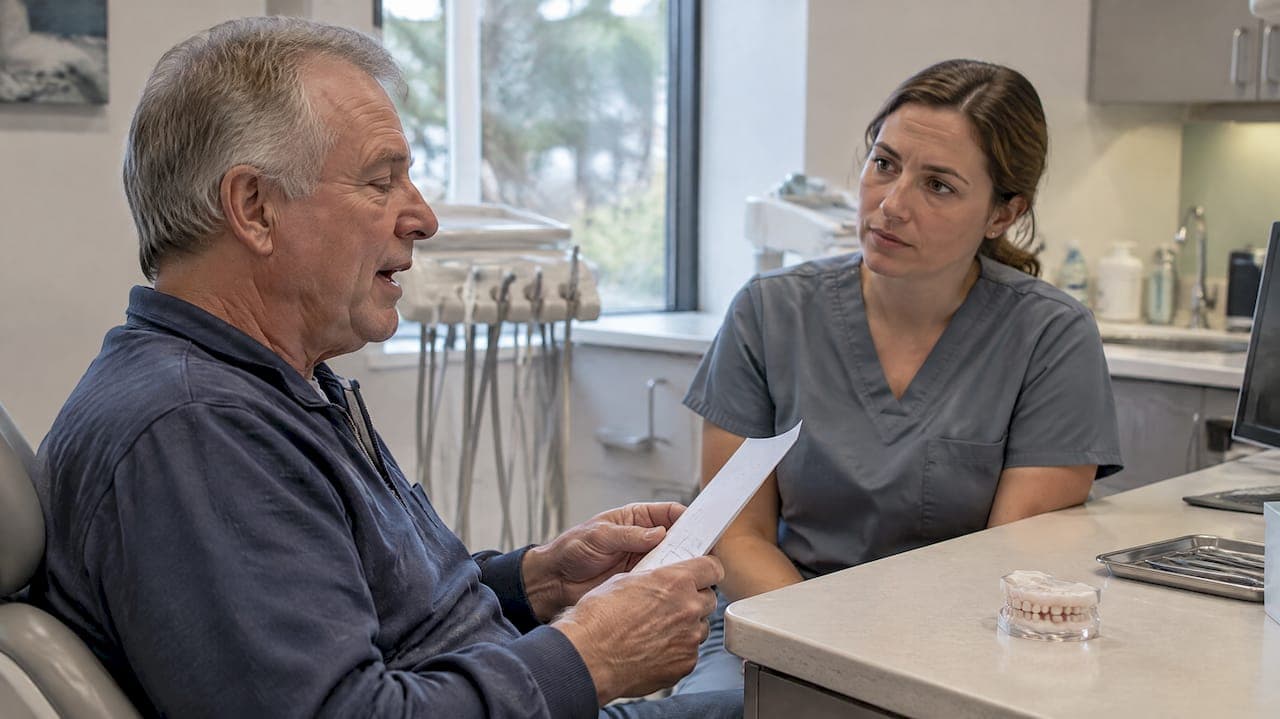
Yes, All-on-4 implants often change your speech for a while, and most of those changes fade as you adapt or get a small prosthetic adjustment. The usual culprits are the new palatal shape, tooth position, and bite height, not a surgical problem. If a specific sound still sounds off after several weeks of practice, that's your cue to call your clinic for a review rather than wait it out.
TL;DR:
- Most speech issues after All-on-4 implants are due to changes in palate shape, tooth position, or bite height, not surgical injury, and usually improve over time.
- Problems with /s/, /z/, /sh/, /f/, /v/, /th/, /l/, and bilabial sounds are most common, often linked to the new prosthesis's geometry and vertical dimension.
- If a specific sound remains distorted after 4 to 8 weeks, a prosthetic adjustment or reline is typically more effective than extended practice.
- Practice exercises like reading aloud and recording progress can speed up adaptation, but persistent issues often require prosthetic corrections for full resolution.
- A specialist review with in-house adjustments can streamline fixing speech problems if they do not resolve naturally within a few weeks.
Table of Contents
- Common speech changes people notice after All-on-4
- Why All-on-4 can change speech: the prosthesis and anatomy mechanics
- Which sounds are most vulnerable and why
- Adaptation timeline and realistic expectations
- Practice vs. prosthetic adjustment: who does what and typical clinician fixes
- Expert perspective from Dr. Brian Young and what a specialist looks for
- Practical speech exercises and short-term self-help
- Clinician perspective: balancing patience and timely fixes
- How Forever Smiles can help: specialist review and in-house adjustments
- FAQ
- Sources
- Primary sources and studies cited
Common speech changes people notice after All-on-4
Most patients notice something different about the way they talk within days of getting their new provisional teeth. The change is rarely dramatic, but it's noticeable enough to make people self-conscious in conversation.
The most frequent complaints cluster around a handful of patterns:
- Whistling or air escape, especially on words with /s/, /z/, or /sh/ sounds.
- A lisp or softened /s/, sometimes called sigmatismus, where the tongue hits the wrong spot against the new palate.
- Trouble with /f/, /v/, /th/, and /l/ when tooth position or bite height has shifted from what the tongue and lips are used to.
- Bilabial sounds like /b/, /m/, and /p/ feeling clumsy if the vertical dimension of the bite has changed.
These changes typically show up right after the provisional bridge is placed or during the early healing period, before the mouth has had a chance to relearn where everything sits.
Why All-on-4 can change speech: the prosthesis and anatomy mechanics
Speech depends on precise, repeated contact between the tongue, lips, teeth, and palate. All-on-4 changes several of those reference points at once, which is why the mouth needs time to recalibrate.
The mechanics break down into a few specific factors:
- Palatal volume and contour give the tongue a map for producing fricative sounds like /s/ and /sh/; a bulkier or reshaped palate shifts that map.
- Tooth position and incisal edge length change where the tongue and lips need to land for /s/, /f/, /v/, /th/, and /l/.
- A different vertical dimension, meaning the distance between upper and lower jaw when the teeth meet, can make full lip closure harder for bilabial sounds.
- Air gaps or an imperfect fit on the underside of the prosthesis, called the intaglio surface, commonly cause whistling that a reline or better seal usually resolves.
Life after full-arch implants covers how these physical changes fit into the broader recovery picture, beyond speech alone.
Which sounds are most vulnerable and why
Not every sound is affected equally, and knowing which ones give you trouble helps your clinician pinpoint the cause faster. A short phoneme-level guide:
- Sibilants (/s/, /z/, /sh/): These depend heavily on palatal contour, where your front teeth sit, and how wide the back of the arch is. Problems here often trace back to palate shape or anterior tooth position.
- Labiodentals (/f/ and /v/): These need the right contact between your lower lip and the edge of your upper front teeth, sometimes called the wet-dry line. Incorrect incisal edge position throws this off.
- Linguo-dentals (/th/ and /l/): These require precise tongue-to-tooth contact and are sensitive to extra bulk on the tongue side of the prosthesis or shifted tooth position.
- Bilabials (/b/, /m/, /p/): These require your lips to close fully, which depends on vertical dimension. If your bite sits taller than your natural one did, these sounds can feel effortful or muffled.
Describing exactly which sound gives you trouble, rather than saying your speech "sounds off," gives your clinic a much faster path to the right fix.
Adaptation timeline and realistic expectations
Most temporary speech changes improve over weeks to a few months, and many patients notice the biggest jump after they move from the provisional bridge to the final prosthesis. The mouth needs repeated practice to relearn where to place the tongue and lips against the new geometry.
A few things affect how fast that adaptation happens:
- Patients coming from a full palatal-coverage denture often need more adjustment time than those with natural teeth right before surgery.
- Prior denture-wearers may need longer to adapt, so tracking specific problem sounds over time helps separate real issues from normal transition.
- If a specific sound hasn't improved after the early provisional window, commonly 4 to 8 weeks, that's the point to request a prosthetic check rather than keep practicing alone.
A 2021 systematic review found that maxillary fixed complete dentures carry low-quality evidence of more frequent short-term /s/ distortions than removable dentures, particularly in patients who previously wore palatal-coverage appliances. That pattern lines up with what most clinics see in the first few months after conversion to a fixed arch.
Practice vs. prosthetic adjustment: who does what and typical clinician fixes
Deciding whether to keep practicing or ask for a fix comes down to the pattern of the problem, not how frustrated you feel about it.
- Favor practice when the change is diffuse, mild, and recent, and you're willing to work on it for 2 to 6 weeks before judging the result.
- Favor an adjustment when one specific phoneme stays distorted, when whistling persists and traces to an air gap, or when you can point to a clear contact or tooth-position problem.
- Common clinician corrections include relining the intaglio surface, reducing palatal bulk, adjusting incisal edge length or tooth position, changing vertical dimension, or recontouring the posterior arch width.
- Typical diagnostic workflow: the clinician isolates the problem phoneme, trials a temporary composite modification on the provisional, then makes a definitive change once the fix is confirmed.
A clinical study on fixed maxillary restorations found that reducing palatal volume around the premolar area restored baseline speech in 5 of 7 affected patients and improved it in the remaining 2, which supports treating persistent sibilant problems as a contour issue rather than something more practice alone can fix.
Pro Tip: Record yourself reading the same paragraph each week so you and your clinician can compare actual progress instead of relying on memory.

Expert perspective from Dr. Brian Young and what a specialist looks for
Careful planning before surgery prevents a lot of avoidable speech trouble. Surgical guides and provisional contours that account for tongue space and lip line reduce the odds of a palate that's too bulky or a bite that's too tall.
A well-planned provisional should never be the final answer for speech, it's a starting point the team refines as the patient talks, eats, and lives with it.
Dr. Brian Young, a residency-trained surgical specialist who has placed more than 28,000 implants over a 20-plus year career, built Forever Smiles Implant Center's workflow around keeping surgical planning, the in-house lab, and restorative adjustments under one roof, which shortens the loop between noticing a speech problem and fixing it. Patients evaluating a persistent sound are encouraged to bring a short recording and a list of problem words to their review.
— Dr. Brian Young
Practical speech exercises and short-term self-help
While you're waiting out the early adaptation window, a few habits speed things along. Reading aloud for 20 to 30 minutes a day gives your tongue and lips repeated reps against the new shape of your mouth.
- Practice targeted drills like repeating "sixty-six" for /s/ sounds or "fifty-five" for /f/ sounds, slowly and with exaggerated articulation.
- Record short clips of yourself talking each week and bring them to your follow-up appointment so your clinician can hear the actual change.
- If articulation problems are complex or combined with hearing loss, ask about a referral to a speech-language pathologist.
Pro Tip: Slow down before you worry. Most people sound worse to themselves than they do to others, because they're hyperaware of the one sound that feels wrong.
Exercises help the brain and muscles catch up, but they won't fix a sound caused by restoration geometry. If the palate shape, tooth position, or air seal is the real problem, no amount of drilling replaces a prosthetic correction.
Clinician perspective: balancing patience and timely fixes
Most speech changes after All-on-4 settle down on their own, and clinics expect to see them. What matters more is tracking which sound bothers you and when it started relative to your provisional or final delivery.
Don't wait months hoping a single distorted sound will resolve itself. A quick recording and a call to your clinic usually leads to a fast, targeted fix rather than a long guessing game.
How Forever Smiles can help: specialist review and in-house adjustments
If a sound still isn't right after a few weeks of practice, a specialist review is a faster path than continued guesswork. Some specialized implant centers keep surgical planning, prosthetic design, and an in-house lab under one roof, so an adjustment like a reline, a palatal contour change, or a tooth position tweak can happen without bouncing between offices.
Bring a short audio or video clip of the sound giving you trouble, a rough timeline of when the change started, and your prior denture history if you have one. That information lets the team isolate the cause quickly instead of starting from scratch. You can review the full-mouth implant process and schedule a specialist evaluation directly.
This article is general information, not a substitute for advice from a qualified doctor. Consult a qualified healthcare professional about your own circumstances before acting on anything here.
FAQ
What is the downside of All-on-4 dental implants?
The most common downsides are a temporary change in speech, an adjustment period for chewing and tongue positioning, and the need for a provisional-to-final prosthesis transition. Most of these resolve with time or a minor prosthetic adjustment rather than representing a lasting problem.
Can dental implants cause speech problems?
Yes, fixed implant restorations can temporarily affect speech, particularly sounds like /s/, because the new palate shape and tooth position are different from what the tongue is used to. A systematic review found low-quality evidence that this effect is more common with maxillary fixed dentures than removable ones in the first several months.
Why can't I close my lips with dentures or a new prosthesis?
Difficulty closing the lips usually points to a vertical dimension that sits taller than your natural bite did before treatment. Adjusting that dimension, along with tooth position, typically resolves bilabial sounds like /b/, /m/, and /p/.
How long does it take for speech to return to normal after All-on-4?
Most people see meaningful improvement within weeks to a few months, with a further jump after moving from the provisional to the final prosthesis. If one sound hasn't improved after the early provisional window, commonly 4 to 8 weeks, a prosthetic assessment is the next step rather than more waiting.
Sources
- On Speech Problems with Fixed Restorations on Implants in the Edentulous Maxilla
- Speech evaluation during maxillary mini‑dental implant overdenture treatment: A prospective study
- Speech in implant-supported and removable complete denture wearers: A systematic review
- For
Primary sources and studies cited
- Speech evaluation during maxillary mini-dental implant overdenture treatment: A prospective study
- For
- On Speech Problems with Fixed Restorations on Implants in the Edentulous Maxilla
- Speech in implant-supported and removable complete denture wearers: A systematic review