
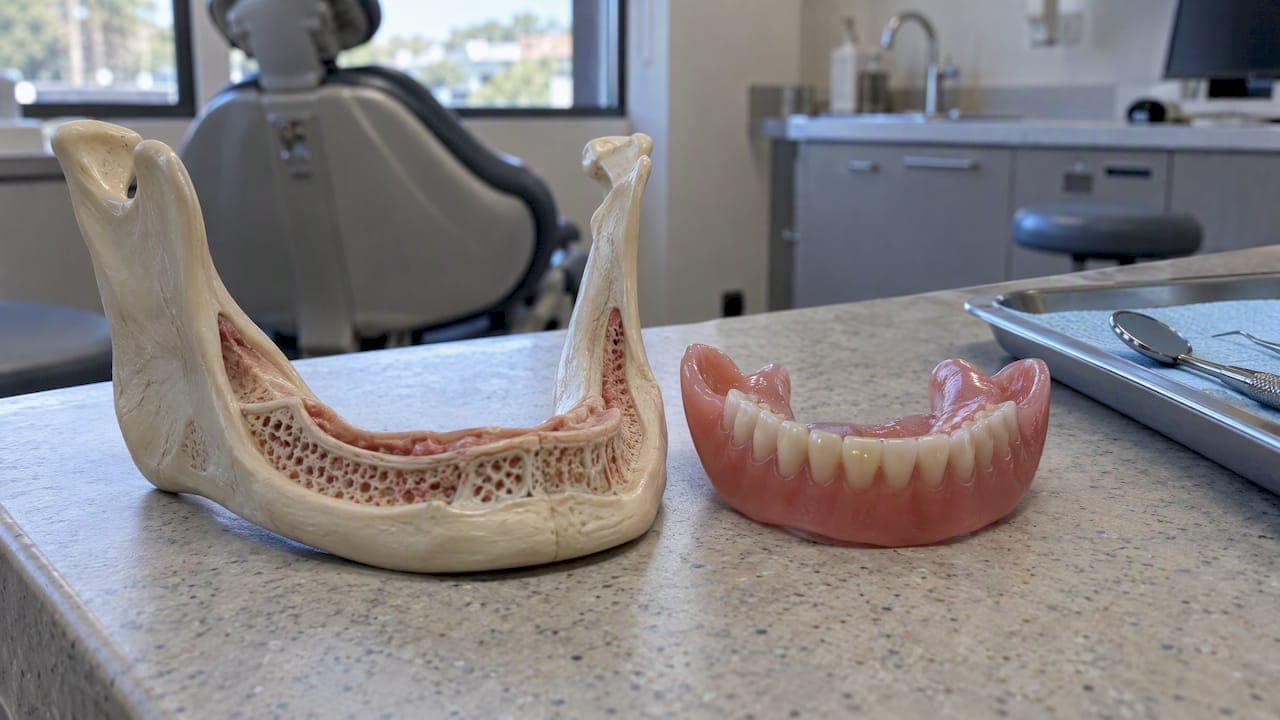
Conventional dentures do not stop jawbone loss, and in many patients the bone keeps shrinking underneath them year after year. Implant-supported restorations and early ridge-preservation strategies are the treatments shown to reduce that resorption. If you wear dentures and your fit feels different than it used to, a checkup with imaging is the right next step before the bone changes further.
TL;DR:
- Bone loss is fastest during the first months after extraction; over one year, the mandible lost bone roughly twice as fast as the upper jaw.
- A loosening or rocking denture, new sore spots, more adhesive use, or difficulty chewing can signal ridge changes; arrange an exam and imaging.
- Implant supported overdentures preserved more mandibular bone than conventional dentures, while long term prosthetic maintenance occurred more often than biologic failure.
- Before an extraction, ask about ridge preservation, which can limit bone loss in width and height soon after surgery, though longer term benefits remain uncertain.
- When little upper jaw bone remains, specialist planning with three dimensional imaging can assess grafting or implants anchored in the cheekbone.
Table of Contents
- Why Your Jawbone Shrinks After You Lose Teeth
- Do Conventional Dentures Make Bone Loss Worse?
- How Implants Help Preserve the Bone Underneath Them
- What to Do Now if You're Worried About Bone Loss
- Managing Severe Bone Loss: When Specialist Surgical Care Matters
- A Patient-Centered Perspective on Jaw Health and Prosthetic Choices
- How a Full-Arch Implant Center Approaches Denture-Related Bone Loss
- FAQ
- Sources
Why Your Jawbone Shrinks After You Lose Teeth
Your jawbone needs the mechanical pressure of tooth roots to stay dense. Once a tooth is gone, that stimulation disappears, and the bone around the empty socket begins to resorb through a process of disuse atrophy, similar to how an unused muscle loses mass.
The speed of this loss is not steady. Resorption is fastest in the first months after extraction, then slows into a gradual, lifelong decline. A study tracking complete denture wearers over one year found significant residual ridge resorption during that window, with the mandible losing bone roughly twice as fast as the upper jaw, and the front of the lower jaw taking the heaviest hit. That mismatch happens partly because the lower arch has a smaller bone surface to absorb chewing forces and because chewing pressure concentrates differently between the two jaws.

How much bone you lose and how fast depends on more than anatomy. Time spent without teeth matters: the longer you go edentulous, the more bone disappears. Smoking restricts blood flow to healing tissue and speeds resorption. Periodontal disease before extraction, uncontrolled diabetes, and general bone density also shape the outcome. None of these factors act alone, which is why two people with the same missing teeth can end up with very different ridge shapes a decade later.
Do Conventional Dentures Make Bone Loss Worse?
Removable dentures replace the visible crown of a tooth, but they do nothing to replace the root, and the root is what transmitted load into the bone in the first place. Without that root-level stimulation, the jaw continues to resorb underneath a denture much as it would with no prosthetic at all.
A 2 to 6 year follow-up study comparing conventional complete dentures with implant-supported overdentures found measurably greater alveolar ridge height loss in both the anterior and molar regions of the mandible for conventional denture wearers. A separate systematic review and meta-analysis of patients with atrophic mandibles found that conventional removable dentures performed worse functionally as ridge resorption progressed, confirming that bone loss and poor denture function tend to feed each other.
Mechanically, resorption works against the denture itself. As the ridge flattens, the denture base loses the foundation it was molded to fit, so pressure concentrates unevenly on whatever bone remains, which can accelerate further loss in a slow, self-reinforcing cycle.
Watch for these practical warning signs:
- Your denture feels loose, rocks when you chew, or needs adhesive more often than before.
- Sore spots develop in new places, or old spots stop responding to adjustments.
- Your lower face looks more sunken, your lips appear thinner, or your chin seems to jut forward.
- Chewing efficiency drops, and you find yourself avoiding firmer foods.
How Implants Help Preserve the Bone Underneath Them
Dental implants restore what dentures cannot: a load-bearing post anchored directly in bone, transmitting chewing force the way a natural root once did. Learn more about whether you might be a candidate at Do You Need Dental Implants? That mechanical stimulation is the biological signal bone needs to maintain its density instead of resorbing.
The same 2 to 6 year mandibular study found that implant-supported overdentures preserved significantly more alveolar bone height than conventional dentures over the full follow-up period. A broader literature review echoed this, reporting that jaws rehabilitated with implant-supported prostheses often showed less resorption than those relying on conventional dentures, with some cases even showing bone apposition around the implant sites, though the review noted that results vary and more research is needed. Consensus statements from the International Team for Implantology support the same conclusion: implant-supported prostheses generally offer an advantage for preserving alveolar bone in edentulous patients, provided they receive regular maintenance.
The right option depends on how much bone remains and how much stability you need:
- A 2-implant overdenture anchors a removable prosthesis on two implants, a common entry point for lower-jaw stabilization.
- A 4+ implant bar overdenture spreads load across more anchor points for patients needing broader support.
- A fixed implant bridge eliminates removability entirely, functioning closest to natural teeth.
- Zygomatic implants anchor into the cheekbone instead of the upper jaw, an option for patients whose maxillary bone is too thin for conventional implants.
Implants are not maintenance-free. Long-term outcome data covering nearly three decades of implant prostheses shows that prosthetic maintenance, things like relines, attachment replacement, or bridge adjustments, happens far more often than outright biologic failure, and patients should plan for that ongoing care rather than expect a permanent, untouched result.
Pro Tip: Ask any implant provider what percentage of their long-term patients return for prosthetic maintenance versus biologic complications. The answer tells you how realistic their outcome expectations are.
What to Do Now if You're Worried About Bone Loss
If you already wear dentures or you're facing extractions soon, a few concrete steps slow the damage and keep your options open.
- Get your dentures checked and relined whenever they start to feel loose; a poor fit accelerates uneven bone pressure.
- Treat sore spots immediately rather than adjusting around them for months.
- Schedule regular dental exams with radiographs so ridge changes get caught early, not after your fit has already failed.
- If you're facing an extraction, ask your dentist about alveolar ridge preservation at the time of the procedure, since reviews show it can limit short-term width and height loss, though long-term benefits and the superiority of specific graft materials remain uncertain.
- Ask whether any remaining roots can be preserved to anchor a future overdenture, and request CBCT imaging before any implant planning so your surgeon can see bone volume in three dimensions.
Our jawbone health guide before implant surgery walks through what that imaging and planning process typically involves.
| Risk factor | Effect on bone loss |
|---|---|
| Smoking | Reduces blood flow to healing bone, slowing recovery and speeding resorption |
| Uncontrolled diabetes | Impairs bone healing and increases resorption risk |
| Poor nutrition | Limits the minerals and protein bone needs to remodel properly |
| Time without teeth | Longer edentulous periods correlate with greater cumulative bone loss |
Managing Severe Bone Loss: When Specialist Surgical Care Matters
Patients with significant bone loss, or those told elsewhere they weren't implant candidates, often still have options, but the evaluation needs to go beyond a visual exam. A specialist assessment typically includes 3D CBCT imaging and a full surgical treatment plan before any decision gets made.
For jaws with minimal or no remaining bone, advanced techniques exist:
- Onlay grafts and block grafts rebuild width and height in localized areas.
- Sinus lifts add bone volume in the upper jaw before conventional implants go in.
- Zygomatic implants bypass deficient maxillary bone entirely by anchoring into the cheekbone, often avoiding the need for grafting altogether in severe atrophy cases.
Pro Tip: Ask your surgical team to separate what they call "biologic events" (implant failure, infection) from "prosthetic events" (reline, bridge adjustment) when they explain long-term outcomes. The distinction shapes what kind of follow-up you should actually expect.
Experienced surgical teams matter most in these complex cases, where staged planning and precise execution determine whether a graft or zygomatic approach succeeds on the first attempt.
A Patient-Centered Perspective on Jaw Health and Prosthetic Choices
Missing teeth are not a problem you solve once and forget. They start a chronic process that keeps evolving, and every prosthetic choice you make today either slows that process or accelerates it. The mistake I see most often is patients treating the first denture as the finish line, when it's really the starting point of a decades-long relationship with their own jawbone.
Ask any provider directly what maintenance their recommended option will require five and ten years out, not just what it costs today. And get a baseline CBCT scan now, even if you're not ready for surgery, so you and your dentist have an honest reference point for how your bone is actually changing.
— Dr. Brian Young
How a Full-Arch Implant Center Approaches Denture-Related Bone Loss
We built our practice around full-mouth implant reconstruction exclusively, with a surgical team, an in-house dental lab, and anesthesia support handling every case under one roof. That structure lets us plan complex bone loss cases, including zygomatic implants and previously failed implant revisions, without passing you between separate offices.
We work daily with denture wearers whose bone has already resorbed, patients with failing teeth, and those told elsewhere they had no options left. If your checkup raised concerns about your ridge or your denture fit, schedule an evaluation with imaging to see exactly what your bone can support.
This article is general information, not a substitute for advice from a qualified doctor. Consult a qualified healthcare professional about your own circumstances before acting on anything here.
FAQ
What should I do if my dentures are too thick?
A denture that feels too thick is usually a fit or design issue your dentist can adjust, often tied to how much bone remains to support the base. If bone loss is the underlying cause, an implant-supported option can reduce how much bulk the prosthetic needs for stability.
Can stem cell therapy help regenerate jaw bone?
Stem cell approaches for jaw bone regeneration remain experimental and are not a standard clinical option for denture-related bone loss today. Established techniques like ridge preservation grafting and implant placement have the stronger evidence base for maintaining or rebuilding bone volume.
How should I wear my dentures day to day?
Dentures should be removed at night to let your gums and bone rest, and cleaned daily with a denture-specific brush and cleanser rather than regular toothpaste. Regular checkups let your dentist catch fit changes early, since a shifting ridge changes how the denture sits over time.
I have trouble swallowing with new dentures. What could be causing this?
New dentures commonly cause swallowing difficulty while your mouth and tongue adjust to the altered shape and space, and this usually improves within a few weeks. If the problem persists, the issue is more likely to be fit or sizing, which a compare between implants and dentures can help you evaluate against a more stable implant-supported alternative.
How is bone loss from dentures actually diagnosed?
Dentists and surgeons assess bone loss using clinical exams alongside imaging, typically panoramic X-rays for a general view and CBCT scans for precise 3D measurement of remaining bone volume. For candidacy questions specific to denture wearers, our implant candidacy guide outlines what that evaluation covers.
Sources
- Effects of conventional complete dentures and implant-supported overdentures on alveolar ridge height and mandibular bone structure: 2-year and 6-year follow-up study
- Influence of body mass index and the time of edentulousness on the residual alveolar ridge resorption in complete denture wearers
- Prognosis of removable complete dentures considering the level of mandibular residual ridge resorption: a systematic review and meta-analysis
- Effect of Dental Implant Therapy on the Preservation of Orofacial Tissues - Consensus Statements - ITI