
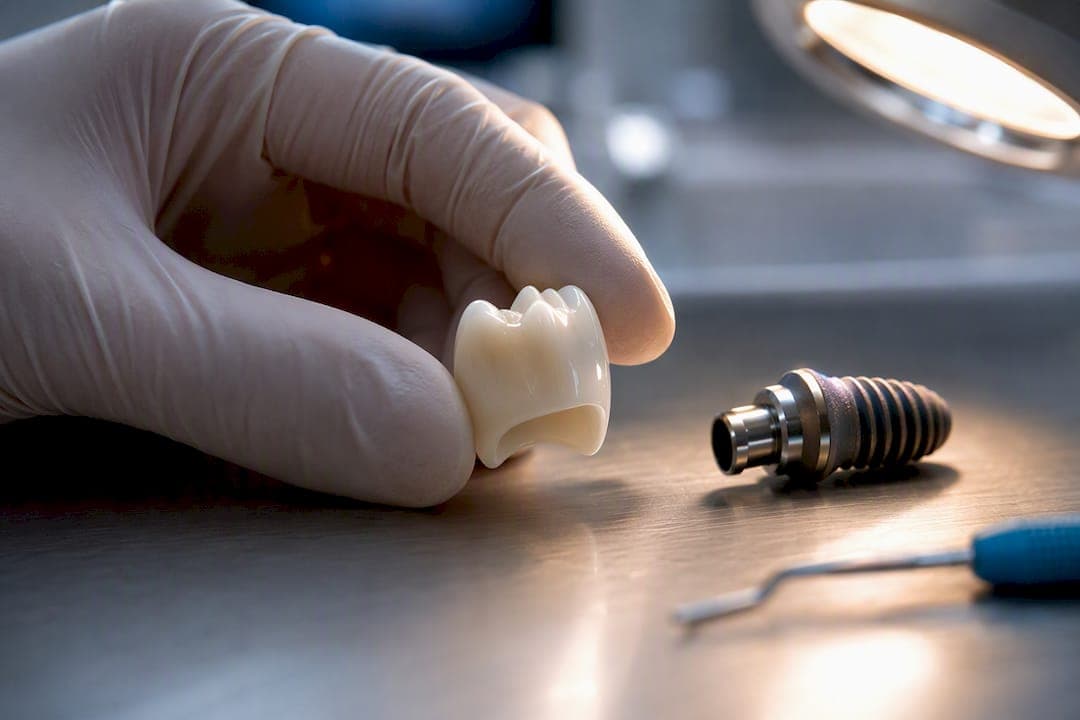
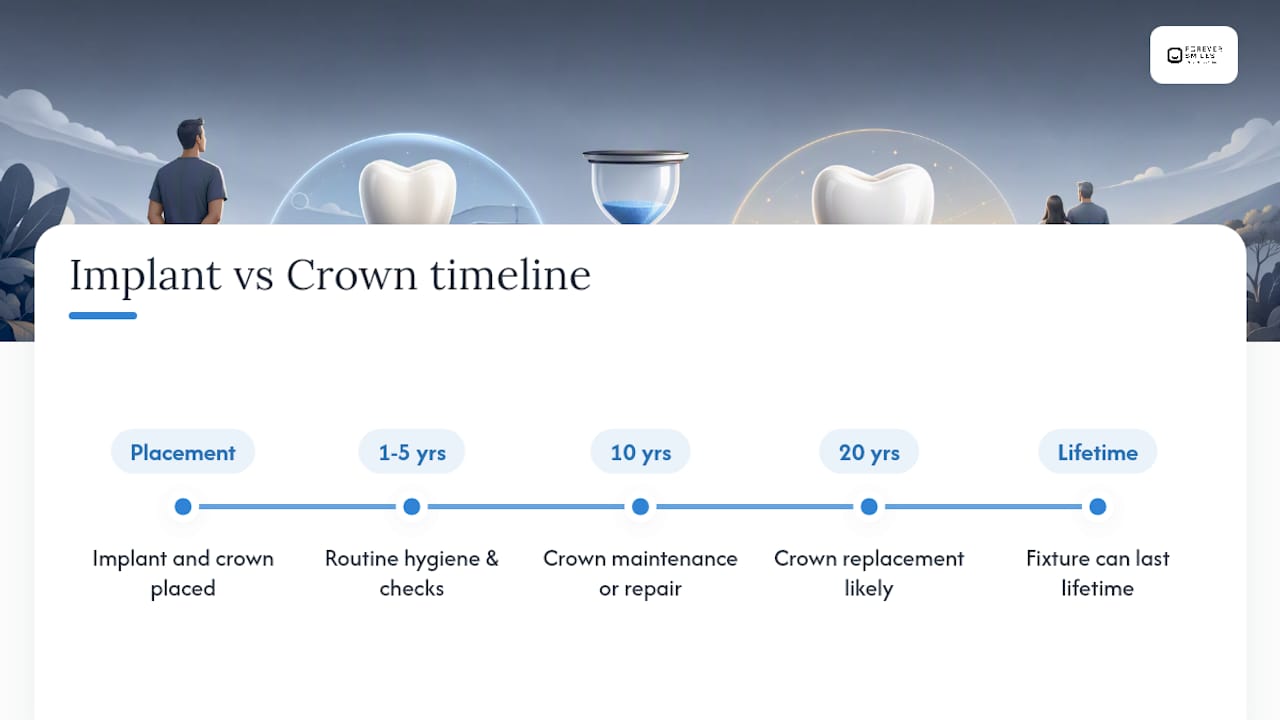
Dental implants are built to be permanent. The titanium fixture anchored in your jawbone commonly lasts decades, often for life, while the crown attached to it typically needs replacement every 10 to 20 years, according to Cleveland Clinic. Before any of that durability matters, the implant needs 3 to 9 months to fuse with your bone through a process called osseointegration.
TL;DR:
- The titanium implant fixture can last for decades or a lifetime with proper osseointegration, but crowns typically require replacement every 10 to 20 years.
- Long-term survival rates of implants range from 92% to 98.9% over 15 to 22 years, depending on study criteria and patient factors like smoking or diabetes.
- Crown failure usually occurs due to wear, chipping, or aesthetic issues, while biological problems like infection or bone loss cause implant failure.
- Factors such as peri-implantitis, smoking, grinding, and inadequate bone volume significantly reduce implant longevity, especially in complex cases.
- Proper maintenance, including regular cleaning, professional checkups, X-rays, and lifestyle management, is essential for maximizing implant lifespan beyond the typical 10-20 year restoration cycle.
Table of Contents
- How Long Do Dental Implants Really Last?
- What's Actually in Your Mouth: Parts and Types
- What Actually Shortens Implant Lifespan
- Why the Crown Usually Fails Before the Implant Does
- How to Make Your Implants Last Decades, Not Years
- What a High-Volume Surgical Practice Actually Watches For
- The Gap Between "Lifetime" Marketing and What the Research Shows
- Ready to Discuss Long-Term Options for Your Smile?
- Sources
- FAQ
How Long Do Dental Implants Really Last?
Lifespan depends on which part you're talking about. The implant fixture, the screw-shaped post placed in your jawbone, is the part designed to last indefinitely once it fuses with bone. The restoration, the crown, bridge, or denture attached on top, is a wear item that eventually needs redoing.
The data backs up that split pretty consistently:
- A large cohort study following 10,871 implants for up to 22 years found cumulative survival of 98.9% at 3 years, 96.8% at 10 years, and 94.0% at 15 years.
- A 20-year meta-analysis puts prospective-study survival around 92% at the two-decade mark, though that figure drops closer to 78% once researchers account for patients lost to follow-up.
- A single-implant follow-up spanning 38 to 40 years found implant survival near 95.6%, while the crowns on those same implants had been replaced far more often, with a survival rate of only about 60.9%.
That spread between 92% and 78% isn't a contradiction. It reflects how researchers handle patients who drop out of long-term studies, and it's a reminder that the "20 years" quoted in marketing materials and the "20 years" reported in peer-reviewed research aren't always measuring things the same way. Patient mix matters too. A study population skewed toward smokers or people with poorly controlled diabetes will report lower survival than one that isn't, independent of anything about the implant itself.
What's Actually in Your Mouth: Parts and Types
An implant is three separate pieces, and only one of them is meant to outlast you.
- Fixture: the titanium (or sometimes zirconia) post embedded in bone. This is the part with genuine decades-long survival data behind it.
- Abutment: the small connector piece linking the fixture to the visible tooth.
- Crown: the visible tooth, the part you'll almost certainly replace at least once.
Most of the long-term survival research, including the cohort and meta-analysis studies cited above, focuses on screw-shaped titanium implants with roughened surfaces, since that's the design dentistry has used most for the past few decades. Endosteal implants (placed directly into bone) dominate the evidence. Subperiosteal implants sit on top of the jawbone rather than in it and are reserved for patients with severe bone loss. Mini implants, thinner and less invasive, have far less long-term data behind them, so treat lifespan claims for that category with more caution.
What Actually Shortens Implant Lifespan
Some of these factors you control. Others require your surgeon to plan around them.
- Peri-implantitis, a gum infection around the implant, is the leading cause of late-stage failure and is strongly tied to inconsistent oral hygiene.
- Smoking and uncontrolled diabetes were both linked to significantly higher failure rates in the 10,871-implant cohort study.
- Bruxism (chronic teeth grinding) puts repeated mechanical stress on the fixture and crown alike, accelerating wear on both.
- Insufficient bone volume at placement, often requiring grafting first, raises surgical complexity and risk.
- Certain medications, including some osteoporosis drugs and immunosuppressants, can interfere with healing and integration.
Case complexity compounds all of this. Full-arch and multi-implant cases carry more cumulative risk than a single tooth replacement simply because there are more points where something can go wrong, which is why experienced, high-volume providers tend to report better long-term outcomes on complex cases.
Pro Tip: Bring a full medication list, including supplements, to your consult. Some blood pressure and osteoporosis medications affect bone healing in ways that change how your surgeon plans the case.
Why the Crown Usually Fails Before the Implant Does
The fixture and the crown age on completely different timelines, and that gap explains most of the confusion around implant "lifespan."
- Crowns wear down, chip, or start looking dated well before the underlying implant shows any biological problem. The 38 to 40 year follow-up study found crown survival around 60.9%, far below the 95.6% implant survival in the same patients.
- Implants fail for biological reasons, mainly infection or bone loss, not simple wear.
- Zirconia crowns tend to hold up better against chipping and wear than some other materials, which matters if you're weighing options at the restoration stage.
One caution worth flagging here: manufacturer "lifetime warranties" on implants typically cover the device itself, and that coverage runs between the manufacturer and your surgeon, not you. It rarely extends to surgical fees or the cost of redoing a crown, so don't treat a warranty label as a guarantee your out-of-pocket costs are covered.
How to Make Your Implants Last Decades, Not Years
Longevity is mostly a maintenance problem, not a luck problem.
- Brush and clean between implants daily. Use a soft brush plus interdental brushes or floss made for implants; plaque buildup around the fixture is what triggers peri-implantitis.
- Keep every professional cleaning appointment. Your dentist should be probing around the implant and checking gum health at each visit, not just polishing teeth.
- Get periodic X-rays. Radiographs catch bone loss around the fixture before it becomes symptomatic, and that early detection is what the long-term survival data depends on.
- Address lifestyle risk factors directly. Quitting smoking and keeping blood sugar controlled measurably improve the odds shown in the cohort data above.
- Wear a nightguard if you grind your teeth. An occlusal guard protects both the crown and the fixture from repetitive overload.
Contact your dentist promptly if you notice implant mobility, persistent pain, swelling, or drainage. None of those are normal, and none should wait until your next scheduled cleaning.
Pro Tip: Ask your provider to show you your baseline X-ray right after placement. Having that reference image makes it much easier for future dentists, or you, to spot bone changes early. A maintenance checklist built around this exact schedule can help you stay consistent.
What a High-Volume Surgical Practice Actually Watches For
Dr. Brian Young has placed more than 28,000 implants over a 20-plus year career, almost all of them full-arch cases, and that volume changes what stands out as a risk factor before surgery even happens. Planning with 3D imaging, having an in-house lab for the final zirconia teeth, and using a dedicated MD anesthesiologist for complex cases all reduce the number of variables that can go wrong later. If you're heading into a consult anywhere, these are the questions worth asking:
- How many full-arch or complex cases has the surgeon personally handled?
- What imaging is used to plan bone volume and implant placement?
- What's the plan if a complication or infection develops years later?
- What does the follow-up schedule look like after the first year?
Patients with significant bone loss should expect the conversation to include grafting or zygomatic implant options, plus a longer, staged treatment timeline. For deeper background on the process itself, osseointegration explains why that healing window matters so much.
The Gap Between "Lifetime" Marketing and What the Research Shows
The word "permanent" gets thrown around loosely in implant marketing, and it's not entirely wrong, but it's incomplete in a way that sets patients up for disappointment. The fixture really can last a lifetime. The research on that point is solid. What the marketing usually skips is that the crown on top of it is a maintenance item, not a one-time purchase, and pretending otherwise is where most patient frustration comes from years later.
The conventional advice, "brush twice a day and you'll be fine," undersells how much peri-implantitis and unmanaged risk factors like smoking or uncontrolled blood sugar drive failure in the data. Hygiene matters, but it's one piece of a longer commitment that includes radiographs, professional probing, and honest conversations about grinding habits or medications.
If I had to prioritize one thing for a patient weighing this decision, it's provider experience on complex cases, not the implant brand or the marketing claims. Full-arch and multi-implant cases carry more cumulative risk, and the research on that is clear that outcomes track with how much complexity a provider has actually managed. Ask about volume before you ask about warranties.
— Dr. Brian Young
Ready to Discuss Long-Term Options for Your Smile?
If you're missing most or all of your teeth, or you're unhappy with dentures that shift and click, the lifespan math above changes in your favor with full-arch, fixed solutions rather than removable ones. Some implant centers plan cases with 3D imaging, build zirconia teeth in their own labs, and use board-certified MD anesthesiologists for complex surgical days, consolidating care in one location rather than across multiple referrals.
Bring your recent dental records or panoramic X-ray to your consult, along with any medication list, so the surgical team can evaluate bone volume and complexity up front. If cost is on your mind, the cost and financing breakdown outlines what's typically included. To see what full-arch treatment actually involves, start with the full-mouth dental implants page and schedule a consultation when you're ready to talk specifics.
Sources
- Dental Implants: Types, Purpose & Benefits - Cleveland Clinic
- How far can we go? A 20-year meta-analysis of dental implant survival rates (Clinical Oral Investigations)
- Long term clinical performance of 10 871 dental implants with up to 22 years of follow-up: A cohort study
This article is general information, not a substitute for advice from a qualified doctor. Consult a qualified healthcare professional about your own circumstances before acting on anything here.
FAQ
What Is the Life Expectancy of a Dental Implant?
The titanium fixture often lasts decades and can function for life with good care, while the crown on top typically needs replacement within 10 to 20 years, per Cleveland Clinic.
What Happens After 25 Years With a Dental Implant?
Long-term follow-up studies show many implants remain functional past 20 years, though the crown has usually been replaced at least once or twice by that point, and periodic X-rays remain important to catch any late bone loss.
How Many Times Can a Dental Implant Be Replaced?
The implant fixture itself is meant to be placed once; it's the crown or restoration on top that gets replaced, sometimes more than once over several decades, as it wears, chips, or needs updating.
Do Dental Implants Wear Out Over Time?
The fixture doesn't wear out the way a tooth does. When implants fail, it's almost always biological, from infection like peri-implantitis or bone loss, rather than mechanical wear on the titanium post.
Does an Implant Warranty Cover Replacement Costs?
Usually not entirely. Manufacturer warranties typically cover the device between the maker and the surgeon, not surgical fees or the cost of redoing a crown, so ask your provider directly what's included.