
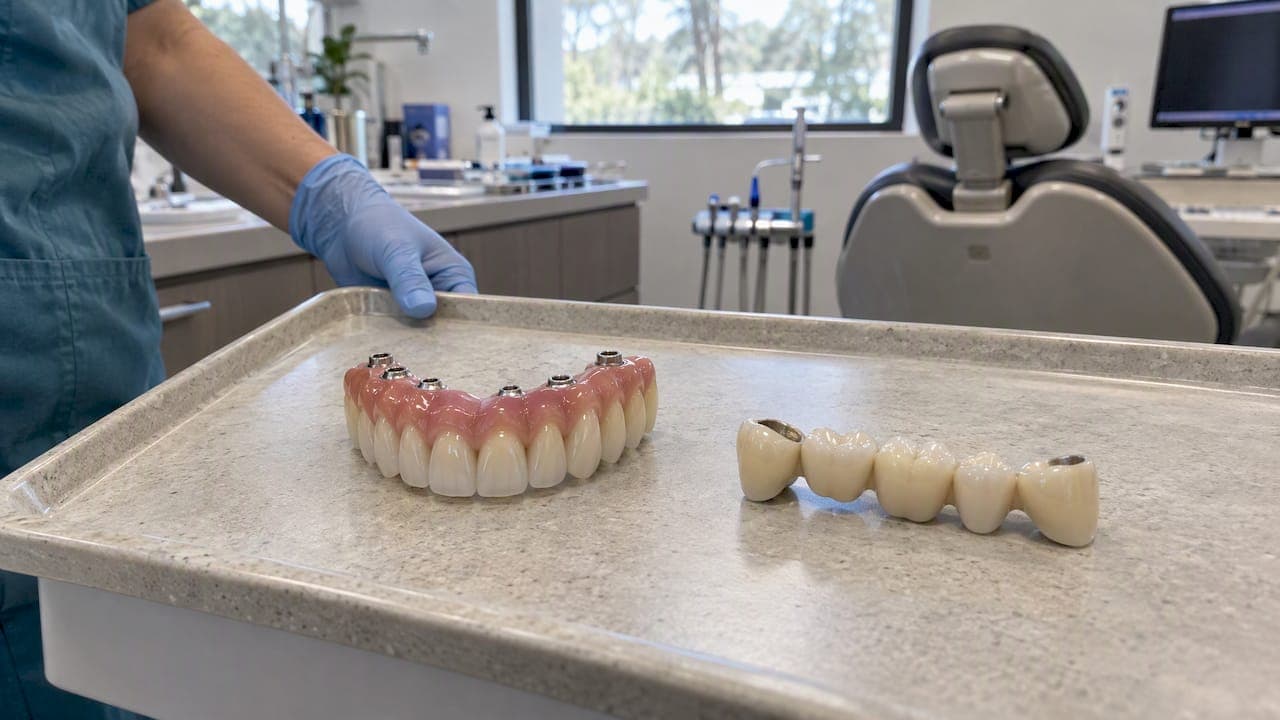
For adults missing most or all of their teeth who can pay out of pocket and want a permanent, fixed solution, full-arch implant reconstruction with All-on-4 or zygomatic implants typically outperforms full-arch bridges and dentures in function, durability, and satisfaction. The trade-offs are real: a higher upfront investment, a surgical procedure, and a lifelong maintenance routine, as explained in this dental implants vs dentures pros and cons guide. Even with severe bone loss, zygomatic implants can often keep a fixed-teeth solution on the table.
TL;DR:
- Full-arch implant solutions typically have a survival rate around 96% over several years, especially for zygomatic implants in cases of severe bone loss.
- Candidacy depends heavily on bone volume, health history, and oral hygiene, with smokers and uncontrolled diabetics facing higher risks of failure.
- The full-arch procedure involves digital planning, often allows same-day temporary teeth, and final zirconia prostheses are usually placed after several months.
- Regular maintenance, including daily cleaning and biannual professional recalls, is essential to prevent common issues like sinusitis or mechanical failures.
- Higher initial costs for implants are offset over time by their durability and ability to preserve jawbone, unlike bridges or dentures that often require more frequent replacements.
Table of Contents
- Dental implants vs bridges: comparing your full-arch options
- Am I a candidate for full-arch implants?
- What happens during the full-arch implant process
- Complications and the maintenance implants actually require
- Why surgical experience changes the outcome
- Your next step toward permanent, fixed teeth
- FAQ
- Sources
Dental implants vs bridges: comparing your full-arch options
A full-arch bridge or implant-retained denture works for some patients, but it rarely matches what a fixed implant prosthesis delivers in chewing force, stability, and day-to-day comfort. Bridges that rely on remaining natural teeth put extra load on those teeth and often require shaving down healthy enamel to serve as anchors, which is not a concern with implant-supported arches. Patients missing most or all of their teeth usually are not good bridge candidates anyway, since there is no healthy dentition left to anchor one.
The clinical evidence for full-arch implants is substantial. Systematic review data on immediate-loading full-arch protocols shows implant survival rates in the mid-90% range, with most failures occurring in the first year. For patients with severe upper jaw bone loss who would otherwise need extensive grafting, zygomatic implant reviews report a mean survival rate around 96.2% over roughly six years of follow-up.

Zygomatic implants show a high mean survival rate over a multi-year follow-up, a notable figure given that these patients often had no other fixed-teeth option due to bone volume.
Where the two paths really diverge:
- Candidacy: implants work for patients with adequate bone or who qualify for zygomatic placement; bridges need healthy anchor teeth that most full-arch candidates no longer have.
- Longevity: implant-supported prostheses are built to function for many years with proper care, while bridges and dentures typically need more frequent replacement or relining.
- Bone health: implants help preserve jawbone through ongoing stimulation; bridges and dentures do nothing to stop the bone loss that follows tooth loss.
- Upfront cost: implant reconstruction carries a higher initial price, while bridges and dentures cost less at the outset but often cost more over a lifetime of adjustments and replacements.
- Recovery: implants involve a surgical procedure and a healing period; bridges and dentures involve no surgery but years of fit issues as the jaw changes shape.
More on how implant-supported fixed bridges compare to traditional options, and why implants tend to pay off long-term despite the higher starting cost.
Am I a candidate for full-arch implants?
Candidacy comes down to health history, bone structure, and oral hygiene habits. FDA guidance on dental implants identifies smoking, uncontrolled diabetes, and poor oral hygiene as major risk factors for delayed healing, infection, and implant failure, so these get evaluated closely before any surgical plan moves forward.
Dental factors matter just as much. A hierarchy of restorative space needs to be measured before surgery: fixed hybrid screw-retained prostheses need meaningfully more vertical room than other designs, and skipping this step is a common cause of prosthetic problems later. Active infection needs to be resolved first, and overall bone volume determines whether standard implants, grafting, or zygomatic implants make the most sense.
- Review your medical history for smoking status, diabetes control, and any conditions affecting healing.
- Get a CBCT scan to measure available bone and restorative space in three dimensions.
- Treat active infection or disease before any implant planning proceeds.
- Discuss zygomatic implants if upper jaw bone loss is severe enough that grafting would otherwise be required.
- Bring prior dental records and imaging to your consult so the surgical team has a complete picture.
Pro Tip: Ask your surgical team whether your case calls for grafting or whether zygomatic implants could skip that extra step entirely.
What happens during the full-arch implant process
Full-arch reconstruction follows a fairly predictable sequence, though the details shift based on bone volume and which implant approach fits your case. Planning starts with 3D imaging that maps bone density, nerve position, and restorative space, which then guides a surgical plan built before anyone touches a drill.
All-on-4 uses a mix of straight and angled implants to maximize contact with available bone, often allowing a temporary fixed prosthesis the same day as surgery. For patients with significant upper jaw resorption, zygomatic implants anchor into the cheekbone instead of the deteriorated maxilla, often avoiding the extended healing time that major bone grafting requires.
- Digital planning and surgical guides reduce guesswork during placement.
- Same-day temporary teeth let most patients leave surgery with a functional, fixed arch.
- Final monolithic zirconia teeth are typically delivered after a healing period of several months, once the bone has integrated with the implants.
- An in-house lab and coordinated anesthesia care matter most in complex or previously failed cases, where timing and precision affect the outcome.
Monolithic zirconia prostheses show strong short-term clinical and aesthetic outcomes with low rates of technical complications in the available studies, though long-term, high-level evidence is still accumulating.
Complications and the maintenance implants actually require
Full-arch implants are durable, but they are not maintenance-free, and understanding the real complication picture helps set expectations. The most common issue with zygomatic implants is sinusitis, occur with notable frequency, according to systematic review data, while All-on-4 prostheses more commonly see mechanical issues like acrylic fracture in immediate provisional designs. FDA guidance again points to smoking, uncontrolled diabetes, and poor hygiene as the main drivers of complications across implant types.
The American College of Prosthodontists recommends in-office recalls every 2 to 6 months depending on individual risk, along with baseline radiographs and screw-retained designs where feasible.
- Daily cleaning around the prosthesis and gum line is non-negotiable for long-term success.
- Professional recall visits catch early issues before they become costly repairs.
- Minor prosthetic repairs are generally far less expensive than the repeated relines and replacements bridges and dentures tend to require over time.
A full maintenance checklist for implant-supported teeth lays out what a realistic care routine looks like.
Why surgical experience changes the outcome
After placing more than 28,000 implants over two decades, I've learned that the deciding factor in full-arch cases usually isn't the implant brand or even the prosthesis material. It's judgment: knowing when zygomatic implants solve a bone problem that grafting would only delay, and when staged grafting is still the more conservative, appropriate path. A single team handling planning, surgery, lab work, and anesthesia under one roof removes the handoffs where complex cases tend to go wrong.
— Dr. Brian Young
Your next step toward permanent, fixed teeth
At Forever Smiles Implant Center, we focus exclusively on full-arch reconstruction: All-on-4 zirconia, zygomatic implants for severe bone loss, and full-mouth zirconia implants, all planned and delivered by one surgical team with an in-house lab and an MD anesthesiologist on every complex case. Full-mouth treatment starts from $19,000 per arch, covering planning, surgery, temporary teeth the same day, final zirconia teeth, and follow-up care.
A consult starts with a CBCT scan, a review of your medical history, and a conversation about your goals, so we can tell you plainly whether you are a candidate and what your specific case involves. If you are missing most or all of your teeth and want a permanent, fixed outcome done once and done right, schedule a consultation with our team to see what full-arch reconstruction looks like for you.
This article is general information, not a substitute for advice from a qualified doctor. Consult a qualified healthcare professional about your own circumstances before acting on anything here.
FAQ
Are dental implants really better than bridges long-term?
For patients missing most or all of their teeth, implants generally outperform bridges because they preserve jawbone, do not rely on compromised natural teeth, and offer stronger long-term function. Traditional bridges can still work well for isolated gaps with healthy neighboring teeth, but that is a different clinical situation than full-arch reconstruction.
How long does recovery take after full-arch implant surgery?
Most patients leave surgery with a temporary fixed prosthesis the same day, and initial healing typically settles within a couple of weeks. Final zirconia teeth are usually placed after several months, once the implants have fully integrated with the bone.
What if I have severe bone loss in my upper jaw?
Zygomatic implants anchor into the cheekbone rather than the resorbed upper jaw, which can avoid the extended healing time that major bone grafting requires. Systematic review data shows these implants achieve strong long-term survival even in patients who were told elsewhere that grafting was their only option.
How much do full-arch dental implants cost?
At Forever Smiles Implant Center, full-mouth treatment starts from $19,000 per arch, which includes planning, surgery, same-day temporary teeth, final zirconia teeth, and follow-up care. Pricing varies by case complexity, including whether zygomatic implants or additional planning are needed.
Do implants need special maintenance compared to bridges or dentures?
Yes, implants require daily meticulous hygiene plus professional recall visits, generally every 2 to 6 months depending on individual risk. Bridges and dentures need their own upkeep too, but they typically face more frequent relines, adjustments, or full replacement over the years.