

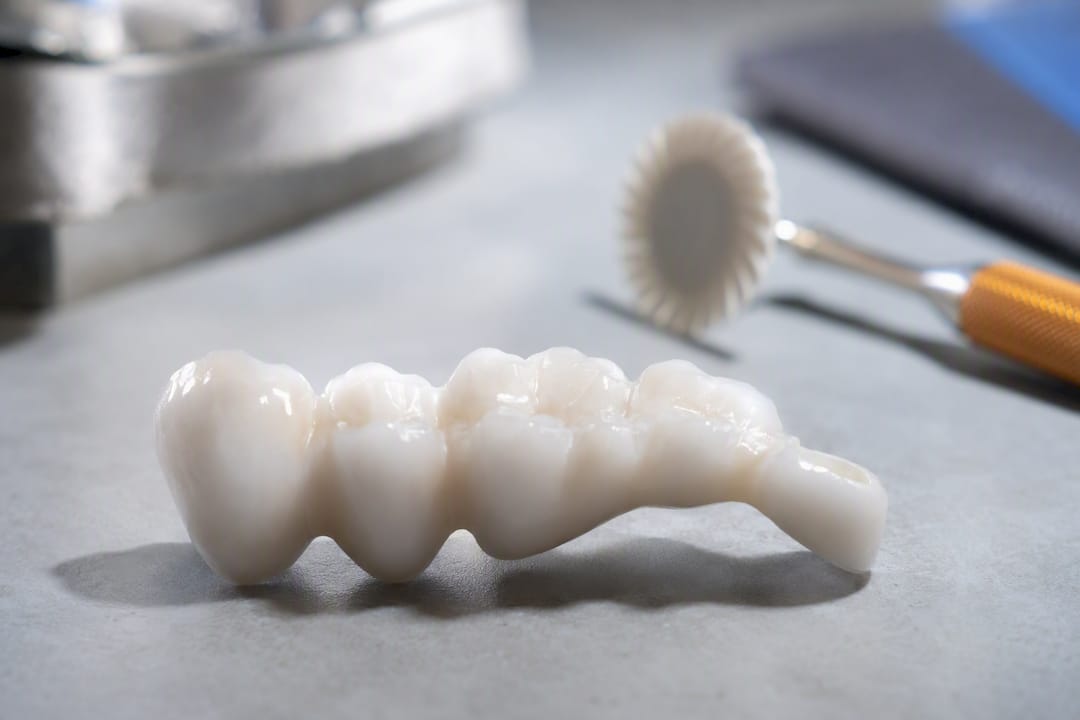
A fixed zirconia bridge is a durable, long-term option for permanent tooth replacement when prosthetic design and surgical planning are done correctly. It can be tooth-supported or implant-supported, and the difference matters more than the material itself. Published survival ranges run high over multi-year follow-ups, but only when the underlying framework, occlusion, and implant positions are engineered around the final teeth, not the other way around.
TL;DR:
- Monolithic zirconia offers higher long-term survival rates and fewer chipping incidents compared to porcelain-veneered zirconia, especially over multi-year periods.
- Implant position should be planned prosthetically based on the final tooth position, not simply the available bone, to maximize the bridge's longevity.
- Proper cementation, occlusal scheme, and passive fit verification are critical steps that significantly influence the success and durability of the restoration.
- Regular maintenance, including daily cleaning and semiannual checkups, can extend the lifespan of a zirconia bridge and prevent common technical issues.
- Costs and risks vary with case complexity, with full-arch cases often requiring advanced planning, zygomatic implants, and a collaborative, experienced clinical team.
Table of Contents
- Fixed Zirconia Bridge Basics: What It Is and How It's Built
- The Real Trade-Offs: Strength, Looks, and What Can Go Wrong
- From Consultation to Final Teeth: The Treatment Timeline
- How Long Does a Zirconia Bridge Last?
- The Design Decisions That Actually Determine Success
- What a High-Volume Full-Arch Specialist Looks For
- Deciding If a Zirconia Bridge Fits Your Priorities
- Getting a Zirconia Fixed Bridge Done Once, Correctly
- Sources
- FAQ
Fixed Zirconia Bridge Basics: What It Is and How It's Built
A fixed zirconia bridge is a non-removable dental prosthesis milled from zirconium dioxide, a ceramic prized for its strength and biocompatibility. Labs design and mill it using CAD/CAM technology then either leave it as a single solid block (monolithic) or layer porcelain over a zirconia framework for a softer, more translucent look (porcelain-veneered).
The clinical form depends on what the patient is missing and what's supporting the bridge:
- Tooth-supported fixed dental prosthesis: anchored to adjacent natural teeth, the traditional bridge model
- Resin-bonded fixed partial denture (RBFDP): a minimally invasive option for a single missing anterior tooth, bonded with minimal tooth reduction
- Implant-supported partial bridge: replaces several teeth anchored to two or more implants
- Zirconia full arch bridge: replaces an entire upper or lower arch, typically supported by four to six implants
Monolithic zirconia dominates full-arch cases today because it holds up better under bite force. Veneered zirconia still has a place where esthetics in the smile zone outweigh the slightly higher mechanical risk.
The Real Trade-Offs: Strength, Looks, and What Can Go Wrong
Monolithic zirconia's biggest advantage is durability under load. It doesn't chip the way porcelain-veneered zirconia does, because there's no separate veneering layer to fracture off.
The numbers back this up. A systematic review comparing the two designs found monolithic zirconia carried a 5-year survival rate higher than that of porcelain-veneered zirconia, with significantly fewer chipping incidents in the monolithic group.
That strength advantage isn't free of trade-offs, though:
- Early monolithic zirconia looked flat and opaque; modern multi-layered discs blend shade gradients that narrow the esthetic gap considerably
- Zirconia is harder than natural enamel, so it can accelerate wear on opposing natural teeth if occlusion isn't managed carefully
- Mandibular flexure and poor connector design can concentrate stress and crack a full-arch framework over time
- Cementation errors on tooth-supported bridges are a common source of decay underneath the restoration
Material choice sets the ceiling on performance. Design and cementation decide whether the bridge ever reaches it.
— Dr. Brian Young
From Consultation to Final Teeth: The Treatment Timeline
Every well-planned zirconia dental bridge case follows a similar sequence, whether it's a single-tooth replacement or a full-arch reconstruction.
- Diagnostic workup: CBCT imaging, bite records, and a digital smile design establish where the final teeth need to sit.
- Prosthetically driven planning: implant positions (for implant-supported cases) or tooth preparation design (for tooth-supported cases) are mapped backward from that final tooth position, not forward from available bone.
- Surgery or preparation: implants are placed, or natural teeth are prepared, depending on the case type.
- Temporary phase: many full-arch patients receive a provisional set of teeth the same day surgery is completed; tooth-supported cases usually wear a temporary bridge for a few weeks.
- Final delivery: after healing (often three to six months for implants), the lab fabricates and delivers the definitive zirconia bridge.
Cost scales with complexity: implant count, whether bone grafting or zygomatic implants are needed, arch-wide versus single-span cases, and the lab's fabrication workflow all move the price. A structured guide to the implant process walks through what each phase involves for patients coming from dentures.
How Long Does a Zirconia Bridge Last?
Published survival data for implant-supported zirconia bridges clusters in a wide but generally favorable range.
Survival snapshot: Systematic reviews report survival rates broadly between 88% and 100% across follow-ups spanning 3 to 13 years, with monolithic zirconia consistently outperforming veneered zirconia on chipping-related failures.
Survival and "complication-free" are not the same thing. A bridge can survive in the mouth for over a decade while still needing a screw retightened, a minor chip polished, or a hygiene adjustment along the way. One long-term cohort found implant survival near 97.6%, yet prosthesis survival (meaning zero technical issues) dropped to 82.35% over 5 to 13 years, largely driven by mandibular framework fractures and peri-implantitis.
What actually extends bridge life:
- Daily flossing under the bridge with a floss threader or water flosser, plus a soft-bristle brush at the gumline
- Recall visits every 4 to 6 months for professional cleaning and occlusion checks
- Prompt reporting of any looseness, clicking, or sharp edge, which usually signals a screw or cement issue rather than the zirconia itself
A maintenance checklist built for implant-supported teeth covers the daily routine in more detail.
The Design Decisions That Actually Determine Success
The strongest material on the market will still fail in a poorly designed mouth. Implant position has to follow the planned tooth position, not the bone that happens to be available. That's the core principle behind prosthetically driven planning, and it's the single biggest factor separating a bridge that lasts fifteen years from one that fractures in two.
A few technical variables carry outsized weight:
- Occlusal scheme: finite-element studies show group-function occlusion generates more stress at the framework than canine-guided occlusion, making connector geometry a real engineering decision, not an afterthought.
- Passivity of fit: any residual tension between the framework and the implants creates chronic micro-stress that eventually cracks zirconia or loosens screws.
- Implant distribution and hybrid bases: titanium bases or zirconia-titanium hybrid substructures absorb stress that pure zirconia can't flex to accommodate, particularly in the lower jaw where mandibular flexure is a known risk.
Verification tools like photogrammetry and physical verification jigs confirm passive fit before the final bridge is ever seated.
Pro Tip: Ask your surgical team three questions before you commit to treatment: How do you verify passive fit before final delivery? What's your plan if I'm a mandibular case with higher fracture risk? And will implant positions be planned from my final smile design, or from wherever bone happens to be available?
What a High-Volume Full-Arch Specialist Looks For
Treating complex bone loss, failed prior implants, and zygomatic cases every day changes how a team approaches a zirconia dental bridge. A high-volume full-arch implant center builds its process around the prosthetically driven principle: plan the final teeth first, then build backward to implant position and surgical approach.
That model shows up in a few concrete ways:
- A dental lab that controls the zirconia fabrication workflow start to finish, rather than outsourcing to a third party
- An MD anesthesiologist on complex cases, which matters for patients needing extensive bone grafting or advanced implants
- Daily case volume focused specifically on full-arch reconstruction and previously failed implant revisions, including patients told elsewhere they weren't candidates
Experience isn't expensive. Inexperience is.
For patients with minimal remaining bone, zygomatic implants anchor into the cheekbone instead of the jaw, opening up full-arch fixed zirconia bridge options for cases that would otherwise require extensive grafting first.
Deciding If a Zirconia Bridge Fits Your Priorities
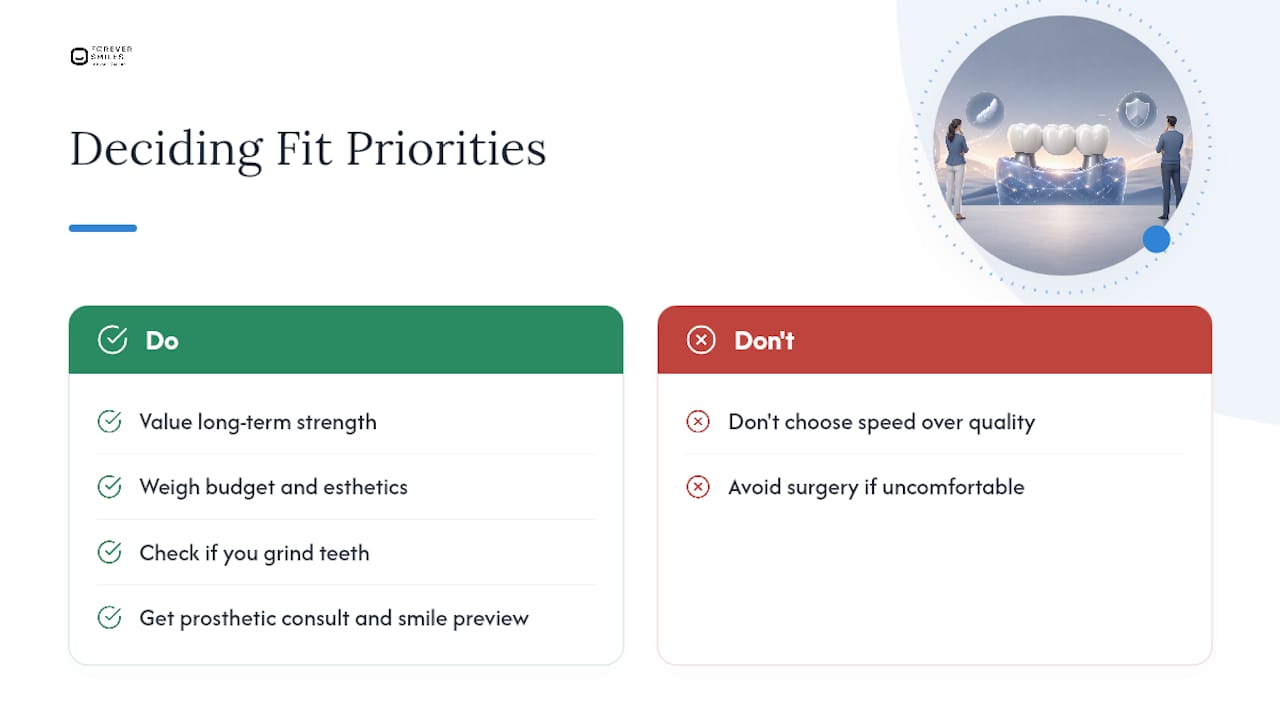
Zirconia makes the most sense for patients who value long-term strength and are prepared for a surgical or restorative process done right, not fast. Weigh your budget, esthetic priorities, whether you grind your teeth, and your comfort with implant surgery against the alternatives. The next real step is a prosthetically driven consultation and a visualization of your final smile before anyone touches a drill.
Getting a Zirconia Fixed Bridge Done Once, Correctly
Certain specialized implant centers exist for cases where implant positions are planned around the final smile, not just available bone. Having a lab and surgery under the same roof allows the surgical team and lab technicians to work from one plan instead of passing files between separate offices.

A consultation starts with 3D imaging and a review of your dental and medical history. Bring a list of prior dental work, any implant history if you've had failed implants elsewhere, and questions about your specific bone situation. The team will evaluate whether you're a candidate for a standard full-arch approach or need advanced options like zygomatic implants, and walk you through what full-mouth dental implant treatment looks like for your case, including the timeline for temporary and final teeth. If you're ready to see whether your case qualifies for treatment the same day as surgery, schedule a consultation to get a prosthetically driven plan built specifically around your bite and your bone.
Sources
The survival and complication figures in this guide come from peer-reviewed systematic reviews and cohort studies, including comparisons of monolithic versus porcelain-veneered zirconia, long-term implant-supported cross-arch outcome data, and technique reviews on full-arch prosthetic design. For workflow context on collaborative clinical production, see this practice management resource.
This article is general information, not a substitute for advice from a qualified doctor. Consult a qualified healthcare professional about your own circumstances before acting on anything here.
- Can monolithic zirconia frameworks in implant-supported cross-arch prostheses deliver reliable long-term outcomes? | Evidence-Based Dentistry
- Fixed full-arch implant-supported restorations: techniques review and proposal for improvement — PMC
FAQ
Is a Fixed Zirconia Bridge a Good Option?
Yes, for most patients missing one or more teeth who want a strong, permanent restoration, provided the framework and occlusion are planned around the final tooth position rather than around available bone.
How Long Does a Zirconia Fixed Bridge Last?
Survival ranges reported in the literature run roughly 88% to 100% across follow-up periods of 3 to 13 years, with monolithic zirconia outperforming veneered zirconia on chipping-related failure.
How Much Does a Fixed Zirconia Bridge Cost?
Cost varies widely based on implant count, arch complexity, and whether bone grafting or zygomatic implants are needed; full-mouth implant reconstruction at specialized centers varies widely by case complexity and services included, covering planning, surgery, temporary teeth, and the final zirconia restoration.
What Are the Downsides of a Zirconia Bridge?
The main risks are opposing-tooth wear from zirconia's hardness, framework fracture from poor connector design or mandibular flexure, and chipping in porcelain-veneered versions, though monolithic zirconia largely avoids that last issue.
What's the Difference Between Monolithic and Veneered Zirconia?
Monolithic zirconia is milled as a single solid block with no separate porcelain layer, making it more chip-resistant, while porcelain-veneered zirconia layers porcelain over a zirconia core for improved esthetics at some cost to durability.