
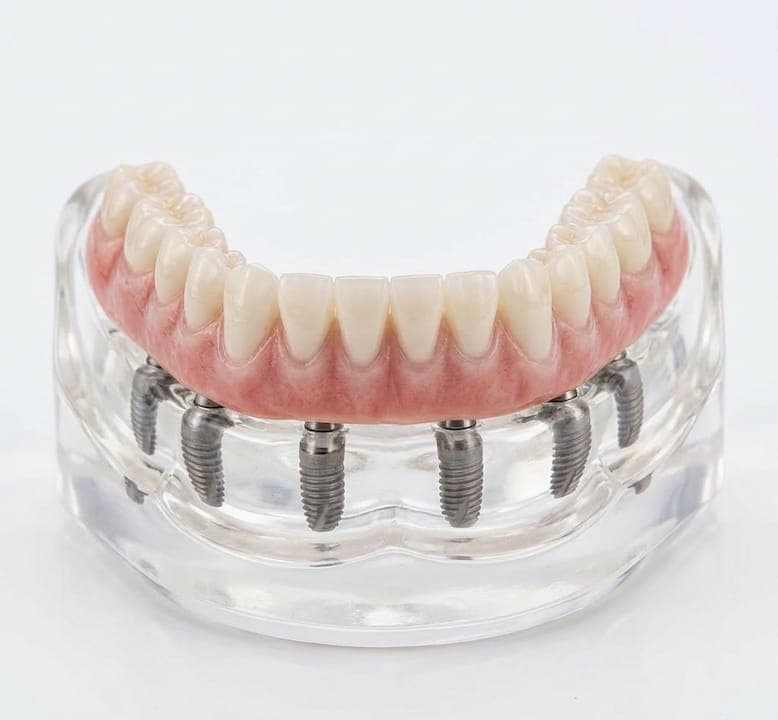

Yes: when done correctly, an in-house dental lab paired with a digital workflow typically delivers faster turnarounds, tighter fit, and more predictable customization for implant restorations. Systematic reviews show digital workflows achieve implant survival above 98%, matching conventional methods while cutting clinical chair time. Surgeons who run high-volume full-arch practices, including Dr. Brian Young of Forever Smiles Implant Center, rely on this model daily for exactly that reason.
TL;DR:
- In-house labs with digital workflows can reduce fabrication times by around 4.28 minutes per case, especially benefiting full-arch and full-mouth restorations.
- Using photogrammetry alongside intraoral scanning and CBCT improves accuracy across long spans, minimizing passive misfit of implant frameworks.
- Clinics that own and operate their own lab can streamline adjustments and quality control by enabling real-time communication and case ownership.
- For complex cases like full-arch implants, in-house labs are most valuable, but they may offer limited benefits for single-tooth restorations.
- Verifying a clinic's use of certified technicians, specific digital tools, and clear turnaround times helps distinguish genuine in-house capabilities from marketing claims.
- ✓Surgical planning and 3D imaging
- ✓In-house dental lab
- ✓Board-certified MD anesthesiologist
- ✓Final custom zirconia teeth
Table of Contents
- What is an in-house dental lab and how does it differ from outsourcing?
- Key technologies and the in-house digital workflow
- What to expect for visits, temporary teeth, and final zirconia
- What the clinical evidence says about survival, precision, and time efficiency
- How an expert surgical center makes in-house labs work
- How to evaluate a clinic that offers in-house dental lab implants
- When an in-house lab is worth prioritizing
- Why Forever Smiles Implant Center is an option for patients seeking in-house lab implant care
- Sources
- FAQ
What is an in-house dental lab and how does it differ from outsourcing?
An in-house dental lab is a fabrication facility owned and staffed by the same clinic that performs the surgery, with technicians working alongside the surgical and restorative team rather than at a separate company. An outsourced lab, by contrast, receives digital files or physical impressions, builds the restoration off-site, and ships it back, often with days or weeks between each round of communication.
That structural difference changes who own the outcome. When the technician sits down the hall from the surgeon, a fit problem gets solved in an afternoon instead of a mailed remake cycle.
- Communication: adjustments happen in real time between surgeon and technician instead of through notes and photos.
- Control: the clinic sets its own quality standards rather than depending on a third party's schedule.
- Case ownership: one team is accountable for the entire result, from planning to the final restoration.
Full-arch and full-mouth cases, where a millimeter of misfit can cause chronic soreness, tend to benefit the most from this arrangement.
Key technologies and the in-house digital workflow
A digital implant workflow generally runs through three phases, each requiring specific tools to hand off clean data to the next stage.
- Data acquisition: an intraoral scanner (IOS) captures the arch, cone-beam computed tomography (CBCT) maps bone and implant positions, and photogrammetry adds precision for multi-implant cases where scanner distortion becomes a problem across a full arch.
- Design: software such as Exocad turns that data into a virtual restoration, letting the technician and surgeon review emergence profile and occlusion before anything is built.
- Manufacturing and delivery: milling machines shape titanium frameworks and zirconia, sintering ovens harden the ceramic, and 3D printers produce provisional or try-in pieces quickly.
Photogrammetry matters specifically for full-arch cases because standard scanners can drift slightly across a long span of missing teeth. That drift translates into a framework that does not sit flush on the implants, a problem known as passive misfit. Connected software that shares data between the scanner, the design program, and the mill closes that gap by keeping every stage working from the same coordinate set, described in technique reviews of full-arch protocols.
Pro Tip: Ask whether your clinic uses photogrammetry for full-arch cases specifically, since standard intraoral scanning alone can lose accuracy across longer spans.

What to expect for visits, temporary teeth, and final zirconia
A typical full-arch timeline starts with a scanning and imaging visit, moves to surgery with an immediate provisional, and finishes with a final zirconia restoration once the site has healed.
- Consultation and imaging: CBCT and intraoral scans map the jaw and plan implant placement in advance.
- Surgery day: implants are placed, and many patients leave with a fixed temporary set the same day.
- Healing period: the jawbone integrates with the implants over several months, depending on bone quality and case complexity.
- Final restoration: once healing is confirmed, the in-house lab mills and delivers the permanent zirconia teeth.
"Same-day teeth" refers to the temporary provisional, not the final restoration. That distinction matters because complex cases involving significant bone loss or previously failed implants often need extra healing time before the permanent zirconia is fitted.
What the clinical evidence says about survival, precision, and time efficiency
The research on digital implant workflows is more mature than most marketing claims suggest, though it still has gaps. A systematic review and meta-analysis published in 2026 found that fully digital workflows significantly reduce fabrication time compared with conventional methods, while showing comparable accuracy and implant survival for implant-supported restorations.
Digital workflows reduced mean procedure time by approximately 4.28 minutes per case in pooled meta-analysis data, while implant survival remained comparable between digital and conventional methods at over 98%. (source) That time saving compounds across multi-visit treatment plans and reduces the number of adjustment appointments patients need.
The evidence has real limits. Fewer randomized controlled trials exist for multi-unit and full-arch restorations specifically, and a related systematic review of complete digital workflows noted that high-quality trial data for these more complex cases is still limited even as single-unit evidence has grown stronger. Patient-reported outcomes, including comfort and satisfaction, tend to favor digital methods, but reviewers caution that device technology is evolving faster than the trial data can track it.

How an expert surgical center makes in-house labs work
Coordination is where an in-house lab earns its keep. When surgical planning, lab design, and anesthesia scheduling happen under one roof, a misaligned implant angle or a bite discrepancy gets caught and corrected before it becomes a remake.
- Technicians refine emergence profile directly from surgical notes instead of guessing from a photo.
- PMMA try-ins let the surgeon validate fit and aesthetics chairside before the final zirconia is milled.
- In-room validation catches occlusion issues the same day surgery happens, not weeks later.
The lead surgeon at the implant center has placed thousands of implants over more than 20 years and performs full-arch surgery daily. He trains other surgeons nationally and sits on the editorial board of Implant Practice US.
Experience isn't expensive. Inexperience is.
— Dr. Brian Young
An in-house lab is not always the right investment. A general practice placing a handful of single implants a year may find outsourcing to a specialized partner more practical than building lab capacity it will rarely use at full capacity.
How to evaluate a clinic that offers in-house dental lab implants
Marketing language around "in-house" labs varies widely, so a short checklist helps separate substance from claims.
- Ask for sample cases: request before-and-after photos of full-arch or full-mouth cases similar to yours.
- Verify technician credentials: ask who designs and mills the restorations and what training they hold.
- Confirm the digital workflow: ask specifically whether the clinic uses intraoral scanning and CBCT, not just one or the other.
- Ask about turnaround: get a specific timeframe from surgery to final zirconia delivery, not a vague estimate.
- Clarify materials: confirm whether the final restoration is monolithic zirconia, a milled titanium framework, or both.
- Review the remake policy: ask what happens if the fit or aesthetics need adjustment after delivery.
Pro Tip: When reviewing before-and-after photos, ask whether the same technician who designed the case also handled the final fitting, since continuity between design and delivery often predicts fewer remakes.
Red flags include vague answers about who staffs the lab, reluctance to share technician credentials, or turnaround estimates that shift significantly during the conversation.
When an in-house lab is worth prioritizing
An in-house lab matters most for full-arch candidates, patients who need high aesthetic control, or anyone hoping to minimize the number of office visits. For a single missing tooth, the difference between in-house and outsourced fabrication is often negligible.
The trade-off is real: building lab capacity requires capital and a learning curve that only pays off at higher case volume. A clinic's marketing claim of "in-house" means little without asking how many complex cases that team has actually completed. Team experience and documented outcomes matter more than the label itself.
Why Forever Smiles Implant Center is an option for patients seeking in-house lab implant care
This implant center was built around this model with surgical planning, an in-house lab for design and fabrication, and anesthesia management all coordinated by one team in one location.
- Full-mouth treatment starts from $19,000 per arch, covering planning, surgery, same-day teeth, final zirconia, and follow-up care.
- The center specializes in complex cases, including zygomatic implants for patients with severe bone loss and previously failed implants.
- Details on treatment scope and candidacy are outlined on the permanent full-mouth implants page.
If you have been told elsewhere that you are not a candidate, request a consultation through the cost and financing page to review your options with the surgical team directly.
Sources
- Systematic review/meta-analysis on digital workflows and implant survival
- Clinical effectiveness and accuracy of fully digital workflows vs conventional methods: systematic review and meta-analysis (2026)
FAQ
What is the newest technology in dental implants?
Photogrammetry combined with intraoral scanning and CBCT imaging represents the newest widely adopted technology, improving accuracy for full-arch implant cases where standard scanning alone can drift. These tools work together in connected digital workflows to speed up design and reduce fitting errors.
Is it worth getting dental implants at 70 years old?
Age alone does not disqualify someone from full-arch implants. Candidacy depends on bone quality, overall health, and healing capacity, which is why a surgical consultation with 3D imaging matters more than age when evaluating suitability.
Does Affordable Dentures have an in-house lab?
That detail is not publicly listed here, and readers should confirm lab ownership and technician credentials directly with any specific provider they are researching. Asking whether a clinic's lab is staffed by its own technicians is one of the most reliable ways to evaluate this claim.
How long does the in-house lab process take for full-arch implants?
Timelines vary by case complexity, but digital workflows have been shown to reduce fabrication time by an average of 4.28 minutes per procedure in pooled meta-analysis data, with cumulative savings across multi-step treatment plans. Same-day provisional teeth are common, while final zirconia restorations typically follow a healing period of several months.
What materials are used for in-house implant restorations?
Monolithic zirconia and milled titanium frameworks are the most common materials for permanent full-arch restorations. Reviews of monolithic zirconia show high short-term success and low technical complication rates for full-arch reconstructions.