
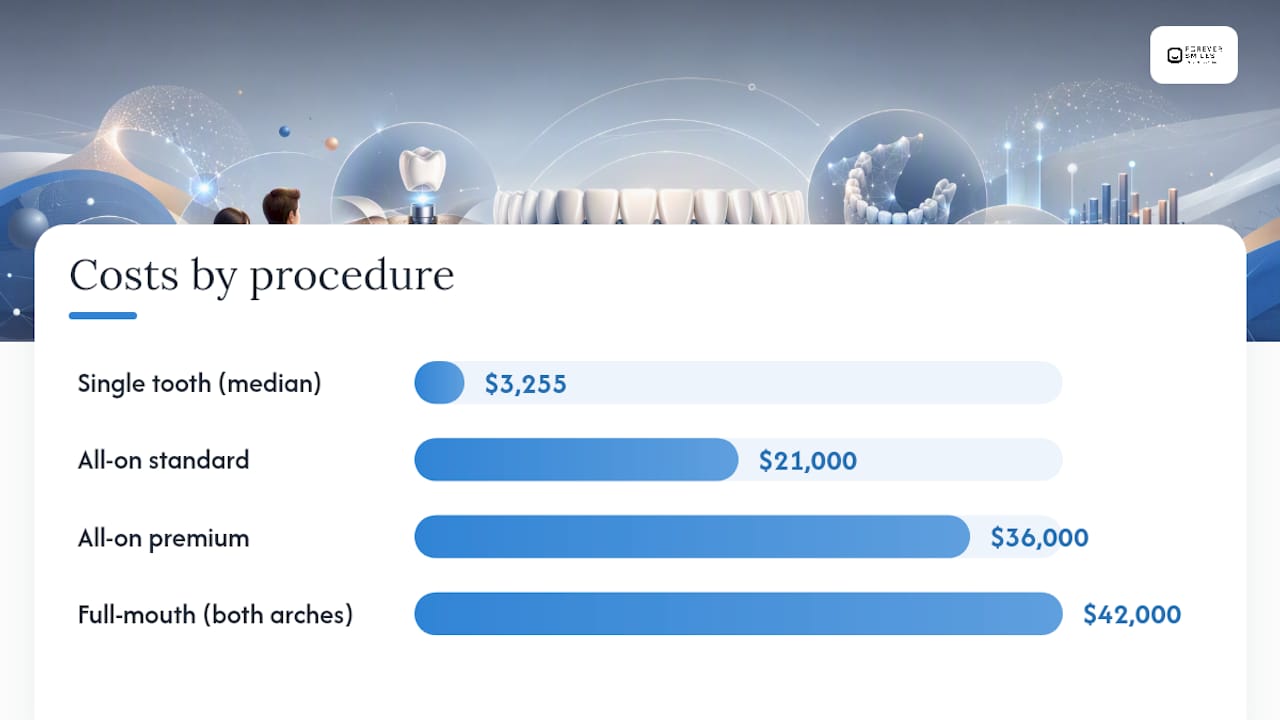
Single-tooth immediate-load implants typically run $2,506 to $5,953, with a national median around $3,255. Full-arch All-on-4 or All-on-6 treatment usually lands between $14,000 and $28,000 per arch, sometimes higher. The teeth you walk out with same-day are almost always temporary. The final zirconia set comes later, often at extra cost, so read the line-item breakdown below before you sign anything.
TL;DR:
Quotes for full-arch “teeth in a day” procedures can range from $14,000 to over $36,000 per arch, depending on complexity and included services.
Line items like bone grafting, sedation upgrades, and final zirconia prostheses often add significant costs beyond initial estimates.
A practice with high case volume, in-house lab, and experienced surgeon typically offers more reliable outcomes and comprehensive pricing.
Insurance rarely covers implant procedures fully, so most patients rely on financing options like medical credit cards or in-office payment plans.
Carefully compare detailed, itemized quotes instead of just headline prices to avoid unexpected charges and ensure all necessary steps are included.
Table of Contents
What “Teeth in a Day” Actually Means
“Teeth in a day” refers to immediate-load implants: your surgeon places the implant posts and attaches a temporary set of teeth in the same visit, instead of sending you home with a gap for months while the bone heals. That temporary set, usually made from PMMA acrylic, holds you over during recovery. The final restoration, typically a custom zirconia bridge, gets placed later, once the implants have fully fused to the bone.
Full-arch cases use the All-on-4 or All-on-6 technique, which anchors an entire arch of replacement teeth on four or six strategically placed implants instead of one implant per missing tooth. That’s why full-arch quotes are priced per arch rather than per tooth. A patient missing all upper teeth gets one price for that arch, not fourteen separate implant charges.
Some practices call staged, multi-visit implant plans “teeth in a day” if the patient leaves with any temporary teeth that day, even if those are basic removable dentures rather than implant-supported temporaries. True immediate-load treatment means temporary teeth are securely attached to implants placed the same day, not just resting in the mouth. Make sure to confirm if your temporaries are implant-retained.
How Much Do Teeth in a Day Cost on Average?
Single-tooth immediate-load implants carry a public benchmark median of $3,255, with a typical range of $2,506 to $5,953 depending on your state and the specific clinic. That figure usually covers the implant post and its immediate-load abutment, but not always the imaging, sedation, or temporary crown that go with it.
Full-arch pricing moves in a much wider band because it involves more implants, more surgical time, and more lab work per arch:
-
Standard All-on-4/All-on-6 (per arch): commonly $14,000 to $28,000, covering implant placement, temporary teeth, and basic follow-up
-
Premium or complex cases (per arch): can climb toward $36,000 when the case needs extra bone grafting, sinus lifts, or a higher-grade final prosthesis
-
Full-mouth, both arches: essentially doubles the per-arch figure, though some clinics offer a modest discount for treating upper and lower simultaneously
Why such a wide spread for what sounds like the same procedure? It almost always comes down to what’s bundled in versus billed separately. A quote that looks cheap on paper might exclude the CBCT scan, the sedation fee, and the final zirconia prosthesis entirely, leaving you to discover those charges one appointment at a time. A quote that looks expensive might already include every one of those steps plus a year of follow-up visits.
Geography plays a role too. Clinics in major metro areas with higher overhead and specialist surgeons on staff tend to sit at the higher end of these ranges, while general dentists offering implants as a side service in lower cost-of-living regions sometimes advertise the lowest numbers. Lowest advertised price and lowest total cost are not the same thing once every add-on gets tallied.
What’s Included in Your Quote (And What Usually Isn’t)
An implant quote is really a stack of separate line items, and the headline number you see in an ad rarely covers all of them. Here’s what typically shows up on a full breakdown:
-
Implant post: the titanium screw that fuses to your jawbone
-
Abutment: the connector piece linking the implant to your visible tooth
-
Temporary prosthesis: your same-day teeth, usually acrylic
-
Final zirconia prosthesis: the permanent, custom-milled replacement placed months later
-
CBCT imaging: the 3D scan used to plan implant placement precisely
-
Surgical guide: a custom template that directs exact implant positioning during surgery
-
Anesthesia or sedation: ranges from local numbing to full IV sedation with an anesthesiologist
-
Bone grafting: additional material and healing time if your jawbone needs reinforcement
-
Extractions: removing failing or infected teeth before implant placement
-
Lab fees: fabrication costs for both temporary and final prosthetics
-
Follow-up visits: adjustments, checkups, and monitoring during healing
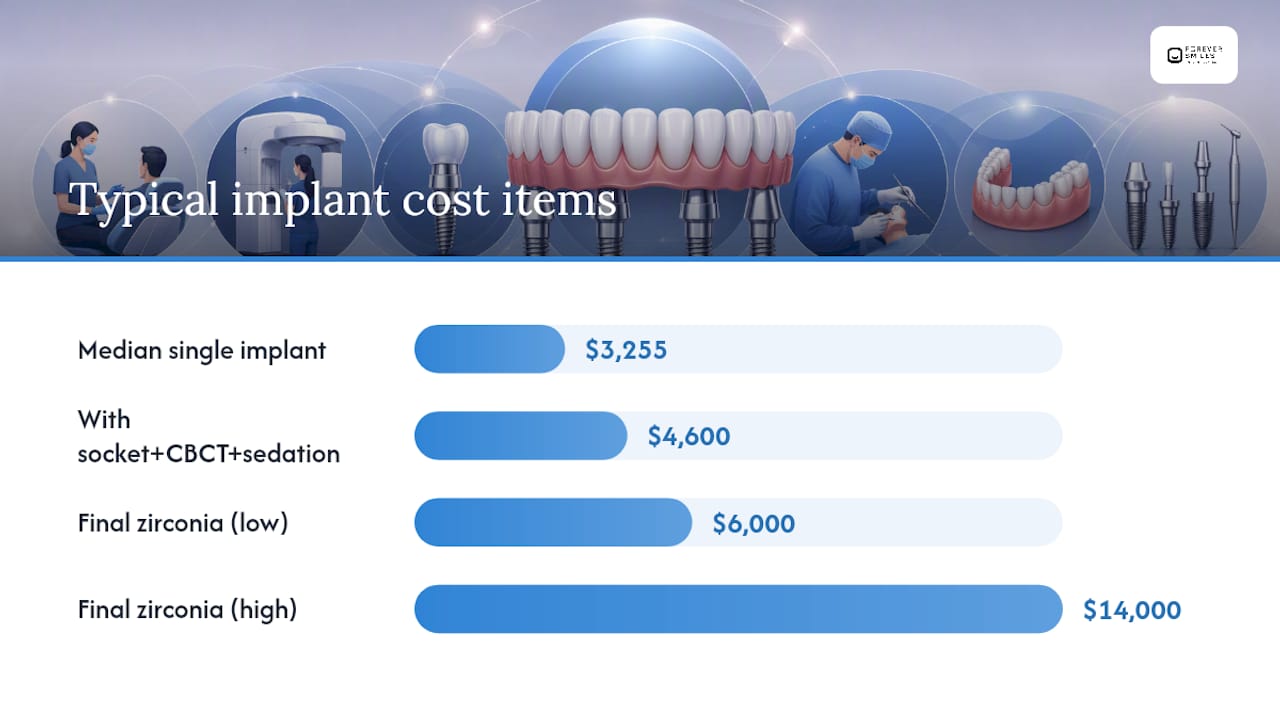
A worked example makes this concrete. Start with the $3,255 median for a single immediate-load implant. Add a socket graft to preserve bone at the extraction site, a CBCT scan for surgical planning, and moderate sedation, and that same case commonly lands closer to $4,600 once every line item is tallied.
Pro Tip: Ask specifically whether the quote includes your final zirconia prosthesis or only the temporary set. On full-arch cases, final zirconia restorations commonly add $6,000 to $14,000 per arch beyond the surgical fee. That single question separates a complete price from a partial one.
Bone grafting, sedation upgrades, and lab material changes are the three items most likely to turn a quoted number into a surprise invoice. None of them are optional add-ons a clinic invents to pad a bill. They’re often clinically necessary. The problem is when they’re left off the initial estimate.
What Makes One Quote Higher Than Another?
Clinical complexity drives cost more than almost anything else. A patient with healthy bone and no active infection is a straightforward case. A patient who needs several extractions first, has active gum disease, or has lost enough bone to require a sinus lift or grafting will pay more, because each of those steps adds surgical time, materials, and healing complexity.
Material choice matters just as much. A temporary PMMA acrylic prosthesis costs a fraction of a final zirconia bridge, because zirconia requires digital design, milling, and lab time that acrylic simply doesn’t need. That price gap is normal, not a sign you’re being overcharged.
Provider factors shift pricing too:
-
Surgeon specialization: a residency-trained surgical specialist who places implants daily typically charges more than a general dentist doing implants occasionally, but often with meaningfully lower complication and remake rates
-
Anesthesiologist involvement: having an MD anesthesiologist manage sedation adds cost but also adds a real safety margin for complex, longer surgeries
-
In-house lab versus outsourced lab: clinics with their own lab can control quality and turnaround, though the equipment investment can show up in pricing
-
Case volume: high-volume full-arch practices often build a specific pricing pattern from repetition that general practices doing implants part-time don’t have
Market geography adds one more layer. Urban centers with higher rent and staffing costs tend to run higher than rural practices, though a lower price there doesn’t automatically mean lower quality.
Does Insurance Cover Teeth in a Day, and How Do You Finance It?
Routine dental insurance rarely covers implants in full. Most plans treat implants as an elective procedure and either exclude them entirely or cap coverage at a small percentage of the total, usually far below what full-arch treatment costs. Some medical insurance can apply in specific cases, such as when tooth loss stems from trauma or a covered medical condition, but that’s the exception rather than the rule.
Because of that gap, most patients budgeting for same-day teeth cost lean on financing rather than insurance:
-
Medical credit cards like CareCredit, often with promotional no-interest periods if paid within a set window
-
In-office payment plans offered directly by the practice, sometimes interest-free over a shorter term
-
Third-party lenders specializing in healthcare financing, with terms that vary widely on interest rate and length
-
Combination financing, splitting a down payment with a financed balance
Before signing any financing agreement, check the interest rate after any promotional period ends, the total repayment amount, and any prepayment penalties. And always request a full itemized quote first. Lenders and insurance reviewers both respond better to a detailed breakdown than a single lump number, and it protects you from discovering mid-treatment that a step wasn’t covered.
How Do You Compare Quotes From Different Clinics?
Two quotes with the same headline number can represent very different treatment plans. Working through these steps before you commit keeps you from comparing apples to oranges.
-
Request a full itemized quote, not just a per-arch or per-tooth total, and confirm it lists temporary teeth, the final prosthesis, imaging, anesthesia, and follow-up visits as separate lines.
-
Ask how many full-arch cases the surgeon performs, not just how many years they’ve practiced. Volume and specialization tend to correlate with outcomes more than tenure alone.
-
Ask whether the practice has an in-house dental lab or outsources fabrication, since in-house work often means faster turnaround and easier adjustments.
-
Ask what happens if an implant fails, and whether that failure pathway is covered under warranty or billed as new treatment.
-
Bring your existing dentures, recent x-rays, and a current medication list to your consult so the clinic can quote accurately on the first visit instead of revising the estimate later.
Pro Tip: Take your itemized quote to any financing conversation, whether it’s a medical credit application or a third-party lender. A detailed, line-by-line quote gets approved faster and more accurately than a single rounded-up estimate, because the lender can see exactly what they’re underwriting.
What Happens During the Treatment Timeline?
Before surgery, your team runs diagnostic imaging (typically a CBCT scan), maps implant positions digitally, and often builds a custom surgical guide. This planning phase is what makes same-day placement possible; nothing about “teeth in a day” happens without weeks of preparation beforehand.
Surgery day itself usually runs a few hours, depending on how many implants are placed and whether extractions or grafting happen at the same visit. Sedation ranges from local anesthesia to IV sedation managed by an anesthesiologist for longer or more complex cases. You leave that same day with your temporary teeth attached and functional, though swelling and soreness are normal for the following week.
The real waiting period comes after surgery. Osseointegration, the process where the implant fuses to bone, typically takes three to six months. During that window you’ll have adjustment visits for your temporary prosthesis, and only after healing is confirmed does your final zirconia prosthesis get fabricated and placed. Same-day teeth compress the timeline for visible results, not the biology of healing.
Why Surgical Experience Changes What You Should Pay
Dr. Brian Young, founder and lead surgeon at Forever Smiles Implant Center, has placed more than 28,000 implants over 20-plus years as a residency-trained surgical specialist, not a general dentist offering implants part-time. He performs full-arch surgery daily, trains other dentists and surgeons nationally, and sits on the editorial board of Implant Practice US.
That level of repetition matters because full-arch surgery has a real learning curve, and complications from an inexperienced provider often cost more to fix than the original treatment did. A clinic built around daily full-arch cases, with an in-house lab and an MD anesthesiologist managing sedation on complex cases, is structured to catch problems before they become expensive rework.
Paying more upfront for a high-volume specialist team frequently costs less over the life of the implants, once you factor in the price of remakes, revision surgeries, and failed integrations that show up in lower-volume practices.
Why the Cheapest Quote Is Rarely the Cheapest Outcome
The public benchmarks are useful, but they can mislead you if you shop purely on the lowest number. A $3,255 single-tooth median or a $14,000 per-arch quote only means something once you know exactly what’s inside it. My honest read after years of full-arch cases: patients who chase the lowest headline price almost always end up paying more in total, because the missing line items surface later as separate charges they didn’t budget for.
Conventional advice tells people to “shop around for the best price.” That’s incomplete. Shop around for the most complete quote, then compare prices within that apples-to-apples group. A $28,000 per-arch quote that includes CBCT imaging, sedation, temporaries, final zirconia, and a year of follow-ups is a better deal than a $19,000 quote that covers surgery alone and leaves the rest itemized separately later.
If you take one thing from this article, prioritize the surgical team’s volume and the completeness of the quote over the sticker price. Full-arch implant surgery is not a procedure you want to redo. Get it planned right, priced completely, and done once.
— Dr. Brian Young
What Does Forever Smiles Include in Its Pricing?
The practice offers full-mouth implant treatment pricing that includes planning, surgery, same-day temporary teeth, final custom zirconia teeth, and follow-up care. That’s the completeness gap most quotes in this article don’t close: one price, one accountable team, from 3D imaging through the final prosthesis, instead of a surgical fee followed by a string of separate invoices for imaging, lab work, and adjustments.
To get an accurate number for your specific case, bring recent x-rays or a CT scan if you have one, your current denture if applicable, and a list of current medications to your consult. That lets the surgical team assess bone volume and complexity upfront rather than revising an estimate mid-treatment. If you’re weighing All-on-4 against other paths, see how the numbers actually break down, or review financing options before your visit. Patients with significant bone loss who’ve been told elsewhere they’re not candidates should ask specifically about zygomatic implants. Ready to see where you stand? Schedule a consultation and request an itemized quote before you commit to any provider.
Where These Numbers Come From
-
CareCredit’s Immediate-Load Dental Implants Cost and Procedure Guide — national median and per-tooth price ranges
-
DentalRoundup’s All-on-4 Cost Guide — per-arch pricing bands and zirconia prosthesis costs
-
ThePricer’s Same Day Dental Implant Cost breakdown — worked line-item examples
-
American Academy of Implant Dentistry — clinical definitions and candidacy criteria
This article is general information, not a substitute for advice from a qualified doctor. Consult a qualified healthcare professional about your own circumstances before acting on anything here.
Sources
-
All-on-4 Dental Implants Cost in 2026: Procedure, Pricing & What to Expect
-
What are dental implants? — American Academy of Implant Dentistry