
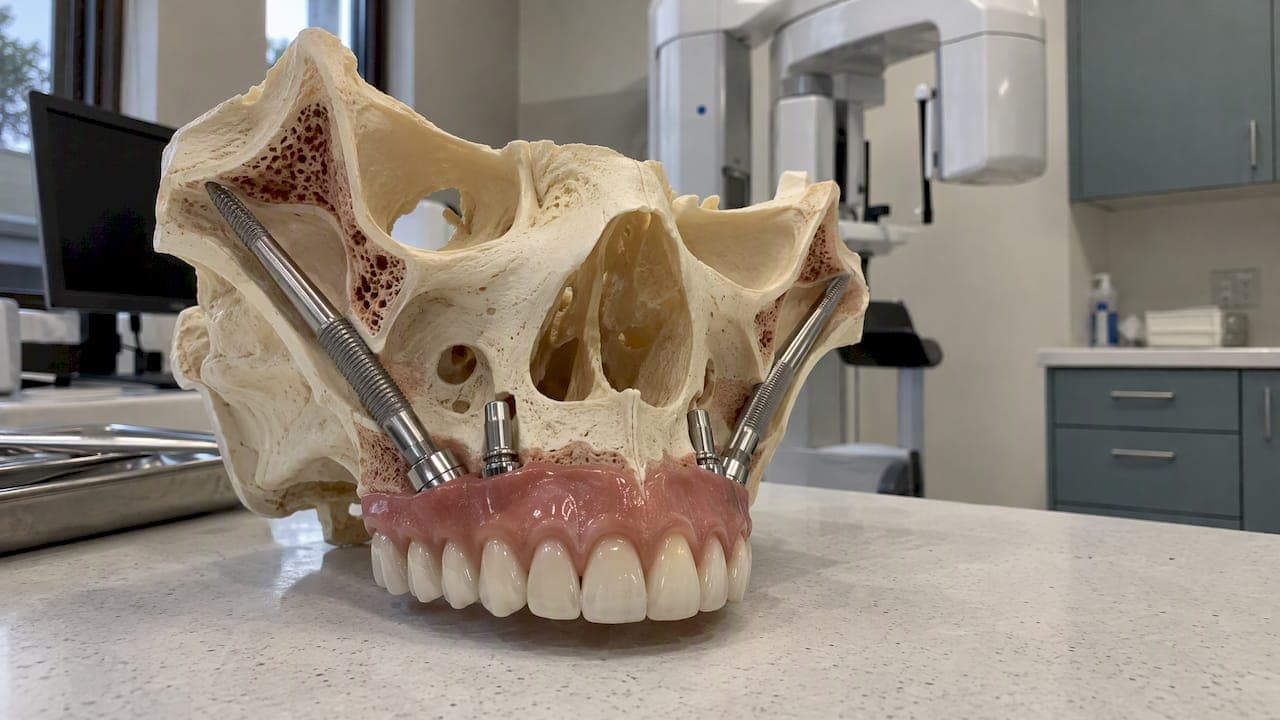
If you have been told there is not enough bone in your upper jaw for dental implants, zygomatic implants may still give you fixed, permanent teeth. They are long implants that anchor in your cheekbone instead of the thin or missing jawbone above your teeth. In Jacksonville, Forever Smiles Implant Center is a surgical center that focuses on full-mouth implant reconstruction, including these advanced cases. This guide explains how the treatment works, who tends to qualify, what the evidence says about results, and what to ask before you choose a surgeon.
TL;DR
- Zygomatic implants anchor in the cheekbone (zygoma), so they can support a full upper arch of teeth when the upper jaw has severe bone loss.
- Candidacy rests on 3D imaging and a surgeon's assessment, not on what a general X-ray suggests or what one office told you.
- In the ITI consensus report, a mean zygomatic implant survival of 96.2% was reported over a mean follow-up of 6.3 years.
- Surgeon training and experience matter more here than in almost any other dental procedure, because the implants are long and the anatomy is complex.
- Our full-mouth treatment starts at $19,000 per arch, and the zygomatic plan is set after your scan and consultation.
Table of Contents
- What zygomatic implants are
- Who may be a candidate
- How the treatment works, step by step
- Success rates and risks, honestly
- Alternatives when the upper jaw lacks bone
- Our perspective
- Why surgeon training matters in Jacksonville
- What zygomatic treatment costs
- Start with a scan, not a guess
- FAQ
- Sources
What zygomatic implants are
A conventional dental implant is a small titanium post set into the jawbone, where it fuses with the bone and holds a tooth or a bridge. It needs enough healthy bone in the right place. In the upper jaw, bone often shrinks after teeth are lost, after years in dentures, or after gum disease. The sinus sits just above, so the bone that remains can be thin and short.
Zygomatic implants solve this by going somewhere else. According to the ITI consensus report on zygomatic implants, they are specialized, long implants that anchor into the zygoma, the cheekbone, rather than the maxillary bone. They provide stable support for replacement teeth in patients with severe upper-jaw bone loss who are not candidates for conventional implants.
The cheekbone is dense and does not resorb the way the tooth-bearing ridge does. That is the reason this approach works when a bone graft or a standard implant would not.
The implant emerges in the mouth near the position where a natural tooth root would be, and the surgeon attaches a fixed bridge to it. The same report describes an "Anatomy-Guided" concept that aims to place the implant head at the natural dental position at the alveolar level, or as near to it as possible. In plain terms, the goal is to put the implant where your new teeth need it, so the final result looks and functions like a normal arch.

Who may be a candidate
Zygomatic implants are not for everyone with a missing tooth. They are meant for people whose upper jaw cannot support standard implants. You may be a candidate if:
- You are missing most or all of your upper teeth, or your remaining teeth are failing and cannot be saved.
- You have worn dentures for years and the ridge has flattened, so the denture slips or no longer fits.
- You have severe gum disease and bone loss in the upper jaw.
- A previous implant or graft failed in the upper jaw.
- You were told elsewhere that you had no bone for implants.
Surgeons often describe bone loss with the Cawood and Howell classification. The ITI report notes that this system, with its Class IV, V and VI categories of maxillary atrophy, is frequently used in clinical literature to categorize the degree of bone loss when deciding on zygomatic implants. The same report is candid that the degree of atrophy is not clearly defined across studies, and it recommends objective criteria and a 3D assessment of both the maxillary and the zygomatic bone volume.
That is why a single flat dental X-ray is not enough to tell you that you are or are not a candidate. A 3D cone-beam scan lets a surgeon measure what is there and plan around it. If you want a general primer on how candidacy is judged for any implant, dental implant candidacy basics cover the health factors that apply across the board. For complex cases like these, our candidacy checklist for complex cases goes deeper.
Health factors a surgeon will review
Beyond bone, a careful evaluation looks at:
- Sinus health, since the implants pass near the sinus.
- Gum disease or infection that needs to be controlled.
- Medical history, medications and conditions such as diabetes, and whether you smoke.
- Your bite, your lip line and how much of your teeth show when you smile.
- Your goals: how you want to eat, speak and look.
If you have a specific condition or take blood thinners, bisphosphonates or other medications that affect healing, raise it at the first visit. Your surgeon and your physician should coordinate before surgery.
How the treatment works, step by step
Every surgeon has their own protocol, but a full-arch zygomatic case follows a recognizable path.
- Consultation and 3D imaging. You bring your history and your questions. The scan shows bone volume, the sinuses and the cheekbone.
- Surgical planning and smile design. The surgeon decides how many implants are needed and where, and designs the teeth with the end result in mind. In planning, the position of the implant head is considered together with the bridge that will sit on it.
- Surgery. Failing teeth are removed if needed, and the zygomatic implants are placed, often together with standard implants in the front of the jaw. Many patients choose sedation or anesthesia for this. At our center, a board-certified MD anesthesiologist provides the anesthesia for complex cases.
- Teeth the same day. The Foundation for Oral Rehabilitation notes that zygomatic implants are usually placed using an immediate loading protocol, meaning a temporary bridge is attached right away rather than after months with no teeth.
- Healing. The implants integrate with bone over the following months while you wear the temporary teeth and eat a soft diet.
- Final teeth. Once healing is complete, a custom fixed bridge replaces the temporary one. We use zirconia, a durable ceramic, made in our in-house dental lab.
For a realistic view of the months after surgery, see our 3 to 6 month timeline for zygomatic implant patients.
Success rates and risks, honestly
Long-term data are encouraging. The ITI consensus report describes zygomatic implants as long-term solutions for restoring the upper jaw with severe bone atrophy, citing a reported 12-year cumulative survival rate of 95.21%. The same consensus report indicates a mean survival of 96.2% over a mean follow-up of 6.3 years.

Those figures come from published studies of many patients treated by different teams. They are not a promise about any single result, and your own outcome depends on your health, your anatomy, your home care and the surgeon's skill.
Like any surgery, this one has risks. The ones most discussed involve the sinus, the soft tissue around the implants, infection, and the need for maintenance of the bridge over time. Good planning, a careful surgical technique and a thorough hygiene routine are what reduce them. We lay out the numbers, including sinus-related findings, and the questions worth asking in our guide to zygomatic implant risks.
Keeping the result for the long run
- Clean under and around the bridge daily with the tools your team shows you.
- Keep your scheduled maintenance visits, where the bridge is checked and professionally cleaned.
- Report swelling, bleeding, a change in your bite or sinus symptoms early.
- Wear a night guard if you are advised to, since grinding stresses any implant bridge.
Alternatives when the upper jaw lacks bone
Zygomatic implants are one of several paths, and an honest consultation should explain how they compare. The main options for a thin upper jaw are:
- Bone grafting and sinus lift, then standard implants. This rebuilds bone first. It can work, but it adds surgeries and months of healing, and grafts do not always take in heavily resorbed jaws.
- Angled or shorter standard implants. Tilting implants can use the bone that remains. This only works when enough bone exists to anchor them.
- Zygomatic implants. They skip the jaw bone problem by using the cheekbone, and often allow a fixed bridge on the day of surgery.
- Implant-retained or traditional dentures. A removable option that can suit some people, though many wearers find them unstable on a resorbed upper ridge.
If you are weighing a fixed bridge against what you have now, our pages on full-mouth implants compared with bridges and on whether full-mouth implants can permanently replace dentures walk through the differences. If bone loss is the main worry, your real options for permanent teeth despite bone resorption is a good next read.
Our perspective
Most patients who reach us have already been told no. They were told the bone was gone, that a graft was the only route, or that dentures were their future. What they usually had was a consultation with someone who does not perform this surgery every day.
We built Forever Smiles around a single focus: full-mouth implant reconstruction, including zygomatic implants and the repair of implants that failed elsewhere. We do these procedures daily. Planning, surgery, the dental lab and anesthesia all live under one roof, with one accountable team, so nothing is handed off between offices.
Our belief is simple: experience isn't expensive, inexperience is. A zygomatic case done once and done right costs less in the end than a failed attempt, a revision and years of living without a stable bite. That is how we plan every case, in advance, with the final teeth in mind.
Dr. Brian Young
Why surgeon training matters in Jacksonville
A zygomatic implant is placed through anatomy that leaves little margin: the sinus, the cheekbone, the eye socket and the nerves are all nearby. The professional guidance reflects this. The American Association of Oral and Maxillofacial Surgeons states that dental implant surgery is best performed by surgeons with specialized education and training. The same body describes the purpose of an implant procedure as correcting defective structures to restore function for a compromised patient, which is exactly what a full-arch reconstruction aims to do.
So when you compare Jacksonville providers, ask direct questions:
- Who will place the implants, and what is their surgical training?
- How many full-arch and zygomatic cases do they do in a typical month?
- Do they treat cases that other offices turned away, or revise failed implants?
- Is anesthesia given by a physician anesthesiologist, and is it included in the plan?
- Who makes the final teeth, and can they adjust them in-house?
- What is covered if something needs attention after surgery?
We wrote about the volume question in how many implants an experienced surgeon should have placed. The short version: ask, and expect a specific answer. For more on the long-term view, read why implants are a long-term investment in oral health.
What to bring to a consultation
- Any recent X-rays or scans, and records from earlier implant or graft attempts.
- A list of your medications and medical conditions.
- Your current dentures, if you wear them, so the surgeon can see how they fit.
- Photos of your natural smile, if you have them.
- A written list of what you want to eat, how you want to look and what worries you.
What zygomatic treatment costs
Zygomatic cases vary more than standard ones, because the number and length of implants, the need for revision of earlier work, and the anesthesia plan differ from patient to patient. We do not publish a single fixed price for zygomatic implants. We set the plan after your 3D scan and consultation, so you see one figure for your own case.
For reference, our published full-mouth pricing is $19,000 per arch for All-on-4 zirconia, and full-mouth zirconia implants from $19,500 per arch, depending on your specific needs. That price includes planning, surgery, teeth on the same day, final zirconia teeth and follow-up care. We do not compete on being the cheapest. We compete on getting a complex case right the first time. Payment plans and financing are available, and you can review them on our cost and financing page.
Start with a scan, not a guess
If you live in Jacksonville or elsewhere in Northeast Florida and have been told you lack the bone for implants, the next step is a 3D evaluation with a surgeon who performs this surgery every day. We will tell you whether zygomatic implants, a different full-arch plan or another route fits your anatomy.
Learn more about zygomatic implants at Forever Smiles, or see how our permanent full-mouth implants work from first scan to final zirconia teeth.
FAQ
Are zygomatic implants the same as All-on-4?
No, but they can be combined. All-on-4 uses four standard implants per arch, which needs enough bone. Zygomatic implants anchor in the cheekbone and are used when the upper jaw lacks bone for standard ones. A plan may use both types in the same arch.
Will I leave surgery with teeth?
Usually yes. Zygomatic implants are typically placed with an immediate loading protocol, so a temporary fixed bridge is attached right away. Final custom teeth follow once healing is complete. Your surgeon confirms this after reviewing your scan.
How long do zygomatic implants last?
The ITI consensus report cites a 12-year cumulative survival rate of 95.21% and a mean survival of 96.2% over a mean follow-up of 6.3 years. Those are study averages. Your own result depends on your health, hygiene and maintenance visits.
Can zygomatic implants fix a failed implant in the upper jaw?
Often they can be part of the solution, depending on how much bone remains after the failed implant is removed. This is a core part of our work. A 3D scan and an exam show whether the failed site can be revised and what the replacement plan should be.
Do I need to be put under for surgery?
Most patients choose sedation or anesthesia for full-arch surgery. At our center, a board-certified MD anesthesiologist provides it for complex cases. We discuss the options and your health history at the consultation.
Sources
- ITI consensus report on zygomatic implants: indications, outcomes and complications
- Zygomatic implants, Foundation for Oral Rehabilitation treatment guidelines
- Dental Implant Surgery, American Association of Oral and Maxillofacial Surgeons