

Most patients rate dental implant pain between 2 and 4 out of 10, with discomfort peaking in the first 24 hours and fading substantially within 3 to 7 days. That's the short version. The longer version matters more if you're actually scheduled for surgery, because "mild to moderate" hides a lot of variation depending on how many implants you're getting, whether you need bone grafting, and how your body handles healing.
A 507-patient cohort study found that 55.6% of patients reported any postoperative pain at all, and of those, the overwhelming majority (51.4% of the total group) called it mild. A separate patient recovery survey found pain and swelling dropped to minimal levels by day 4 or 5 for most people. Dr. Brian Young of Forever Smiles Implant Center, who has placed more than 28,000 implants, puts it plainly to patients: the surgery itself is numb and pressure-based, and the recovery is manageable with the right plan.
Here's what that breaks down to in practice:
- During surgery: You'll feel pressure and vibration, not sharp pain, thanks to local anesthesia (and sedation, if used).
- First 24 to 48 hours: Soreness, swelling, and tenderness peak here, typically in the 2 to 4 range on a 0 to 10 scale.
- Days 3 through 7: Pain drops off quickly for most patients, though bruising and mild stiffness can sometimes linger.
Call your surgeon if pain gets worse instead of better after 48 to 72 hours, if swelling spreads beyond the surgical site, if you develop a fever, or if an implant feels loose. Those are not part of a normal recovery.
Key Takeaways
Dental implant pain is typically mild to moderate, peaks within the first 24 to 48 hours, and resolves for most patients within a week, while full bone integration continues quietly for months afterward.
| Point | Details |
|---|---|
| Typical pain range | Most patients report 2 to 4 out of 10, with the majority calling their pain mild. |
| Peak and resolution timing | Pain peaks in the first 24 to 48 hours and drops sharply by day 3 to 7 for most patients. |
| Biggest risk factors | Multiple implant sites, bone grafting, sinus lifts, and smoking all increase pain and swelling. |
| Red flag for concern | Pain that worsens after 48 to 72 hours, fever, or a loose implant means call your surgeon that day. |
| Complex-case support | Forever Smiles Implant Center pairs MD-anesthesiologist sedation with daily full-arch surgical experience for higher-risk cases. |
Table of Contents
- Is Dental Implant Surgery Painful While It's Happening?
- What Does Dental Implant Recovery Pain Look Like Day By Day?
- How Long Does Healing Actually Take, Pain Aside?
- What Increases Pain or Slows Down Implant Recovery?
- Do Full-Arch and Complex Implant Cases Hurt More?
- How Do You Manage Dental Implant Pain at Home?
- Do Implants Hurt More Than a Tooth Extraction or Root Canal?
- When Is Dental Implant Pain Not Normal?
- What Do Research and Experienced Surgeons Say About Average Implant Pain?
- Why Most Patients Overestimate Implant Pain Before Surgery
- How Forever Smiles Implant Center Approaches Pain Control for Complex Cases
- Sources
Is Dental Implant Surgery Painful While It's Happening?
No, you shouldn't feel sharp pain during the procedure itself. Mayo Clinic's clinical guidance is direct on this point: local anesthesia numbs the surgical site completely, and most patients describe the experience as pressure rather than pain. What you feel is more mechanical than painful.
During placement, expect:
- Firm pressure as the implant post is seated into the jawbone
- Vibration and drilling sounds (louder in your own head than they'd sound to someone next to you)
- A cool sensation from irrigation fluid used to keep the site cool during drilling
- Occasional tugging if stitches are placed
Anesthesia options scale with the complexity of your case. A single implant in a cooperative patient often needs nothing more than local anesthesia, sometimes paired with nitrous oxide or an oral sedative for anxiety. Full-arch cases or patients with significant dental anxiety often move to IV sedation administered by a board-certified MD anesthesiologist, which keeps you relaxed and unaware of the procedure without the risks of general anesthesia in a less-monitored setting. General anesthesia is reserved for the most complex reconstructions or patients who can't tolerate sedation for medical reasons.
Pro Tip: Tell your surgical team about any past reactions to anesthesia, including nausea, dental anxiety, or previous negative experiences at the dentist. This isn't small talk. It changes how they sedate you and can meaningfully lower how much pain and stress you perceive during and after surgery.
What Does Dental Implant Recovery Pain Look Like Day By Day?
Pain after dental implants follows a fairly predictable arc: it peaks within the first day, then drops sharply. Patient-reported outcome data consistently shows the worst discomfort happening in the first 24 to 48 hours, with most people reporting major improvement by day 3.

Here's how a typical single-implant recovery tends to unfold:
| Timeframe | Typical pain (0 to 10) | Swelling | Eating | Bruising |
|---|---|---|---|---|
| Day 0 to 1 | 3 to 5 | Starts to build, peaks near end of day 1 | Cold, soft foods only | Minimal to none yet |
| Day 2 | 2 to 4 | Peak swelling, may look worse than it feels | Soft foods (eggs, soup, yogurt) | May appear, especially in cheek/jaw |
| Day 3 to 4 | 1 to 3 | Starts subsiding | Soft to semi-soft foods | Often visible, fading |
| Day 5 to 7 | 0 to 2 | Mostly resolved | Transitioning toward normal diet | Fading, mostly gone |
A few things stay true across nearly every case:
- Pain and analgesic use tend to drop off by around day 3, based on HRQOL survey data.
- Swelling and stiffness can take up to 7 to 10 days to fully resolve, per Cleveland Clinic's patient guidance.
- Most patients return to desk work or light routines within 2 to 3 days, though physically demanding jobs often call for closer to a week off.
Diet matters more than most people expect for comfort. Easing back into solid foods gradually, rather than testing your limits on day 3 with something crunchy, keeps irritation and swelling from spiking unnecessarily.
How Long Does Healing Actually Take, Pain Aside?
Pain resolving in a week doesn't mean the implant is done healing. Two separate clocks are running after surgery, and confusing them is where a lot of patient anxiety comes from.
Soft-tissue healing, the process that governs how sore your gums feel, typically wraps up in 1 to 3 weeks. This is what determines when eating, talking, and brushing feel normal again.
Osseointegration, the process where the implant post physically fuses with your jawbone, takes 3 to 6 months, sometimes longer in the upper jaw or in grafted sites. During this window:
- You shouldn't feel active pain, but occasional pressure or mild sensitivity near the site is normal, especially with temperature changes or chewing on that side.
- The implant should feel stable, not loose, at any point after the first couple of weeks.
- Analgesics are rarely needed past the first 7 to 10 days; if you're still reaching for pain medication two weeks out, that's worth a call to your surgeon.
- Follow-up checks typically happen at 1 to 2 weeks, then again before the final restoration is placed months later.
Understanding what post-surgery healing actually means at each stage helps you tell the difference between normal bone-integration sensitivity and a problem worth flagging.
What Increases Pain or Slows Down Implant Recovery?
Not every implant patient has the same experience, and the research backs up what surgeons see clinically: certain factors reliably predict more pain and slower healing. The 506-patient risk-prediction study found postoperative swelling in 65.6% of patients and identified specific predictors of higher symptom severity.
The biggest factors:
- Multiple surgical sites. Placing several implants in one visit increases tissue trauma compared to a single site.
- Bone grafting or bone-substitute use. Augmentation procedures were independently linked to more pain and swelling in the cohort study above.
- Sinus lifts. Adding sinus floor elevation to upper-jaw implants extends both swelling and recovery time.
- Implant location. Back-of-the-mouth (posterior) sites tend to swell more than front-of-the-mouth placements.
- Smoking. It restricts blood flow to healing tissue and is one of the strongest modifiable risk factors for complications.
- Uncontrolled diabetes. Poor glycemic control slows tissue repair and raises infection risk.
- Hypertension. Some studies associate it with higher post-op swelling, alongside female sex as a demographic factor in symptom severity.
- Pre-existing infection at the surgical site. Active infection before surgery predicts a rougher recovery.
Pro Tip: If you smoke, stopping for at least a week before and two weeks after surgery measurably improves healing. Pair that with tight blood sugar control if you're diabetic, and follow every pre-op instruction your surgeon gives you. These aren't formalities. They're the levers most within your control.
Do Full-Arch and Complex Implant Cases Hurt More?
Yes, generally, but not dramatically more per site. A single, straightforward implant in healthy bone is usually the most comfortable version of this surgery. Multi-implant, full-arch, and grafted cases involve more tissue manipulation, which shows up as more swelling and a longer window of tenderness, not necessarily a higher peak pain score.
| Case type | Typical peak pain (0 to 10) | Recovery to comfortable | Extra care needed |
|---|---|---|---|
| Single implant, no graft | 2 to 4 | 3 to 5 days | Standard analgesics, soft food briefly |
| Multiple implants, same visit | 3 to 5 | 5 to 7 days | Extended soft diet, scheduled dosing |
| Implant with bone graft or sinus lift | 4 to 6 | 7 to 10 days | Longer antibiotic course, staged follow-up |
| Full-arch (All-on-4 type) | 4 to 6 | 7 to 10 days, months for full stability | MD-anesthesiologist sedation, structured aftercare plan |
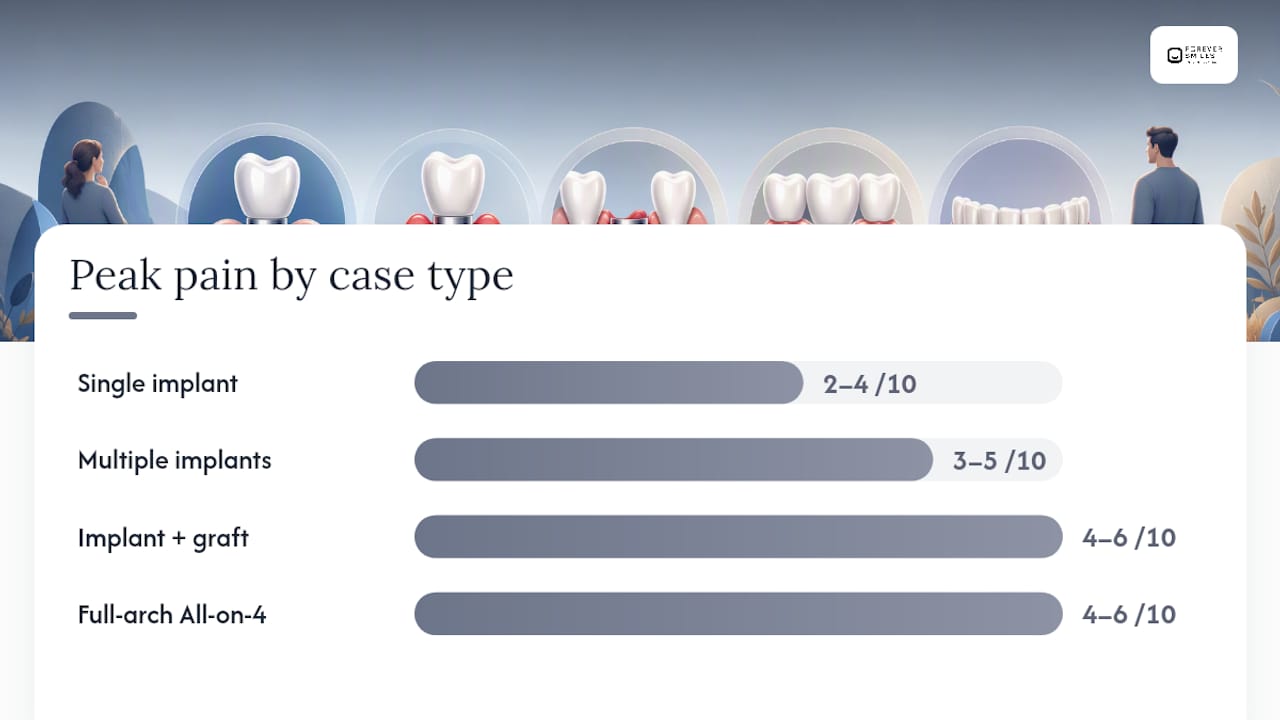
For full-arch and grafted cases, the additional care usually includes a longer course of antibiotics, extended scheduled pain medication rather than as-needed dosing, strict ice and head-elevation protocols for the first 48 hours, and a soft diet held longer than for a single implant. Guided bone regeneration and multi-site surgery both correlate with higher early symptom burden in the research, which is exactly why practices that handle these cases daily plan pain control ahead of time rather than reacting to it. If severe bone loss rules out conventional implants, options like zygomatic implants add their own recovery considerations worth discussing directly with your surgeon.
How Do You Manage Dental Implant Pain at Home?
Effective pain management after implants isn't about toughing it out. It's about staying ahead of the discomfort instead of chasing it once it's already spiked.
For medication:
- Alternate or combine acetaminophen and NSAIDs (like ibuprofen) on a scheduled basis for the first 48 to 72 hours, rather than waiting until pain builds up.
- Prescription opioids, when given, are typically meant for a short window, often just the first night or two, not the full recovery.
- Never mix opioids with alcohol or other sedatives, and check with your surgeon before taking NSAIDs if you have kidney issues, a bleeding disorder, or take blood thinners.
For non-drug relief:
- Apply cold packs in 15 to 20 minute intervals for the first 24 to 48 hours to blunt swelling before it peaks.
- Keep your head elevated, even while sleeping, for the first couple of nights.
- Start gentle saltwater rinses around 24 hours post-op (check your surgeon's specific timing), avoiding vigorous swishing.
- Stick to cold, soft foods for the first day or two, then progress gradually.
Patient-reported data consistently shows pain peaking in the first 24 to 48 hours and dropping fast after, which is exactly the window where scheduled, proactive dosing matters most. Waiting until pain is a 7 out of 10 to take something is much harder to manage than starting on a schedule before it climbs.
Pro Tip: Prop yourself up with an extra pillow and take your evening dose of pain medication on a fixed schedule rather than "whenever it starts hurting." Most patients report the first night as the roughest, and staying ahead of the pain curve there blunts the whole spike.
Do Implants Hurt More Than a Tooth Extraction or Root Canal?
Implant placement is generally similar to or milder than a surgical tooth extraction, and it feels different in character from root canal pain, which involves inflamed nerve tissue rather than a surgical wound. A comparative review found that patients undergoing implant placement often reported milder post-op pain than those undergoing extraction, with flapless implant techniques showing particularly fast recovery.
| Procedure | Intra-op sensation | Peak post-op pain timing | Days to major improvement |
|---|---|---|---|
| Surgical tooth extraction | Pressure, cracking sounds | Within 24 hours | 3 to 5 days |
| Single implant placement | Pressure, vibration | Within 24 hours | 3 to 7 days |
| Root canal | Pressure, occasional throbbing pre-numbing | Can persist intermittently for days | 3 to 7 days, sometimes longer if infection present |
| Ill-fitting or aging dentures (ongoing) | N/A, chronic irritation rather than acute pain | Ongoing, not a single event | Ongoing until replaced |
The comparison to dentures is worth sitting with for a moment. Denture pain isn't a single event with a resolution date; it's chronic, low-grade irritation from sore spots, slipping, and bone loss that keeps changing the fit. Implants trade a short, defined recovery window for the elimination of that ongoing discomfort, which is part of why so many denture wearers who switch describe the trade as worth it almost immediately.
When Is Dental Implant Pain Not Normal?
Most recovery pain gets better every single day. When it doesn't, or when new symptoms show up, that's your signal to call.
Watch for:
- Pain that worsens after 48 to 72 hours instead of improving. Call your surgeon the same day.
- Spreading facial swelling, especially if it extends toward your eye or down your neck. Call immediately.
- Fever, particularly paired with chills or feeling generally unwell. Call your surgeon; go to the ER if it's accompanied by vomiting or difficulty swallowing.
- Uncontrolled bleeding that doesn't slow with gauze and gentle pressure. Call your surgeon promptly.
- Pus or foul-tasting drainage from the surgical site. This suggests infection and needs same-day evaluation.
- Numbness that increases or persists beyond the expected anesthesia window. This can signal nerve involvement and needs prompt attention.
- An implant that feels loose or mobile. This is not something to wait out.
Cleveland Clinic's guidance puts a rough outer boundary on normal recovery: swelling and stiffness commonly resolve within 7 to 10 days. Throbbing pain that persists or intensifies past that 10 to 14 day mark is unusual and deserves a follow-up visit rather than more waiting.
What Do Research and Experienced Surgeons Say About Average Implant Pain?
The numbers from published research line up closely with what high-volume surgical practices see every day. In the 506-patient cohort study, 55.6% of patients reported some postoperative pain, but the overwhelming majority of that group, 51.4% of all patients, described it as mild.
Recovery is genuinely individual, and the factors that push someone toward the higher end of the pain scale, like grafting or multiple sites, are largely predictable ahead of time. That predictability is exactly why early communication with the surgical team matters if recovery starts deviating from the expected downward trend, rather than waiting to see if it resolves on its own.
Surgeon experience and a team-based surgical model show up in outcomes, not just marketing copy. Dr. Brian Young has placed more than 28,000 implants over two decades and performs full-arch surgery daily at Forever Smiles Implant Center, a volume most general dentists offering implants as a side service never approach. That repetition matters for pain control specifically: a surgeon who handles the same anatomy every day tends to work faster and more precisely, which reduces tissue trauma. Pairing that with an in-house MD anesthesiologist for sedation, rather than relying on oral sedatives alone, gives complex and previously failed cases a more controlled comfort experience from the first incision onward.
Why Most Patients Overestimate Implant Pain Before Surgery
The gap between what patients expect and what they actually feel is one of the most consistent things I see. People walk in bracing for a version of dental pain they remember from a bad extraction as a kid, or from stories they've heard secondhand, and that expectation does real damage before surgery even starts. Anxiety itself amplifies perceived pain. It's not imaginary, it's physiological, and it's also one of the few variables we can actually address before you're ever in the chair.
What the data actually shows, and what two decades of full-arch surgery every single day confirms, is that the pain ceiling on this procedure is lower than most people assume, and the variability is driven by identifiable factors, not bad luck. If you're getting one implant in healthy bone, you are very likely looking at the mild end of that 2 to 4 range. If you're getting a full-arch reconstruction with grafting, you should expect more, but "more" still has a defined shape and a defined end date, not an open-ended ordeal.
Where I think the conventional advice falls short is in treating all implant pain as one bucket. A single implant and a full-arch zygomatic case are not the same conversation, and patients deserve to know which conversation they're actually in before they sign consent forms. Ask specific questions at your consultation. Bring your full medication list and health history. The predictability of this pain is the whole point, and a surgical team that plans for your specific risk factors ahead of time, rather than reacting to complications after they show up, is the difference between a rough week and a manageable one.
How Forever Smiles Implant Center Approaches Pain Control for Complex Cases
Forever Smiles Implant Center is built around the cases that make pain control genuinely complicated: full-arch reconstructions, patients with significant bone loss, and previously failed implants that a general dentist referred elsewhere. That focus means every piece of pain management, from sedation to the final restoration, happens under one accountable team instead of being split across multiple offices.
A board-certified MD anesthesiologist handles sedation for every complex case, surgical planning happens with 3D imaging before you're ever in the chair, and the practice's in-house dental lab means fewer appointments and less prolonged tissue irritation from temporary fittings. For patients facing severe bone loss, zygomatic implants offer a path forward even when standard implants aren't an option elsewhere. If you're missing most or all of your teeth, unhappy with dentures, or dealing with implants that failed at another practice, this is the kind of case Dr. Young's team manages every day, not occasionally. Explore full-arch implant treatment and schedule a consultation to get a pain and recovery plan built around your specific case rather than a generic estimate.
Sources
- Patients’ Perception of Recovery after Dental Implant Placement - PMC
- Development of Multiple Risk Prediction Models for Postoperative Symptoms Following Dental Implant Surgery
- Dental implant surgery - Mayo Clinic
- Dental implants - Cleveland Clinic
- Dental Implant Pain: What’s Typical & When to Get Help
This article is general information, not a substitute for advice from a qualified doctor. Consult a qualified healthcare professional about your own circumstances before acting on anything here.