
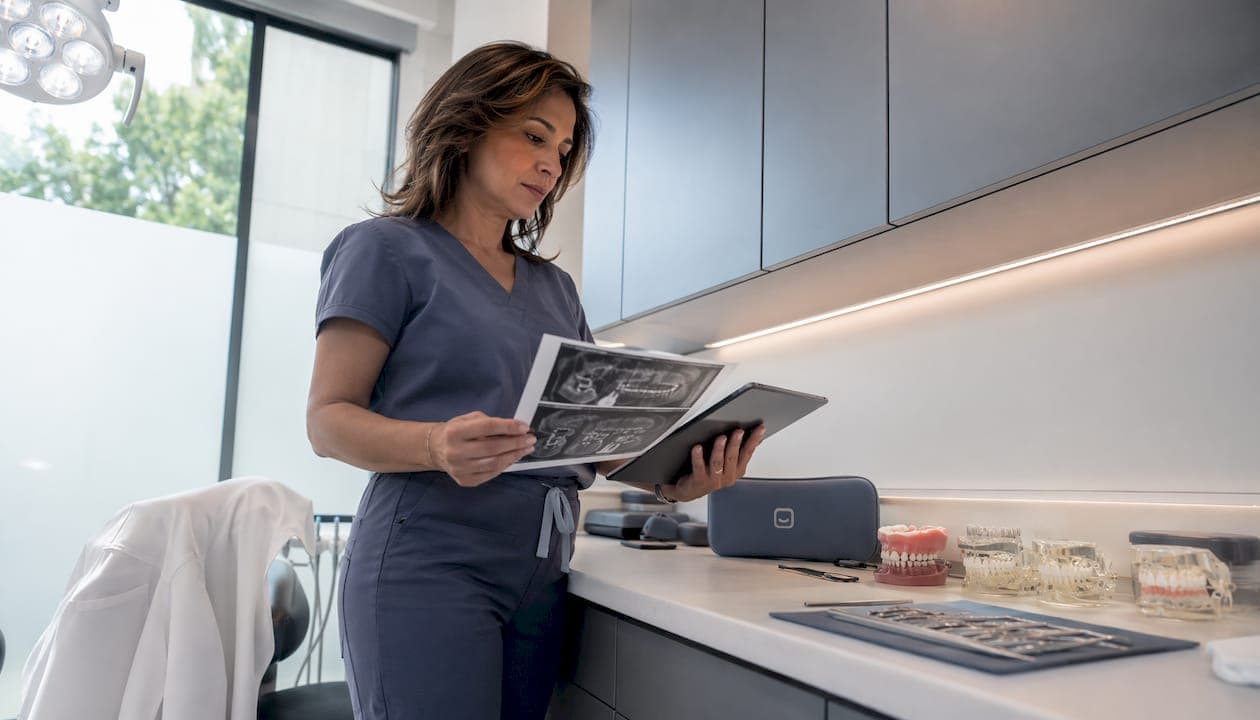
The most common dental implant mistakes are preventable errors in planning, provider selection, and aftercare. Confirm CBCT-based 3D imaging, full medical disclosure, and a written maintenance schedule before you proceed — those three steps alone eliminate the majority of avoidable failures.
The highest-impact mistakes fall into two categories: things patients control and things providers control.
Patient-side mistakes:
- Choosing a provider based on price rather than surgical credentials and case volume
- Withholding medical history (diabetes, osteoporosis, bisphosphonate use, radiation therapy)
- Continuing to smoke through the surgical and healing period
- Eating hard foods or loading the implant before osseointegration is complete
- Skipping follow-up appointments once the implant feels fine
Provider-side mistakes:
- Placing implants without CBCT imaging, relying on 2D X-rays alone
- Failing to plan prosthetically (placing where bone exists rather than where the tooth needs to function)
- Skipping bone grafting when bone volume is insufficient
- Inadequate management of bruxism before and after loading
Smoking roughly doubles implant failure risk: failure rates run approximately 11% in smokers versus 5% in non-smokers. If you smoke and are planning implants, that single variable is the most modifiable risk factor you have.
Table of Contents
- 1. The most common dental implant mistakes, ranked by impact
- Why do dental implants fail? Early vs. late failure explained
- Surgical and prosthetic planning: what "prosthetically driven" actually means
- How to recognize a failing implant before it gets worse
- What happens when an implant fails: treatment options and timelines
- How to choose the right provider: questions to ask and red flags to avoid
- Post-op care and long-term maintenance: what actually prevents complications
- What the research consistently shows about implant failure
- Key Takeaways
- What I see in practice: the mistakes that keep showing up
- What a specialist implant center does differently
- Sources and further reading
1. The most common dental implant mistakes, ranked by impact
Every mistake below has a clear cause, a predictable consequence, and a specific action you can take to prevent it. Red-flag signs are included so you know when to call your dentist immediately rather than wait.
1. Choosing the wrong provider
Cause: Selecting a general dentist who places implants occasionally, or choosing based on the lowest advertised price, rather than verifying surgical training and case volume.

Consequence: Malpositioning, nerve injury, sinus perforation, and prosthetic misfit — all of which are far more expensive to correct than the original procedure.
Prevention:
- Confirm the surgeon is residency-trained in oral surgery, periodontics, or a related surgical specialty
- Ask how many implants they place per week (not per year)
- Request before-and-after cases for patients with similar bone loss or complexity to yours
- Verify that they use CBCT imaging as a standard part of planning
Red flags: No CBCT on-site, reluctance to share case examples, or a price that is dramatically below the regional average.
2. Skipping CBCT imaging
Cause: Relying on 2D panoramic X-rays, which cannot show bone depth, width, or proximity to the inferior alveolar nerve and maxillary sinus in three dimensions.
Consequence: Nerve damage, sinus perforation, or implant placement into inadequate bone — complications that can be permanent. A CBCT-based study reported positioning error prevalence as high as 82.9% in one sample, while another radiographic analysis of 500 CBCT scans found that 56.6% of implants had at least one positioning error, with thread exposure (37.7%) and proximity to the maxillary sinus (27.7%) among the most common findings. Poor axis and position create prosthetic complications that are difficult or impossible to correct without removing the implant.
Prevention:
- Require CBCT as a non-negotiable part of your pre-surgical workup
- Ask your surgeon to walk you through the 3D scan and show the planned implant position relative to the nerve and sinus
- Confirm the implant diameter and length were selected from the CBCT data, not estimated from a 2D film
Red flags: Surgeon says a panoramic X-ray is sufficient for your case without explaining why CBCT is unnecessary.
Pro Tip: Ask your surgeon to show you a cross-sectional CBCT slice at the planned implant site and point out the nerve canal or sinus floor. If they cannot or will not do this, that is a planning gap worth addressing before surgery.
3. Incomplete medical history disclosure
Cause: Patients omit medications, supplements, or conditions they assume are unrelated to dental work.
Consequence: Bisphosphonates (used for osteoporosis) can impair bone healing and increase the risk of osteonecrosis. Uncontrolled diabetes slows healing and raises infection risk. Radiation to the jaw compromises blood supply. None of these are disqualifiers on their own, but each requires a modified protocol.
Prevention:
- Bring a complete medication list to your consultation, including over-the-counter supplements and herbal products
- Disclose any history of radiation therapy to the head or neck
- Tell your surgeon if you have been diagnosed with osteoporosis, diabetes, autoimmune conditions, or bleeding disorders
- Ask specifically whether any of your medications require a drug holiday or protocol adjustment
Red flags: A provider who does not ask for a full medical history or who dismisses your medication list as irrelevant.
4. Smoking during the healing period
Cause: Nicotine constricts blood vessels and impairs the cellular activity needed for osseointegration. Carbon monoxide reduces oxygen delivery to healing tissue.

Consequence: Failure rates are approximately 11% in smokers versus 5% in non-smokers. The risk is highest in the first weeks after placement, when the implant surface is bonding to bone.
Prevention:
- Stop smoking at least two weeks before surgery and for a minimum of two months after
- Ask your provider about nicotine replacement options that do not involve smoking
- Enroll in a cessation program through the American Lung Association's Freedom From Smoking or your primary care physician
Red flags: A surgeon who does not address your smoking status during the consultation.
5. Uncontrolled systemic health conditions
Cause: Conditions like uncontrolled Type 2 diabetes, severe osteoporosis, or active periodontal disease create a biological environment that resists osseointegration.
Consequence: Higher rates of early failure, infection, and peri-implant bone loss. Patients with a history of periodontitis carry an elevated risk of peri-implantitis because the same bacterial populations that destroyed natural tooth support can colonize implant surfaces.
Prevention:
- Get medical clearance and achieve stable glycemic control (HbA1c under 7% is a commonly cited threshold) before scheduling surgery
- Treat any active periodontal disease before implant placement
- Discuss bone density with your physician if you have osteoporosis or are on long-term corticosteroids
Red flags: A provider who schedules surgery without reviewing your most recent bloodwork or medical clearance.
6. Poor oral hygiene before and after surgery
Cause: Bacterial biofilm around the implant site creates the conditions for peri-implantitis, the leading biological cause of late implant failure.
Consequence: Peri-implantitis often progresses without pain until bone loss is advanced. By the time patients notice symptoms, significant structural damage may already have occurred.
Prevention:
- Treat existing gum disease before implant placement
- Use an electric toothbrush, interproximal brushes, and a water flosser daily after healing
- Attend every scheduled professional cleaning — implants require the same maintenance as natural teeth, and in some ways more
Red flags: Bleeding, swelling, or a bad taste around the implant site that persists beyond the initial healing period.
7. Premature loading and hard foods
Cause: Placing functional stress on an implant before osseointegration is complete creates micromotion at the bone-implant interface, disrupting the cellular bonding process.
Consequence: Early failure. The implant never fully integrates, becomes mobile, and must be removed. Osseointegration typically requires months of biologic healing, and loading before that window closes significantly raises failure risk.
Prevention:
- Follow your surgeon's diet protocol precisely — soft foods are not optional
- Avoid chewing on the implant side until cleared by your surgeon
- Do not use your implant teeth as tools (opening packages, biting nails, chewing ice)
Red flags: Pain or any detectable movement when biting down during the healing phase.
8. Bruxism and mechanical overload
Cause: Grinding and clenching generate forces that exceed what implant-bone interfaces are designed to handle, particularly during healing and in the posterior jaw where occlusal forces are highest.
Consequence: Clinical cohorts have reported implant loss rates of 41% in bruxers versus 12% in non-bruxers in certain immediate loading contexts. Mechanical overload causes screw loosening, prosthetic fracture, and bone loss around the implant.
Prevention:
- Disclose bruxism to your surgeon before treatment planning
- Wear a night guard as prescribed
- Discuss whether immediate loading is appropriate for your case given the parafunctional risk
Red flags: Repeated screw loosening, chipping of the prosthetic crown, or jaw soreness on waking.
9. Prosthetic planning errors
Cause: Placing an implant where bone is available rather than where the final tooth needs to function. This is the single most common planning mistake in implant dentistry.
Consequence: A radiographic analysis of 500 CBCT scans found that 56.6% of implants had at least one positioning error, while a separate CBCT-based study reported error prevalence as high as 82.9%; thread exposure and sinus proximity were the most common findings. Poor axis and position create prosthetic complications that are difficult or impossible to correct without removing the implant. Poor axis and position create prosthetic complications that are difficult or impossible to correct without removing the implant.
Prevention:
- Ask whether your case is being planned prosthetically — meaning the final tooth position drives the implant location, not the other way around
- Request a digital wax-up or prosthetic mock-up before surgery so you can see the planned result
- Confirm that the restorative dentist and surgeon have communicated before your procedure
Red flags: No discussion of the final prosthetic design before surgery is scheduled.
10. Inadequate bone grafting
Cause: Placing an implant into insufficient bone volume without augmentation, either to save time, reduce cost, or because the deficiency was not identified on 2D imaging.
Consequence: Thread exposure, implant mobility, and early failure. Bone grafting adds time and cost upfront but is far less expensive than removing a failed implant and starting over.
Prevention:
- CBCT imaging will identify bone deficiencies before surgery
- Ask specifically whether your case requires a bone graft and what type
- Understand the timeline: some grafts require months of healing before implant placement
Red flags: A surgeon who says you have "enough bone" without showing you the 3D measurements.
Why do dental implants fail? Early vs. late failure explained
Understanding the biology behind implant failure helps you recognize which mistakes carry the most risk and when.
Implant failures split into two distinct categories with different causes and different timelines. Early failures occur at rates of 0.5%–5.2% and typically happen before or shortly after osseointegration. The main drivers are surgical errors, infection at the time of placement, and systemic factors like uncontrolled diabetes or smoking. Late failures occur at rates of 0.5%–7.8% and tend to emerge months to years after the implant has been in function, most often from peri-implantitis or mechanical overload.
| Failure Type | Rate Range | Primary Drivers |
|---|---|---|
| Early failure | 0.5%–5.2% | Infection, surgical error, systemic factors, premature loading |
| Late failure | 0.5%–7.8% | Peri-implantitis, bruxism, biomechanical overload, bone loss |
Peri-implantitis is the dominant biological cause of late failure. It is an inflammatory condition affecting the tissue and bone around the implant, and it frequently progresses without obvious symptoms until bone loss is already significant. Patients often feel nothing until the implant is mobile. That silent progression is exactly why maintenance visits matter — a clinician can detect early bone loss on a radiograph long before you feel anything.
The osseointegration window is the most vulnerable phase. During this period, the implant surface is bonding to bone at a cellular level. Any disruption — infection, micromotion from premature loading, or poor blood supply from smoking — can prevent that bond from forming. Once osseointegration fails, the implant will not stabilize on its own. For a deeper look at osseointegration mechanics, the biology of this phase explains why so many post-op restrictions exist.
Surgical and prosthetic planning: what "prosthetically driven" actually means
Most patients assume the surgeon decides where to put the implant based on available bone. The better approach works in reverse: the final tooth position is determined first, and the implant is placed to support that position. This is what prosthetically driven planning means, and it is considered best practice in implant dentistry.
When planning skips this step, the result is an implant that may be biologically stable but functionally or esthetically compromised. The crown sits at the wrong angle, hygiene access is poor, or the bite loads the implant in a direction it was not designed to handle.
Specific surgical and prosthetic planning mistakes to watch for:
- No CBCT: placement based on 2D panoramic films alone misses bone width, depth, and proximity to vital structures
- Freehand placement without a surgical guide: increases axis deviation and positional error
- Wrong implant diameter or length for the available bone
- Skipping bone augmentation when the ridge is deficient
- No provisional restoration plan: jumping straight to the final prosthetic without a healing phase managed by a temporary
- Restorative dentist and surgeon not communicating before surgery
The difference between guided and freehand placement is meaningful in complex cases. Guided surgery uses a CBCT-derived surgical stent to direct the drill to the planned position. In cases with limited bone, proximity to the nerve, or multiple implants, guided placement reduces the margin for positional error. For straightforward single-tooth cases in experienced hands, freehand placement by a high-volume surgeon can be equally precise — but the key phrase is "experienced hands."
Pro Tip: Before surgery, ask to see a digital wax-up or a printed analog of your planned final teeth. If the team cannot show you what the final result is designed to look like before the first drill goes in, that is a gap in the planning process.
How to recognize a failing implant before it gets worse
Most implant problems give you warning signs. The question is whether you know what to look for.
Call your provider immediately for any of these:
- Implant mobility — any detectable movement is an emergency
- Increasing pain after the first week of healing (pain should decrease, not increase)
- Swelling, warmth, or pus around the implant site
- Sudden change in how your bite feels
- Numbness or tingling in the lip, chin, or tongue that persists after the first 24–48 hours
Signs that warrant an urgent (but not emergency) appointment:
- Persistent bleeding around the implant crown
- Gum recession exposing the implant collar or threads
- Loose or repeatedly dislodging crown
- Chronic bad taste or odor localized to the implant site
When you come in, your dentist will typically run through a standard diagnostic sequence: clinical exam of the soft tissue, periapical radiographs or CBCT to assess bone levels, probing depths around the implant (healthy implants probe similarly to natural teeth), mobility testing, and an occlusal analysis to check whether the bite is overloading the implant.
ER vs. implant office: Go to the emergency room if you have uncontrolled bleeding, severe swelling that is spreading to your neck or airway, or a fever above 101°F with facial swelling. For everything else — pain, mobility, loose hardware, suspected infection without systemic symptoms — call your implant provider first. Most implant offices have after-hours protocols for urgent calls.
For a detailed look at what post-surgery healing should feel like, knowing the normal timeline helps you distinguish expected discomfort from a warning sign.
What happens when an implant fails: treatment options and timelines
A failed implant is not the end of the road. The right next step depends on whether the failure is early or late, how much bone remains, and whether infection is present.
Retrieval techniques range from conservative to surgical, and the choice matters for future re-implantation because some methods preserve more bone than others.
Management options, from least to most invasive:
- Antibiotics and local debridement: For early peri-implantitis without significant bone loss, professional cleaning and antimicrobial therapy can arrest progression
- Regenerative surgery: When bone loss is present but the implant is still stable, guided bone regeneration around the implant may salvage it
- Reverse-torque explantation: Unscrewing the implant using controlled counter-rotation; pooled studies report approximately 87.7% success and this method preserves the most bone
- Piezoelectric explantation: Ultrasonic vibration to loosen the implant with minimal bone removal; preferred when bone preservation is a priority
- Trephine bur removal: A circular drill removes the implant and a cylinder of surrounding bone; success rates of 70–100% depending on context, but sacrifices bone and typically requires grafting before re-implantation
Decision flow: Conservative treatment first (debridement, antibiotics) → if the implant is salvageable with regenerative surgery, attempt that → if the implant is mobile or infected beyond salvage, explant using the most bone-preserving method available → bone graft the site → wait for graft maturation (typically several months) → re-implant.
Re-implantation is possible in most cases after adequate healing, but the timeline is longer and the total cost is substantially higher than getting it right the first time. Patients who chose a low-cost provider initially often spend more on revision than a specialist would have charged originally.
How to choose the right provider: questions to ask and red flags to avoid
The consultation is your best opportunity to assess whether a provider has the planning infrastructure and surgical experience your case requires. Come prepared.
Questions to ask at every implant consultation:
- Do you use CBCT imaging for every case, and can I review the scan with you?
- Who designs the prosthetic, and will the restorative plan be finalized before surgery?
- What anesthesia options are available, and is a board-certified anesthesiologist involved?
- If my bone volume is insufficient, what is your grafting protocol?
- What is your complication protocol, and who do I call after hours?
- What does the follow-up schedule look like for the first year?
- What is included in the quoted price, and what would trigger additional costs?
For a complete list of consultation questions to ask, having them written down before your appointment keeps the conversation focused.
Provider red flags:
- Price significantly below the regional average with no explanation of what is excluded
- No CBCT on-site or no plan to order one
- No discussion of the final prosthetic design before surgery
- Unwillingness to share before-and-after cases or explain their contingency plan for complications
- Pressure to schedule surgery at the first appointment before planning is complete
- No clear answer on who performs the surgery (surgeon vs. general dentist)
On credentials: ask whether the surgeon completed a formal residency in oral and maxillofacial surgery, periodontics, or prosthodontics. A weekend implant course is not equivalent. Case volume matters too — a surgeon who places implants daily develops pattern recognition that a part-time provider simply cannot replicate.
Seeking a second opinion is not an insult to your current provider. Any surgeon confident in their plan will welcome the comparison. If a provider discourages a second opinion, that reaction tells you something.
Post-op care and long-term maintenance: what actually prevents complications
The surgery is one day. The maintenance is the rest of your life. Most late failures are preventable with consistent follow-through on a few high-yield habits.
The highest-impact actions after surgery:
- Follow your surgeon's post-op instructions exactly, including diet restrictions and medication schedule
- Stop smoking and do not restart — the healing-period risk does not disappear after the implant integrates
- Keep every scheduled follow-up appointment, even when the implant feels fine
Do and don't list for the healing period:
- Do: Eat soft foods (yogurt, eggs, mashed vegetables, fish) for the first several weeks
- Do: Rinse gently with a prescribed antimicrobial rinse as directed
- Do: Sleep with your head slightly elevated the first few nights to reduce swelling
- Don't: Drink through a straw, spit forcefully, or smoke for at least the first two weeks
- Don't: Chew on the implant side until cleared by your surgeon
- Don't: Skip antibiotics or anti-inflammatory medications because you feel fine
Maintenance schedule:
| Timeframe | What gets checked |
|---|---|
| First week | Swelling, bleeding, suture integrity, initial healing |
| 1 month | Soft tissue healing, infection screening, provisional fit |
| 3 months | Osseointegration progress, bone levels, hygiene assessment |
| 6–12 months | Final prosthetic delivery or review, radiographic bone levels |
| Annual | Probing depths, radiographs, professional cleaning, occlusal check |
For daily hygiene, an electric toothbrush handles the implant crown surfaces well. Interproximal brushes (GUM Soft-Picks or Oral-B Interdental Brushes) clean under the crown margins where a regular brush cannot reach. A water flosser like the Waterpik is particularly useful for implant-supported bridges and full-arch restorations where flossing is difficult. The full maintenance checklist covers each of these tools with technique guidance.
Pro Tip: If you smoke, the American Cancer Society's Quitline (1-800-QUIT-NOW) connects you to free coaching and cessation support. Pairing behavioral counseling with nicotine replacement therapy roughly doubles cessation success rates compared to willpower alone. Book the call before your surgery date, not after.
What the research consistently shows about implant failure
The clinical evidence on implant failure converges on a short list of high-confidence findings. Knowing them helps you have a more informed conversation with your provider.
Smoking is the most modifiable risk factor. Multiple meta-analyses confirm it. An umbrella review of meta-analyses identifies smoking as a highly suggestive factor for implant failure, alongside short implants and immediate loading in certain contexts. The PMC data puts the failure rate at roughly 11% for smokers versus 5% for non-smokers — a gap that is entirely within the patient's control.
Positioning errors are far more common than most patients realize. The MDPI radiographic analysis of 500 CBCT scans found 56.6% of implants had at least one positioning error. Thread exposure and sinus proximity were the most common findings. These are not rare edge cases — they represent a majority of placed implants in that sample, which underscores why 3D imaging and prosthetically driven planning are non-negotiable in experienced centers.
Peri-implantitis dominates late failures. It progresses silently, which is why annual radiographic monitoring is not optional. Patients who skip maintenance visits are not saving time — they are allowing a treatable condition to advance to the point where explantation becomes the only option.
— Dr. Brian Young, Founder and Lead Surgeon, Forever Smiles Implant Center
Pro Tip: When reviewing risk with your provider, ask them to cite the specific clinical basis for their recommendations. A surgeon who can point to peer-reviewed evidence for their protocol — not just "this is how we do it" — is demonstrating the kind of evidence-based practice that reduces your risk.
Key Takeaways
Avoiding common dental implant mistakes comes down to three non-negotiables: CBCT-based planning, full medical and behavioral disclosure, and consistent long-term maintenance.
| Point | Details |
|---|---|
| Verify CBCT and prosthetic planning | Confirm 3D imaging and a prosthetically driven plan before any surgery is scheduled. |
| Disclose everything | Medications, smoking status, and systemic conditions all affect protocol — omitting them raises your risk. |
| Smoking roughly doubles failure risk | Failure rates run approximately 11% in smokers vs. 5% in non-smokers; cessation is the highest-yield modifiable action. |
| Positioning errors are common | A radiographic analysis found that a majority of implants had at least one positioning error, underscoring the importance of CBCT and guided planning. |
| Forever Smiles Implant Center | Specializes in complex and previously failed cases, with CBCT planning, in-house lab, and board-certified anesthesia under one roof in Jacksonville, FL. |
What I see in practice: the mistakes that keep showing up
The single most important thing I tell every patient considering implants: the planning phase determines the outcome. By the time you are in the chair, most of the variables that will determine whether your implant succeeds or fails have already been set.
After more than 20 years and over 28,000 implants placed, the cases I see most often in revision are not failures of surgical technique. They are failures of planning. A patient who was told they had "enough bone" without a CBCT scan. A case where the implant was placed where bone was available rather than where the tooth needed to be. A patient who was never told that their uncontrolled diabetes or their bruxism required a modified protocol. These are not exotic complications — they are the predictable consequences of skipped steps.
The second pattern I see constantly is the low-cost trap. Patients who chose the cheapest option, often at a practice where implants are a side service rather than the core focus, frequently arrive having spent less upfront and far more in total. Revision surgery, bone grafting, new prosthetics, and the time cost of multiple failed attempts add up quickly. The philosophy at Forever Smiles Implant Center is straightforward: experience is not expensive. Inexperience is.
If you are in a consultation right now and the surgeon cannot show you a CBCT-derived surgical plan, cannot tell you who designed the prosthetic, or cannot explain what happens if something goes wrong — those are not minor gaps. They are the exact gaps that turn a routine procedure into a revision case.
What a specialist implant center does differently
Most of the dental implant errors covered in this article share a common root: they happen when implants are placed by providers who do not do this work every day, in settings that lack the imaging, lab, and anesthesia infrastructure that complex cases require.
Forever Smiles Implant Center in Jacksonville, Florida, was built around a single focus: full-mouth implant reconstruction, performed daily, by a residency-trained surgical specialist. Every case starts with CBCT-based 3D planning and a prosthetically driven design. The in-house dental lab means the surgical team and the restorative team are the same accountable group — no handoffs, no communication gaps. A board-certified MD anesthesiologist is on-site for every procedure.
For patients who have already experienced a failed implant, or who have been told elsewhere that they are not candidates due to bone loss, the practice specializes in exactly those cases — including zygomatic implants for patients with severe maxillary bone loss. Full-mouth implant treatment starts from $19,000 per arch, which includes planning, surgery, same-day teeth, final zirconia restorations, and follow-up care. For a detailed breakdown of cost and financing options, the practice offers transparent estimates before any commitment is made.
If you want to understand exactly what went wrong with a previous implant or you want to get this right the first time, the next step is a consultation. Call Forever Smiles Implant Center or schedule online at foreversmilesjax.com.
Sources and further reading
The following peer-reviewed sources were used throughout this article. Each is publicly accessible and appropriate for patients who want to read the underlying evidence before their consultation.
- Risks and complications associated with dental implant failure: Critical update (PMC) — Covers smoking, bruxism, and systemic risk factors with failure rate data; directly relevant to understanding modifiable risks.
- Positioning errors of dental implants: A CBCT-based study (PMC) — Documents the prevalence of malpositioning and the role of 3D imaging in prevention.
- Prevalence of Dental Implant Positioning Errors: A Radiographic Analysis (MDPI) — Radiographic review of 500 CBCT scans quantifying positioning error types and frequency.
- Dental implant failure and retrieval techniques: A scoping review (Frontiers in Oral Health) — Covers early and late failure rates and compares explantation methods including bone-preservation trade-offs.
- Risk factors related to late failure of dental implants: A systematic review (PMC) — PRISMA-guided review of 14 studies identifying patient history, clinical, and clinician-decision risk factors for late failure.
- Umbrella review: Factors leading to implant failure from meta-analyses (ScienceDirect) — Synthesizes multiple meta-analyses to identify the strongest evidence-based risk factors.
- Prosthetically driven implant planning (Wiley) — Clinical rationale for planning implant position from the final prosthetic outcome backward.
When reviewing any of these sources, bring specific questions to your provider rather than drawing conclusions in isolation. The evidence is most useful when interpreted in the context of your individual anatomy, health history, and treatment goals.
This article is general educational information, not medical or dental advice. Confirm all clinical decisions with a qualified implant specialist who has reviewed your specific imaging, medical history, and treatment goals.