
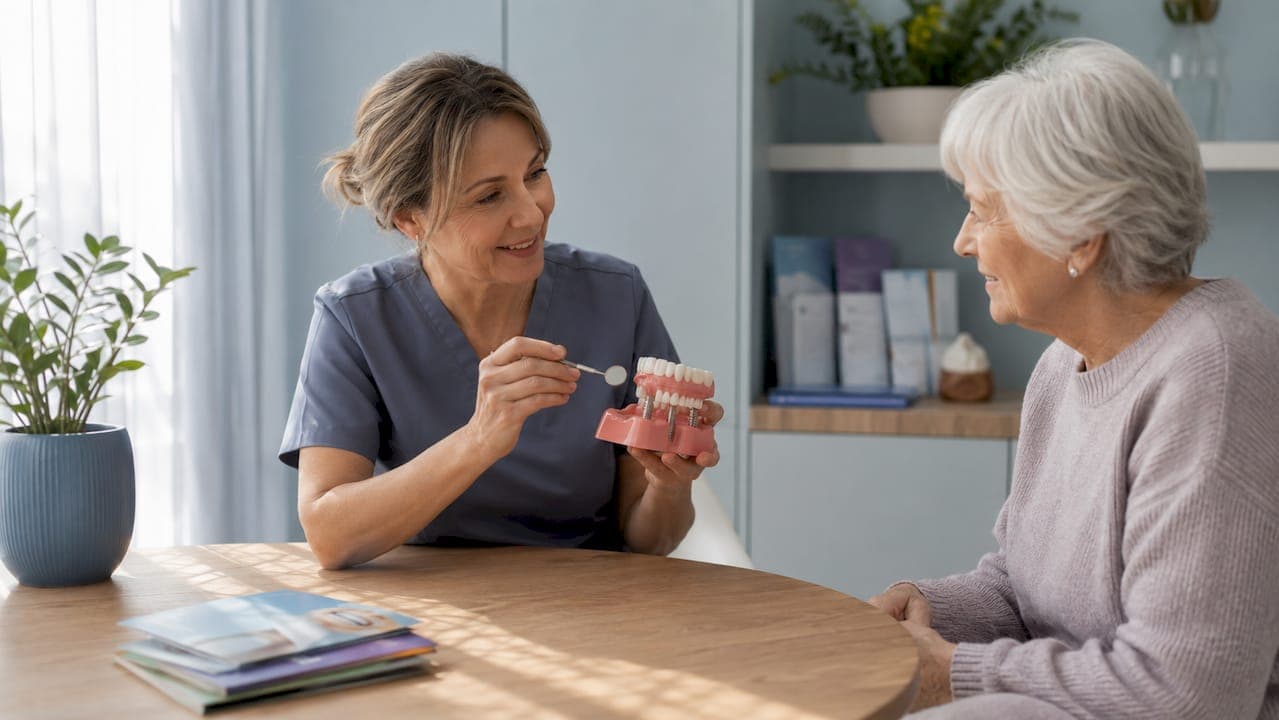
An implant overdenture is defined as a removable dental prosthesis anchored to titanium implants placed in the jawbone, giving patients a stable, functional alternative to conventional dentures. The implant overdenture advantages over traditional dentures are well documented: success rates exceed 95% for mandibular cases, and the McGill Consensus formally recognized the two-implant mandibular overdenture as the new standard of care for edentulous patients. Chewing force, bone preservation, and quality of life all improve measurably. Forever Smiles Implant Center treats patients across these cases daily, and the difference in outcomes is not subtle.
1. Implant overdenture advantages over traditional dentures
The single biggest complaint about conventional dentures is movement. Implant overdentures eliminate that problem by using locator attachments or bar frameworks to snap the prosthesis directly onto implants. The denture cannot shift while eating or speaking.
Chewing force tells the full story. Implant overdentures restore 60%–80% of natural chewing force. Conventional dentures restore roughly 25%. That gap means patients with implant overdentures can eat steak, raw vegetables, and crusty bread without anxiety.

The psychological benefits are equally real. Patients report confident speech and social interaction once denture movement is no longer a concern. Reduced embarrassment is a clinical outcome, not a marketing claim.
Key functional benefits at a glance:
- Retention: Snap-on attachments prevent slipping during meals and conversation.
- Chewing force: 60%–80% of natural bite force restored vs. 25% with conventional dentures.
- Speech clarity: Stable base eliminates the slurring caused by shifting plates.
- Food variety: Patients return to foods they avoided for years.
- Confidence: Reduced denture movement directly improves social comfort.
Pro Tip: Ask your provider to demonstrate the attachment mechanism before surgery. Understanding how locator vs. bar attachments feel helps you choose the right system for your lifestyle.
2. How implant overdentures preserve jawbone
Conventional dentures sit on the gums and transmit no force to the bone beneath. The jaw reads that as a signal to stop maintaining itself. Bone resorption follows, and the ridge shrinks over time, making dentures fit worse every year.
Functional loading from implants reverses that pattern. When you chew, force travels down the implant into the bone, stimulating remodeling the same way natural tooth roots do. This is the principle behind Wolff's Law: bone maintains itself when it receives mechanical stress.
Implant overdentures slow bone loss significantly. They do not stop it entirely because the soft tissue components still receive some forces, but the reduction in bone resorption is clinically meaningful compared to conventional dentures. Patients who act earlier preserve more ridge for future treatment options.
| Factor | Conventional dentures | Implant overdentures |
|---|---|---|
| Bone stimulation | None | Yes, via functional loading |
| Bone resorption rate | Accelerated | Significantly slowed |
| Gum sore spots | Common | Reduced |
| Long-term fit | Degrades as bone shrinks | More stable over time |
Pro Tip: If you have already experienced significant bone loss, ask about bone preservation options before assuming implants are off the table. Many patients who were told "no" elsewhere are still candidates.
3. What implant overdenture maintenance actually involves
Removable implant overdentures are cleaned outside the mouth, which is a genuine advantage for patients with limited hand dexterity. You remove the prosthesis nightly, brush it, and clean around the implant attachments with a soft brush or floss. The routine takes about five minutes.
The one maintenance task patients often overlook is nylon insert replacement every 12–18 months. The nylon inserts inside the locator attachments wear down with daily snapping and unsnapping. When retention weakens, the inserts need swapping, not the implants. This is a quick in-office procedure.
Fixed hybrid bridges require professional cleaning because patients cannot remove them. Specialized brushes and water flosses are necessary, and periodic professional debridement is standard. For patients who prefer simplicity, the removable overdenture wins on hygiene accessibility.
Routine maintenance checklist:
- Daily: Remove and brush the prosthesis; clean around implant abutments.
- Nightly: Soak the overdenture in a non-bleach cleaning solution.
- Every 12–18 months: Replace nylon retention inserts at your provider's office.
- Annually: Full implant and attachment inspection by your dental team.
- As needed: Reline or rebase the prosthesis if fit changes over time.
For a full breakdown of ongoing care, the implant maintenance checklist from Forever Smiles Implant Center covers every step in detail.
4. Cost comparison: what implant overdentures actually cost
Implant overdentures occupy the middle ground in dental prosthetics pricing. Conventional dentures run $1,500–$3,500, implant overdentures run $5,000–$15,000, and fixed hybrid bridges run $15,000–$30,000. The price reflects the number of implants, the attachment system, and the surgical complexity involved.
The cost gap between overdentures and fixed bridges is real, but so is the functional gap. Overdentures restore significantly more chewing force than conventional dentures at a fraction of the fixed bridge price. For patients who want a major upgrade from conventional dentures without committing to a full fixed reconstruction, overdentures deliver strong value.
Long-term costs matter too. Nylon inserts need periodic replacement. Relining may be needed as the jaw changes. These costs are predictable and modest compared to the cost of replacing a poorly fitting conventional denture every few years. Patients who understand the long-term investment in implant treatment consistently report satisfaction with the value.
Financing options exist at most implant centers. Forever Smiles Implant Center offers detailed cost and financing information for patients who want to plan before committing to a consultation.
5. Who is the best candidate for implant overdentures?
The ideal candidate is an edentulous patient, meaning someone who has lost all teeth in one or both arches, who wants significantly better stability than conventional dentures provide but is not ready for or does not need a fixed bridge. The lower jaw is the most common starting point.
Two implants support a mandibular overdenture, while the upper jaw typically requires four or more due to lower bone density and different anatomy. That difference in implant count affects both cost and surgical complexity. Patients with moderate bone loss are often still good candidates, especially in the lower jaw where bone density tends to be higher.
Patients who benefit most from implant overdentures:
- Edentulous patients in the lower jaw seeking stability with fewer implants than a fixed bridge requires.
- Patients with moderate bone loss who are not candidates for fixed full-arch reconstruction without grafting.
- Patients with dexterity challenges who need a removable prosthesis for easier daily hygiene.
- Patients who want improved facial support. Overdentures provide lip and tissue support via flanges that fixed bridges do not replicate.
- Patients who want a proven, cost-effective upgrade from conventional dentures with a strong clinical track record.
Bone grafting sometimes influences the decision. If bone volume is insufficient for standard implants, grafting can create the foundation needed. In more advanced cases, zygomatic implants bypass the upper jaw entirely and anchor in the cheekbone, which is a specialty at Forever Smiles Implant Center.
Key Takeaways
Implant overdentures are the clinically validated standard for edentulous patients who need stable, functional teeth without the cost or complexity of a fixed full-arch bridge.
| Point | Details |
|---|---|
| Clinical success rate | Mandibular overdentures exceed 95% success, making them the standard of care. |
| Chewing force restored | Overdentures restore 60%–80% of natural bite force vs. 25% with conventional dentures. |
| Bone preservation | Functional loading slows jawbone resorption significantly compared to conventional dentures. |
| Maintenance cycle | Nylon inserts need replacement every 12–18 months to maintain retention and fit. |
| Cost position | Implant overdentures ($5,000–$15,000) sit between conventional dentures and fixed bridges in price and function. |
What I've learned after 28,000 implants placed
Most patients arrive at my office having worn conventional dentures for years, sometimes decades. They have adapted their diet, their speech, and even their social habits around a prosthesis that was never doing the job well. What surprises them most after getting implant overdentures is not the stability. It is the food. They order things from a menu they stopped ordering years ago.
The McGill Consensus changed how the profession thinks about edentulous care, and rightly so. Two implants in the lower jaw is not a luxury upgrade. It is the minimum standard a patient deserves. The evidence behind that position is strong, and the patient outcomes I see every day confirm it.
What I tell patients who are weighing cost is this: the difference between a $2,500 conventional denture and a $10,000 implant overdenture is not just money. It is bone. Every year a patient wears a conventional denture, the ridge shrinks. That lost bone narrows future options and raises future costs. Acting earlier preserves more.
The technology side has also improved dramatically. CAD/CAM digital workflows now produce passive fit that manual casting techniques could not reliably achieve. Better fit means fewer complications, longer component life, and less chair time over the years. Patients who get their overdentures done with modern digital planning start ahead and stay ahead.
My honest advice: do not let cost be the only variable you optimize. The right implant surgeon with the right training and volume makes a larger difference to your outcome than the price difference between providers.
— Dr. Brian Young
Full-arch implant care at Forever Smiles Implant Center
Patients who are ready to move beyond conventional dentures have a clear next step. Forever Smiles Implant Center in Jacksonville, Florida, specializes exclusively in full-mouth implant reconstruction. Every case is planned with 3D imaging, performed by a residency-trained surgical specialist, and supported by an in-house dental lab.
Dr. Brian Young has placed over 28,000 implants and performs full-arch surgery daily. The practice handles complex cases, including patients with significant bone loss and previously failed implants. If you want to understand whether implant overdentures or a fixed full-arch solution fits your situation, the dental implants FAQ is the best place to start. For patients ready to explore full-mouth reconstruction, the full-mouth implant guide covers every stage of the process.
FAQ
What makes implant overdentures better than regular dentures?
Implant overdentures snap onto titanium implants, eliminating the shifting and slipping that makes conventional dentures unreliable. They restore 60%–80% of natural chewing force compared to roughly 25% with conventional dentures.
How many implants does an overdenture require?
The lower jaw typically requires two implants, while the upper jaw requires four or more due to lower bone density. The two-implant mandibular overdenture is the recognized standard of care for edentulous lower jaws.
Do implant overdentures prevent bone loss?
Implant overdentures significantly slow jawbone resorption by transmitting chewing forces into the bone, which stimulates remodeling. They do not eliminate bone loss entirely, but the reduction compared to conventional dentures is clinically significant.
How often do implant overdentures need maintenance?
Nylon retention inserts need replacement every 12–18 months to maintain a secure fit. Daily cleaning takes about five minutes and does not require special tools beyond a soft brush and a non-bleach soaking solution.
Are implant overdentures removable?
Yes. Implant overdentures snap on and off, which makes daily hygiene straightforward and is a practical advantage for patients with limited hand dexterity. Fixed hybrid bridges, by contrast, are permanently attached and require professional cleaning.