
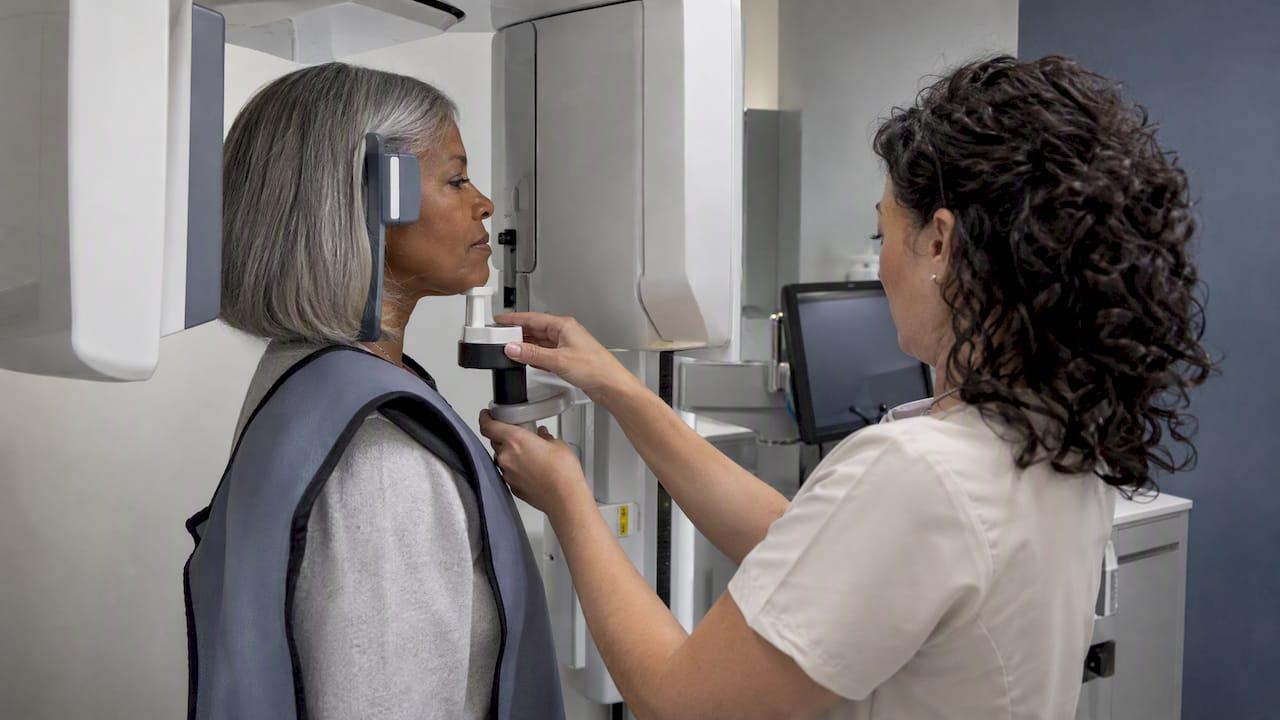
You may be a candidate for zygomatic implants if you are missing most or all of your upper teeth and have been told you do not have enough upper jawbone for conventional implants. These implants anchor in the dense cheekbone (the zygoma) instead of the thinned-out jaw, so many patients with severe bone loss can still get fixed, permanent upper teeth without bone grafting. Candidacy is confirmed with a 3D scan and an exam by a surgeon who does this work regularly.
This guide explains who typically qualifies, which health and anatomical factors matter, how the evaluation works, and what to ask before you commit.
TL;DR
- Zygomatic implants are mainly for the upper jaw, when bone loss is too advanced for standard implants or when grafting is not feasible, predictable, or preferred.
- Typical candidates include long-term denture wearers, people with severe gum disease, patients whose earlier implants or grafts failed, and people who want to avoid staged graft surgeries.
- Restricted mouth opening, active sinus or local disease, certain medications, and prior radiation need individual review, and a 3D scan decides the rest.
- Outcomes depend heavily on the surgeon's skill and experience, so choose a specialist team that places these implants regularly.
- At Forever Smiles in Jacksonville, candidacy is assessed by Dr. Young with 3D imaging before any plan is made.
Table of Contents
- What zygomatic implants are, and why the upper jaw is the focus
- The profile of a typical candidate
- Health and anatomy: what gets reviewed before you are cleared
- How a surgeon decides whether you are a candidate
- Zygomatic implants versus grafting and conventional options
- Why surgeon experience is part of candidacy
- Perspective: why we treat these cases as our daily work
- Cost and what to expect from the plan
- Think you may be a candidate? Start with a scan
- FAQ
- Sources
What zygomatic implants are, and why the upper jaw is the focus
A conventional implant needs bone to grip. In the upper jaw, that bone is often the first thing to go. After teeth are lost, the ridge shrinks, and the sinuses can expand downward into the space where bone used to be. Severe maxillary atrophy limits the bone available for conventional implants, and zygomatic implants are a graftless alternative to augmentation.
A zygomatic implant is much longer than a standard one. Instead of sitting in the thin ridge, it passes along the side of the sinus and anchors in the zygomatic bone, the strong bone of the cheek. Placed together with other implants, it supports a fixed arch of teeth. According to an international consensus from a professional implant academy, zygomatic implants can support fixed or removable prostheses in edentulous maxillae, with a mean survival rate of 97% when splinted to other implants.

That is why the keyword here is the upper jaw. The lower jaw rarely loses bone in the way that calls for cheekbone anchorage, so zygomatic treatment is essentially an upper arch solution. You can read how we approach it on our zygomatic implants page.
The profile of a typical candidate
No single checklist fits everyone, but the same situations come up again and again. The professional consensus describes candidates as patients with maxillary bone atrophy or deficiency, bone loss after resection, trauma or congenital defects, failed implants or grafts, or a need to avoid staged grafting. In everyday terms, that usually means one of these stories.
You have worn an upper denture for many years
Bone needs the stimulation of tooth roots. Without it, the ridge keeps shrinking. Researchers note that long periods of maxillary denture wear or severe periodontal problems can lead to severe maxillary atrophy that hampers implant placement. If your denture has become loose, needs constant adhesive, or no longer seats the way it did, that shrinkage is often the reason, and it is also what can make you a zygomatic candidate.
If this is you, our guide on permanent teeth despite bone resorption walks through your options in more depth.
You were told you do not have enough bone
This is the most common reason patients reach us. Many arrive after another office said they were not candidates for implants. Being turned down for conventional implants is not the same as being ineligible for every implant. The consensus statement notes that patients for whom conventional implants cannot be placed in the posterior and anterior maxilla may be considered for quad zygomatic implants when grafting is not feasible, predictable, or preferred. Quad zygomatic means two zygomatic implants on each side.
For a broader look at the question, see dental implants with bone loss, which covers how bone loss affects implant planning.
Your earlier implants or bone grafts failed
A failed graft or failed implant does not close the door. A systematic review of the indications found that zygomatic implants are considered after failed implants or grafts, when medical compromise contraindicates staged grafting, or when patients prefer a graftless approach. Fixing previously placed implants that have failed is a core part of our work, and it is one reason a surgeon's experience matters so much.
You want to avoid multiple surgeries
Bone grafting for the upper jaw often means a graft surgery, months of healing, and only then implants. Candidates often include patients unwilling or unable to tolerate multiple procedures. Authors reviewing the atrophic maxilla also point out that augmentation may be more time-consuming and costly than graftless solutions like zygomatic implants. If you want to understand what grafting involves, this explanation of bone grafts for implants sets out what to expect, and our own page on dental implants without a bone graft covers the graftless route.
You have a defect from trauma, cysts, or surgery
The consensus also lists conditions that complicate grafting: zygomatic implants are indicated for patients avoiding staged bone graft procedures and for conditions such as benign cysts and trauma. Bone loss after tumor resection and congenital defects fall in the same family of cases and are handled with a coordinated, individual plan.
Health and anatomy: what gets reviewed before you are cleared
A good candidacy review is not about finding reasons to say no. It is about making the plan safe. A surgical commentary in the Journal of Oral and Maxillofacial Surgery describes absolute contraindications as restricted mouth opening, inability to tolerate anesthesia, and local pathologic features. Here is what each means in practice.
| Factor | Why it matters | What happens in evaluation |
|---|---|---|
| Mouth opening | The surgeon needs room to reach the cheekbone region | Measured at the exam |
| Anesthesia tolerance | Surgery is typically done under sedation or general anesthesia | Medical history review and anesthesia planning |
| Local pathology | Cysts, tumors, or infection in the area must be dealt with first | Examined on the 3D scan |
| Sinus health | Active sinus disease may change the plan, though chronic sinusitis is accepted | CT or CBCT of the sinuses |
| Bisphosphonates or prior radiation | These are relative factors that need individual review | Coordination with your physician or oncologist |
| Cheekbone volume | The same commentary says at least 7 mm of anchorage into the zygoma is required for stability, with more if two implants are used | Measured on the scan |
The JOMS commentary calls active maxillary sinus pathology and the use of bisphosphonates or prior radiation therapy relative factors, and notes chronic sinusitis is accepted. Relative means it is weighed case by case. If you take a bisphosphonate for osteoporosis, have had head and neck radiation, or have a history of sinus problems, tell us at your first visit. Your medication and radiation history should be reviewed with your prescribing physician or oncologist, not changed on your own.
Smoking, diabetes control, and general health also affect healing for any implant surgery. Our team reviews your full history, and our MD anesthesiologist is part of the planning for complex cases.
For a full picture of the risks and how they are measured, read our evidence-first guide to zygomatic implant risks.
How a surgeon decides whether you are a candidate
The evaluation has a clear sequence. Clinicians use CT or CBCT scans that include the mid-face to assess maxillary and zygomatic bone volume and sinus health, and may use objective criteria such as the Cawood and Howell classification. The surgical commentary adds that the preoperative evaluation must include a full history, physical examination, and CBCT imaging to assess bone volume and the distance from the alveolar ridge to the zygoma body.
Here is how that looks at a specialist center.
- Health history and exam. Medications, medical conditions, past surgeries, and your dental history, including how long you have worn dentures.
- 3D imaging. A CBCT scan shows the ridge, the sinuses, and the cheekbone in three dimensions.
- Bone classification. Surgeons may use a radiographic tool such as the Bedrossian classification, which uses zones to assess bone availability and guide the surgical approach.
- Option comparison. Standard implants, tilted implants, grafting, and zygomatic implants are weighed against your goals. The consensus is clear that each site should be analyzed individually, with options discussed in light of risks, benefits, patient preferences, and conditions.
- Smile design and a written plan. You see the plan before surgery, including what happens on the day and how the final teeth are made.
One point worth knowing: same-day teeth are a possible benefit, not a reason to choose the procedure. A systematic review states that immediate loading is a potential benefit, not a clear indication, and depends on the surgical and restorative team's expertise and intraoperative findings. That is why the planning, the surgeon, and an in-house lab matter more than any promise made in advance.
Zygomatic implants versus grafting and conventional options
Severe bone loss does not have only one answer. Here are the main paths and who each tends to suit.
| Option | Best suited to | Trade-off to discuss |
|---|---|---|
| Conventional implants | Enough healthy ridge bone | Not possible when the ridge is too thin or the sinuses are low |
| Tilted (angled) implants | Moderate loss where the front bone is sound | Needs enough bone in the right zones |
| Bone grafting, then implants | Patients who accept staged treatment | More surgeries and a longer timeline |
| Zygomatic implants | Severe upper jaw loss, failed grafts, or a wish to avoid grafting | Requires a surgeon with specific training and a CBCT-based plan |
The academic literature supports this ladder. The review of the atrophic maxilla lists tilted or angled implants to avoid pneumatized sinuses, or bone augmentation, as alternatives. Zygomatic treatment sits at the end of the ladder for the most advanced cases, and for patients who want to skip the graft stage.
If you are also comparing implants with other ways of replacing teeth, our page on implants versus dentures is a good next step.
Why surgeon experience is part of candidacy
You can be an anatomically perfect candidate and still have a poor result if the surgeon rarely does this work. The consensus statement says that the success of zygomatic implant treatment is highly dependent on the skill and experience of the clinician, necessitating specialized surgical and restorative expertise.
When you interview a practice, ask:
- How many zygomatic cases does the surgeon place in a typical month?
- Is the surgeon residency-trained in surgery, or a general dentist who added implants?
- Who provides anesthesia, and are they a physician anesthesiologist?
- Is the lab in the same building, so the final teeth can be adjusted quickly?
- Will you see your 3D scan and a written plan before you decide?
- What happens if a previously placed implant needs to be removed or repaired?
A candidate who gets clear, specific answers to these questions is in a far better position than one who hears only a price.
Perspective: why we treat these cases as our daily work
We built Forever Smiles around one kind of patient: someone who has run out of easy options. Most people who ask us about zygomatic implants have already been told they cannot have implants, or they have a denture that no longer stays put.
Our view is simple. Candidacy is a surgical judgment, not a sales conversation. I am a residency-trained surgical specialist, and full-arch reconstruction is what our team does every day. We study the CBCT scan, plan each case in advance, and decide whether zygomatic implants, tilted implants, or another approach gives you the most predictable permanent result.
We also believe the whole process should sit under one roof: surgical planning, surgery with a board-certified MD anesthesiologist, an in-house dental lab, and final custom zirconia teeth. One accountable team means fewer hand-offs and fewer surprises.
Our guiding idea is that experience is not expensive, inexperience is. Doing it once and doing it right is the goal of every plan we write.
Dr. Brian Young
Cost and what to expect from the plan
For full-arch treatment, our published prices are $19,000 per arch for All-on-4 Zirconia and from $19,500 per arch for Full-Mouth Zirconia Implants. Treatment is built around your specific needs, and the price includes planning, surgery, teeth the same day, final zirconia teeth, and follow-up care. We do not publish a fixed price for zygomatic cases, because the plan depends on your anatomy and what the scan shows. You will receive a clear figure after your evaluation. Payment plans and financing are available, and you can see the details on our cost and financing page.
Recovery is also part of the plan. Our surgeon-backed 3 to 6 month zygomatic recovery timeline explains what the healing phases look like, and how the temporary and final teeth fit into them.
Think you may be a candidate? Start with a scan
If you are missing most or all of your upper teeth, if your denture is failing, or if you have been told you lack the bone, the next step is a specialist evaluation with 3D imaging. At Forever Smiles Implant Center in Jacksonville, Dr. Young reviews your scan, explains your options in plain language, and tells you honestly which approach fits.
See how our full-mouth implant treatment works, or go to foreversmilesjax.com to request your consultation.
FAQ
Can I be a candidate for zygomatic implants if I have worn dentures for decades?
Yes, long-term denture wear is one of the most common reasons patients need them. Years without tooth roots lead to shrinking of the upper ridge, which can make conventional implants hard to place. A 3D scan will show how much bone you have left and whether the cheekbone offers enough anchorage.
Are zygomatic implants only for the upper jaw?
Yes. They anchor in the cheekbone, which sits above the upper jaw, so they are used for the maxilla. Lower-jaw cases are typically planned with conventional or angled implants in the available bone.
Does a history of sinus problems rule me out?
Not automatically. Surgical literature accepts chronic sinusitis, while active sinus disease may need treatment first or a different plan. Your CT or CBCT scan and your history will show which applies to you, and an ENT physician may be involved if needed.
Do I need a bone graft before zygomatic implants?
One reason surgeons choose zygomatic implants is to avoid staged grafting. Whether a graft is needed in your case depends on the scan and the plan the surgeon designs for you.
Who is a poor fit for zygomatic implants?
People with restricted mouth opening, those who cannot safely tolerate anesthesia, and those with local disease in the area need individual review. Use of bisphosphonates or prior radiation therapy is weighed case by case. Your surgeon will tell you clearly whether to proceed, treat something first, or choose another option.
Sources
- Indications for Zygomatic Implants, consensus statements (ITI Academy)
- Indications for Zygomatic Implants, consensus statements, academy edition (ITI Academy)
- Indications for zygomatic implants: a systematic review (PMC)
- The severely atrophic maxilla: decision making (PMC)
- Commentary: Step-by-Step Zygomatic Implants (Journal of Oral and Maxillofacial Surgery)
- Can I Get Dental Implants with Bone Loss?
- Bone Graft for Implants: What It Is and What to Expect