
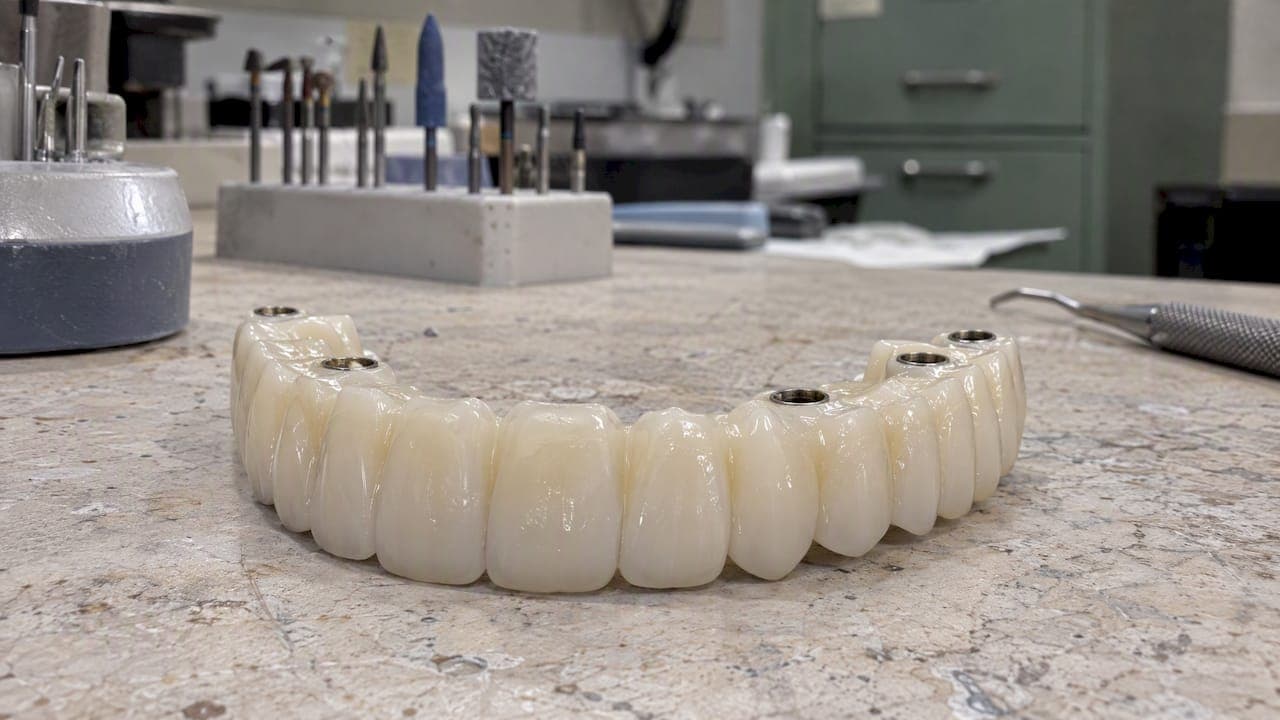
Custom zirconia teeth are made in stages. First comes planning and implant surgery. Then a temporary set of teeth carries you through healing. Finally, a lab mills, sinters, stains and glazes your permanent zirconia arch to fit your implants, your bite and your smile. Each stage exists to answer one question: will this arch fit, feel and look right before it becomes permanent?
Below, we walk through every stage the way a surgical team sees it, explain what the lab does with your arch, and cover timelines, care and risks.
TL;DR
- Custom zirconia teeth are a fixed arch of milled zirconia that attaches to dental implants. They are designed for your mouth, not picked from a shelf.
- The path runs from imaging and planning to implant surgery, healing, a temporary try-in, and the final zirconia delivery.
- The final restorative phase can take one to six months or longer, depending on the complexity of the case and how long bone needs to heal.
- Zirconia resists staining and plaque, but it still needs daily cleaning and professional checkups every 2 to 6 months.
- At Forever Smiles, All-on-4 Zirconia is $19,000 per arch, and the planning, surgery, same-day teeth, final zirconia teeth and follow-up care are included.
Table of Contents
- What custom zirconia teeth actually are
- The full process, step by step
- How long does the process take?
- Why a surgical team and an in-house lab matter
- Our perspective
- Cost: what the price covers
- Caring for your zirconia teeth
- Risks and complications to understand
- Questions to ask before you choose a provider
- FAQ
- Sources
What custom zirconia teeth actually are
Zirconia is a ceramic. In full-arch dentistry, it is milled into a single fixed bridge of teeth that screws onto implants placed in your jaw. "Custom" means the shape, shade, length, tooth arrangement and bite are designed from your face, your jaw position and your approved trial teeth.
Why do so many surgeons choose it? A 2023 review of zirconia for implant-supported fixed complete prostheses reports good biocompatibility, high flexural strength, less plaque accumulation and resistance to staining compared with resin-based materials. Those are the properties a full arch needs, because it sits in your mouth for years and takes real chewing force.
The American College of Prosthodontists also treats the material as its own category. Its definitions of implant dental prostheses note that a fixed complete prosthesis made from monolithic zirconia differs distinctly in cost and performance from an acrylic and titanium hybrid. If someone quotes you a price for "a full arch," ask which of these it is.
Temporary teeth versus final zirconia teeth
The temporary teeth and the final teeth do different jobs.
| Temporary teeth | Final custom zirconia teeth | |
|---|---|---|
| Purpose | Let you leave surgery with teeth and protect healing | Permanent, long-term function and appearance |
| Typical material | Acrylic-type resin (PMMA) | Milled, sintered, stained and glazed zirconia |
| Design role | A working draft of your smile and bite | The finished design, refined from the draft |
| When it is made | Around surgery | After the implants have healed |
The temporary set is also a test drive. How it feels when you speak, smile and chew tells the team what to keep and what to adjust in the final design.
The full process, step by step
Every practice sequences things a little differently, and your case can change the order. This is the typical path for a full-arch zirconia restoration.
Step 1: Imaging, evaluation and smile design
The process starts with a diagnosis. The team looks at your teeth, gums, existing dentures or failing implants, and the bone available in your jaws. 3D imaging shows where bone is solid, where it has shrunk, and where the sinuses and nerves sit.
This is also where design begins. The team looks at how much of your teeth shows when you smile, how your lips sit, and how your jaws meet. These details decide the length and shape of your final teeth, and it is far easier to plan them before surgery than to fix them afterward.
The American Dental Association encourages patients to discuss all treatment options, including alternatives to full-arch implants, with their dentist so healthy teeth are preserved. A good consultation includes that conversation. If you want the bigger picture first, our specialist's guide to replacing all teeth with implants covers the options.

Step 2: Surgical planning
A full-arch case should be planned before the day of surgery, not improvised during it. The plan sets the number of implants, their angles and positions, and whether any teeth need to come out. It also covers how the temporary teeth will attach.
For patients with little bone, planning also decides whether standard implants will work or whether longer anchors such as zygomatic implants are needed. Those anchor in the cheekbone instead of the thin upper jaw. Our page on zygomatic implants explains when they come into play.
Step 3: Implant surgery and same-day teeth
Surgery involves drilling into the jawbone and placing the implants. Afterward comes a healing period called osseointegration, when the implants fuse with the bone. For a deeper look at that stage, read our guide to dental implant osseointegration.
At Forever Smiles, you leave surgery with teeth the same day. These are the temporary teeth described above. They are for looking normal, speaking and eating carefully while the bone heals. They are not the finished product.
Step 4: Healing
During healing, the bone grows onto the implant surfaces. This is not a stage to rush. The restorative phase can take anywhere from one to six months or longer, according to the American Academy of Implant Dentistry, and site preparation or extra time for bone to heal can extend it further.
In this window you will follow a softer diet and a gentle cleaning routine. Your team will tell you exactly what to do, and it is worth following to the letter.
Step 5: Capturing the exact position of your implants
Once the implants are stable, the team needs a precise record of where each one sits. A 2024 review of fixed full-arch implant restorations describes acquiring implant-position data through intraoral scanning or photogrammetry. Traditional impressions are also still used in some workflows.
Why so much care? A full arch is one rigid piece connected to several implants. If it does not fit passively, meaning without strain, it can put stress on the screws and the implants. Verification steps, such as checking the record against a rigid jig, exist to catch errors before the final arch is made.
Step 6: The try-in
Before anything is milled in zirconia, you try a prototype. The same 2024 review explains that a PMMA try-in is used to validate fit before the zirconia is milled. This is your chance to judge the design in real life.
Here is what to check at the try-in:
- Smile line: how much tooth and gum show when you smile broadly.
- Tooth length and shape: whether they suit your face and age.
- Shade: whether the brightness looks natural next to your skin and eyes.
- Speech: whether S and F sounds are clear.
- Bite: whether the upper and lower teeth meet evenly, without a high spot.
- Cleaning access: whether you and your hygienist can reach underneath.
Speak up now. Changes made at the try-in are cheap and fast. Changes after the zirconia is made can mean starting that stage over.
Step 7: How the lab makes the zirconia arch
Once the design is approved, the lab turns it into the final arch. Per the review of full-arch techniques, the sequence is milling, sintering, staining, glazing and delivery. In plain terms:
- Design: the approved try-in is scanned and the final arch is designed in software.
- Milling: a machine cuts the arch from a zirconia block, in an oversized, softer state.
- Sintering: a furnace heats the milled arch at very high temperature, which shrinks it to final size and makes it hard.
- Staining and glazing: the lab adds natural color variation to the teeth and gums, then glazes the surface for a smooth finish.
- Quality check: the arch is checked on the model for fit and contacts before it goes to you.
Having the dental lab under the same roof as the surgeon, as we do, means the person making your teeth can talk directly with the person who placed your implants. A design question is answered in a hallway, not in an email chain.
Step 8: Delivery and bite adjustment
On delivery day, the final arch is fitted, screws are tightened to the specified torque, and the bite is checked and fine-tuned. The access holes for the screws are covered. You will get instructions for cleaning and a schedule for follow-up visits.
Some patients need minor refinements afterward. That is normal, because chewing, speech and muscle habits settle in over the first weeks.
How long does the process take?
There is no honest single number. The AAID reports that the restorative phase can run one to six months or longer, and that site preparation and bone healing can add time. Here is what moves your timeline:
- Bone quality and quantity. Dense bone usually heals predictably. Thin or damaged bone may call for more planning or a different implant strategy.
- Extractions. Teeth that must come out add healing considerations.
- Previously failed implants. Removing and replacing them adds a step.
- Health factors. Smoking, diabetes control and gum disease history can affect healing and risk.
- Design refinements. An extra try-in round adds days, but it can save you from a poor final result.
If you are moving from dentures, our dental implant process from dentures guide shows what that path usually looks like.
Why a surgical team and an in-house lab matter
The most common problem with full-arch work is not the zirconia itself. It is a handoff problem. One office places implants, a second office makes the teeth, and a third reviews the bite. Nobody owns the whole result.
At Forever Smiles Implant Center, surgical planning, surgery, the dental lab and the final zirconia teeth all happen in one place with one accountable team. Anesthesia is provided by a board-certified MD anesthesiologist. That structure is why we can take on cases other offices turn away, including previously failed implants and severe bone loss.
Our perspective
We treat the final teeth as the end of a surgical plan, not a separate product. By the time we design your zirconia arch, the position of every implant has already been chosen with the teeth in mind. That order matters. When teeth are an afterthought, the lab is left compensating for implants that sit in awkward places.
We also believe patients should see the design before they commit to it. The temporary teeth and the try-in are not formalities. They are how you judge the result with your own eyes, and how we make sure the permanent arch is right the first time. Our philosophy is simple: experience isn't expensive, inexperience is. A full arch is meant to be done once and done right.
What we ask in return is patience with healing. Bone cannot be hurried, and a rushed final arch is the surest way to create problems later.
— Dr. Brian Young
Cost: what the price covers
Price questions come up at every consultation, so here are the numbers we publish. All-on-4 Zirconia is $19,000 per arch. Full-Mouth Zirconia Implants start from $19,500 per arch. Your specific needs determine where your case falls.
The price includes planning, surgery, teeth the same day, final zirconia teeth and follow-up care. That matters when you compare quotes, because some offers list surgery alone, and others quote a resin-based arch rather than final zirconia. Ask every office what is included and which material the final teeth are made of.

We do not compete on being the cheapest. We compete on getting a complex case right. Details and financing options are on our cost and financing page.
If you have been told you are not a candidate, or you have implants that failed, a consultation is the place to find out what is possible. See our full-arch implants page, or book a visit with our Jacksonville team.
Caring for your zirconia teeth
Zirconia does not decay, but the gums and bone around your implants can still get inflamed if plaque builds up. Home care is the foundation.
The American College of Prosthodontists' position statement on maintaining full-arch implant restorations lists daily brushing, flossing and interdental cleaners or water irrigators. It recommends professional appointments every 2 to 6 months based on your risk, for example a history of periodontitis or smoking. At those visits, the clinician checks soft tissues, plaque and calculus and cleans the restoration. Radiographs are taken every 1 to 2 years.
For practical routines, see our guides on how to clean an implant-supported arch and our implant-supported teeth maintenance checklist.
Risks and complications to understand
No full-arch restoration is risk-free. The 2024 review of full-arch restorations lists biological complications such as peri-mucositis and peri-implantitis, which are inflammation of the tissue around an implant. It also lists technical ones: fractures, chipping, component debonding, and screw fracture or loosening.
Material choice affects some of these. The same review notes that monolithic zirconia may solve the ceramic chipping associated with zirconia-ceramic and metal-ceramic prostheses. A clinical review of monolithic zirconia similarly suggests that a full monolithic zirconia chewing surface appears to be a solution to chipping complications.
What can you do? Keep your maintenance appointments, clean daily, and tell your team early about a loose feeling, a bad taste, bleeding or a change in your bite. Smokers and people with a history of gum disease should talk to their surgeon about the added risk before treatment, because those factors shape the maintenance schedule.
If you are weighing fixed zirconia against other options, read our piece on the questions to ask about a fixed zirconia bridge.
Questions to ask before you choose a provider
- Who places the implants, and what is their surgical training?
- Who designs and makes the final teeth, and where?
- Will I get to try in the design before the zirconia is made?
- Is the final arch monolithic zirconia, and what does the quote include?
- What happens if an implant fails or a part fractures?
- How often will I need to come back for maintenance?
The answers tell you whether the practice treats full-arch work as its main craft or as an add-on.
FAQ
How long does it take to get final zirconia teeth?
There is no fixed answer. The restorative phase can take one to six months or longer, depending on case complexity and how long your bone needs to heal. You wear temporary teeth in the meantime.
Are the teeth I get on surgery day permanent?
No. They are temporary teeth that protect healing and let you leave with a smile. The permanent custom zirconia arch is made after the implants have fused with your bone.
Why does the try-in matter so much?
It lets you judge shade, shape, speech and bite on a prototype before the zirconia is milled. Changes at this point are simple, while changes after sintering can mean remaking the arch.
Do zirconia teeth need special care?
Yes, though not complicated care. You clean daily with a brush, floss or interdental tools, and attend professional visits every 2 to 6 months depending on your risk. Your team will set the schedule.
Can I get zirconia teeth if I have little bone?
Sometimes, yes. Bone loss changes the surgical plan, and options such as zygomatic implants may be considered. A 3D scan and a surgical consultation are the only reliable way to know.
Sources
- The Use of Zirconia for Implant-Supported Fixed Complete Dental Prostheses (PMC, 2023)
- Definitions of Implant Dental Prostheses (American College of Prosthodontists)
- Statement on Dental Implant Practices in the News (American Dental Association)
- Dental implant patient brochure (American Academy of Implant Dentistry)
- Teeth in a Day: Myth or Reality? (American Academy of Implant Dentistry)
- Fixed Full-Arch Implant-Supported Restorations: Techniques (PMC, 2024)
- Position Statement: Maintenance of Full-Arch Implant Restorations (American College of Prosthodontists)
- Clinical Advantages and Limitations of Monolithic Zirconia Restorations (PMC, 2015)