
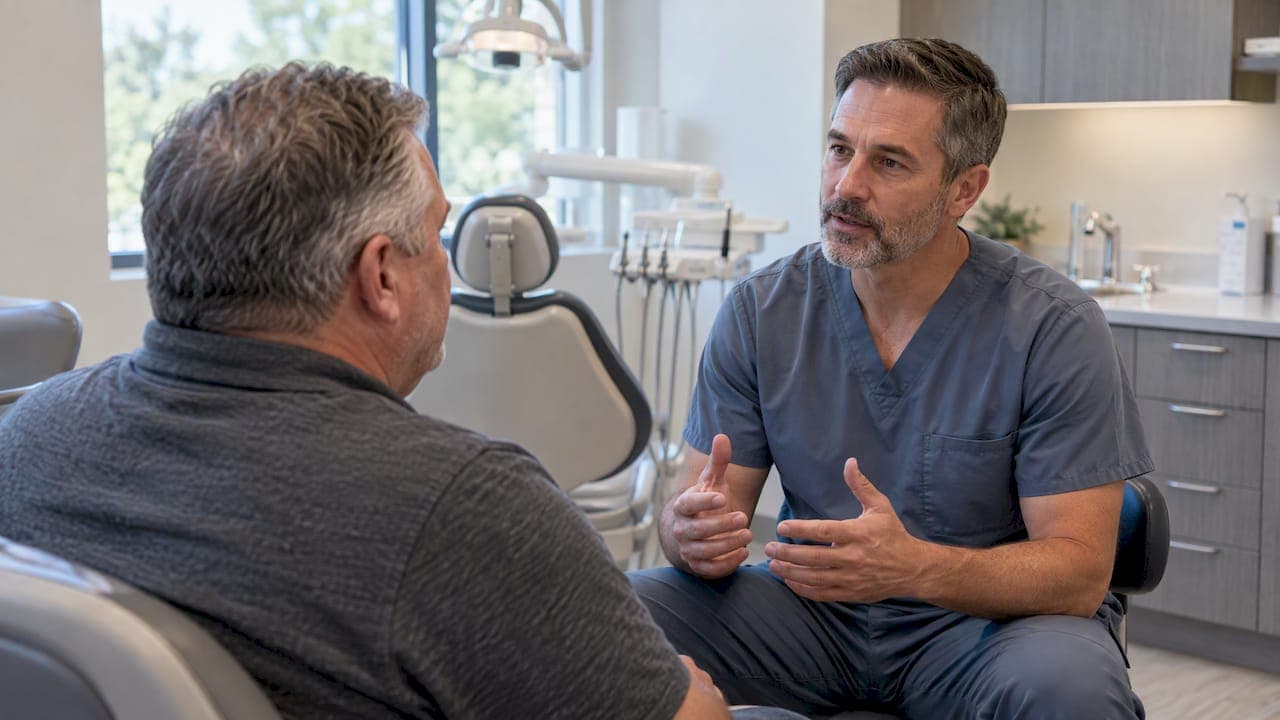
Yes, smokers can get dental implants, but smoking roughly doubles the risk of implant failure compared with non-smokers, and quitting before and after surgery meaningfully improves those odds. Smoking does not automatically disqualify anyone from treatment. It does change the conversation you need to have with your surgical team about timing, technique, and realistic expectations.
TL;DR:
- Heavy smokers over 20 cigarettes daily face approximately four times the risk of implant failure compared to non-smokers, with overall risk roughly doubling.
- Nicotine constricts blood vessels, reducing oxygen and nutrients delivery, which impairs bone healing and slows proper integration of implants.
- Smoking elevates inflammatory markers around the implant site and can mask early signs of inflammation, making monitoring more crucial.
- Quitting at least two weeks before surgery and avoiding smoking for the first four weeks post-op significantly improve healing outcomes.
- Most surgeons still proceed with implants in smokers but adjust planning, timing, and provide cessation resources to mitigate risks.
Table of Contents
- How smoking affects implant healing at the cellular level
- How much smoking raises the odds of implant failure
- Can smokers get dental implants? Candidacy and shared decision-making
- When to stop smoking and if you can ever resume
- Practical steps to lower your risk before and after surgery
- Recovery milestones and warning signs after implant surgery
- How a specialist approaches full-arch care for smokers
- How Forever Smiles supports smokers considering full-mouth implants
- FAQ
- Sources
How smoking affects implant healing at the cellular level
Nicotine constricts blood vessels, which cuts oxygen and nutrient delivery to the gum and bone tissue your implant depends on during the first weeks after surgery. That reduced blood flow slows the two processes that make an implant stick: angiogenesis (new blood vessel growth) and osteoblast activity, the bone-building cells that lock the implant into your jaw. Without adequate blood supply, osseointegration, the process where bone fuses to the implant surface, happens more slowly and less completely.
Smoking also shifts the bacterial environment in your mouth and ramps up inflammatory signaling. Research on tobacco and smoke-free nicotine products shows elevated levels of inflammatory markers like IL-1β and TNF-α in the fluid around implants in smokers and vapers, with cigarette smokers showing the largest increases among all nicotine users studied. Here is the complication: smokers sometimes show less visible bleeding when probed, which can look like a good sign. It is not. That reduced bleeding can mask active inflammation and delay diagnosis of peri-implant disease until it is more advanced.
- Vasoconstriction from nicotine reduces oxygen delivery to healing tissue.
- Smoking impairs osteoblast function and slows new blood vessel formation.
- Elevated IL-1β and TNF-α levels correlate with worse peri-implant bone and gum health.
Smokers face elevated inflammatory markers and reduced bleeding on probing that can mask early disease, which makes routine monitoring more important, not less.
How much smoking raises the odds of implant failure

Pooled data from multiple systematic reviews puts the implant failure risk in smokers at roughly double that of non-smokers, with some analyses reporting risk ratios in the 2.2 to 2.5 range and a 140% higher risk of failure in some pooled estimates. That is not a small effect, and it tracks closely with how much someone smokes.
A dedicated systematic review and meta-analysis on smoking levels found a clear dose-response relationship: heavy smokers consuming more than 20 cigarettes a day had a patient-based risk ratio for implant failure of roughly 4.0 compared with non-smokers, a far steeper risk than lighter smokers face according to the pooled analysis.
- Pooled risk ratios across reviews cluster around 2 to 2.5 times higher failure risk in smokers.
- Heavy smokers (over 20 cigarettes daily) face roughly 4 times the failure risk of non-smokers.
- Marginal bone loss also tends to be higher in smokers, though the exact amount varies by study design.
These numbers come from studies with different follow-up periods, implant systems, and patient populations, so treat any single figure as a range rather than a guarantee. Grafting history, implant site, and underlying gum disease all shift the picture further.
Can smokers get dental implants? Candidacy and shared decision-making
Smoking is a significant risk factor, not an automatic disqualifier. Most surgeons will still place implants in smokers, but the decision usually involves a more detailed conversation about risk, timing, and what happens if the first attempt does not integrate well.
Several factors interact with smoking status to shift candidacy:
- A history of periodontitis compounds smoking's effect on bone and gum health.
- Uncontrolled diabetes adds its own healing impairment on top of smoking's effects.
- Cases requiring bone grafting carry added risk when the patient also smokes.
- Upper jaw (maxillary) sites tend to have softer bone and already run a higher baseline failure rate.
A responsible informed-consent conversation lays out the actual risk numbers, explains why cessation matters, and gives you a realistic picture of what could go wrong and how it would be managed. Depending on your case, your surgeon might recommend delaying surgery until you have cut back or quit, staging bone grafts separately from implant placement, or adjusting the prosthetic plan to reduce load on any single implant site.
When to stop smoking and if you can ever resume

The earlier you stop before surgery, the better your healing odds, but even a short window helps. Many clinicians recommend quitting at least one to four weeks before surgery when that timeline is feasible, since blood flow and tissue oxygenation start recovering within days of your last cigarette.
The first 72 hours after surgery are the most fragile period for clot stability, and the following few weeks are when early bone-to-implant contact forms. Smoking during this window directly works against both processes.
- Set a quit date at least two weeks before your scheduled surgery, earlier if possible.
- Avoid smoking entirely through the first two to four weeks of healing, the window when osseointegration is most vulnerable.
- Ask your surgeon about nicotine replacement options, since nicotine itself still constricts blood vessels and impairs healing regardless of delivery method, so these aids are used with caution and under guidance rather than as a free substitute.
- Schedule a follow-up check specifically to confirm healing is on track before considering any return to smoking.
Pro Tip: Write your quit date and follow-up appointments into your calendar before surgery, not after, so cessation becomes part of the treatment plan rather than an afterthought.
Practical steps to lower your risk before and after surgery
A few concrete actions make a measurable difference in outcomes, and most of them cost nothing beyond effort and follow-through.
Ask your dental team to walk through the 5As framework: Ask about your smoking habits, Advise on quitting, Assess your readiness, Assist with resources like a QuitLine or pharmacotherapy, and Arrange follow-up. This structured approach, paired with medication support, improves long-term quit rates and surgical outcomes together.
- Start a pre-op oral hygiene routine with antiseptic rinses a week or more before surgery.
- Avoid all smoking during the critical early healing window, even if you plan to resume later.
- Coordinate perioperative antibiotics or antiseptic protocols with your surgeon as clinically indicated.
- Keep every follow-up imaging appointment so bone integration can be checked on schedule.
- Build a long-term maintenance routine, since professional cleanings and early reporting of symptoms catch problems before they become implant failures, a point covered in more detail in our maintenance checklist for implant-supported teeth.
A practical aftercare guide from another dental practice echoes the same theme: consistent hygiene and prompt attention to minor symptoms prevent most of the serious complications smokers worry about.
Pro Tip: Keep a simple symptom log for the first month, noting swelling, pain level, and any drainage, so you and your surgeon can spot a trend before it becomes a problem.
Recovery milestones and warning signs after implant surgery
Normal healing looks like steadily decreasing pain and swelling that peaks in the first two to three days, then fades over one to two weeks. Our implant recovery guide covers what a typical timeline looks like in more detail.
Watch for these signs that something is off track:
- Pain that increases instead of decreases after the first few days.
- Persistent drainage, bad taste, or bleeding beyond the initial healing period.
- Any looseness or mobility in the implant itself.
- Fever, facial swelling that spreads, or other signs of systemic infection.
Peri-implantitis, inflammation and bone loss around an integrated implant, often starts quietly with gum redness and mild bleeding before progressing to bone loss if untreated. Early treatment matters far more than late treatment. If an implant does fail, salvage options range from site treatment and re-grafting to replacement with a new implant once the area has healed, and understanding why implants fail in the first place helps set realistic expectations going in.
How a specialist approaches full-arch care for smokers
Dr. Brian Young, a residency-trained surgical specialist who has placed over 28,000 implants, treats smoking status as a planning variable, not a stop sign. Full-arch workflows built around 3D imaging, an in-house dental lab, and an MD anesthesiologist on the surgical team allow for more precise staging and closer monitoring of healing in higher-risk patients. Candid risk disclosure and cessation support are part of that planning conversation, paired with surgical choices tailored to each patient's bone quality and smoking history.
— Dr. Brian Young
How Forever Smiles supports smokers considering full-mouth implants
If you smoke and need full-mouth reconstruction, same-day teeth, or a fix for implants that failed elsewhere, our team-based surgical center plans around that risk rather than ignoring it. We handle complex cases, including severe bone loss treated with zygomatic implants, with surgical planning, placement, and final zirconia teeth under one roof.
A consultation with us covers your specific risk profile, a honest discussion of smoking's effect on your timeline, and cessation resources where they help your outcome. Explore our full arch implant options or full-mouth implant solutions and schedule a consultation to find out what your case needs.
This article is general information, not a substitute for advice from a qualified doctor. Consult a qualified healthcare professional about your own circumstances before acting on anything here.
FAQ
Can you have dental implants if you smoke?
Yes, smoking is a significant risk factor rather than an automatic disqualifier for most patients. Your surgeon will likely recommend cessation support and may adjust timing or technique to account for the added risk.
What percentage of dental implants fail in smokers?
Smokers face roughly double the implant failure risk of non-smokers, with pooled risk ratios in several systematic reviews landing around 2.2 to 2.5 times higher. Heavy smokers consuming more than 20 cigarettes a day face a steeper risk, with one meta-analysis reporting a patient-based risk ratio near 4.0.
Can an oral surgeon tell if you smoke?
Surgeons often notice signs associated with smoking, such as staining, altered gum tissue, and distinct healing patterns, though these are not a formal diagnostic test. Being upfront about your smoking habits lets your surgical team plan more accurately, since smoking status directly affects healing and infection risk.
When can I smoke again after dental implants?
Avoid smoking for at least the first two to four weeks after surgery, since that window covers the most critical period for clot stability and early bone integration. Many clinicians advise waiting even longer where possible, since nicotine's effect on blood flow continues to work against healing for as long as you smoke.
Sources
- Smoking and dental implants - PMC - NCBI (Kasat et al.)
- Levels of smoking and dental implants failure: A systematic review and meta-analysis