

Yes, water flossers are safe and effective for cleaning dental implants when used with the right technique and pressure settings. A 30-day randomized clinical trial found water flossing significantly reduced bleeding on probing around implants compared to string floss. The Waterpik Plaque Seeker tip is specifically designed for implant abutments and hard-to-reach margins. At Forever Smiles Implant Center, patients with full-arch restorations are routinely guided toward oral irrigation as a core part of their home-care routine.
A few things to know right away:
- Start at the lowest pressure setting and increase only as comfort allows.
- Place the tip inside your mouth before powering the device on.
- Avoid directing water into fresh surgical sites until your clinician clears you.
- Water flossing works best as an adjunct to brushing, not a replacement for it.
Key stat: A 2.45× reduction in bleeding on probing versus string floss after 30 days of water flosser use around implants.
Table of Contents
- Why dental implants need special home care
- What is a water flosser, and how does it clean around implants?
- How to use a water flosser on implants, step by step
- Which tips and accessories work best for implant patients?
- What does the research actually show?
- Limitations, risks, and misconceptions worth knowing
- What to look for when buying a water flosser for implants
- Key Takeaways
- What implant specialists actually tell patients about water flossers
- Sources and further reading
Why dental implants need special home care
Implants don't get cavities, but they can absolutely fail. The threat is peri-implant disease, which starts as peri-implant mucositis (reversible gum inflammation around the implant) and can progress to peri-implantitis, a destructive infection that attacks the bone supporting the implant. Biofilm, the sticky bacterial layer that forms on every surface in your mouth, is the primary driver of both conditions.
What makes implants more vulnerable than natural teeth is their anatomy. Prosthesis margins, submucosal gaps, and the junction between the implant and the abutment all create spaces where biofilm accumulates and standard brushing can't reach. Bridges and overdentures add another layer of complexity because tissue sits directly underneath the prosthesis.
The cost difference between prevention and treatment is significant. Daily maintenance with tools like a water flosser preserves the bone and tissue you have. Treating peri-implantitis, by contrast, often requires surgical intervention. Understanding why implants are a long-term investment starts with protecting them every single day.
Professional hygiene visits every three to six months remain a non-negotiable part of any implant care plan, regardless of how thorough your home routine is.
What is a water flosser, and how does it clean around implants?
A water flosser, also called an oral irrigator, delivers a pulsating or continuous stream of water under controlled pressure through a removable tip. You adjust the pressure, choose the tip for your prosthesis type, and direct the stream along the gumline and between teeth or implant sites.
Around implants, the mechanism matters. The pressurized stream flushes loosely attached debris from peri-implant sites and produces a hydromassaging effect that stimulates circulation and reduces gingival inflammation. It doesn't scrape like a brush or slide like floss. Instead, it disrupts biofilm through fluid dynamics, which is why it reaches areas that neither string floss nor a toothbrush can access effectively.
| Method | Plaque removal around implants | Prosthesis suitability | Pressure/comfort | Dexterity needed | Specialized tips |
|---|---|---|---|---|---|
| Oral irrigator | Good; best for biofilm disruption and bleeding reduction | Excellent for bridges, overdentures, full-arch | Adjustable; gentle at low settings | Low; one-handed use | Yes (Plaque Seeker, Implant Denture Tip) |
| String floss | Moderate; difficult under prostheses | Limited for bridges/overdentures | N/A | High; requires manual dexterity | No |
| Interproximal brush | Good for plaque scores in some patients | Better for single crowns with space | Mechanical; no pressure control | Moderate | Sized to fit gaps |
Systematic reviews confirm that oral irrigators and interdental brushes are both effective, and that a multimodal approach combining powered brushing with an interdental aid produces the best outcomes. For patients with dental implants and gum disease, the irrigator's ability to reach inflamed sulci without traumatizing tissue is a genuine clinical advantage.
How to use a water flosser on implants, step by step
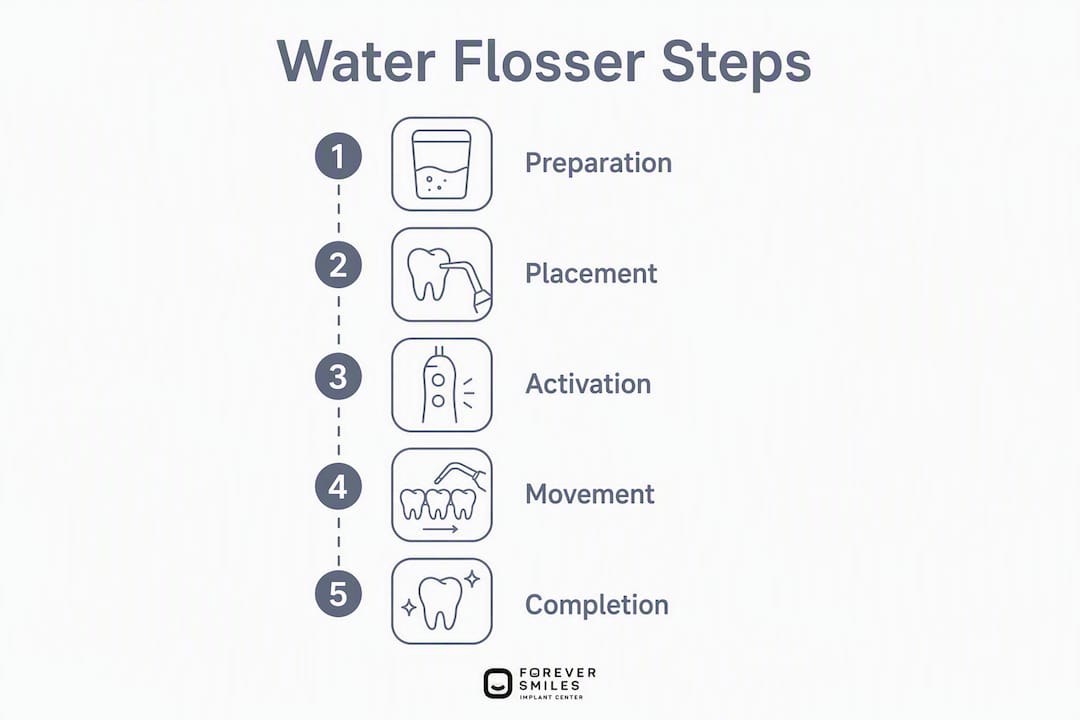
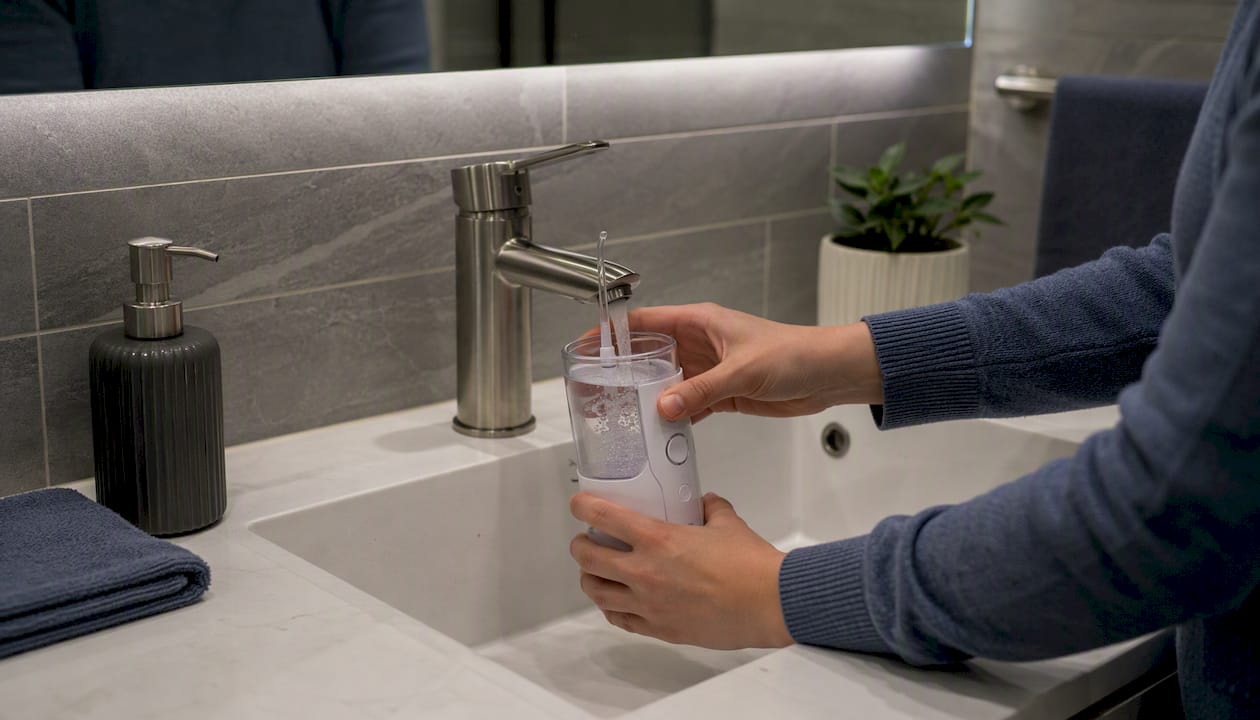
- Fill the reservoir with warm water. Warm water is more comfortable and less likely to cause sensitivity around implant sites.
- Select the correct tip for your prosthesis (see the next section). Attach it securely before use.
- Place the tip inside your mouth before powering on. Turning the device on outside the mouth causes splashing and reduces control.
- Lean forward over the sink with your lips slightly closed around the tip to contain the water.
- Start at the lowest pressure setting. Increase only if you feel no discomfort. Most clinical trials use medium settings; low is the right starting point.
- Aim the tip at approximately 90° to the gumline. Follow the gumline slowly with a sweeping motion, pausing briefly at each implant site to let the stream work.
- Move systematically from the back of one side to the front, then to the other side. Don't rush.
- Power off before removing the tip from your mouth.
- Use once daily, after brushing, as part of your complete routine.
Post-surgical caution: Do not use a water flosser near a fresh surgical site until your surgeon or hygienist explicitly clears you. The implant recovery timeline varies by procedure. When in doubt, call the office before resuming.
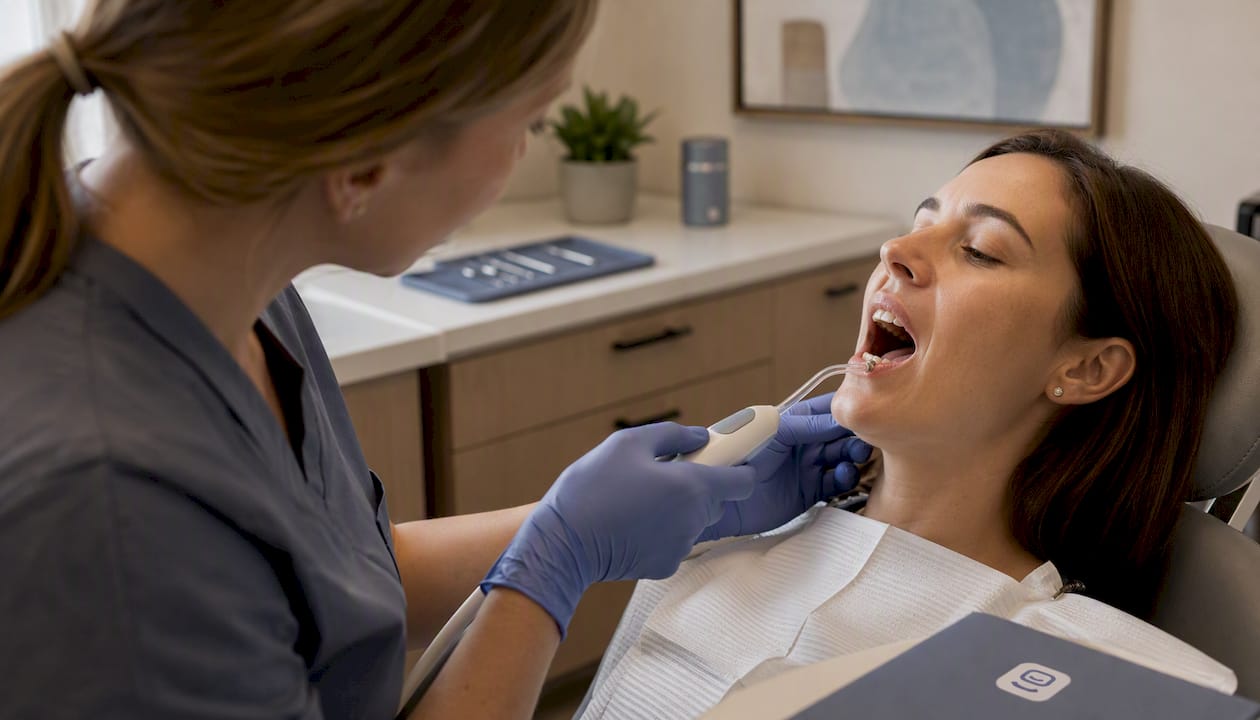
Pro Tip: Have your clinician demonstrate tip placement at your first post-op visit and practice the angle once in the office. Getting the 90° angle right from the start prevents both tissue irritation and missed spots.
Which tips and accessories work best for implant patients?
The tip you use matters as much as the device itself. Generic tips clean reasonably well around natural teeth but often miss the critical zones around implant abutments and under prostheses.
- Plaque Seeker tip (Waterpik): Three soft tufted bristles surround the water stream, making it effective at scrubbing around abutments and implant crowns. This is the go-to tip for single implant crowns and implant-supported bridges.
- Implant Denture Tip (Waterpik): Designed specifically to clean under hybrid prostheses, overdentures, and full-arch fixed restorations. The angled tip reaches the tissue-facing surface of the prosthesis where biofilm accumulates.
- Pik Pocket tip: A soft, flexible tip for directing water into deeper sulci when a clinician recommends subgingival irrigation. Use only under professional guidance.
For prosthesis-specific cleaning guidance on full-arch restorations, the implant-supported arch cleaning guide covers the full routine in detail.
On the device side: countertop models offer larger reservoirs and a wider pressure range, which is useful for full-arch patients who need more continuous use. Cordless models work well for travel and for patients with limited bathroom counter space. Replace tips every three to six months or per manufacturer guidance.
What does the research actually show?
The clinical evidence for water flossers around implants is solid, though not without nuance.
2.45× reduction in bleeding on probing versus string floss after 30 days in a randomized clinical trial.
| Study type | Population | Key outcome | Caveat |
|---|---|---|---|
| 30-day RCT | Implant patients, water flosser vs. string floss | 2.45× reduction in bleeding on probing | Single-center; 30-day follow-up |
| Systematic review (Frontiers) | Implant maintenance patients | Oral irrigators reduce bleeding and inflammatory markers; multimodal approach best | Heterogeneous study designs |
| RCT (single-implant crowns) | Three-arm: irrigator, interproximal brush, floss | All improved plaque and gingival indices; irrigator showed trend toward reduced IL-6 | IL-6 reduction non-significant in this trial |
| BDJ Open meta-analysis | Multiple implant and prosthesis settings | Irrigators reduce BOP and some inflammatory mediators; effect sizes vary | Population and design variability |
The BDJ Open systematic review found that oral irrigators reduce bleeding on probing and pocket-depth markers across multiple studies, though effect sizes vary by patient population. The Frontiers systematic review reinforces that the best outcomes come from combining powered brushing with an interdental aid, not from any single tool used alone.
Limitations, risks, and misconceptions worth knowing
Common misconceptions:
- "Water flossers push bacteria deeper into pockets." Clinical evidence and professional consensus refute this when the device is used at appropriate pressure settings. The pulsating stream disrupts biofilm rather than forcing it apically.
- "A water flosser replaces brushing." It does not. Brushing removes the bulk of plaque from tooth and implant surfaces; irrigation addresses the interproximal and subgingival zones brushing misses.
- "Any pressure setting is fine." High pressure on recently healed or inflamed tissue causes irritation. Start low.
Genuine limitations:
- Oral irrigators may not reach full pocket depth in deep peri-implant defects without a specialized subgingival tip.
- Interproximal brushes sometimes outperform irrigators on raw plaque scores for single-crown implants with adequate embrasure space.
- Adherence matters. A water flosser used inconsistently produces inconsistent results.
Red flags that require a call to your clinician:
- Persistent bleeding that doesn't improve after two weeks of consistent use
- Pain during or after irrigation
- Visible pus, implant mobility, or deepening pockets
- Any change in how the prosthesis fits or feels
What to look for when buying a water flosser for implants
Not every water flosser is built for implant care. These are the features that actually matter:
- Adjustable pressure with a true low setting. You need to start gentle, especially post-surgery or around sensitive tissue.
- Availability of implant-specific tips. Confirm the model accepts the Plaque Seeker tip and Implant Denture Tip before purchasing.
- Reservoir capacity. Full-arch patients benefit from a larger reservoir that doesn't need refilling mid-session.
- Tip storage and hygiene. A tip holder or cover keeps tips clean between uses.
- Durability and warranty. Look for at least a two-year warranty on countertop models.
- ADA Seal of Acceptance or clinician-recommended status, where present, as a baseline quality signal.
Mid-range countertop models from Waterpik typically cover all of these requirements and are the most widely studied in clinical trials. Waterpik's implant-specific tip lineup is the most documented in peer-reviewed literature. Replace tips every three to six months regardless of visible wear.
Key Takeaways
Water flossers reduce bleeding around implants significantly more than string floss in clinical trials and are safe for daily use when started at low pressure with the correct implant-specific tip.
| Point | Details |
|---|---|
| Safe with correct technique | Place the tip in your mouth before powering on; start at low pressure and increase gradually. |
| 2.45× bleeding reduction | A 30-day RCT showed water flossers outperformed string floss for reducing bleeding on probing around implants. |
| Use implant-specific tips | The Plaque Seeker tip and Implant Denture Tip reach zones that standard tips and string floss cannot. |
| Pause after surgery | Do not irrigate near fresh surgical sites until your clinician explicitly clears you to resume. |
| Combine with brushing | Oral irrigation works best as part of a multimodal routine that includes twice-daily powered brushing. |
What implant specialists actually tell patients about water flossers
The conversation about water flossers comes up at nearly every post-op visit. Patients often arrive having read conflicting things online, and the most common question is whether the device is safe for their specific prosthesis.
The honest answer is that the tool itself is rarely the problem. Technique and pressure are. Patients who start at high pressure or turn the device on before the tip is positioned in the mouth are the ones who call the office with irritated tissue. The fix is simple: demonstrate it once in the office, have the patient try it, and the problem usually doesn't recur.
For full-arch patients, the Implant Denture Tip is worth the extra step. The tissue-facing surface of a fixed hybrid prosthesis is one of the hardest areas to clean, and most patients don't realize how much biofilm accumulates there until they see it at a hygiene visit. The implant maintenance checklist we give patients covers this in detail.
Patient tailoring matters more than any single product recommendation. Someone with limited hand dexterity benefits from a water flosser more than from string floss, simply because it requires less fine motor control. Someone with a single implant crown and good dexterity might get equivalent results from an interproximal brush. The systematic review evidence supports individualizing the recommendation based on prosthesis design and patient ability. That's what a good follow-up visit is for.
If you have questions about your specific prosthesis and home-care routine, the dental implants FAQ at Forever Smiles Implant Center is a good starting point, and the team is available to walk through your individual situation.
Sources and further reading
- Comparison of the Impact of Two Interdental Cleaning Devices on the Reduction of Bleeding Around Implants — 30-day RCT; primary source for the 2.45× bleeding reduction finding.
- Best oral self-care practices for peri-implant conditions and diseases: a systematic review — Frontiers in Oral Health; multimodal home-care recommendations and tip individualization.
- Efficacy of oral irrigators compared to other interdental aids for managing peri-implant diseases: a systematic review — BDJ Open meta-analysis; BOP reduction and inflammatory mediator outcomes.
- Efficacy of three interdental cleaning methods for peri-implant health maintenance of single implant-supported crowns — Quintessence RCT; three-arm comparison including IL-6 inflammatory marker data.
- Dental Implant Care & Maintenance — Waterpik EDU — Manufacturer guidance on implant-specific tips and clinical recommendations.
- Waterpik Implant Chairside Guide — Step-by-step patient education resource for clinician use.
- Peri-Implant Disease Information — American Academy of Periodontology — Patient-facing overview of peri-implant mucositis and peri-implantitis.